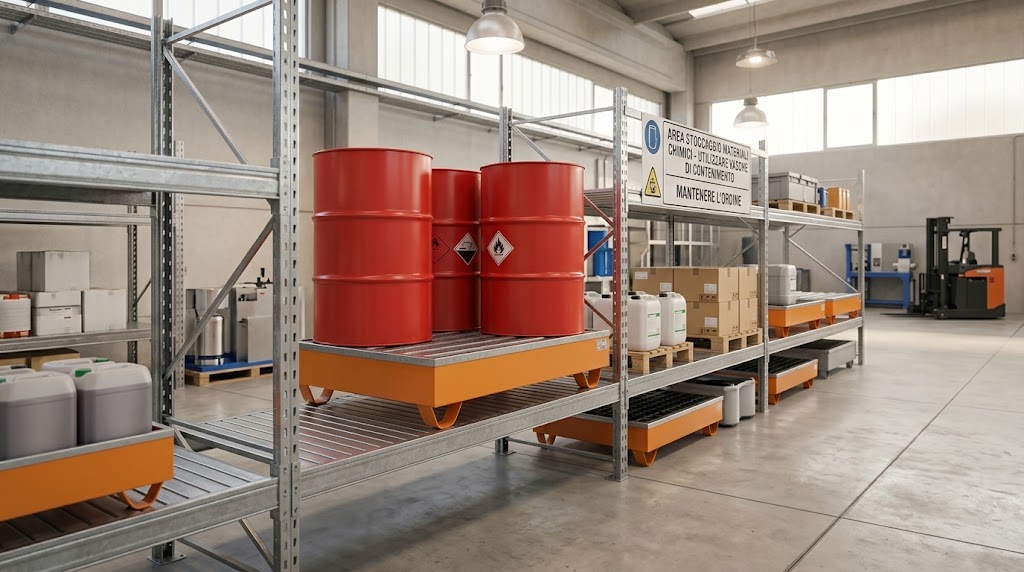
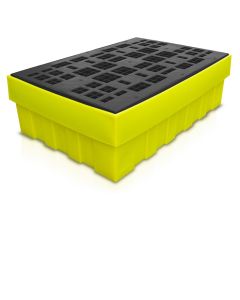
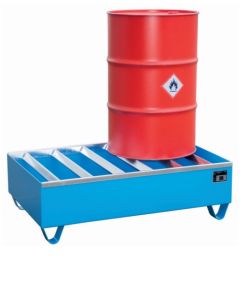
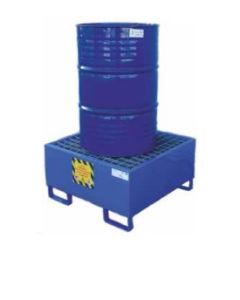
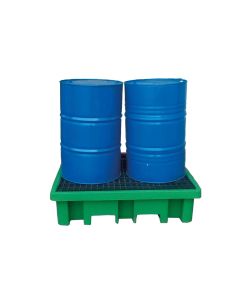
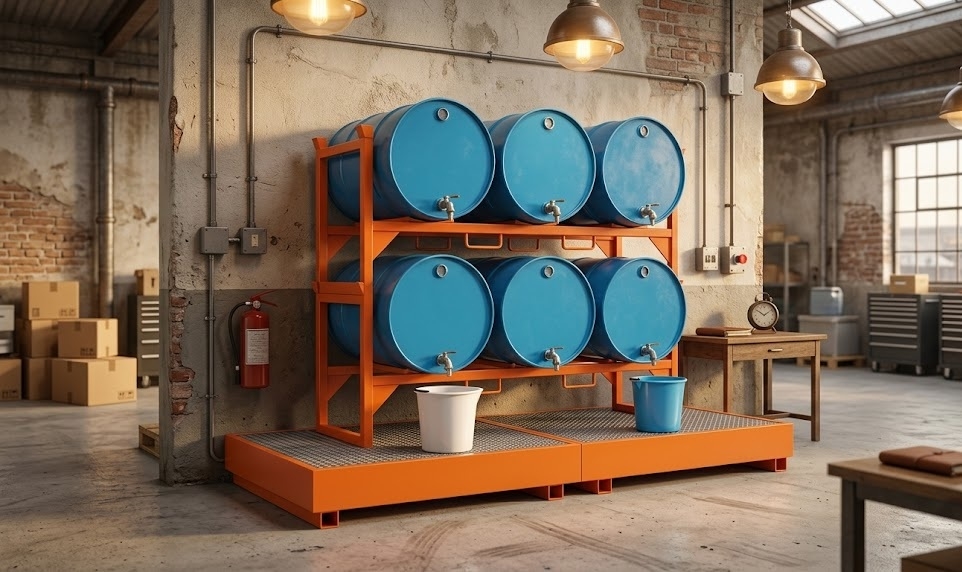
Choosing containment tanks for drums requires considering the number of containers, collection volume, material, flow rate and available space. A location for a single 200-litre drum has different needs compared to an area intended for two or four containers. The grating and handling methods also influence the choice. The sizing must therefore start from the actual storage configuration and the characteristics of the liquids used.
The choice starts from the drums actually present in the area
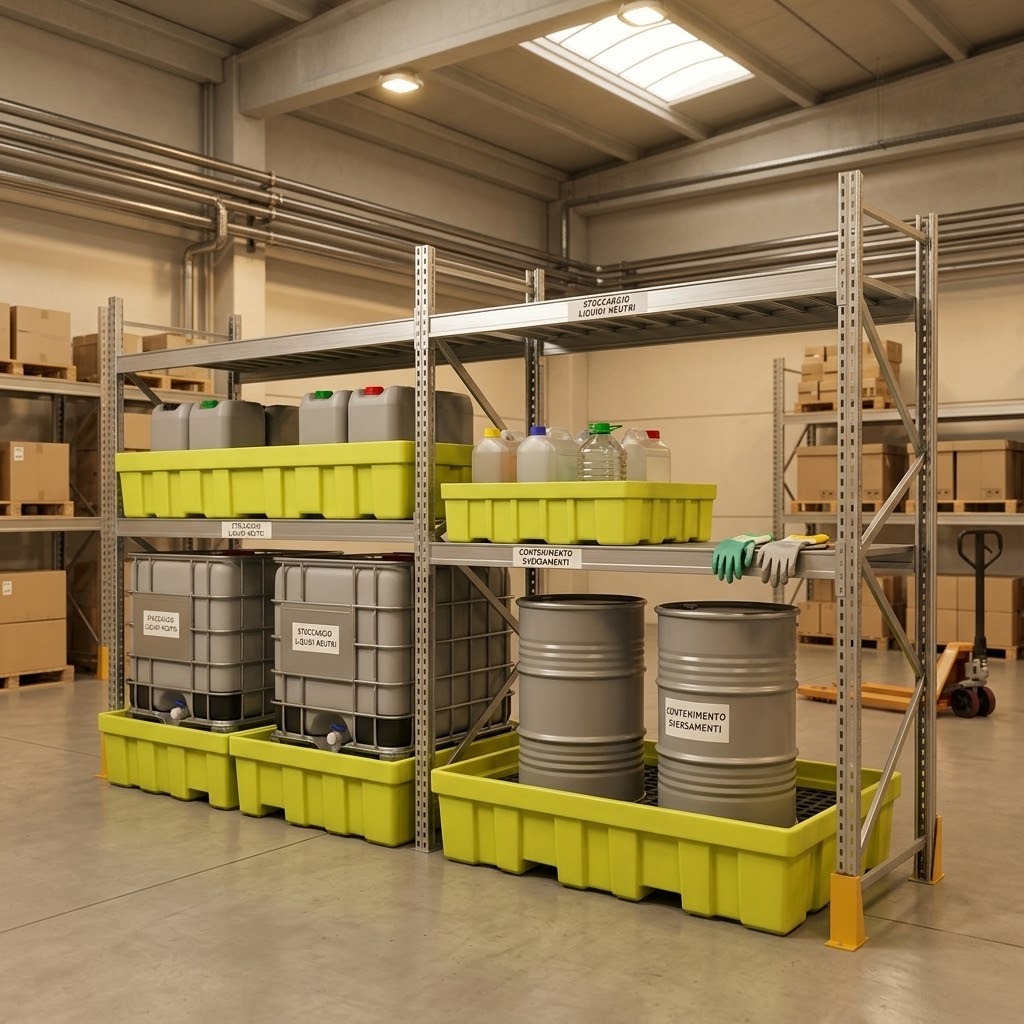 . Before comparing tanks it is necessary to establish how many drums will be present at the same time and which format will be used. The nominal number of containers indicated by the manufacturer in fact represents a first operational limit of the structure. A tank designed for two 200-litre drums should not be equated with a model intended for four drums just because both belong to the same commercial category. Quantity, size and arrangement of the containers therefore constitute the starting point of the project.
It is also useful to consider how the area may change over time. A workshop that permanently uses two drums may have different needs than a warehouse in which the quantities increase during certain production cycles. Undersizing the surface area may make it necessary to subsequently add a second tank, while a structure that is much larger than necessary takes up usable surface area without necessarily offering an operational advantage. The foreseeable future capacity must therefore be considered together with current needs.
The collection capacity must be sized on a case-by-case basis
The capacity expressed in litres indicates the volume that the tank can hold. collect and should not be confused with the nominal sum of the liquids contained in the drums positioned above the grating. Two tanks, both designed for two 200-liter drums, may in fact have different collection volumes. The Holity catalog includes, for example, steel models for two drums with a capacity of 225 or 227 liters and a polyethylene solution with a capacity of 305 liters. This demonstrates why the number of drums alone is not sufficient to define the sizing.
It is not correct to automatically apply a single containment percentage to each storage facility. The requirements depend on the substance, the type of storage, and the applicable regulations. For specific waste storage activities, for example, Ministerial Decree no. 186 of 5 April 2006 provides specific criteria for basins with one or more containers, while other contexts may be subject to different provisions. The capacity must therefore be verified with respect to your specific case and the applicable documentation, avoiding transforming a sector rule into a universal requirement.
One, two or four drums require different configurations
The transition from one to more drums does not only determine an increase in surface area. The distribution of the loads, the accessibility of the containers and the space required for replacement operations also change. A tank for two 200-litre drums can develop in width while maintaining a relatively limited depth, while a solution for four drums can assume a more square configuration or arrange the containers in line. The choice must therefore also be consistent with the shape of the available area.
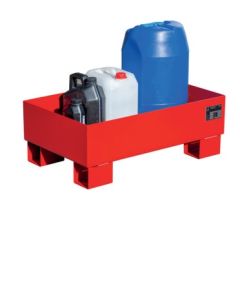
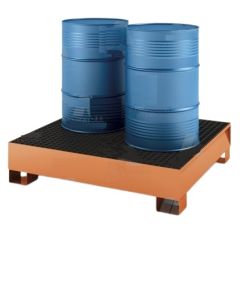
Holity offers different examples of the same concept. A steel tank for two drums measures 1340 x 850 mm and offers a capacity of 227 litres, while a model for four drums measures 1340 x 1250 mm with a capacity of 284 litres. There are also configurations for four drums developed on 2400 x 800 mm, useful when space allows for a linear arrangement. Holity, a specialist in professional equipment for industrial storage, therefore allows you to compare not only the number of drums but also different geometries.
The grating separates the containers from the collection volume
Many professional tanks are equipped with a grating on which the drums are placed. This configuration keeps the containers above the bottom of the tank and allows any leaks or drips to reach the volume below. The grating should therefore not be considered a simple accessory, because it participates directly in the organisation of the workstation. It is It is necessary to check the material, dimensions, capacity and possibility of removal.
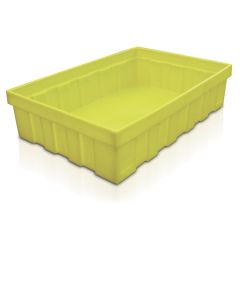
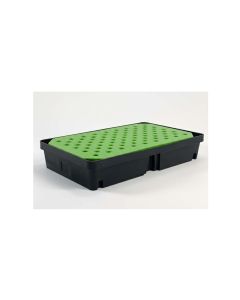
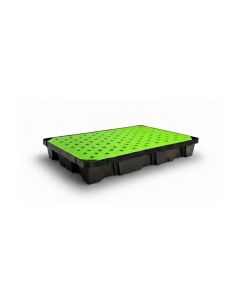
A removable grating can also simplify the inspection and cleaning of the tank when company procedures require it. The Holity catalogue includes steel models with hot-dip galvanised grating and polyethylene tanks with removable support surfaces. The two configurations are not interchangeable by definition, because the materials and compatibility with liquids vary. The tank and grating must be evaluated as a single containment and support system.
The capacity and weight of the drums must be checked together
The nominal volume of a drum does not automatically indicate the weight that will be loaded onto the tank. Two 200-litre containers can exert different loads depending on the density of the liquid contained and the weight of the container itself. For this reason, the capacity collection must be accompanied by the verification of the declared structural capacity. Ignoring this data means comparing the models using only half of the necessary information.
The available examples show significant differences. A Holity tank for two steel drums declares a total capacity of 480 kg, while a polyethylene model for the same quantity of drums declares 400 + 400 kg. A polyethylene configuration intended for four 200-litre drums reaches a maximum capacity of 1000 kg uniformly distributed. Each value must be verified on the data sheet of the selected product and related to the liquids actually stored.
Steel and polyethylene respond to different needs
The choice of material must start from the compatibility with the contents of the drums and the environment of use. Steel is used in numerous professional tanks intended for industrial storage and offers robust structures with metal gratings and configurations suitable for heavy loads. Polyethylene, on the other hand, is used in solutions characterised by corrosion resistance and compatibility with various chemical substances. It is incorrect, however, to consider one of the two materials universally superior.
Before purchasing, it is necessary to verify the substance or mixture stored through technical documentation and any safety data sheet. INAIL reminds us that dangerous substances and mixtures are classified according to the CLP Regulation and that for professional users, information on hazards is also communicated through safety data sheets. Chemical compatibility must therefore precede the preference for steel or polyethylene. A material suitable for oils or certain solutions must not automatically be considered suitable for any chemical product.
External dimensions and layout of the warehouse influence the choice
A tank adequate in terms of capacity and load bearing capacity can, however, be impractical if it does not integrate correctly into the warehouse. Before ordering, it is advisable to measure the available width and depth, taking into account corridors, doors, shelving and areas used for the passage of vehicles. Sufficient space must also be left to place and remove the drums without hindering other activities. The external footprint of the tank is therefore a design factor, not simply a dimensional specification.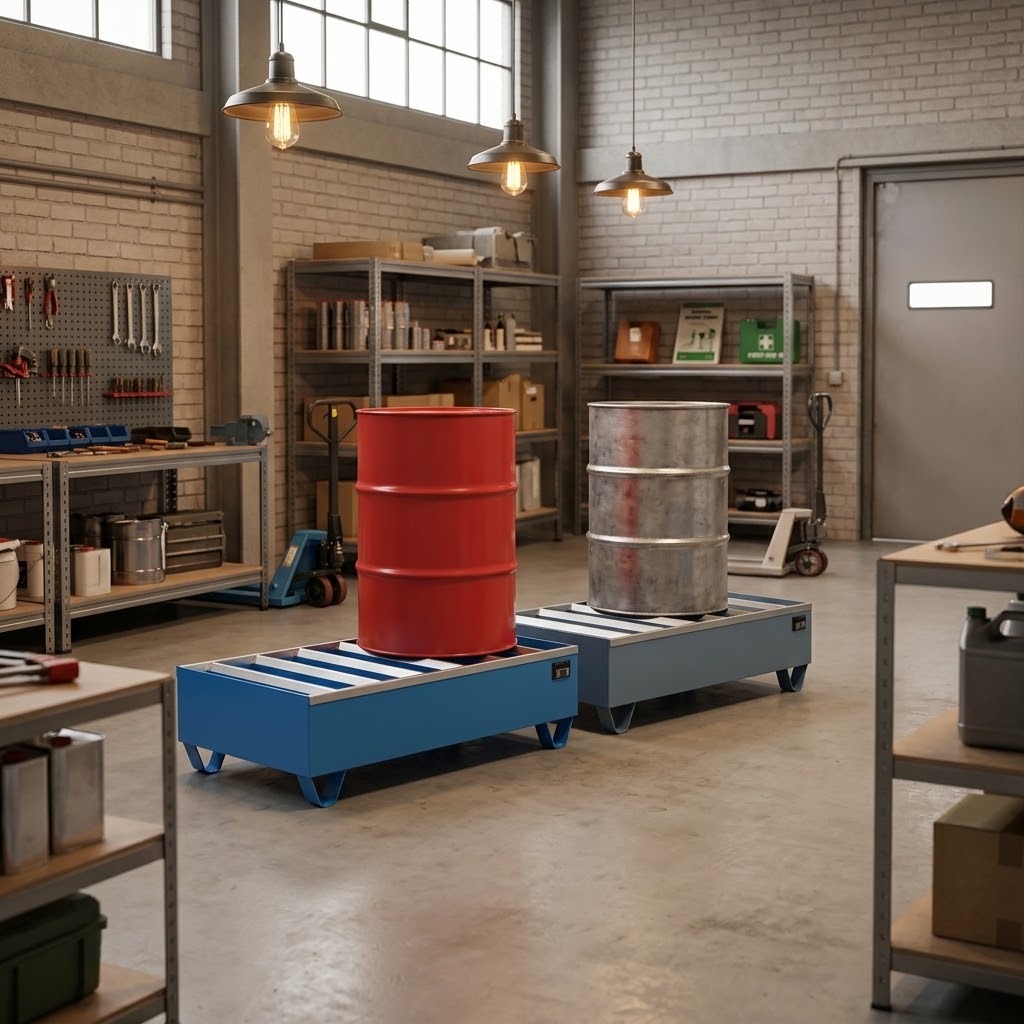
This aspect becomes even more important when multiple tanks are placed in the same area. Arranging the containers in an orderly fashion also facilitates inspection and the identification of any leaks. For some waste storage regimes, the legislation specifically requires that the containers be organised in such a way as to allow inspection and rapid removal of damaged ones. The organizational principle remains useful even outside that specific regulatory framework, without confusing good layout practice with a requirement that is automatically applicable to every warehouse.
Handling must be planned before purchase
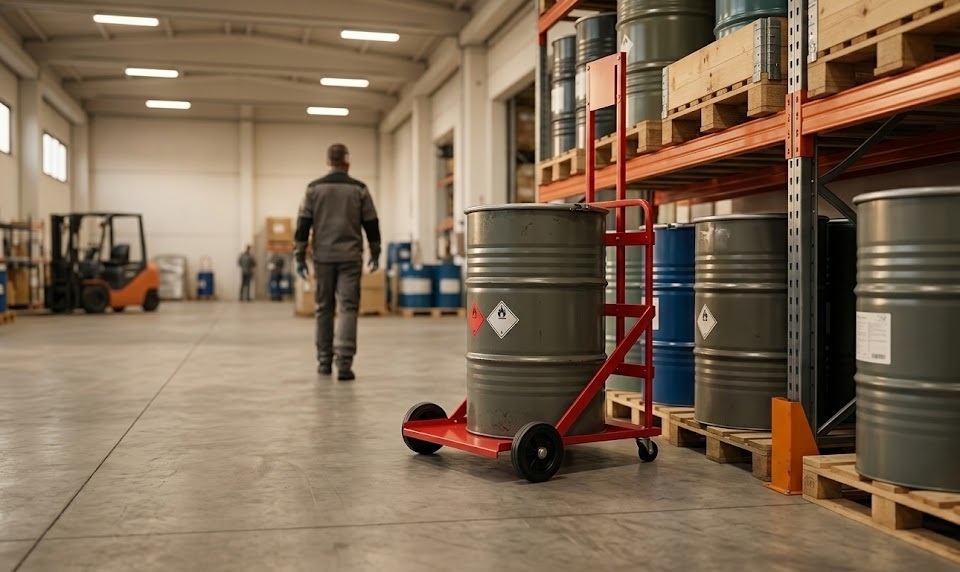
In many systems, the container is positioned once and remains stable, while in others it must be possible to reposition it during warehouse reorganizations. The presence of pockets or spaces for the forks of pallet trucks and forklifts can therefore become an important criterion. However, it is necessary to carefully check whether the manufacturer allows handling only when the container is empty or also in other conditions. The possibility of inserting forks under the structure does not automatically equate to authorization to transport it loaded.
Some Holity models expressly specify handling by pallet truck or forklift, while certain polyethylene containers indicate that this operation must be carried out without a load. There are also mobile configurations with wheels intended for two drums, designed for specific operational needs. The handling method must therefore be read in the model's technical data sheet and integrated into the company's internal procedures. Holity allows you to compare static, forkliftable, and mobile containers based on the planned logistics.
The technical documentation completes the sizing
The product data sheet must be used to simultaneously check capacity, dimensions, load-bearing capacity, material, and maximum number of containers. If any of these data is missing, the comparison between two containers risks being incomplete. It is also advisable to check any declarations, approvals, or technical references reported for the specific model. This information must not be automatically transferred to other products in the same category.
The correct configuration arises from the entire storage system
The final comparison should start from a precise sequence: identify the liquids, establish how many drums will be present, verify their weight, define the required collection capacity and measure the available space. It is subsequently possible to compare the material, grid, flow rate and handling methods. Proceeding in this order avoids choosing a tank simply because it can physically contain the expected number of drums. Any future growth of the station should also be considered before ordering.
Holity, a leader in the selection of containment tanks and professional equipment for industrial storage, offers steel and polyethylene configurations for one or more containers, with different capacities, flow rates and handling systems. To choose the containment tanks for drums it is therefore necessary to think about the entire system, from the stored liquid to the space needed to operate around the containers. The technical documentation allows you to narrow the comparison to solutions compatible with the project. In this way, workshops, industries and warehouses can identify a tank consistent with the actual organization of the area and with the requirements applicable to their storage.
 English
  Italian
 French
 German
 Spanish