mon-fri 9-13 / 14.30-18.30
Construction site equipment represents the operational infrastructure that allows building sites to function safely and in compliance with regulations. From the delimitation of work areas to solutions for managing logistics services, every element is designed to protect workers, passers-by, and ensure order at construction sites. The choice of the right equipment is not a matter of convenience, but of legal and management liability, as each component must meet precise technical standards and safety requirements defined by Italian and European regulations.
A modern construction site requires a systemic approach that integrates perimeter protection, signaling, sanitary facilities, and waste management into a single coordinated solution. Professional construction equipment are not mere physical barriers, but strategic prevention and communication tools that reduce risks and improve operational efficiency. Whether it is a small maintenance intervention or a large infrastructure project, the appropriate selection of equipment directly impacts project duration, compliance costs, and the company's reputation.
Construction site equipment addresses concrete needs that emerge every day on building sites: perimeter protection, effective signaling, access control, and management of ancillary services. Correct site equipment reduces accidents, speeds up operations, and demonstrates compliance with regulations toward both authorities and the subjects involved, from workers to suppliers. Mobile scaffolds offer controlled vertical mobility, walkways ensure safe passage, barriers create physical separations between operational and non-operational zones, while signaling systems—from traffic cones to traffic lights—communicate danger conditions in real time.
Investing in quality equipment brings tangible advantages: reduction of downtime due to accidents, elimination of complaints from control bodies, ease of visual communication of hazards, and the creation of a work environment where safety is visible and perceived. Professional site equipment is built to withstand weather conditions, impacts, and continuous wear, maintaining its safety properties even after months of use. Choosing verified and certified products also means legally protecting the company from civil and criminal liability, as the traceability of compliance becomes essential documentation in case of disputes.
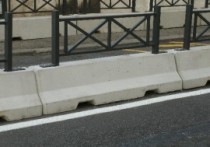
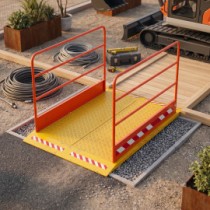
The catalog of construction site equipment is divided into well-defined functional categories. Mobile scaffolds are rolling platforms on wheels with side protections, ideal for reaching heights of up to 12-15 meters with agility; unlike fixed scaffolding, they allow the work point to be moved without dismantling and reassembling the entire structure. Site walkways are linear crossing elements, available in galvanized steel or aluminum, which facilitate safe passage over excavated areas, obstacles, or between elevated areas. Site barriers—in both metal and plastic—create delimitation perimeters, separate trucks from pedestrian transit areas, and protect excavations. Signaling systems include PVC or rubber traffic cones, New Jersey barriers in concrete or steel, signaling chains, luminous road markers, and temporary traffic lights powered by battery or solar energy.
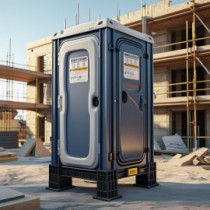
Alongside these are logistics service equipment such as chemical toilets, essential for hygienic compliance in long-term sites, and rubble chutes, which manage the disposal of demolition waste in a controlled and safe manner. Delimitation posts are used to mark soft boundaries and are frequently used to delimit site areas, work paths, and parking zones. Each type is available in different construction variants: dimensions, materials, load capacity, and degree of resistance to chemical agents and climatic conditions. The choice between one type and another depends on the nature of the work, the expected duration of the site, and the specific safety requirements of the site.
The selection of construction site equipment must start with an analysis of the operational context: what is the maximum height to be reached, what weight is to be lifted, how many workers will use the structure simultaneously, and what is the external environment (e.g., urban, rural, coastal, or mountainous site). A frequent error is undersizing the equipment: many companies choose scaffolds that are too low to avoid costs, risking having to rent additional equipment at a higher price or resorting to improvised solutions that violate safety. Similarly, the construction material is critical: galvanized steel resists weather and humidity, while aluminum is lighter but less resistant to impacts; the choice depends on the type of site and its expected duration.
Another decision-making aspect concerns mobility: if the site changes location multiple times, equipment on wheels (mobile scaffolds, mobile barriers) is more convenient than fixed structures. For signaling, evaluating whether the site is visible primarily by day or also at night determines the need for luminous or reflective elements. Common errors also include choosing elements that are too heavy for transport and handling (with risks of back injury), or purchasing excessive quantities due to not correctly estimating the areas to be delimited. A good practice is to consult the technical specifications and certified compliance data, verifying that the products are ISO certified, have the CE mark, and are accompanied by documentation in English that is easy to understand.
Construction site equipment is regulated by a complex regulatory architecture involving European directives, international technical standards, and national requirements. The Construction Sites Directive 92/57/EEC mandates that all sites have perimeter protection measures and visible signaling; equipment must comply with this standard. Mobile scaffolds must meet the EN 1004 standard (safety, stability, dimensions, marking), walkways must meet EN 13850, while barriers and delimitations follow EN 13180 and EN 13583. Regarding road signaling, the reference standards are the relevant national codes and European standards EN 23603 for cones and EN 13422 for temporary road signs.
Chemical toilets must comply with the UNI EN 16001 standard and ensure a minimum space of 1.5 meters in front of the site for every 10 workers present simultaneously. Compliance includes frequent documentary checks: every piece of equipment must be accompanied by a CE certificate of conformity, an instruction manual, a manufacturer's declaration of conformity, and, for more critical elements (such as mobile scaffolds), a periodic inspection report. Liability falls both on the supplier (who must sell compliant products) and the buyer (who must verify documentation and use the equipment according to instructions). An additional check required by many local administrations and clients is the periodic review of metal elements, particularly to check the state of galvanization and the absence of corrosion.
Explore all products in the category and compare the available solutions to find the one best suited to your operational context. A conscious choice of construction site equipment ensures safety, compliance, and long-term operational efficiency.
A mobile scaffold is a rolling platform on wheels, which can be dismantled in minutes, ideal for temporary work up to 12-15 meters in height. Traditional scaffolding is a fixed structure, requiring complex assembly, suitable for long-term construction sites. Mobile scaffolds offer flexibility and setup speed; fixed scaffolding ensures greater stability for concentrated loads and heights exceeding 20 meters.
In coastal environments, hot-dip galvanized steel is the preferred choice over painted steel, as galvanization resists saline corrosion for 20-30 years. High-density plastic is lighter and does not rust, but is less impact-resistant. Reinforced concrete is ideal for fixed barriers, where weight is not an operational issue and durability is maximized.
According to regulations, at least 1 chemical toilet is required for every 10 workers present at the same time. For 50 workers, at least 5 chemical toilets are necessary, preferably 6-7 to ensure comfort and reduce queues. The UNI EN 16001 standard also specifies that the toilet must be located at a maximum distance of 500 meters from the work areas.
PVC cones are lightweight, economical, and easy to transport, suitable for temporary sites and road maintenance. Rubber cones are heavier, more resistant to impacts and wear, and preferable for long-term sites and high-traffic areas. PVC degrades faster with sun exposure; rubber maintains its properties for 3-5 years with minimal maintenance.
Always check the CE marking, the certificate of conformity issued by the manufacturer, the instruction manual, and, if required, the initial testing report. For scaffolds and critical equipment, also request periodic inspection documentation and a declaration of conformity with applicable EN standards (EN 1004, EN 13850, etc.). Keep all documentation for 5 years for legal purposes.
It depends on the height and width of the assembled scaffold. Most models exceed the size limits for road transport (approximately 2.6 meters wide and 4 meters high), so they must be dismantled. Partially assembled transport is only possible if certified by the supplier. Always check local transport restrictions and ensure the transport vehicle is suitable and insured.
Standard hot-dip galvanization lasts 20-30 years in normal urban environments, reduced to 10-15 years near the sea due to saline corrosion. In industrial areas with chemical pollution, durability can drop to 5-10 years. Periodic maintenance (cleaning and checking the state of the galvanization) significantly extends the useful life of the equipment.
At a minimum: perimeter fencing with metal barriers, signaling with cones and fluorescent banners, company contact numbers clearly visible, sanitary facilities (chemical toilets), waste collection system, and night signaling (if the site remains open). Some municipalities additionally require walkways, traffic lights, or Jersey barriers for pedestrian crossings. Consult local regulations before starting work.
 English
  Italian
 French
 German
 Spanish