
mon-fri 9-13 / 14.30-18.30
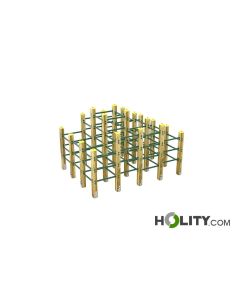
Vertical maze in nordic pine wood and steel for public parks. Multi-layer structure with 90x90 mm glulam poles, climbing and sliding elements. Height 168 cm, suitable for ages 3–11.
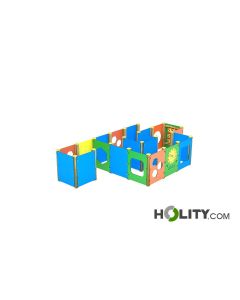
Horizontal maze in Nordic pine wood and colored HDPE for public parks, with educational teaching panels. Dimensions 458x235x103 cm, age 2-8 years.
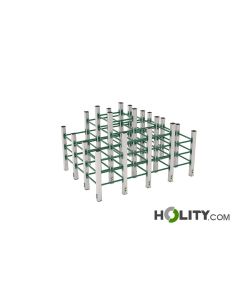
Vertical aluminum maze with tubes at different heights for playgrounds. Develops logic and spatial orientation. Age 3-11 years, structure 254x193xH166 cm.
Playground mazes represent one of the most effective solutions for creating play spaces that simultaneously stimulate children’s physical and cognitive development. These furnishing elements represent a strategic opportunity for public administrations, educational facility managers, and private space owners who intend to offer safe and engaging recreational activities. The design of a maze must take into account multiple technical factors, from compliance with European safety standards to the choice of the most appropriate materials to ensure durability over time and resistance to weather conditions.
A maze installed in a public or school space generates multiple benefits that go beyond simple entertainment. Cognitive stimulation represents one of the primary advantages: as children navigate within the structure, they naturally develop spatial orientation skills, visual memory, and problem-solving abilities through direct experience. Physical activity is intrinsically connected to the labyrinthine path, as children practice continuous movement, improve balance, motor coordination, and cardiovascular endurance without the perception of “forced exercise”. From a social point of view, the maze fosters peer interaction, encouraging collaboration to discover paths and mutual help when one of the participants becomes disoriented. Municipal administrations and recreational facilities recognize how these elements significantly increase the attractiveness of public areas, contributing to the creation of active communities aware of the importance of free play.
Furthermore, modern mazes represent a conscious alternative to exclusively digital play, promoting contact with the outdoors and tangible interaction with the environment. For schools, they represent an unconventional educational tool that integrates physical education with diversified sensory stimuli. For managers of theme parks or private recreational facilities, the presence of a well-designed maze constitutes a differentiating element capable of attracting families and increasing the perceived value of the structure itself.
In the playground furniture market, mazes are divided into several macro-categories that respond to specific spatial and demographic needs. Traditional vertical mazes represent the classic solution, characterized by perimeter walls generally made of Nordic pine wood (with sections of 90x90 mm) that create complex paths to explore. These models, typically available in sizes of approximately 240-250 cm in length, 180-190 cm in depth, and 160-170 cm in height, offer an immersive experience due to the impossibility of viewing the entire path from the outside. Horizontal mazes, on the other hand, develop mainly on the floor level, using Nordic pine posts combined with HDPE (high-density polyethylene) panels to create lower paths (generally 100-105 cm in height) and more extensive ones (sometimes exceeding 450 cm in length). This type allows for better adult supervision and is more accessible for children in lower age groups.
A third significant variant is represented by aluminum mazes, premium solutions characterized by light but robust structures, with rounded corners that further increase the safety profile. These models, while having higher costs, guarantee exceptional longevity and require minimal maintenance. There are also customizable thematic solutions that incorporate narrative elements (castles, forests, urban environments) to increase the immersive and playful factor. For structures with significant space constraints, compact mazes in reduced formats still maintain the complexity of the paths in smaller footprints. Finally, inclusive mazes have been specifically developed to ensure accessibility for children with motor disabilities, through widened paths, regular surfaces, and controlled angles.
Choosing a playground maze requires a systematic evaluation of technical and contextual parameters that determine the suitability of the solution. The first element to consider is space availability: accurately measuring the designated area allows for the exclusion of incompatible solutions and identifying whether to opt for a vertical type (more compact footprint) or horizontal (wider distribution). The target age group represents a second decisive criterion: children aged 3-5 benefit from mazes with less complex paths and reduced heights, while children aged 6-10 derive greater stimulus from structures with multiple branches and standard heights. A recurring error is underestimating the importance of visual supervision: if the surrounding space allows limited views, a vertical maze could compromise the ability of adults to monitor children, making a horizontal or reduced-height solution necessary.
The climatic profile of the geographical area where the maze will be installed directly influences the material choice: treated Nordic pine wood represents an economical solution suitable for temperate climates, while aluminum or HDPE are superior in environments with prolonged exposure to intense solar radiation or high humidity. The available budget must consider not only the purchase cost but also the expected maintenance: wood requires periodic inspections and preservative treatments, HDPE requires regular cleaning but offers greater resistance, aluminum requires minimal intervention but has a high initial cost. Verifying compliance certifications with EN 1176 and EN 1177 standards (European standards for outdoor play) is fundamental and non-negotiable, as it guarantees that the structure has been tested for strength, edge safety, stability, and the absence of strangulation or entrapment elements.
The installation of playground mazes in public or school settings is subject to compliance with stringent European regulations aimed at ensuring the safety of minors. The EN 1176 standard establishes general safety requirements for outdoor play, including specifications related to: structural strength, prevention of entrapment (openings must not contain spaces that capture the head or limbs), falling surface, and maximum height from which it is possible to fall. The complementary standard EN 1177 defines the specific properties of impact-absorbing materials (such as synthetic rubber or certified wood chips) that must be positioned under and around elevated structures to mitigate the risk of fall trauma. All compliant mazes must have rounded edges and corners with specified minimum radii, certified non-slip surfaces with defined static friction values, and materials free of toxic or carcinogenic substances according to the European Union’s REACH directives.
Additional requirements include the obligation of installation by qualified technicians with the issuance of a compliant assembly certificate, visual inspections at least monthly during periods of intense use to verify the integrity of the structure and the absence of deterioration, and annual preventive maintenance. For wooden structures, this involves inspection of the state of conservation of surface treatments, verification of the absence of splinters or shards, and eventual reconditioning. Original technical documentation, construction drawings, and certifications must be kept for at least 5 years and made available to the competent authorities in case of inspection. The civil liability of the facility manager remains central: specific insurance for playgrounds must cover damages deriving from improper use or maintenance deficiencies, and safety signage must be visibly displayed indicating the recommended minimum age, the maximum number of simultaneous children, and use precautions.
Explore all the products in the category and compare available solutions to find the one best suited to your operational context. Carefully evaluate available spaces, demographic characteristics of the target population, and maintenance constraints to identify the maze that maximizes safety, usability, and longevity over time.
Mazes are modular structures available in different configurations. Low-height models and simple paths are recommended for children aged 3-5, while standard mazes with greater complexity are ideal for ages 6-10. Thematic variants can also engage adolescents up to 12-14 years if the paths maintain an adequate cognitive and physical challenge.
A standard vertical maze occupies approximately 240-250 sqm of horizontal projection, while horizontal versions can reach 450+ sqm. Spaces smaller than 200 sqm require the choice of specifically designed compact models, reducing path complexity. It is also essential to verify the surrounding space for visual supervision and perimeter safety zones.
Aluminum represents the premium material with minimal maintenance and a longevity of 20+ years. Treated Nordic pine wood requires biennial checks and preservative treatments every 3-4 years, guaranteeing 10-15 years of use. HDPE offers an intermediate compromise: high resistance with moderate maintenance, lasting 15-18 years.
The structure must have EN 1176 and EN 1177 certification (requestable from the manufacturer). Technical documentation must include detailed construction drawings, material specifications, certified surface friction values, and an impact attenuation test report. Verify that the installer is qualified and issues a post-assembly certificate of conformity.
Vertical mazes in Nordic wood range between 4,650-5,000 euros (excluding VAT). Mixed horizontal versions (wood + HDPE) vary around 4,897-5,500 euros. Aluminum solutions with rounded corners reach 7,162+ euros. Installation and maintenance costs must be added to the purchase price for a total TCO evaluation.
Yes, many manufacturers offer thematic options (castles, forests, cities) through decorative elements integrated into the structure. Customizations require longer lead times (4-8 weeks) and a variable surcharge of 15-30% depending on the complexity. Check with the supplier for availability of standard versus custom themes.
Monthly visual inspections are mandatory during periods of intense use, checking structural integrity, rounded edges, and the absence of splinters. Annual scheduled maintenance includes deep cleaning, preservative treatments (for wood), and verification of foundation stability. Corrective interventions immediately follow any detected anomaly.
Specific inclusive models include widened paths (for wheelchairs), absence of critical height differences, regular surfaces, and controlled angles. These mazes maintain cognitive stimulus while reducing physical barriers. Check with the manufacturer for the inclusive features of the model and accessibility certifications compliant with international standards.
 English
  Italian
 French
 German
 Spanish