
mon-fri 9-13 / 14.30-18.30
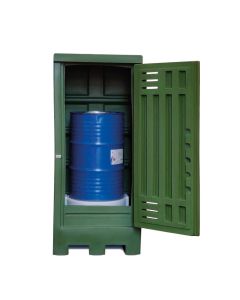
UV-stabilized polyethylene drum storage cabinet for 1 x 200L drum. Includes a 230L sump tray and monoblock structure measuring 88x83x199 cm.
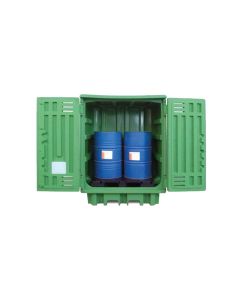
Box for 4 drums in UV-stabilized polyethylene (154x100x194 cm). Monobloc anti-corrosion structure for safe outdoor storage.
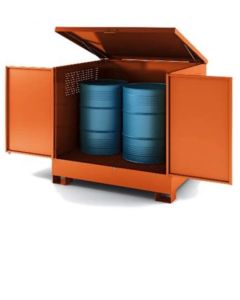
Steel drum storage box for 2 drums of 200 l. Dimensions 134x85x145 cm, capacity 230 l, with hinged doors and lateral ventilation louvers.
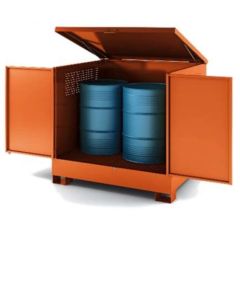
Steel cabinet for the storage of 4 drums of 200 lt, with a 280 lt sump, hinged doors and lid. Ideal for safety in industrial environments.
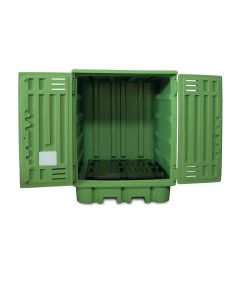
Ecological polyethylene drum storage cabinet. Capacity: 450 lt. Dimensions: W. 154 x D. 160 x h. 200 cm.
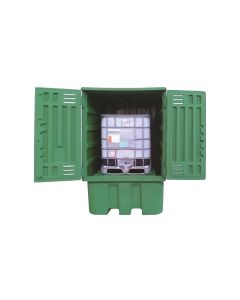
UV-stabilized polyethylene drum storage box (154x160x235 cm) with 1100L sump for safe outdoor storage of 1000L IBC tanks.
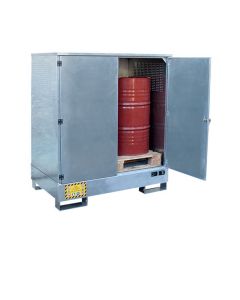
Drum storage cabinet. Capacity: 209 L. Load capacity: 460 kg. Dimensions: W. 139.5 x D. 90.5 x H. 150 cm.
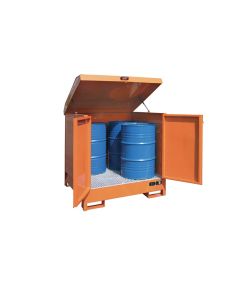
Cabinet for drum storage. Capacity: 284 liters. Dimensions: W. 135 x D. 126 x H. 144 cm.
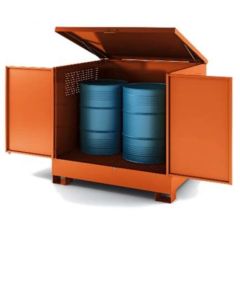
Steel storage unit for the storage of 1 x 1000 L IBC, featuring swing doors, lid, and ventilation louvres. Dimensions 135x165x196 cm.
Drum storage boxes represent a fundamental structural solution for the storage and protection of drums and tanks in industrial environments, warehouses, and outdoor storage areas. These safety cabinets are designed to contain hazardous liquids such as mineral oils, acids, fuels, and other chemicals, ensuring compliance with European regulations on spill prevention. Their robust structure and integrated collection systems protect both the environment and workplace safety, reducing the risk of contamination of groundwater and soils. Available in different capacities and materials, drum storage boxes adapt to any operational context, from small artisanal businesses to large production plants.
The choice to install drum storage boxes entails concrete advantages from both an operational and regulatory point of view. These containment systems effectively prevent accidental spills of hazardous liquids, drastically reducing environmental damage and the costs associated with the remediation of contaminated soils. In industrial environments, where the risk of leaks from drums is always present, a safety cabinet creates a physical barrier that isolates toxic or flammable substances from transit and work areas. The integrated collection sump immediately captures any dispersion, subsequently facilitating waste management and disposal according to legal provisions. Furthermore, structured containment allows for the optimization of warehouse space, permitting an orderly vertical storage that simplifies inventory operations and material traceability.
From the perspective of corporate responsibility, having certified drum storage demonstrates the company’s commitment to employee safety and ecosystem protection. Drum storage boxes are essential tools to ensure work environments comply with international regulations, while reducing exposure to legal and sanctioning risks. In sectors such as chemicals, logistics, automotive, and energy, where hazardous substances are a daily part of operations, these cabinets become critical infrastructure. Their presence also facilitates inspections by control bodies and environmental audits, as it clearly documents compliance with safety protocols. Finally, accessibility to the drums remains simple thanks to the programmed front opening, ensuring operational practicality without compromising the general protection of the system.
Drum storage boxes are mainly distinguished by their storage capacity and the number of drums they can accommodate, with variants ranging from compact models for a single 200-liter drum to structures containing 1000-liter IBC tanks. Construction materials represent a fundamental difference between the various production lines: some models use galvanized sheet metal with ventilation grilles, while others utilize rotomolded ecological polyethylene, which offers greater resistance to chemical and atmospheric agents without the need for painting maintenance. The choice of material directly affects durability over time and compatibility with specific substances: polyethylene is preferable for acids and corrosive products, while galvanized sheet metal is suitable for oils and fuels. Integrated collection sumps vary from 230 liters for single models up to over 1100 liters for large tanks, always sized to contain at least 110% of the capacity of the largest drum stored, according to European standards.
Further variants concern the configuration of the openings and ventilation systems. Some cabinets feature hinged doors with lockable closures and internal document holders, excellent for contexts where it is necessary to control access to hazardous materials. Other models incorporate fixed lids or lids with gas shocks, which facilitate opening without excessive effort by the operator. The presence of aeration grilles on the side and top walls is decisive for avoiding the accumulation of potentially explosive gases inside the cabinet, a critical aspect especially when the box contains fuels or volatile solvents. External dimensions vary widely to adapt to specific spaces: lengths from 88 centimeters up to 154 centimeters, depths from 83 to 165 centimeters, and heights reaching 235 centimeters in models for tanks. The load capacity, expressed in kilograms, is a further discriminating parameter, with values ranging from 460 kg for light structures up to 1500 kg for cabinets built for maximum loads.
Selecting the most appropriate drum storage box depends on a series of interdependent technical factors that must be evaluated simultaneously. The first criterion is to precisely identify the type of substance to be stored, as different materials have different chemical compatibilities: strong acids require polyethylene, while oils and fuels tolerate galvanized sheet metal well. Subsequently, it is essential to calculate the total number of drums to be stored and their standard size, given that the number of available compartments must correspond to actual needs—choosing a model for 4 drums when 2 will be stably stored means underutilizing the investment. The space available at the installation site represents a concrete physical constraint: measuring the width, depth, and height of the designated space is essential before ordering, as these cabinets can hardly be shortened and their placement must guarantee easy access for both loading and periodic inspection of the collection sump.
A frequently overlooked aspect concerns the meteorological and environmental conditions of the installation site. Environments exposed to extreme temperature variations, high coastal humidity, or corrosive atmospheres require specific materials—ecological polyethylene with UV stabilization is ideal for these situations, while galvanized sheet metal might require periodic revisions in brackish areas. The assessment of the maximum supported load capacity is critical if the cabinet will be positioned on soft or not perfectly level ground: structural overloads or differential settlements can compromise the integrity of the collection sump and cause spills. Finally, consider the frequency of access to the drums and operational needs: if the opening is daily, prefer models with a dampened lid; if access is occasional, simple lockable doors are more economical. No less relevant is checking the availability of certificates of conformity (declarations according to UNI EN ISO) and any need for municipal authorizations for the installation of chemical storage, an aspect that varies based on the location and applied regional regulations.
The regulatory framework governing drum storage boxes is complex and varies by national jurisdiction, but the European StawaR directive (Storage of Waste Accumulators) and the international standards UNI EN ISO 3834-3:2006 provide the fundamental framework for most European countries. These standards establish that the collection sump must contain at least 110% of the capacity of the largest container stored, ensuring protection even in the event of a simultaneous spill. Construction requirements include the use of materials that do not react negatively with the substances contained, the presence of controlled drains for the collection of liquids, and ventilation systems that prevent the accumulation of flammable vapors. In Italy, Law 152/2006 (Environmental Code) further integrates these obligations, requiring that hazardous waste storage facilities comply with specific safety measures and the prevention of soil and groundwater pollution.
From the practical point of view of operational compliance, every installation of drum storage boxes must be accompanied by a declaration of conformity signed by the manufacturer, which certifies compliance with applicable construction and safety standards. Technical documentation must be kept in the company and made available on the occasion of environmental inspections or audits by the relevant bodies. Further recurring obligations include the clear and legible labeling of contents and associated hazards, periodic maintenance of the collection sump (cleaning and checking of structural integrity at least annually), and training of personnel on the correct use of the cabinet. Some regional or local regulatory contexts may also require prior authorizations before installation, especially if the site is near protected or environmentally sensitive areas. Ordinary inspections by Municipalities, Arpa (Regional Agency for Environmental Protection), or the Fire Department will check for correct maintenance and the absence of visible leaks, making the preserved documentation and certificates of conformity key elements for passing such checks without problems.
Explore all the products in the category and compare the available solutions to find the one best suited to your operational context.
A drum storage box is a safety cabinet designed to store drums and tanks containing hazardous liquids. The structure features an integrated collection sump that captures any spills, preventing environmental contamination and ensuring regulatory compliance. The walls isolate toxic substances from the external environment and ventilation systems prevent the accumulation of harmful gases inside.
Galvanized sheet metal offers structural solidity and high mechanical resistance, ideal for oils and fuels, but requires painting maintenance in corrosive environments. Rotomolded ecological polyethylene resists chemical and atmospheric agents better, does not require painting, and is preferable for acids; however, it has a lower maximum load capacity compared to sheet metal structures.
Capacity varies by model: compact boxes hold 1 200-liter drum, intermediate models accommodate 2 or 4 drums, while larger structures house single 1000-liter IBC tanks. Each product’s documentation specifies the exact number and size of supported containers, along with the total maximum load capacity in kilograms.
The main references are the European StawaR directive, the UNI EN ISO 3834-3:2006 standards for construction, and Law 152/2006 (Environmental Code). Each box must be accompanied by a declaration of conformity and the collection sump must contain at least 110% of the capacity of the largest drum stored, as required by international standards.
The box must be positioned on a flat and well-drained surface, preferably in an outdoor area or dedicated warehouse, away from high-traffic areas and direct heat sources. The position must guarantee easy access for loading drums and periodic inspection of the collection sump, as well as allowing air circulation around the structure for correct ventilation.
Visual inspections should take place monthly to check for the absence of leaks and liquid accumulation, while full cleaning of the collection sump is recommended at least once a year or immediately after an accidental spill. Regular maintenance extends the life of the structure and ensures continuous effectiveness of the containment system.
No, it is strongly discouraged to mix chemically incompatible substances in the same collection container. Separate drum storage boxes for different categories (acids, oils, fuels) represent the safest practice. If a technical evaluation proves compatibility, segregation must still be documented and supervised by qualified personnel.
 English
  Italian
 French
 German
 Spanish