
mon-fri 9-13 / 14.30-18.30
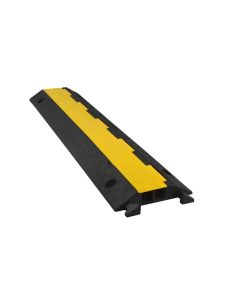
Rubber floor cable protector with 2 channels Ø 30 mm, visible yellow cover. Dimensions: L 980 x W 240 x H 45 mm.
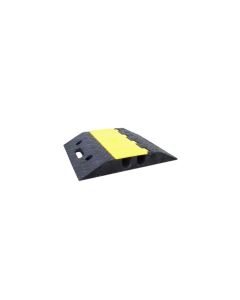
Rubber floor cable protector with 2 channels of 35 x 35 mm and yellow cover. Dimensions: L 400 x W 500 x H 65 mm.
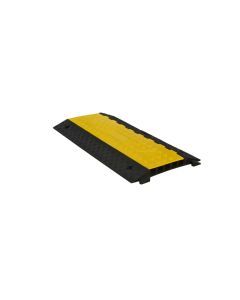
5-channel rubber cable protector Ø 35 mm, with visible yellow cover. Dimensions: L 900 x W 500 x H 50 mm.
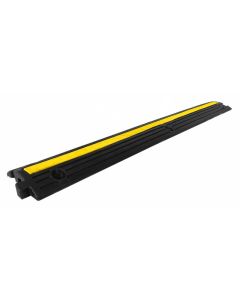
1-channel Ø 20 mm rubber cable protector, walkable and drive-over up to 40T. Dimensions: L 1000 x W 150 x H 30 mm.
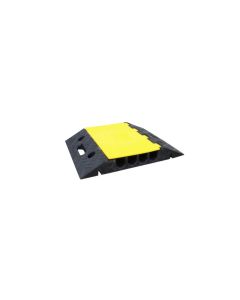
Rubber cable duct with 4 channels of 35x35 mm and yellow lid. Dimensions: L 400 x W 500 x H 65 mm.
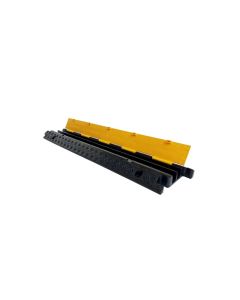
Rubber cable protector with 2 channels 38 x 35 mm and high-visibility yellow cover. Dimensions: L 1000 x W 250 x H 50 mm.
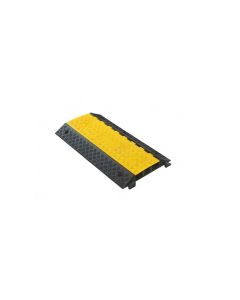
Rubber cable protector ramp with 3 channels Ø 50 mm and visible yellow lid. Dimensions: L 900 x W 500 x H 70 mm.
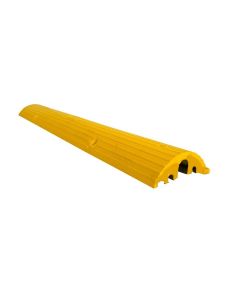
Vulcanized rubber cable protector with 3 channels. Dimensions: W 120 x D 21 x H 6.5 cm.
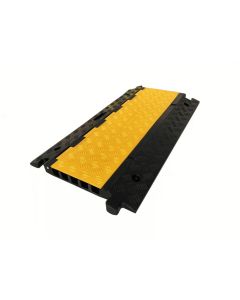
5-channel rubber cable protector 34x34 mm, driveable up to 30T. Dimensions: L 910 x W 500 x H 50 mm.
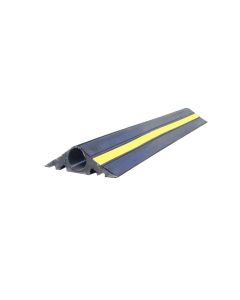
Cable protector ramp in vulcanized rubber for vehicles up to 40 t. Dimensions: L 100 x D 24 x H 7 cm.
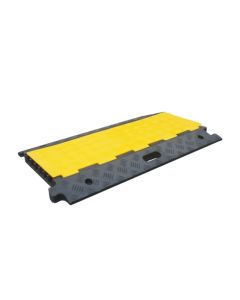
Rubber cable ramp with 6 channels measuring 25x34 mm, driveable up to 30T. Dimensions: L 910 x W 500 x H 48 mm.
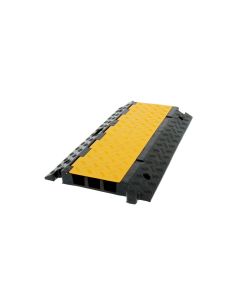
Floor cable protector ramp, with 3 cable channels of 58x52 mm, high visibility. Dimensions: L 910 x W 500 x H 68 mm.
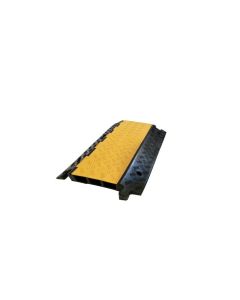
Rubber floor cable protector with 3 channels of 65x65 mm, drive-over up to 30T. Dimensions: L 910 x W 500 x H 81 mm.
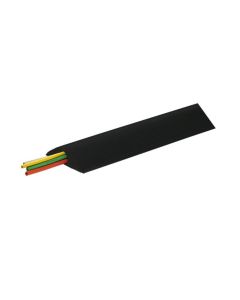
Drive-over rubber cable protector (H 70 mm) with a 42 mm Ø open channel on the bottom. Ideal for protecting cables and pipes on construction sites and event areas.
Cable protectors constitute an essential structural solution in environments where orderly cable management represents a safety and operational requirement. These protection systems, made of vulcanized rubber, industrial PVC, and polyurethane, allow for the containment of electrical, data, and signal cables, creating defined paths along floors, on work surfaces, or in transit between different areas. Regardless of the application context—be it an industrial space, an office, a school facility, or a temporary event setup—cable protectors offer a combination of functional protection, structural resistance, and safety for personnel and end users.
Choosing to install cable protectors in an operational area responds to multiple technical and safety needs. First and foremost, these systems protect cables from mechanical wear, humidity, and atmospheric agents, significantly extending their useful life and reducing maintenance and replacement costs. In industrial environments, where the passage of heavy vehicles is frequent, a correctly sized cable protector made of suitable material prevents snags, breaks, and short circuits that could cause costly production downtime. Furthermore, by containing cables in defined paths, protectors eliminate potential obstacles on the floor, drastically reducing the risk of trips and falls, a crucial factor in high-traffic spaces such as schools, medical environments, or public areas during events.
An additional advantage lies in the organizational and management aspect: protectors facilitate visual identification of cables, simplify inspection and maintenance operations, and allow for future additions and modifications with less disruption. In temporary contexts such as trade fairs, concerts, or exhibition setups, the ability to quickly position a walk-over cable protector allows for optimized setup times while maintaining high safety standards. Many available models also feature high-visibility coatings, such as the color yellow, which serve as additional visual markers for staff and visitors.
The cable protector catalog is divided into various versions, each optimized for specific wiring configurations and usage contexts. Single-channel protectors represent the most essential solution, ideal for small systems or areas with limited wiring needs; these offer a small internal diameter (usually between 20 and 50 mm) and guarantee a low profile on the floor, making them particularly suitable for corridors or environments where bulk must be kept to a minimum. Two, three, and four-channel protectors expand containment capacity, allowing different circuits to be separated and wiring to be organized in a structured way, which is fundamental when data, power, and signal cables are present simultaneously. Five and six-channel versions represent more complex solutions suitable for articulated systems or situations where clear compartmentalization of services is required.
Regarding materials, vulcanized rubber protectors predominate due to their excellent elasticity, abrasion resistance, and impact absorption capacity, a quality particularly valuable in contexts where the passage of carts or heavy vehicles is frequent. Industrial PVC versions, which are more rigid, are preferable where maintaining a stable shape over time is a priority and where the environment does not present excessive mechanical stress. Several models include cable ramps, which are raised profiles that facilitate the passage of elements such as sliding doors or boom gates, while creating a safe transition for pedestrians. Size and capacity vary significantly: light walk-over models and up to 40-ton load-bearing models for heavy vehicle passage coexist with more compact versions dedicated to pedestrian traffic.
Selecting the appropriate cable protector requires a methodical analysis of at least four critical factors. First, it is necessary to precisely quantify the number and type of cables to be contained, considering not only the current configuration but also margins for future growth; this directly determines the number of channels required and their internal cross-section. Second, it is essential to evaluate the mechanical load to which the protector will be subjected: environments with exclusive pedestrian traffic require lower resistance than industrial spaces where forklifts, reach trucks, or motor vehicles transit, thus determining the choice between a standard model and a high-resistance version in vulcanized rubber. A common mistake is undersizing the capacity, believing that the actual weight is modest; in reality, a single passage of a heavy vehicle concentrates point loads that can damage an unsuitable protector.
Third, the dimensions of the available space and the installation height influence the profile of the protector: a narrow space requires low and compact models, while areas where a greater protrusion is tolerable allow for taller protectors with greater containment capacity. Finally, the environmental context—permanent indoor, temporary indoor, outdoor, humid environments, or those exposed to chemical agents—guides the choice toward specific materials and surface treatments (such as high-visibility yellow coatings for public areas). An incorrect assessment of these parameters produces tangible consequences: an oversized protector creates unnecessary bulk, while an undersized one offers neither adequate protection nor sufficient space, forcing subsequent corrective interventions.
Cable protectors must comply with a series of technical and regulatory standards that vary depending on the application context. In the electrical sector, IEC 61084 standards and the provisions of the Italian CEI 23-51 standard establish construction and performance requirements for cable laying systems, including criteria for mechanical resistance, fire resistance, and insulating properties. For applications in public and school environments, regulations on the prevention of tripping hazards (Ministerial Decree of September 6, 1994, and subsequent additions) require that transitions between levels and obstacles on the floor be managed according to specific slopes and heights, an aspect that directly affects the design of cable ramps. In the industrial context, the provisions of Legislative Decree 81/2008 (Consolidated Law on Health and Safety at Work) require that all suspended or floor cables be protected in such a way as to prevent mechanical damage and risks of accidental contact, a principle that properly sized protectors fully satisfy.
Further technical requirements concern fire resistance: many regulations, particularly those applicable in public buildings and hospitals, require that the materials making up the protectors comply with specific fire reaction classes according to the EN 13501-1 standard (at least class D-s2, d1 for high-traffic environments). For outdoor installations or in environments with exposure to cyclic stress, the protector’s ability to maintain elastic properties over time represents a performance requirement governed by ISO 1402 and ISO 1403 standards, which define methods for verifying the aging resistance of elastomeric materials. Finally, where the protector supports critical systems, technical documentation such as EC declarations of conformity, load resistance certifications, and test reports on representative samples must be available and accessible, ensuring traceability and contractual responsibility.
Explore all products in the category and compare the available solutions to find the one best suited to your operational context, considering the number of channels required, mechanical capacity, available dimensions, and regulatory standards applicable to your specific application.
Dimensions vary significantly depending on the model and containment capacity. Lengths between 400 and 1000 mm, depths between 150 and 500 mm, and heights between 30 and 81 mm are the most common. Internal channel diameters range from 20 mm for monolithic versions up to 65 mm for three-channel industrial configurations.
Yes, provided that a suitable version is selected. Vulcanized rubber models with robust structural specifications are certified for loads up to 40 tons, ensuring lasting protection even with frequent heavy traffic. It is crucial to consult the technical specifications of the chosen product.
Installation is generally simple and does not require specialized tools. Most models are simply placed on the floor and fixed using industrial adhesives, bolting, or simply gravity, if the weight is sufficient. For permanent installations in critical environments, additional mechanical fixing is recommended.
Floor cable covers have a flat profile and are optimized to contain cables without creating significant obstacles. Cable ramps, on the other hand, have a raised and inclined profile, facilitating the passage of doors, screens, or people with reduced mobility, while simultaneously acting as visual transition markers.
Yes, as long as a version specifically formulated for resistance to UV rays, humidity, and thermal variations is selected. Industrial-grade vulcanized rubber and protective coatings ensure durability even with prolonged exposure to weather. Always check the technical data sheet for outdoor specifications.
The number depends on the specific diameter of the cables to be contained. A channel with a 35x35 mm section, for example, can usually accommodate 4–6 cables of 5–8 mm diameter, but it is advisable not to exceed 80% of the total volumetric capacity to ensure ventilation and ease of future maintenance.
Many models are formulated to meet EN 13501-1 fire reaction requirements, reaching classes D-s2, d1. However, not all available versions have this characteristic. For environments subject to strict regulations (hospitals, schools, public buildings), it is essential to verify the specific certification of the product.
Vulcanized rubber offers elasticity, abrasion resistance, and the ability to absorb impacts, making it ideal in contexts with heavy traffic and thermal variations. Industrial PVC is more rigid, maintains its shape over time, and represents a preferable choice in environments with moderate mechanical stress and high dimensional stability requirements.
 English
  Italian
 French
 German
 Spanish