
mon-fri 9-13 / 14.30-18.30
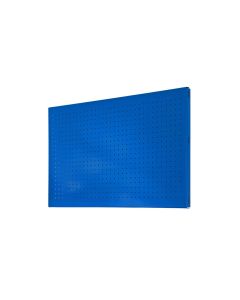
Blue perforated tool panel in scratch-resistant steel, without shelves. Dimensions: W 120 x D 3.5 x H 40 cm.
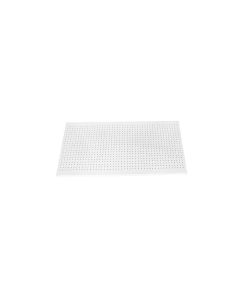
White perforated tool panel with 8 tool hooks. Dimensions: W 90 x D 3.5 x H 60 cm.
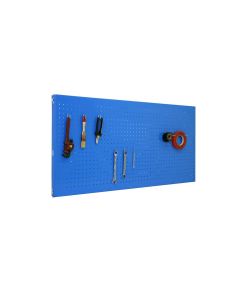
Blue steel panel with 8 tool hooks, screw fixing. Dimensions: W 90 x D 3.5 x H 60 cm.
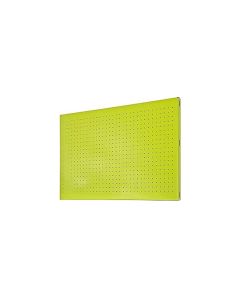
Green perforated tool holder panel, hooks and tools not included. Dimensions: W 120 x D 3.5 x H 40 cm.
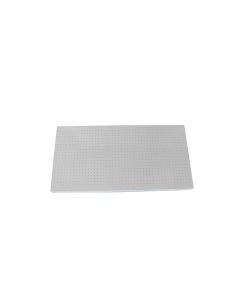
White perforated tool holder panel with 14 hooks and 3 accessories. Dimensions: W 90 x D 3.5 x H 60 cm.
Tool panels represent a fundamental organizational solution in professional environments where space management and tool accessibility directly affect productivity and safety. These systems allow daily tools to be kept visible and orderly, reducing search times and minimizing the risk of damage due to disorganized storage. Available in various configurations, materials, and sizes, tool panels adapt to mechanical workshops, technical warehouses, maintenance departments, and assembly lines, transforming walls and benches into efficient and standardized workstations.
A well-designed wall storage system is not just an organizational tool, but a strategic element for implementing lean and 5S methodologies, improving visual control of tools and facilitating the replicability of workstations. Modularity allows the space to be reconfigured without structural interventions, adapting to updates in operational needs and the equipment available in the company.
The correct choice of the panel and its accessories depends on a combination of technical and operational factors: support stability, compatibility with hooks and attachment systems, resistance to harsh environments, and ease of maintenance. This catalog presents diversified solutions to ensure that every work context finds the configuration most suitable for its characteristics and available budget.
The organized management of tools represents an often underestimated but decisive operational lever for the quality of work performed and the well-being of the team. An effective tool panel significantly reduces downtime related to searching for tools, allows immediate visual control of the status of completeness and wear of instruments, and creates a safer work environment by reducing the risk of trips and falls of heavy objects. In mechanical workshops, for example, the difference between a chaotic bench and a structured one can represent several minutes per operator per shift, multiplied over days and months; in production lines, this difference affects the speed of equipment changes and compliance with quality protocols.
In addition to immediate efficiency, a wall storage system allows work conditions to be replicated across multiple workstations, facilitating the training of new operators and reducing errors due to disorganization. The modularity of the system allows accessories to be added or moved without additional structural investments, adapting to changes in work procedures, the use of new tools, or production volumes. In environments with high personnel turnover or multiplication of workstations, this flexibility becomes a significant competitive advantage, as the initial investment in the panel is quickly amortized by the recurring benefits of efficiency and safety.
The tool panel market is structured around solutions that vary in both geometry and attachment systems, each designed for specific operational contexts. The perforated tool panel represents the most versatile and widespread solution: made of painted sheet steel, it features a regular matrix of holes (typically with a 50 mm pitch) that allows hooks, supports, shelves, and containers to be positioned in any combination. This system maximizes reconfigurability without predetermined layout limits, allowing the arrangement to be adapted to daily needs and future growth. The modular tool wall with multiple panels represents the natural evolution when available space is large or when multiple operators share the same work area; these systems allow organizational capacity to be extended while maintaining visual consistency and ease of use.
The bench tool board, on the other hand, is designed for direct use at the workstation, ensuring immediate access to tools without needing to leave the bench. It generally features compact dimensions and minimal depth, so as not to clutter the work surface but still remain accessible without extending the arm. From a material standpoint, painted steel remains the dominant choice for its robustness, mechanical resistance, and cost, although some specific solutions provide galvanized finishes or protective coatings for environments with high humidity, chemical aggressiveness, or frequent washing. Compatibility between the panel and accessories (hooks, rods, shelves, containers) is a critical aspect often overlooked; choosing to stay within a coherent ecosystem avoids frustration over time and ensures predictable and safe performance.
Selecting the most appropriate tool panel requires a preliminary assessment of the context of use, the functions it must perform, and the available installation constraints. First, it is necessary to define the operational objective: if the panel must serve as a “lean station” where only the most used tools in the current work cycle are kept in view, the strategy is different from that of a general storage area where dozens of different types coexist. A single workstation intended for a specific operator can be sized and organized with personal logic, while a shared wall requires clear standardization to avoid generational disorder. Similarly, accurately measuring the available space (width, height, attachment depth) is essential to avoid undersized or oversized purchases that compromise usability and the overall appearance of the workstation.
An often critical aspect is the evaluation of the structural capacity of the panel and its fastening system: in the workshop, the load consists not only of tools but also of repeated impacts, vibrations, and the dynamic movements of operators. An insufficiently rigid panel can cause oscillations when removing tools, increasing the risk of falls and progressively weakening the fixings. It is therefore advisable to choose configurations with reinforced supports and anchors sized based on the maximum expected load, not just the static sum of the tools. The work environment represents another decisive parameter: the presence of oils, processing dust, humidity, and frequent cleaning cycles with water jets requires protective finishes and oxidation-resistant materials. Finally, the attachment system must be evaluated not only on the basis of technical compatibility but also on the construction quality of individual accessories, favoring solutions that prevent accidental detachment in environments with vibrations, such as in assembly lines or areas near moving machinery.
Workplace safety forms the regulatory foundation on which the technical requirements for tool panels and their accessories rest. The Machinery Directive (2006/42/EC) and national decrees on health and safety in the workplace (Legislative Decree 81/2008 in Italy) require that storage and work organization elements minimize the risks of falling objects, obstacles to movement paths, and injuries due to sharp edges or surfaces. This means that a tool panel, apparently a simple organizational aid, must be installed and used according to technical specifications and load limits so as not to become an element of danger. The correct choice and sizing of fixings is crucial: a panel anchored to a plasterboard wall requires different types of plugs compared to one installed on solid masonry or metallic structures, and the maximum supported load varies significantly.
In the industrial context, the adoption of 5S methodologies and lean manufacturing has elevated the standards of organization and standardization of workstations, introducing good practices such as clear labeling, the definition of functional zones (hand tools, PPE, small parts), and the maintenance of growth spaces for future additions. The regulation on the management of fall risk prevention (UNI EN 12811-1 for temporary structures, but applicable also to work organization systems) requires that every element be subjected to periodic verification of stability and integrity. For environments with high chemical or biological risk (laboratories, pharmaceutical areas), the use of protective finishes and easily sanitizable surfaces becomes an additional requirement linked to hygiene and contamination standards. In all cases, the technical documentation of the panel and accessories must be kept to facilitate inspections and demonstrate compliance in case of accidents.
Explore all products in the category and compare available solutions to find the one best suited to your operational context, evaluating dimensions, materials, attachment systems, and compatibility with accessories that meet your specific organization and safety needs.
The perforated panel is wall-mounted and covers large areas, allowing for complex layouts with many tools and accessories. The bench board is smaller, designed for a single operator directly at the workstation, providing immediate access to tools without moving from the bench.
Compatibility depends on the pitch and the hole system of the panel. It is preferable to choose accessories from the same manufacturer’s ecosystem to ensure stability and performance. Generic universal hooks often have insufficient tolerances for professional environments with vibrations.
Check the rigidity of the panel itself, the quality of the anchoring supports, the type of fastening (rivets, welds), and the hook specifications (capacity per hook). Real robustness is the result of the combination of panel + accessories + correct installation with an adequate safety margin.
Yes, but it requires specific plugs and anchors for lightweight materials, with a reduction in maximum capacity compared to solid masonry. It is advisable to consult technical instructions or a specialist to correctly size the fixings and not exceed the permitted load.
Define clear functional zones (frequency of use, type, safety), maintain free spaces for new additions, assign fixed positions to main tools, and apply visual labeling. A consistent and maintained logic significantly reduces the degradation of order over time.
It depends on the finish. Standard painted steel is sufficient for most environments. For direct exposure to humidity, industrial oils, or frequent washing, choose galvanized finishes or additional protective coatings that prevent corrosion and facilitate cleaning.
If the budget allows, a modular panel allows you to start with a base and add accessories progressively. Avoid oversizing initially; excessive space encourages disorder. Planned growth keeps the layout efficient and tool control easier.
The panel offers immediate visual control (no opening/closing of doors), quick access without searching, reduces downtime, and facilitates workstation standardization. The cabinet protects tools from dust but hides the content, increasing search times and making it unsuitable for rapid use cycles.
 English
  Italian
 French
 German
 Spanish