mon-fri 9-13 / 14.30-18.30
The setting up of an electoral consultation represents a complex logistical operation that requires specific, robust equipment compliant with current regulations. Professional electoral furniture guarantees full respect for the right to voting secrecy, a cornerstone of every democratic process. Every component, from the booth to the propaganda board, must meet rigorous requirements of sturdiness, privacy, and operational functionality. The proposed solutions are designed to support municipal administrations, prefectures, and public bodies in creating polling stations compliant with ministerial circulars, optimizing installation times and ensuring multi-year durability despite frequent storage and handling cycles.
The transformation of school buildings, public offices, or common spaces into polling stations requires components that combine structural solidity and logistical practicality. Materials such as anodized aluminum and galvanized steel maintain their mechanical integrity over time, resisting intensive use during voting days. From booths with book-style folding to folding tables, every element is designed to be stored in small spaces once the consultation is over, offering communities a reliable, safe operational tool that fully complies with national security protocols regarding the setting up of polling stations.
The adoption of professional electoral equipment is essential to ensure the regularity of voting operations and the protection of the voter’s privacy. Technical booths, unlike improvised solutions, offer total visual isolation thanks to opaque curtains and structures that prevent lateral perspective leaks. The solidity of the integrated support surfaces allows for easy writing, a critical factor in avoiding the cancellation of ballots due to unintentional marks. The lightness of modern materials allows municipal maintenance teams to set up dozens of sections in record time, significantly reducing labor costs and inconvenience for the host structures, such as schools and public offices that must interrupt their normal activities.
In addition to functionality during voting, the utility of these furnishings lies in their post-electoral logistical management. The possibility of folding booths and tables into ultra-flat configurations greatly facilitates storage in municipal warehouses, where space is often limited and precious. The use of anti-corrosion treatments on propaganda boards ensures that external structures do not suffer damage from atmospheric agents, maintaining a dignified urban decor throughout the electoral campaign. Choosing high-quality products means guaranteeing an excellent public service, minimizing the risks of disputes due to malfunctions, and ensuring a comfortable working environment for the members of the sectional electoral office and for the law enforcement agencies engaged in the security of the polling station.
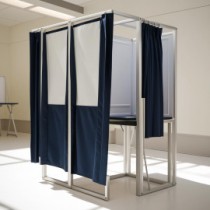
The range of furniture for polling stations is divided into various product categories, each intended for a specific phase of the electoral consultation. Electoral booths represent the central element, available with a ribbed aluminum structure, equipped with fireproof curtains and writing surfaces in wood or plastic material resistant to stress. For document management and counting, electoral tables with folding legs offer large work surfaces that can be easily placed side-by-side to create the station for the president and poll clerks. The electoral propaganda boards, made of hot-dip galvanized steel, are instead intended for outdoor spaces or halls, available in different standard sizes for the orderly posting of list posters according to the equality criteria established by law.
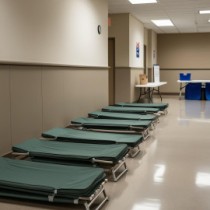
The complete setup is enriched by a series of fundamental logistical accessories for the well-being of the personnel and the orientation of flows. Among these, the cots for the military and law enforcement agencies in charge of the night-time surveillance of the polling station stand out, designed to be robust but easily transportable in cars and vans. For the orientation of voters, signs and sign holders are available for numbering the sections and identifying booths intended for the disabled, elements that reduce confusion during peak hours. There is no shortage of modular delimitation systems, barriers, and platforms for the organizational phases, ensuring that every moment of the process, from posting to proclamation operations, takes place in an orderly and professional manner according to established protocols.
The selection of electoral furniture must start from a precise calculation of the number of sections to be set up and the square footage of the available rooms, considering the minimum surface standards for each station. For booths, it is essential to check the closing system: book-style models are the most efficient for those with warehouses with low ceilings or narrow shelving, while wall-closing systems are more suitable for spaces with irregular geometries. In choosing propaganda boards, the fixing system must be evaluated (on the ground with ballasted bases, or on the wall) based on the type of public ground where they will be installed and the meteorological conditions of the electoral season. For electoral office tables, preference should be given to models with laminate tops, easy to clean in case of ink stains and resistant to the weight of ballot boxes and ballot packs.
Another critical factor is accessibility equipment: every polling station must provide at least one booth suitable for non-ambulatory voters, equipped with support surfaces at a reduced height (usually between 70 and 80 cm) and maneuvering spaces greater than 150 cm to allow for wheelchair rotation. Attention must also be paid to the quality of the curtains, which must be heavy, darkening, and fireproof to guarantee voting secrecy even under intense artificial lights, as well as compliance with fire safety regulations. As for field cots, it is advisable to choose models with a reinforced steel structure and a cover in washable and treated fabric, ensuring a dignified rest for security personnel during night shifts. The choice of clear and readable signs helps prevent crowds and confusion, allowing a constant flow of people and reducing voter waiting times, overall improving the efficiency of the municipal service.
Electoral furniture must meet rigorous regulatory standards defined by the Ministry of the Interior and the laws in force regarding popular consultations. Electoral booths must be designed to guarantee absolute voting secrecy, with minimum dimensions that allow the voter to move easily but without openings that allow viewing from the outside, thus preventing any form of interference or control of the vote. The materials used must be fireproof, especially regarding the curtains and writing surfaces, to comply with fire prevention regulations in school and public buildings according to D.M. March 10, 1998. Compliance with Legislative Decree 81/08 on safety in the workplace is mandatory for all furniture handled by municipal personnel, ensuring the absence of sharp edges, the stability of the mounted structures, and ergonomics during the setup and dismantling phases.
Propaganda boards must comply with the standard dimensions provided by Law 212/1956 and subsequent amendments, guaranteeing equal space to all competing lists and correct positioning according to prefectural circulars. It is fundamental that manufacturers provide certificates of conformity and technical data sheets certifying wind load resistance for external structures (calculated according to UNI EN 1090 standards) and the mechanical stability of internal booths subjected to load tests. CE marking and the use of non-toxic paints and recyclable materials are increasingly required requirements in public tenders for the supply of electoral furniture, representing a commitment to environmental sustainability. Compliance with these parameters not only protects the legal validity of the electoral consultation but also guarantees the managing body a secure investment compliant with national security protocols, minimizing legal and operational risks during the electoral event.
Explore all the products in the category and compare the available solutions to find the one most suitable for your operational context, considering the specific needs of your administration and the number of sections to be set up.
A compliant booth has a stable structure in ribbed aluminum, three darkened fixed sides, and a heavy, fireproof front curtain to guarantee voting secrecy. Inside, there is a fixed support surface at a suitable height, allowing the voter to fill out the ballot comfortably while standing, completely isolated from outside view.
Book-style folding is a mechanism that allows the booth structure to fold in on itself in an ultra-compact way, similar to the pages of a closed book. This system is fundamental for municipal logistics because it drastically reduces bulk during storage in warehouses and facilitates the transport of large quantities of booths to various polling stations distributed throughout the territory.
Yes, regulations require the installation of booths for non-ambulatory voters. These structures have larger internal dimensions to allow for wheelchair rotation and are equipped with a writing surface positioned at a reduced height, generally between 70 and 80 cm, allowing the ballot to be filled out in total autonomy and privacy.
Electoral posting boards are mainly made of hot-dip galvanized steel. This material is chosen for its high resistance to corrosion and atmospheric agents, ensuring that posters remain stable and legible outdoors for the entire duration of the electoral campaign, without deformation or rust formation.
Tables used in polling stations must be robust and stable to support the weight of the ballot boxes and minutes during the count. The most appreciated feature is the folding structure, which allows for quick setup and fast dismantling at the end of operations. The tops are usually in washable laminate to guarantee hygiene and resistance to ink stains.
Absolutely yes. Since they are furniture installed in public places such as schools or municipal offices, the booth curtains must have fire-retardant certifications compliant with fire prevention regulations according to D.M. March 10, 1998. This requirement is essential to ensure the safety of the polling station and voters in case of emergency.
The number of booths depends on the number of voters registered in the section and the turnout forecasts. Generally, one booth is calculated for every 300-400 voters, but in contexts with high expected participation, it may be necessary to increase the ratio. Ministerial regulations provide specific indications based on the population and electoral history of the section.
Centralized storage in municipal warehouses reduces management costs, facilitates preventive maintenance, and allows the use of limited spaces thanks to compact folding systems. An administration can thus serve dozens of polling stations with a single set of furniture, maximizing economic efficiency without compromising on quality and regulatory compliance.
 English
  Italian
 French
 German
 Spanish