mon-fri 9-13 / 14.30-18.30
Collective catering represents a specific sector that requires equipment and furniture designed to handle high volumes of meal preparation and distribution in organized contexts. School, hospital, corporate canteens, and reception facilities need functional, durable solutions that comply with hygiene and food safety standards. Equipment for Collective act catering must guarantee operational efficiency, practicality in service management, and compliance with the regulatory requirements that govern the sector.
These environments operate with specific needs: limited space, the need for rigorous hygiene, speed of service, and management cost-effectiveness. The choice of furniture and equipment directly influences the quality of service offered to end users, staff productivity, and the longevity of investments. A well-equipped facility reduces labor time, minimizes contamination risks, and facilitates compliance with food safety and worker welfare regulations.
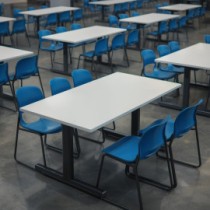
Collective catering faces unique operational challenges: managing the preparation of dozens or hundreds of meals a day, maintaining rigorous hygiene standards, ensuring equity in distribution, and operating within predefined budgets. Specific equipment for this sector is designed to meet these challenges, offering superior durability compared to domestic products, ease of cleaning and sanitization, and production capacities suitable for high volumes. A monoblock canteen table, for example, eliminates the need for separate legs, simplifying hygiene operations and reducing critical points where bacteria could proliferate.
The practical benefits extend to daily management: trained staff know exactly how to use standardized equipment, the replacement of worn components is rapid and does not interrupt services, and space planning becomes more predictable. Facilities such as schools, hospitals, nursing homes, and communities benefit from furniture designed to withstand intensive use, frequent cleaning with strong detergents, and the passage of time. Traceability and responsibility towards public or private entities also require certified, documented equipment that complies with national and international regulations, an aspect that affects the operational credibility of the entire structure.
The Collective catering catalog includes various product categories, each responding to specific functions. Monoblock tables represent the standard solution for canteens and refectories: made of stainless steel or certified composite materials, they offer easily sanitizable surfaces and robust structures that do not require frequent maintenance. Thermal trolleys for the transport and preservation of meals maintain the correct temperatures during distribution, essential in hospital or home catering services. Service counters, with isothermal compartments and work surfaces, allow the meal delivery point to be organized neatly and efficiently.
In addition to furniture, the sector includes support equipment such as beverage dispensers, containers for transporting dishes, waste disposal systems organized for composting, and shelving for food storage. Each type varies in size, materials, and performance: stainless steel for high-humidity environments, resistant laminates for less critical areas, treated wood for less demanding facilities. The choice depends on the specific context, the number of daily meals, the type of users served, and local regulations governing hygiene and food safety.
Correct selection starts with understanding real operational needs. A school canteen serving 200 students a day has different needs than a corporate refectory serving 500, or a hospital facility where meals must be tracked for individual patients. First, evaluate the daily volume of meals, available space, service methods (self-service, controlled distribution, etc.), and specific regulatory constraints of the context. If the facility is a school, school food safety regulations may be stricter; if it is a hospital, even more stringent hygiene protocols apply.
A recurring error is undersizing equipment thinking it will save money: tables that are too small lead to congestion at service time, insufficient thermal trolleys lead to food served at inadequate temperatures, and shallow service counters create clutter and delays. Conversely, oversizing occupies valuable space that could serve other functions. The solution consists of mapping the workflow: how many operators work simultaneously, how meals move from the kitchen to service, how much time is available between service shifts. Consult expert industry suppliers to evaluate efficient layouts, optimal sizes, and materials that align with both budgets and the regulatory standards of your facility.
Contract catering is subject to a complex regulatory framework starting with Regulation (EC) No. 852/2004 on the hygiene of foodstuffs, which specifies how food must be managed, prepared, and served within the EU. Materials in contact with food must comply with Regulation (EC) No. 1935/2004, ensuring they do not release dangerous substances. The equipment used, from work surfaces to thermal trolleys, must be suitable for food contact, certified, and easily sanitizable. In Italy, the Guidelines for Correct Hygiene Practice in Collective Catering provide specific indications on how to design and manage these environments.
Critical aspects frequently emerged include the need for documentary traceability, correct temperature management during transport and storage, and the prevention of cross-contamination. Public facilities, such as schools and hospitals, must also comply with preference criteria established by contracting entities, which often require environmental sustainability certifications, REACH compliance for chemical substances, and detailed CE declarations of conformity. Lack of compliance not only entails health risks but exposes the facility to administrative audits, sanctions, and loss of accreditation. A correct choice of equipment from the start significantly reduces these risks and simplifies daily control and hygiene operations.
Explore all products in the category and compare the available solutions to find the one best suited to your operational context. The collective catering equipment in our catalog is selected for reliability, regulatory compliance, and management practicality.
A monoblock table has an integral structure without separate legs, eliminating spaces where dirt can accumulate. It is made of stainless steel or composite materials, facilitates complete sanitization, and withstands intensive use. Traditional tables with separate legs require more thorough cleaning in the gaps and are less suitable for high-hygiene contexts such as school and hospital canteens.
Evaluate the number of meals served per shift, the type of dishes (hot dishes maintain heat better than soups), and the time that elapses between leaving the kitchen and service. A trolley should hold 30-40% more than the capacity required for a single shift, ensuring operational flexibility and allowing efficient rotation between multiple trolleys.
Stainless steel is the standard for high-humidity environments and frequent sanitization. Melamine laminates certified for food contact are economical but require more maintenance. Modern composite materials offer similar resistance to stainless steel at lower costs. Always check REACH certification and Regulation (EC) No. 1935/2004 for food contact.
The key regulations are Regulation (EC) No. 852/2004 for food hygiene, Regulation (EC) No. 1935/2004 for food contact materials, and specific HACCP Guidelines for collective catering. Each facility must set up a Self-Control Plan based on these standards and maintain documentary traceability of food.
Lo spazio dipende dal numero di commensali e dal tipo di servizio. Una mensa con self-service per 300 studenti richiede almeno 2-3 tavoli monoblocco da 10-12 posti, bancone di servizio di 6-8 metri, zona di raccolta vassoi, e aree di stoccaggio. Consulta un progettista esperto per ottimizzare il layout in base alla configurazione della cucina e alle esigenze logistiche.
Implement a daily cleaning protocol with food-certified detergents, weekly sanitization with authorized disinfectants, and a monthly inspection of the surface condition. Stainless steel, certified laminates, and composites require specific protocols. Train staff on correct maintenance and record every cleaning intervention for hygiene traceability.
Certified and durable equipment reduces maintenance and replacement costs, minimizes the risk of system downtime, and ensures regulatory compliance avoiding sanctions. The lower wear resulting from resistant materials extends the average life of investments by 10-15 years. Furthermore, improved operational efficiency reduces service times and the cost per meal.
Suppliers specializing in the HoReCa and collective catering sector have catalogs with products that comply with European and Italian regulations. Always check the CE conformity documentation, REACH certificates, and declarations of suitability for food contact. Request references from facilities similar to yours to validate reliability and quality over time.
 English
  Italian
 French
 German
 Spanish