
mon-fri 9-13 / 14.30-18.30
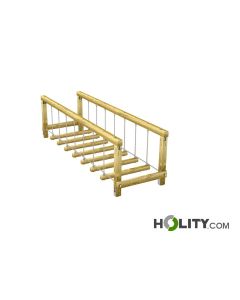
Mobile bridge in glulam nordic pine with galvanized steel chains. Supporting structure 90x90 mm, oscillating elements 70x70 mm. For children aged 5-11 years, safety area 647x400 cm.
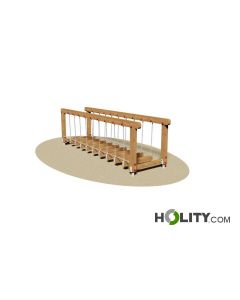
Suspension bridge in pressure-treated Nordic pine glue-laminated wood. 340x90xH.100 cm, 9 joists, 4 posts, connection chains. In-ground or surface-mount fixing. Compliant with EN 1176.
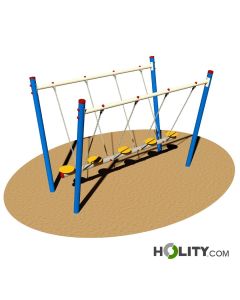
Modular galvanized steel walkway with 5 PEHD platforms and welded chains, for children aged 6–12 years. EN 1176 certified, inclusive, UV resistant.
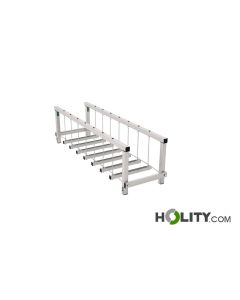
Aluminium moving bridge for play areas. 90x90 mm structure, 70x70 mm oscillating elements, galvanized steel chains. Age range 5-11 years, max 3+ users.
The mobile bridge for playgrounds represents one of the most important structural elements in the design of modern play areas, both in urban contexts and dedicated green spaces. These tools combine recreational functionality with stringent safety requirements, allowing children to develop motor skills, balance, and coordination in a controlled environment. Mobile bridges are made with materials resistant to atmospheric agents and mechanical stresses generated by continuous use, while ensuring comfort and fun for different age groups. Their versatility makes them suitable for municipal parks, school areas, private recreational facilities, and inclusive spaces where accessibility represents an added value for the local community.
A mobile bridge for a playground offers numerous advantages on a pedagogical and recreational level. Regular use of this type of structure promotes the development of balance, proprioception, and self-confidence in children, fundamental elements for their motor and psychological growth. Mobile bridges stimulate spontaneous physical activity, countering sedentary behavior and encouraging children to explore vertical and horizontal space consciously. Compared to other static solutions, the mobility of the structure adds a challenge component that keeps interest alive over time, encouraging repeated use and the progression of motor skills.
In addition to functional aspects, mobile bridges represent a lasting investment for public administrations and private operators. Made with superior quality materials such as treated Nordic wood, anodized aluminum, and painted steel, these tools maintain optimal performance for years with limited routine maintenance. Compliance with European safety regulations drastically reduces the risk of injury, providing parents and educators with the peace of mind necessary for effective supervision. The choice of a certified mobile bridge therefore represents a guarantee of quality, durability, and responsibility in the management of the play space.
In the catalog of mobile bridges for playgrounds, it is possible to find constructive variants that respond to different needs. The Tibetan bridges in Nordic pine wood represent the most traditional and appreciated solution, characterized by compact dimensions (typically around 347 x 100 cm) and suitable for children between 5 and 11 years old. These models combine natural aesthetics, thermal insulation, and a non-slip surface that guarantees grip even in humid conditions. Aluminum bridges, on the other hand, offer greater structural lightness while maintaining mechanical robustness, ideal for contexts where maintenance must be frequent or where direct exposure to atmospheric agents is particularly severe. Finally, steel walkways represent the most robust solution, suitable for wider age groups (from 6 to 12 years) and intensive use in high-traffic public areas.
The functional differences between types do not only concern the material but also the load capacity and geometric configuration. Mobile bridges with a modular structure allow the adventure path to be adapted to irregular spaces or different sizes, while fixed-length models offer greater stability and simplicity of installation. Some models are designed as inclusive elements, with features that promote access even for children with reduced mobility, expanding the potential user base and the social value of the structure. Variants in terms of useful height and distance between cables influence the perceived level of difficulty and, consequently, the most appropriate age range for use.
The choice of a mobile bridge for a playground must start from the analysis of the target users and the operational context. A first fundamental distinction concerns the age of the children: the most compact models with narrow meshes are dedicated to the youngest (5-7 years), while taller structures with larger spaces between cables are designed for children aged 8 and up. The climate zone and the type of maintenance available represent critical decision factors: Nordic wood requires periodic anti-rot treatments and is more suitable in temperate climates, aluminum is practically maintenance-free and perfect for coastal or high-humidity areas, while steel is the best choice for very high-traffic areas where wear resistance is a priority. A common mistake consists in underestimating the space necessary for installation: every bridge requires lateral, front, and rear safety zones according to regulations, reducing the total available play space.
An often overlooked aspect concerns the compatibility of the bridge with other elements of the playground. If the bridge is part of a complex adventure path, it is essential to verify dimensional and technical consistency with slides, zip lines, or other adjacent structures. The declared maximum capacity (number of simultaneous users) must correspond to supervision policies and available space constraints. Many park managers make the mistake of choosing models based exclusively on price without considering the hidden costs of maintenance, painting, or potential replacement of components in the medium term. A higher initial investment in certified materials and optimal performance frequently translates into substantial savings over the useful life of the equipment, in addition to providing an image of quality and responsibility toward the users.
Mobile bridges for playgrounds must comply with the European standard EN 1176-1 and the relative specific safety standards for playground equipment. These standards regulate critical aspects such as the resistance of materials, safety distances from falls, the solidity of anchors, and the prevention of entrapment. Every product marketed in Italy must possess a certificate of conformity certifying that it has passed static and dynamic load tests, as well as the assessment of the risk of injury due to sharp edges, rough surfaces, or pinch points. The CE declaration of conformity represents a mandatory document that the manufacturer must make available to the buyer, guaranteeing that the bridge has been designed and tested according to the protocols in force in the European Union.
Beyond the mandatory CE marking, several additional safety requirements must be considered by playground managers. The safety zone around the bridge, defined based on the maximum height and the geometry of the structure, must be free of obstacles and covered with impact-absorbing flooring compliant with the EN 1177 standard. Installation must be carried out by qualified technicians who verify correct orientation, firm anchoring to the ground, and the absence of spaces that could cause entrapment of limbs between moving components. Periodic maintenance represents a legal obligation for managers of public parks, with semi-annual or annual checks (depending on the intensity of use) of the general conditions of the structure, the state of the materials, and the functionality of the movement mechanisms. Technical documentation of the bridge must be kept at the manager’s office and made available for inspections by competent bodies regarding safety and hygiene.
Explore all products in the category and compare the available solutions to find the one best suited to your operational context. Each bridge offered in the catalog is selected to guarantee safety, durability, and compliance with international regulations in force.
The Tibetan bridge is a specific type of walkway with parallel cables to walk on, designed to simulate the experience of crossing suspended structures. A generic mobile walkway can have different configurations: inclined ramps, steps, mesh surfaces, or single cables. The Tibetan bridge is therefore a narrower and more specialized category within the broader landscape of playground walkways.
Most mobile bridges are recommended for children between 5 and 12 years old, with variations based on the specific model. Smaller bridges with narrow meshes are suitable from 5-6 years and up, while taller and more spacious structures are intended for children from 7-8 years up to 12 years. Always check the manufacturer’s technical instructions and supervise based on the motor skills of the individual child.
Anodized aluminum is the most resistant material to oxidation and natural corrosion, ideal for humid or coastal climates. Painted steel offers superior mechanical robustness but requires periodic checks of the paint. Treated Nordic wood is less resistant in the long term but provides natural thermal insulation and superior aesthetics in temperate environments.
In addition to the length of the structure itself (typically 340-400 cm), it is mandatory to respect lateral safety zones of at least 2-3 meters and a free fall space in front and behind determined by the height. For a bridge 100 cm high, approximately 10-15 square meters of total space is necessary when protection zones are included.
The bridges are specifically designed for children and declare a maximum capacity in terms of the number of simultaneous users (usually 4-6 children). Although a single adult might support the theoretical load, it is not recommended: the construction design, the spaces between cables, and the heights are calibrated for pediatric proportions. Use by adults voids the warranties.
Safety zones are entirely mandatory according to the EN 1176 standard. There are no optional areas: the free fall space must be completely free of obstacles and covered with EN 1177 certified impact-absorbing flooring. The absence or insufficiency of these zones constitutes a violation of the regulations and civil liability for the manager.
Routine maintenance must be carried out semi-annually in high-traffic parks, and annually in areas with moderate use. Monthly visual inspections are recommended to check for visible signs of wear, looseness of bolts, or deterioration of materials. Documentation of every intervention must be kept as proof of correct safety management.
A mobile bridge is primarily designed for outdoor environments where it benefits from natural ventilation and space. Indoor installation is technically possible but requires additional considerations: controlled humidity, adequate lighting, even tighter safety spaces, and specific certifications for buildings. It is a rare practice and generally not recommended by manufacturers.
 English
  Italian
 French
 German
 Spanish