
mon-fri 9-13 / 14.30-18.30
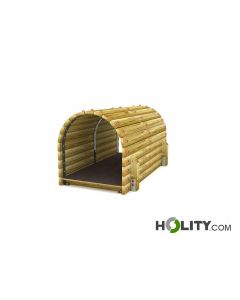
Outdoor wooden tunnel ideal for playgrounds. Dimensions: L.1150 x D.2000 x H.1020 mm. Age: 2-8 years.
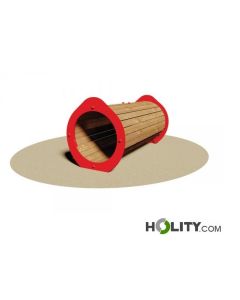
Tunnel for outdoor play areas of playrooms with Nordic pine wood cladding. Dimensions: L.208 x D.91 x H.102 cm.
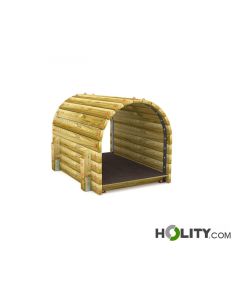
Ludic tunnel in Nordic glulam pine (115x150x102 cm) with CRPLY flooring, designed for motor development and safe exploration.
Playground tunnels represent fundamental play equipment for the creation of safe and stimulating outdoor spaces at kindergartens, playrooms, and public parks. Structures made of certified wood, such as nordic pine or birch, these elements offer children movement and exploration experiences in controlled environments. Their design combines the educational value of motor development with constructive safety standards, responding to the most stringent international regulations. A well-designed play tunnel becomes an integral part of an inclusive play ecosystem, capable of integrating with other equipment such as swings, slides, and climbing frames, creating complete motor circuits.
Play tunnels play a central role in the psychomotor development of children, offering play opportunities that stimulate balance, coordination, and body space awareness. When a child passes through a tunnel, they experience movement dynamics in confined environments that require postural control, sensory perception, and motor adaptation. These elements build the foundations for more complex motor skills, progressively preparing the body for greater challenges. Furthermore, the tunnel represents a particularly effective tool for inclusivity as it is accessible to very different age groups (typically from 2 to 8 years) and does not require specific prior skills to be used.
From the perspective of outdoor spaces, tunnels act as natural attractors that encourage active play, countering sedentary behavior. In playroom or public park contexts, they also reduce vertical bulk compared to other structures, allowing for more efficient management of the available space. The constructive robustness of laminated wood models guarantees durability even in variable weather conditions, with minimal routine maintenance. The possibility of choosing between different lengths and widths allows the equipment to be adapted to the specific characteristics of each play area, from a small kindergarten garden to a larger park structure.
Playground tunnel variants are mainly distinguished by size, construction materials, and internal flooring configuration. Laminated nordic pine models represent the most common solution, characterized by a cross-section that usually varies between 90 and 120 centimeters in internal diameter, with lengths ranging from 150 centimeters to 200 centimeters. This dimensional range allows serving different age groups: more compact tunnels (150-170 cm) are ideal for children between 2 and 5 years, while extended versions (200+ cm) are aimed at children up to 8 years and beyond. The flooring represents a critical variant, as it can be made of CRPLY (water-resistant plywood), shaped boards, or composite systems that increase friction and movement comfort.
Some manufacturers offer tunnels with an oval section instead of circular, a configuration that modifies the perceptual experience and makes the passage less claustrophobic for children with apprehensions. Construction differences are not merely aesthetic: the quality of the painting, the anti-fungal treatment of the wood, and the absence of dangerous protrusions directly affect longevity and safety of use. Specialized models may feature transparent side windows or internal upholstery, solutions that reduce the “cave effect” and favor adoption by educational structures more sensitive to the psychological aspect of play. The choice between variants must consider the climatic context (areas with high humidity require nobler woods), the expected frequency of use, and the most likely target group of children.
The selection of a playground tunnel must start from a clear definition of the prevailing age group for which the game is intended. A frequent error consists in oversizing the equipment thinking that “a larger tunnel serves more children”: in reality, excessively spacious tunnels lose the charm of exploration play in confined spaces and become less stimulating for young children. Conversely, too compact tunnels are uncomfortable or even dangerous for older children, who could get stuck or apply excessive force to the structure. The empirical rule suggests preferring tunnels whose internal dimensions allow the largest child in the target group to pass with a slight contraction, without simultaneously touching the roof and side walls.
A second decision criterion concerns the available space and integration with other equipment. Isolated tunnels rarely generate prolonged use; on the contrary, when positioned as a transition element between two play areas (for example between a climbing area and a slide), they encourage the flow of children and maximize engagement. The flooring deserves particular attention: woods with smooth and well-treated finishes reduce the risk of splinters, while shaped surfaces improve grip in case of wet play. Future maintenance costs should also be evaluated, considering that higher quality woods (nordic birch compared to common pines) require fewer reconditioning interventions. Recurring aspects emerged from users include the ease of internal inspection (essential for checking for the absence of cracks or deterioration) and the simplicity of removing debris accumulated over time.
Playground tunnels must comply with the European standard EN 1176, which defines safety requirements for playground equipment in open spaces. This regulation covers structural aspects (load capacity, assembly strength), ergonomic aspects (dimensions suitable for target age groups), and management aspects (maintenance, inspection). In particular, EN 1176-1 establishes that wooden elements must have a minimum thickness and be treated against biological degradation without the use of toxic preservatives. The standard also requires that there are no dangerous moving parts, sharp protrusions, gaps that can trap fingers or hair, and that all joints are constructed with methods that avoid rainwater accumulation (a vector for deterioration).
From the point of view of structural safety, the minimum certified static load for play tunnels intended for children is usually between 1,000 and 1,500 kg, sufficient to support groups of children simultaneously. CE compliance represents a mandatory prerequisite for marketing in Italy and Europe, certifying that the product has been subjected to conformity assessments according to current directives. Recurring aspects that emerge from professional users include the importance of wood treatment certificates (attesting the use of allowed preservatives), periodic inspection reports (recommended every 12 months in facilities with intensive use), and the availability of replacement parts for wearing components such as joints or flooring. Complete technical documentation, detailed assembly instructions, and manufacturer contacts for after-sales assistance are features that distinguish reliable suppliers.
Explore all products in the category and compare the available solutions to find the one best suited to your operational context. Evaluate dimensions, materials, and configurations based on your specific space needs and target audience.
Most play tunnels are designed for children between 2 and 8 years old. More compact models (150-170 cm) are more suitable for small children (2-5 years), while extended versions also support children up to 8-10 years. It is essential to choose dimensions proportionate to the prevailing age group to maximize engagement and safety.
Laminated nordic pine offers an excellent quality-price ratio and adequate performance in temperate climates. Birch is more resistant in humid environments or those subject to extreme hygrometric variations, but involves higher costs. The choice depends on geographical location, level of weather exposure, and preventive maintenance budget.
Routine maintenance includes a semi-annual inspection (checking for cracks, splinters, swelling), removal of accumulated debris and moss, and cleaning with water. Protective wood treatments (painting or oiling) should be repeated every 2-3 years depending on local weather conditions and the level of use.
In addition to the dimensions of the tunnel itself, it is necessary to provide free circulation zones around the element. EN 1176 regulations require safety zones (fall zones) ranging from 1.5 to 2 meters on the sides, depending on the surrounding configuration and the position of other equipment. Always check the manufacturer’s technical manual.
It depends on the type and degree of disability. Standard tunnels are accessible for children with mild-moderate motor disabilities. Some manufacturers offer adapted versions with side windows, oval sections, or facilitated access. Consult the supplier to evaluate accessibility relative to specific needs.
Wooden tunnels offer greater durability, natural aesthetics, and predictable maintenance costs. Plastic tunnels are lighter and require less maintenance, but can deteriorate under intense UV rays and have less pedagogical appeal. Wood remains the standard for permanent installations in public spaces.
Tunnels that represent a proportionate challenge (not too easy, not impossible) maximize the stimulation of postural control and proprioception. Integrating tunnels into complex motor paths, alternating them with other elements (climbing, slides), encourages combined exercises that develop global coordination skills and body space awareness.
Verify the presence of CE certification and the EN 1176 standard in the technical documentation. Request initial inspection reports and wood treatment certificates. Purchase from reliable suppliers who provide a complete technical manual, maintenance instructions, and documented after-sales support.
 English
  Italian
 French
 German
 Spanish