
mon-fri 9-13 / 14.30-18.30
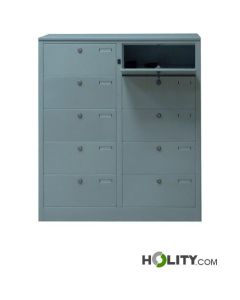
Office furniture pigeonhole unit with 10 compartments. Centralized lock. Dimensions: W.90 x D.36 x h.106 cm.
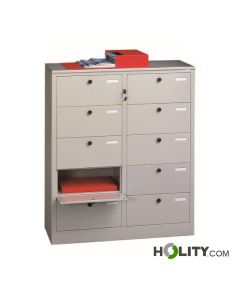
Office sorting cabinet equipped with 10 compartments. With central lock. Material: painted steel.
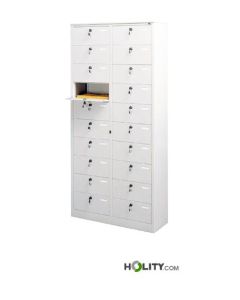
20-compartment sorting cabinet with independent locks. Dimensions: W.90 x D.36 x h.200 cm. Material: sheet metal.
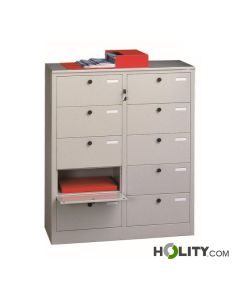
Office filing cabinet with 10 compartments. Color: gray RAL 7035. Single lock + centralized lock.
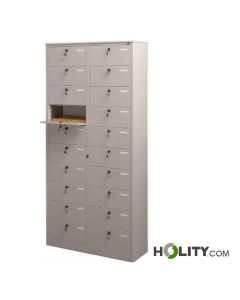
Office sorting unit with 20 compartments and central lock. Height: 200 cm. Material: painted steel.
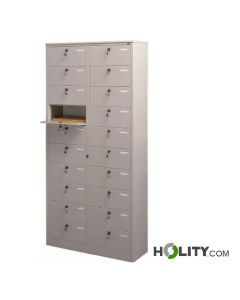
Office pigeonhole unit equipped with 20 compartments with single lock. Color: grey RAL 7035.
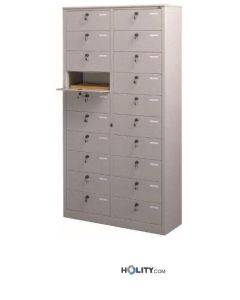
Office filing cabinet with 20 compartments. Dimensions: W.90 x D.35 x h.200 cm. Material: sheet steel.
Office sorting units are modular structures indispensable for the sorting, storage, and organization of documents, correspondence, and personal materials in professional environments with high user density. These furnishings, made of painted steel or sheet metal, guarantee privacy protection, visual order, and ease of access to contents thanks to the division into dedicated compartments. Their importance clearly emerges in contexts such as universities, public offices, administrative secretariats, and companies where efficient management of internal communication flows represents a strategic lever for productivity and reduction of operational times.
The constructive robustness and versatility of configuration make sorting units a long-lasting solution, capable of adapting to different needs without requiring particular maintenance interventions. The integrated base plinth raises the structure from the ground, protecting the sheet metal from humidity and facilitating ergonomic access even to the lowest compartments, while the reinforced internal hinges guarantee mechanical stability even after thousands of consecutive openings. Each door is equipped with a label holder that allows for rapid identification of the recipient or content, significantly reducing search and retrieval times within the structure.
The introduction of professional metal sorting units within an administrative facility responds to concrete needs for security, privacy, and space rationalization. The most evident benefit lies in the protection of document confidentiality: each compartment acts as a private mailbox or container for personal effects, preventing unauthorized access and maintaining the confidentiality of sensitive materials. This aspect becomes critical in university secretariats and post offices, where the sorting of official correspondence, evaluation tests, or personal packages requires a controlled and traceable system, eliminating the risk of loss or involuntary manipulation. Logistic centralization in monitorable points also facilitates administrative audits and reduces disputes related to the non-receipt of important documents.
In addition to confidentiality, metal sorting units offer unmatched mechanical durability thanks to the use of reinforced internal hinges and closing systems tested for tens of thousands of open-close cycles. A professional quality structure maintains perfect alignment of the doors even after years of intensive use, without deformation or structural failure. Powder-coated or matte-finish surfaces allow for quick cleaning with standard detergents, ensuring hygienic and tidy environments. The application versatility makes them perfect for managing the passage of materials between different shifts, eliminating manual transfer and the related risks of loss, contamination, or theft.
Office sorting units are divided into modular configurations designed to adapt to different organizational needs. The most common versions provide from 10 to 20 compartments, capable of being placed vertically or side-by-side horizontally to cover entire departments or divisions without resorting to custom solutions. Each compartment can have completely solid doors, ensuring maximum privacy, or insertion slots to allow the delivery of correspondence without the need for opening, transforming the cabinet into a real battery of internal mailboxes. The standard finish in RAL 7035 gray or neutral tones ensures discrete integration with the surrounding environment, preserving aesthetic consistency with other metal furnishings present in offices, corridors, and public halls.
A fundamental distinction concerns the locking system: there are models with independent locking on each single door, ideal when each user manages their own key autonomously, and solutions with centralized locking or a master key that facilitates administrative management in case of emergency or the need for quick access. The structure can be monobloc, guaranteeing maximum structural rigidity and the absence of weak points, or modular to simplify transport in narrow spaces or installation in already furnished rooms. Some models include adjustable internal shelves or compartments of different depths to accommodate not only A4 sheets and standard envelopes, but also padded packages, tablets, personal devices, and work tools, offering flexibility suited to the contemporary evolution of administrative processes.
The selection of the ideal sorting unit must start from an accurate estimate of the number of end users and the average volume of correspondence or materials to be managed daily. If the cabinet is to be positioned in high-traffic areas, such as university halls, corporate post offices, or public receptions, it is essential to opt for models with reinforced doors and protected label holders, resistant to accidental impacts and the frequent manipulation typical of congested environments. Precisely evaluating the available floor space is equally critical: the presence of the base plinth is highly recommended to lift the structure from the floor, facilitating cleaning operations and preventing damage to the sheet metal due to direct contact with water, detergents, or residual humidity. A common mistake consists in undersizing the compartments: ensuring that the depth and width of the single compartment are sufficient for C4 format envelopes or padded packages avoids forcing the doors and unnecessary prolongation of sorting times.
A decisive factor is the type of lock and the relative key management system. For companies with frequent staff turnover, centralized locks reduce the administrative burden and the risk of lost keys, while for university or post offices where each user owns a compartment, independent locks guarantee maximum autonomy. The depth of the structure deserves particular attention: 35-36 cm models are sufficient for standard documents, but if the use involves the storage of thick files or historical archives, greater depth facilitates operation. Verifying mechanical stability certification and the declared maximum load is essential, especially if the sorting unit will be used in environments with strict safety regulations. Also consider the color and finish to ensure visual consistency with existing furniture and reduce the need for maintenance touch-ups over time.
Professional metal sorting units must meet specific construction and safety standards, particularly when intended for public or high-density environments. In Italy, furnishing structures must comply with the UNI EN 14073 standard regarding the stability and mechanical resistance of office furniture, ensuring that the cabinets do not tip over even if multiple doors are opened simultaneously or in case of uneven loading. The finish paint must comply with the regulations for volatile organic compounds (VOC), ensuring low emissions and a healthy internal environment, a requirement particularly important in public buildings and educational areas. Furthermore, if the sorting unit houses classified documents or sensitive materials, the solidity of the structure and the quality of the lock must prevent unauthorized access, complying with the confidentiality protocols in force at the using institution.
The corrosion resistance of the painted steel sheet is guaranteed by preliminary phosphating treatments and the application of thermosetting powder paint, which provides robustness against mechanical wear and exposure to atmospheric agents in semi-outdoor environments. For structures intended for areas subject to high humidity, such as rooms with inefficient air conditioning systems, it is recommended to opt for finishes that include an additional protective layer. The hinges must be sized according to the weight of the door and the number of opening cycles expected (generally over 100,000 cycles for intense professional use), guaranteeing reliability over time. Finally, the safety of workers during installation and use requires that the structure be anchored to the wall or the floor if it exceeds certain weight-height ratios, preventing accidental tipping in the event of an earthquake or sudden push.
Explore all the products in the category and compare the available solutions to find the one best suited to your operational context, considering the number of users, the volume of correspondence, security needs, and available space.
A sorting unit is a modular cabinet with multiple dedicated compartments, designed to sort and store documents, correspondence, and personal items in professional environments. It guarantees privacy protection and facilitates logistical organization in universities, public offices, and companies, centralizing communication flows into a single orderly and traceable point.
The most common office sorting units have approximate dimensions of 90 cm in width, 35-36 cm in depth, and heights varying from 106 cm (10 compartments) to 200 cm (20 compartments). Each single compartment measures about 17-18 cm in width and 10-12 cm in height, with sufficient internal space for C4 size envelopes and standard documents.
Centralized locking allows for the simultaneous opening of all doors with a single key, facilitating administrative access and control in emergencies. Independent locking assigns each user their own key, guaranteeing maximum autonomy and personal privacy, ideal for post offices and universities where each person is responsible for their own compartment.
Professional quality sorting units are made of painted steel sheet or galvanized steel, subjected to phosphating treatment and coating with thermosetting powder paint. This process guarantees corrosion resistance, mechanical durability for over 100,000 opening cycles, and ease of cleaning with standard detergents.
Evaluate the number of end users who must have a personal compartment, also considering expected future growth. In university or postal environments with high turnover, it is convenient to slightly oversize. Remember that sorting units can be placed modularly side-by-side, so you can start with 10 compartments and add others later without wasting space.
For stability and compliance with UNI EN 14073 safety standards, it is strongly recommended to anchor the sorting unit to the wall, especially if the height exceeds 150 cm or if it is installed in high-traffic areas where it could be subject to accidental pushes. The integrated base plinth raises the structure from the floor, facilitating cleaning and sanitation, but does not replace structural anchoring.
Most standard catalogs offer finishes in RAL 7035 gray and white, chosen for aesthetic versatility and easy integration with existing furniture. For color customizations, significant quantities, or specific requirements, it is possible to request custom solutions by contacting the supplier directly, with possible increases in time and cost.
The installation of a standard sorting unit takes about 2-3 hours, considering positioning, leveling, wall anchoring, and checking hinges and locks. For multiple or modular structures, it is advisable to entrust the installation to professionals to ensure perfect alignment and compliance with structural safety regulations.
 English
  Italian
 French
 German
 Spanish