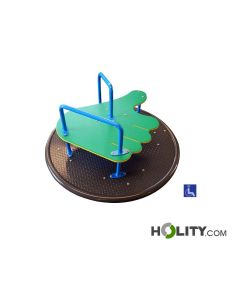
mon-fri 9-13 / 14.30-18.30
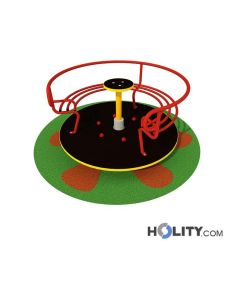
Rotating carousel for playgrounds. Material: wood and metal. Seats: 3. Dimensions: Ø110 x H60 cm.
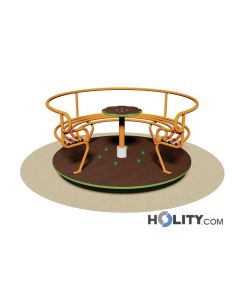
Merry-go-round for children ideal for playgrounds and gardens. Suitable for 6 users.
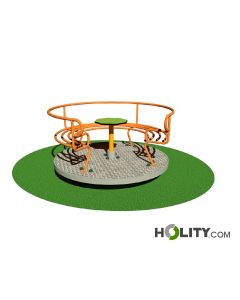
Rotating playground carousel. Material: electro-galvanized steel and chequered aluminum. Seats: 6. Dimensions: Ø124.5 x 66h.
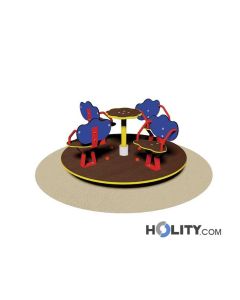
Swivel carousel for children with 4 seats.
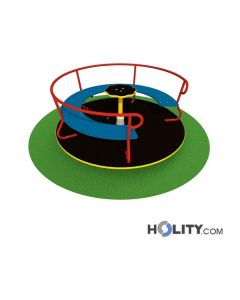
Rotating carousel for children. Material: metal and wood. Seats: 5. Dimensions: Ø152 x H73 cm.
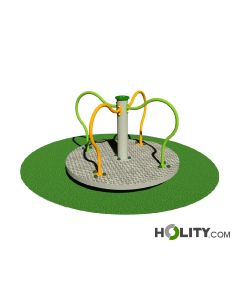
Playground carousel. Dimensions: Ø124.5 x 84 h. Number of users: 4 children.
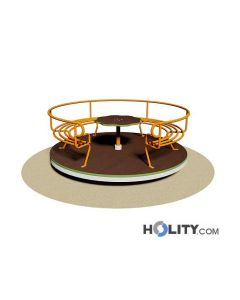
Roundabout merry-go-round for playground. Ø 175x70 h cm. 8 seats. test
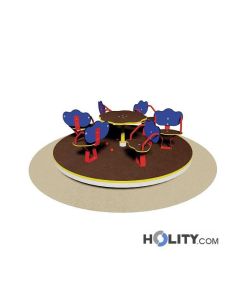
Roundabout carousel for playground with 6 seats. Suitable for children aged between 2-8 years.
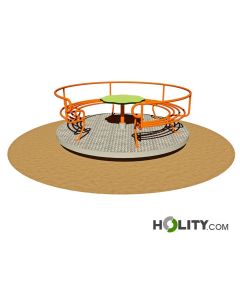
Roundabout with aluminum platform. Dimensions: Ø175xh.70 cm.
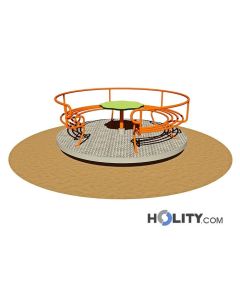
Rotating merry-go-round for playgrounds, with bench seat and aluminum platform. Suitable for 8 users.
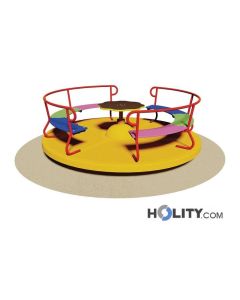
Merry-go-round for playground. For 10 users. Suitable for children with disabilities.
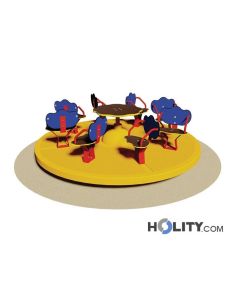
Merry-go-round for playground, with 8 seats. Weight 36 Kg.
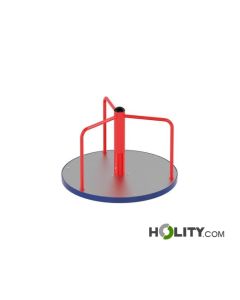
Roundabout for parks with supporting column in round steel tube. Dimensions: W. 120 x L. 120 x H. 85 cm.
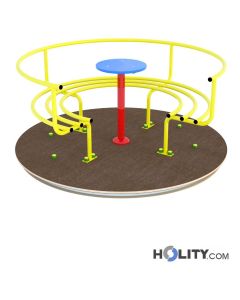
Rotating carousel in galvanized steel, for public parks and school gardens. Dimensions: Ø138 x 73 cm.
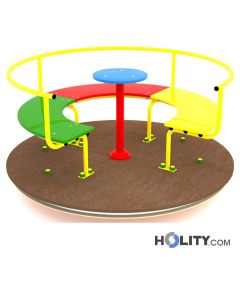
Rotating carousel for furnishing outdoor spaces of schools and nurseries. Designed for use by up to 5 children. Dimensions: Ø138 x 73 cm
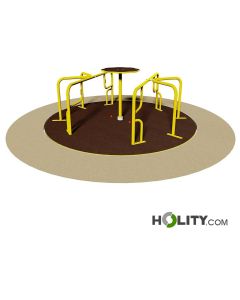
Inclusive carousel for 6 users. Maximum overall dimensions: Ø 240 x h. 83 cm. EN 1176 certified.
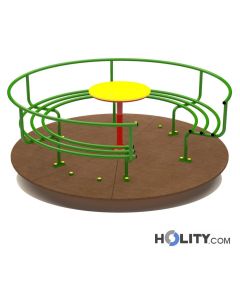
Rotating carousel for setting up school gardens or public areas. Material: wood and galvanized steel. Dimensions: Ø180 x H73 cm
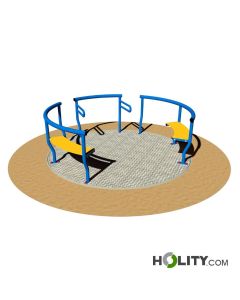
Rotating roundabout for public spaces. Age of use: 3-12 years. Maximum dimensions: Ø203 x h. 64 cm
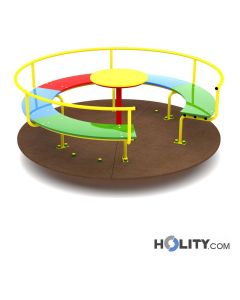
Roundabout for furnishing playgrounds and outdoor gardens of schools and playrooms. Dimensions: Ø180 x H73 cm
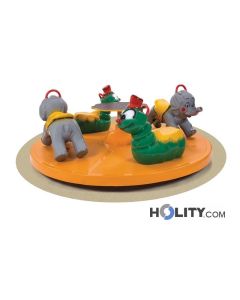
Playground carousel with character-shaped seats. 4 seats.
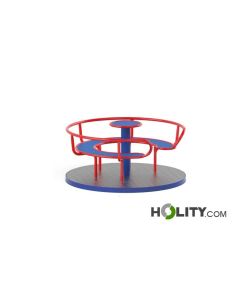
Rotating carousel for outdoor spaces with seats made of high-pressure polyethylene. Dimensions: W. 150 x L. 150 x H. 78 cm.
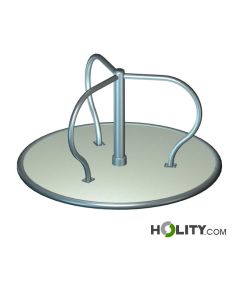
Spinning roundabout for playground. Dimensions: W.130 x D.130 x H.80 cm. Material: galvanized steel and aluminum.
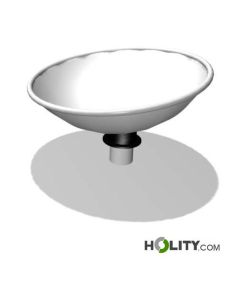
Roundabout suitable for children with disabilities. Dimensions: L.104 x D.104 x h.50 cm. For 2 users.
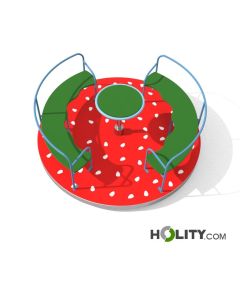
Strawberry-shaped rotating merry-go-round for public gardens. Dimensions: W.180 x D.180 x h.80 cm. No. of users: 8.
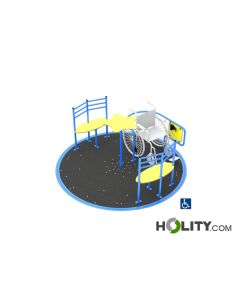
Accessible carousel for children, with wheelchair access for disabled children. Dimensions: Ø 225 x H 88 cm.
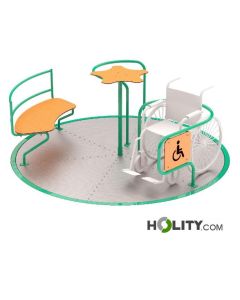
Inclusive roundabout with maximum number of 4 users. Age: 3-8 years. Dimensions: h 88 x Ø 225 cm.
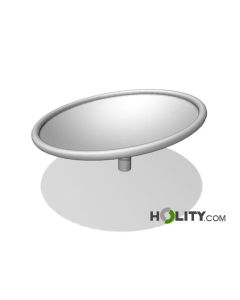
Inclusive rotating carousel for playgrounds. Dimensions: W.155 x D.155 x h.60 cm. Material: steel.
Roundabouts represent a fundamental element in the furnishing of public parks, school gardens, and play centers, offering children a play experience that combines rotary movement and structural safety. These devices, made of resistant materials such as galvanized steel, aluminum, and treated wood, are designed to withstand intensive use and external weather conditions, ensuring durability over time. The choice of a roundabout depends on multiple factors: number of users, target age group, available space, and accessibility requirements. Modern playground roundabouts meet strict international standards, in particular the EN 1176 standard, which ensures protection from impacts and correct ergonomic design for pediatric users.
Having a quality roundabout in a public space does not only mean providing entertainment, but investing in structures that promote motor activity, the development of balance, and social interaction between children of different ages. The variability of models, capacities, and configurations allows public administrators and educational facility managers to find customized solutions that adapt to specific budgets, spaces, and inclusive needs.
Roundabouts play a crucial role in children’s psychomotor development, stimulating the vestibular system and balance through controlled rotary movement. Unlike other static play equipment, the roundabout offers a dynamic experience that encourages coordination, body awareness, and courage in young users. In school contexts, these devices favor social integration as they allow multiple children to participate simultaneously, reducing waiting times and increasing engagement in group play. The circular structure of the roundabout allows for uniform weight distribution and minimizes the risks of accidental falls, especially when made with certified materials and equipped with integrated safety elements such as ergonomic handles and non-slip platforms.
From a management perspective, a well-sized roundabout represents an efficient investment: it requires limited periodic maintenance, occupies limited space compared to other complex structures, and guarantees decades of use with a simple annual mechanical overhaul. For public parks, the roundabout creates an attraction area that increases the flow of visitors and improves the perception of the quality of common spaces. In school environments and play centers, the absence of uncontrolled moving parts and ease of use make it particularly suitable for non-specialized supervisors, reducing surveillance responsibilities compared to more complex equipment.
Playground roundabouts differ mainly in load capacity, number of seats, and construction materials. Entry-level models, sized for 3-4 children with diameters of less than 120 centimeters, are ideal for nurseries and small private gardens, characterized by construction simplicity and affordable prices. Intermediate versions, intended for 5-8 users with diameters between 140 and 180 centimeters, represent the most widespread solution in public school environments and municipal parks, offering a balance between capacity, footprint, and ease of installation. Large-format roundabouts, with diameters exceeding 200 centimeters and a capacity of 10+ children, are aimed at larger public spaces, theme parks, and high-traffic recreational facilities. As for materials, wood and steel versions combine natural aesthetics and durability, while almond-patterned aluminum and electro-galvanized steel structures guarantee reduced weight and extreme resistance to marine corrosion and atmospheric agents.
A special category is represented by inclusive roundabouts, explicitly designed for children with motor disabilities through facilitated access, spaces for wheelchairs, adjustable ergonomic seats, and reduced platform heights. Some models feature particular configurations such as puppet-shaped seats, full aluminum platforms for immediate drainage of rainwater, or mechanical locking systems to prevent excessive rotation. Construction variety also allows differentiation according to the climatic context: reinforced versions for areas with frequent snowfall, models with special painting for high-salinity coastal areas, or open structures for warm environments with better air circulation.
Selecting the most appropriate roundabout starts with quantifying the available space and estimating the number of children who will use it simultaneously. A practical rule consists of measuring the diameter of the roundabout and adding at least 1.5 meters of surrounding safety zone, as prescribed by EN 1176 standards, to ensure a space free of obstacles in case of falls. It is essential to consider the predominant age group: roundabouts intended for children aged 2-4 years require lower seat heights and smaller diameters, while structures for 5-12 years tolerate wider configurations and superior motor challenges. A frequent mistake is undersizing the capacity of the roundabout relative to the expected number of users, leading to waiting queues and frustration for young users. Evaluating maintainability is an often-overlooked aspect: checking the availability of original spare parts, the simplicity of access to mechanical components (bearings, pins, screws), and the presence of technical documentation in English or multiple languages facilitates periodic inspection operations.
If the installation will take place in coastal or industrial areas with a saline atmosphere, opting for aluminum or steel structures with hot-dip galvanizing treatment is essential, as wood and painted steel would undergo accelerated deterioration. For school environments with moderate budget constraints, wood and steel models represent a compromise between cost and longevity, provided the wood is subjected to specific treatment against fungi and insects. The presence of EN 1176 certification and CE marking is not only legally mandatory but constitutes an objective guarantee of compliance with international safety tests, including stability checks, impact resistance, and absence of sharp parts. Finally, consulting the supplier’s technical office on color customization options, access for children with disabilities, and future upgrade possibilities allows for conscious and future-proof choices.
The design, manufacture, and installation of roundabouts for public parks are governed by the European standard UNI EN 1176, divided into multiple parts dedicated to different categories of play equipment. This standard imposes analytical specifications on material strength, free fall heights, critical gap spaces (to avoid trapping fingers and small objects), and zoning of the underlying impact surface with specific materials such as vulcanized rubber or compacted sand. Compliance with safety directives requires that each roundabout be subjected to dynamic and static load tests, stability checks with unevenly distributed weights, and controls on the accidental reversibility of movements. Regarding installation, local regulations (regional and municipal) may add specific requirements for project documentation, the need for a qualified site manager, and foundation soil stability checks.
The civil and criminal liability of the facility manager is covered by specific insurance, usually linked to the scheduled maintenance cycle and documentation of periodic inspections. Most standards require at least biennial reviews for public use structures, with technical reports compiled by specialized personnel. Regarding inclusive accessibility, specific national regulations and regional guidelines prescribe that roundabouts in public or school contexts must provide solutions usable by children with motor, hearing, or visual disabilities, according to universal design principles. Certification marks such as ASTM F1487 (American standard) and CE marking represent proof of compliance, although European legislation prioritizes the EN 1176 standard as the primary technical reference for public procurement.
Explore all products in the category and compare the available solutions to find the one best suited to your operational context. Our catalog covers a complete range from small-format roundabouts to inclusive structures for large-scale public parks, supporting schools, administrations, and recreational facilities in conscious selection.
A playground roundabout is a circular play structure featuring a rotating platform on a central ball bearing, manually activated by children pushing it. Movement is controlled and decentralized through seats or bars arranged radially, allowing multiple children to participate simultaneously. The structure is anchored to the ground by concrete foundations or metal sockets.
The capacity varies from 3-4 children for compact models (110 cm diameter) up to 10-12 for large-format versions (225+ cm diameter). Each model displays the maximum certified capacity on the technical plate. It is fundamental to respect the limit to ensure structural stability and safety during use.
Hot-dip galvanized steel and almond-patterned aluminum represent the most durable materials in outdoor environments, lasting up to 20-30 years with ordinary maintenance. Wood treated with antifungal agents guarantees 10-15 years if subjected to annual inspection. For coastal or brackish areas, favor electro-galvanized steel with duplex treatment or anodized aluminum.
The fundamental standard is UNI EN 1176, which prescribes technical specifications for safety, materials, and dimensions. Additionally, inclusive accessibility regulations must be respected, and local municipal requirements verified. The roundabout must be CE certified and provided with a manufacturer’s conformity report.
Yes, there are inclusive models specifically designed with facilitated access, wheelchair spaces, adjustable ergonomic seats, and reduced platform heights. These versions comply with universal design principles and allow for the participation of children with motor disabilities. Always check the inclusive certification on the product documentation.
The EN 1176 standard prescribes a minimum safety zone of 1.5 meters beyond the perimeter of the roundabout, including the maximum free fall path. A 180 cm diameter roundabout therefore requires a total free space of at least 480 cm in diameter. Always verify the calculations in the technical documentation specific to the chosen model.
Ordinary maintenance includes monthly visual inspection (structural integrity, absence of rust), semi-annual technical review of the central bearing and anchoring screws, and a full annual check by a specialist. Roundabouts with heavy public use require quarterly lubrication of the central pin and replacement of the impact surface if degraded.
 English
  Italian
 French
 German
 Spanish