
mon-fri 9-13 / 14.30-18.30
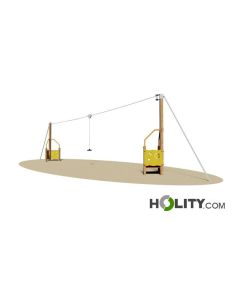
Inclusive playground cableway consisting of 2 vertical posts, 1 steel cable and 1 wooden platform. Dimensions: L. 1330 x W. 110 x h. 324 cm.
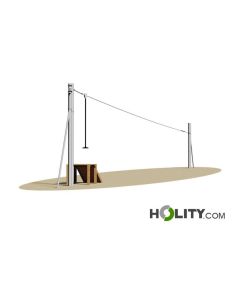
Hot-dip galvanized steel zip line play equipment for children. 2 vertical posts, 1 steel cable, 1 platform. Age of use: 5 - 12 years.
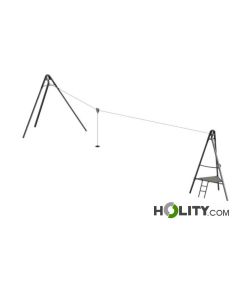
Zip line play equipment for children and teenagers. Dimensions: W.4000 x D.350 x h.350 cm. Cable length: 30 m.
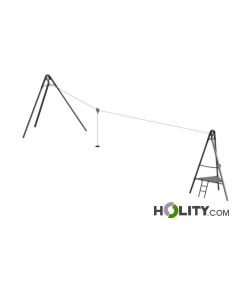
Zip line for children’s park. Dimensions: L.2500 x W.400 x h.350 cm. Safety area: 196 sqm.
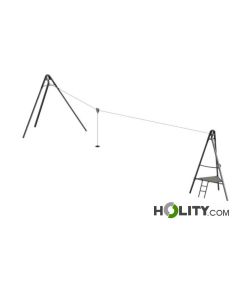
Children’s zip line with 25 m cable. Dimensions: L.3000 x D.400 x h.350 cm. Safety area: 231 sqm.
Playground zip lines represent one of the most engaging attractions in public and private play areas, offering children a suspended movement experience that combines safety, fun, and psychomotor development. These devices, consisting of high-resistance steel cables, support structures, and start-finish platforms, allow young users to experience the sensation of controlled flight, while stimulating confidence and motor coordination. Zip lines constitute a versatile solution adaptable to different contexts: public gardens, theme parks, school areas, recreational facilities, and residential communities. Their design follows rigorous European safety standards, ensuring structural stability and protection against fall risks through certified components and materials tested over time.
Installing zip lines in a play area brings tangible benefits from both a recreational and child development perspective. The zip line game stimulates balance, proprioception, and controlled courage, allowing children to face small physical challenges in a safe and monitored context. The sensation of moving suspended in space activates complex sensory processes, favoring vestibular integration and the reinforcement of self-confidence. From a management point of view, zip lines require limited space compared to other attractions (such as trampolines or multi-play compositions), making them ideal for medium-sized parks or areas with surface constraints. Their maintenance is relatively simple: galvanized steel cables resist atmospheric agents, while structures in laminated wood or treated steel guarantee multi-year durability with reduced maintenance interventions.
In contexts of inclusion, dedicated zip lines represent an important pedagogical tool, allowing even children with different motor abilities to participate actively. Starting and arrival platforms can be designed with access ramps, making the experience accessible to users in wheelchairs or with reduced mobility. Furthermore, the management of user flow is easy: a zip line can accommodate one child at a time, with predictable and controllable transit times by operators. This aspect makes zip lines particularly appreciated in school contexts, where safety and order are priorities.
The catalog of playground zip lines is divided into various configurations, mainly differentiated by cable length, construction material, and platform complexity. Laminated wood zip lines represent the most traditional and widespread solution, characterized by vertical pillars in solid wood subjected to protective treatments with high-penetration impregnating agents. This type of construction offers a natural aesthetic, well integrated into green environments, and maintains excellent thermal insulation properties (wood surfaces do not heat up like steel in summer months). Lengths typically vary from 13 meters (compact models for small spaces) up to 40 meters, with useful flight heights that generally do not exceed 3.5 meters to ensure anti-trauma protection proportionate to the potential fall. Galvanized steel zip lines, on the other hand, offer a lighter but extremely robust structure, particularly suitable for high-traffic parks or particularly aggressive climates (coastal areas, very humid environments).
The choice between wood and steel is not merely aesthetic: laminated wood absorbs vibrations better, offering a “softer” experience to children, while steel guarantees reduced maintenance and the absence of splintering. Some models include rubber seats or side safety nets, while others maintain the essential configuration of cable and platform. Starting platforms can vary: simple elevated walkways, structures with integrated steps, or ramps for assisted access. The length of the cable also determines the surmountable height difference and the necessary safety area; zip lines with 25-30 meter cables require spaces of at least 196-231 square meters, while shorter ones adapt to restricted areas. Many managers choose combinations of zip lines of different lengths to satisfy varying age groups (from 3-4 years up to 12+ years).
The selection of the most appropriate zip line requires a preliminary assessment of the dimensions of the available space, the prevailing age group of the users, and the environmental context. The first step consists of measuring the available length and the total surface of the park: if the space is less than 150 square meters, a compact zip line of 13-15 meters is more functional; for surfaces exceeding 200 square meters, 25-40 meter models with long cables guarantee a more rewarding experience and engage users more in a sensation of prolonged “flight”. The age group is critical: zip lines intended for children aged 3 to 6 must have flight heights not exceeding 2 meters and cables of maximum 10-15 meters, as the psychological impact of height is significant in this range. Children aged 7 to 12 tolerate heights up to 3.5 meters and lengths of 25-30 meters well, developing controlled adrenaline sensations. The material of the structure depends on the local climate: in humid, coastal areas or areas with high temperature excursions, galvanized steel minimizes maintenance interventions; in contexts with snowy winters, laminated wood, by retaining less surface moisture, is more manageable.
A frequent error is undersizing the safety area surrounding the path: EN 1176 regulations require lateral protection margins and stopping zones that must be covered by safety flooring or synthetic grass of adequate thickness (usually 40-60 cm for flight heights of 3.5 meters). Furthermore, many managers forget to evaluate access to starting platforms: for inclusive or school contexts, preferring models with ramps rather than narrow stairs greatly facilitates management. Finally, consider the expected user flow: a zip line accommodates one child at a time, with transit times of 20-30 seconds; if attendance is massive, providing multiple zip lines or successive station systems (where the child descends and starts again from a nearby platform) optimizes the overall experience.
All zip lines intended for public playgrounds in Europe must comply with the EN 1176 standard (Playground equipment and surfacing), which specifies design criteria, materials, test methods, and installation requirements. In particular, the EN 1176-5 standard regulates cableways, imposing strict limits on free flight height, fall zones, distances from fixed obstacles, and characteristics of the steel cable (minimum diameter, breaking load, percentage elongation). The breaking load of the cable must be at least 12 times the maximum weight of the user plus that of the equipment, guaranteeing substantial safety margins. Impact-attenuating surfaces must possess shock absorption properties verified according to the EN 1177 standard (Impact attenuating playground surfacing - Determination of critical fall height), with minimum depth and restitution coefficient calibrated based on the potential fall height. Each zip line must undergo an initial inspection before commissioning, followed by periodic checks (monthly, semi-annually, annually) to verify the state of the cable, the structural integrity of the pillars, the functionality of the pulley mechanisms, and compliance with the safety zones.
Regarding operational safety, the standard requires clear instructions for use (in the local language, accompanied by universal pictograms) displayed on the structure itself. It is mandatory to calculate the maximum free fall height (defined as the vertical distance between the lowest point of the user’s path and the attenuating surface below), which determines the thickness of the required safety flooring. In the Italian context, playground zip lines fall under the category of “amusement equipment” and must have CE marking, technical construction documentation, material test reports, and a certificate of conformity. Furthermore, in public parks, it is the responsibility of the managing body to carry out a site-specific risk assessment, draft a maintenance manual, and designate personnel trained for periodic monitoring. Unauthorized structural modifications by the manufacturer are prohibited, as is the use of non-original components for repairs.
Explore all the products in the category and compare the available solutions to find the one best suited to your operational context. Contact our technical team for support in choosing dimensions, assessing the necessary space, and verifying regulatory compliance for your specific project.
A playground zip line is a piece of play equipment consisting of a steel cable stretched between two vertical pillars, a sliding trolley (pulley), and a seat or platform for the child. The user holds onto the cable or sits on the seat, departs from the starting platform and, thanks to gravity and the low-friction trolley, slides suspended to the arrival platform, simulating the sensation of flight.
Modular zip lines accommodate children from 3 to 12 years old, with specific configurations: compact models for 3-6 years (heights 2 meters, cables 10-15 meters), and standard models for 7-12 years (heights 3.5 meters, cables 25-40 meters). The age group depends on the cable length and the psychological impact of the height.
Laminated wood offers a natural aesthetic, landscape integration, thermal insulation (it does not heat up in the sun), vibration absorption, and greater sensory comfort. Galvanized steel requires less maintenance, is ideal for humid or coastal climates, and guarantees superior durability in high-traffic environments.
The minimum space depends on the cable length: compact models require 100-150 square meters, while 25-40 meter zip lines need 196-231 square meters to accommodate the surrounding safety zone, impact-absorbing flooring, and lateral protection margins according to the EN 1176 standard.
Annual maintenance includes cable inspection, trolley verification, structural check of the pillars, and review of the safety flooring (approximately 2-4% of the initial cost). Steel zip lines reduce costs compared to wood, which requires paint touch-ups and impregnating agent every 3-5 years.
Yes, inclusive zip lines feature wheelchair access ramps, wide starting platforms, and supports for users with reduced mobility. However, the ability to hold onto the cable is fundamental; children with grip deficits require specialized aids or continuous supervision.
The EN 1176 standard is binding in Europe; each zip line must have CE marking, construction documentation, material test reports for the cable, and a certificate of conformity. For Italian public parks, a site-specific risk assessment and a maintenance manual drafted by the managing body are also required.
 English
  Italian
 French
 German
 Spanish