mon-fri 9-13 / 14.30-18.30
Furniture for barracks and prisons represents a specialized category of equipment destined for environments that require high standards of resistance, safety, and operational functionality. These are design solutions that must respond to very specific needs: guaranteeing durability in high-use contexts, facilitating hygiene and cleaning procedures, maintaining order and control, and protecting structural integrity even in stress situations. From the choice of materials to the ergonomic configuration, every element must comply with stringent regulations and quality standards that reflect the critical nature of these institutional environments.
Military and penitentiary structures operate in contexts where the reliability of furniture is non-negotiable: common areas, dormitories, service rooms, and administrative areas require solutions that integrate structural solidity, ease of maintenance, and, when necessary, additional security features. The conscious choice of furniture compliant with these requirements reduces early replacement costs, minimizes organizational inconveniences related to frequent breakdowns, and contributes to the general well-being of the occupants, both personnel and guests of the facility.
Selecting furniture specifically designed for barracks and prisons brings a series of tangible advantages that go beyond the simple acquisition of furniture. These products are conceived for high-occupancy environments, where natural wear and tear is accelerated and maintenance needs require specific protocols. A barracks bed, for example, is not just a place to sleep: it is a reinforced metal structure, designed to withstand repeated stress and at the same time easy to sanitize according to military hygiene protocols. Similarly, armored cabinets do not merely represent a storage space, but security systems that protect personal items, sensitive documentation, and valuable materials, while simultaneously reducing the risk of internal theft or accidental damage.
In prison environments, structural robustness is directly linked to the operational safety of the penitentiary staff. Furniture compliant with the specific requirements of these contexts facilitates visual control of spaces, minimizes vulnerability points that could be exploited for vandalism, and reduces the need for frequent corrective interventions that divert resources from core activities. In military dormitories, robust beds and compliant cabinets create an orderly environment that supports organizational discipline and improves the structure’s logistical efficiency. In barracks with administrative functions, resistant and suitable office furniture contributes to reliable document management and an atmosphere of operational professionalism.
The catalog of furniture for barracks and prisons includes differentiated solutions depending on the specific function of the space and the required security levels. Beds for barracks and prisons constitute the most representative category: usually made of galvanized steel or certified solid wood, they feature reinforced structures, high-capacity support boards, and are designed to facilitate daily cleaning without the risk of dirt accumulation in corners. Dimensions meet international standards for institutional dormitories, and many models include integrated drawer units or under-bed storage spaces. Armored or semi-armored cabinets constitute another crucial type: equipped with reinforced cylinder locks or key-controlled duplicate systems, they offer differentiated protection according to the value and sensitivity of the materials to be stored.
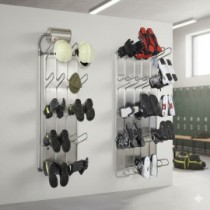
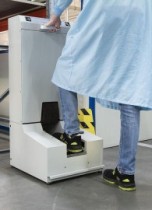
Other specialized solutions include professional boot washers, particularly relevant in military contexts where tactical material (boots, equipment) requires rapid and standardized sanitization, and professional shoe dryers, which reduce drying times and preserve material integrity. Benches, refectory tables, seating systems for classrooms, and common spaces are made with antimicrobial or easily sanitizable materials. Administrative areas include desks, sterile cabinets, bookcases, and modular dividers. The cross-cutting characteristic of all these types is the priority on cleanliness and hygiene: wood treated with specific paints, stainless steel where contact with water is frequent, and surfaces free of crevices or cavities where dust and bacteria could accumulate.
The choice of furniture for barracks and prisons cannot ignore an accurate assessment of the specific operational context. First and foremost, it is essential to precisely identify the function of the space to be furnished: a barracks houses dormitories (where structural resistance and hygiene are priorities), administrative offices (where a combination of functionality and institutional aesthetics is needed), refectories (where ease of cleaning and the ergonomics of the canteen service prevail), and training areas (where the versatility and mobility of furniture can be decisive). In the penitentiary field, further variables come into play: the security level of the section (entailing the need for anti-sabotage furniture), the number of occupants per cell (determining dimensions and configurations), and the rotation frequency of staff and inmates (affecting the need for standardization).
A frequent mistake consists in choosing furniture based on the initial price without considering the maintenance and replacement costs in the medium-to-long term. An inexpensive but low-quality military bed may require repairs every 18-24 months, while a model compliant with standards involves higher initial investments but lower total costs over a five-year cycle. Similarly, armored cabinets made with lightweight steel and non-certified locks offer an apparent economy that quickly translates into security vulnerabilities and the need for costly upgrades. Organizational sustainability factors must also be included in the evaluation: materials requiring specialized maintenance rarely available on-site increase downtime. Consulting the specific regulations in force in your jurisdiction and verifying that suppliers have appropriate certifications is an essential, not optional, practice.
Furniture for barracks and prisons must comply with a complex regulatory framework that varies significantly depending on whether the structure is military or penitentiary, and according to the national jurisdiction. In Italy, prison facilities are regulated by the Department of Penitentiary Administration and must comply with standards defined by ministerial circulars and international guidelines such as the United Nations Minimum Standard Rules for the Treatment of Prisoners. As for barracks, standards are defined by the Ministry of Defense and include both structural resistance and fire safety requirements. At the European level, Directive 2014/30/EU on electromagnetic compatibility and Directive 2014/35/EU on the safety of electrical equipment concern furniture equipped with powered components. Beds, cabinets, and seating must pass specific load tests (for example, for military beds, load capacity from 150 to 250 kg depending on the configuration).
Recurring aspects in the regulations include the fire resistance of coatings (class B-s2, d0 for high-density spaces like dormitories and cells), the non-toxicity of materials and paints (Ecolabel certification or equivalent), the ease of cleaning and disinfection (surfaces free of niches where bacteria could proliferate), and in the penitentiary field, the prevention of the use of furniture as tools for self-harm (rounded edges, absence of protrusions, materials that do not shatter into sharp shards). Armored cabinets in detention environments must pass resistance tests against burglary and tampering. Many certified suppliers can provide documentation of compliance with specific UNI, EN, or ISO standards for each product, a practice strongly recommended during the acquisition phase.
Explore all the products in the category and compare the available solutions to find the one best suited to your operational context, considering the needs for durability, safety, hygiene, and regulatory compliance that characterize environments such as barracks and penitentiary institutions.
Galvanized steel and stainless steel represent the most reliable choices: they offer high corrosion resistance, are easily sanitized, and are very difficult to damage intentionally. Certified solid wood can be used if treated with antimicrobial paints and if the structure does not have metal components that could be detached. Avoid laminated wood or MDF which deteriorate rapidly in humid environments.
Armored cabinets must pass burglary resistance tests, have reinforced cylinder locks (minimum security class 3 according to EN 1303), be constructed with steel sheets at least 1.5 mm thick, and have continuous welds on the joints. Certifications from recognized bodies (for example, VdS tests or equivalent) are strongly recommended for high-criticality environments.
Military furniture emphasizes standardization, ease of movement, and modular configuration to support frequent exercises and reassignments. It prioritizes resistance to transport and wear from repeated movement. Civilian furniture has greater aesthetic and ergonomic flexibility, but in contexts like hospitals or public offices, it maintains strict requirements for hygiene and durability, albeit with generally less stringent security constraints.
Times vary based on the level of customization and the required certifications. Standard products with basic certifications take 4-6 weeks from order confirmation. Furniture built to specification (for example, armored cabinets with a particular configuration or beds with non-standard dimensions) require 8-12 weeks. Volume orders for entire institutions may involve time negotiation.
Military beds have more robust support structures (capacity 150-250 kg), solid wood planks or continuous metal sheets, and more secure mattress fastening systems to avoid displacement during rapid movements. Hospital beds emphasize manual or electric adjustment of inclination and facilitate access by medical staff. Both require ease of cleaning, but the usage patterns and structural stress differ significantly.
The supplier should have ISO 9001 certification (quality management), CE declaration of conformity for products (where applicable), and specific certifications related to load, fire resistance, and fire safety. For armored cabinets, certifications from independent third-party bodies (VdS, iBB or national equivalents) attesting to burglary resistance are essential. Verify that the supplier is able to provide complete technical documentation and test reports.
 English
  Italian
 French
 German
 Spanish