
mon-fri 9-13 / 14.30-18.30
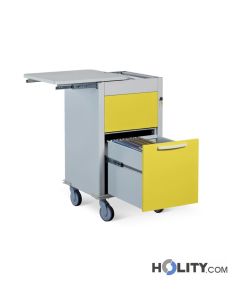
Medical record trolley for ward rounds. Equipped with 1 hanging file drawer. Dimensions: 670x630xh.1070 mm.

Ward round trolley for hospital facilities. Equipped with two large sliding drawers. Dimensions: W 770 x D 600 x h 1070 mm.

Ward round trolley with steel structure, 3 drawers and compartment for a maximum capacity of 20 charts. Dimensions: W67 x D63 x H107 cm.

Folder trolley with 1 X-ray folder drawer, 2 drawers for objects or documents and 1 PC drawer. Dimensions: W70 x D50 x H95 cm

Ward round trolley for hospital facilities with swivel doors. Dimensions 670x600x h.1090 mm
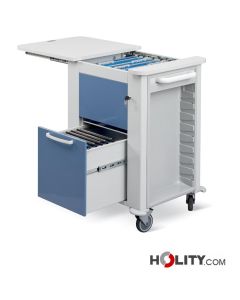
Medical ward round trolley with sliding lid and 3 drawers.
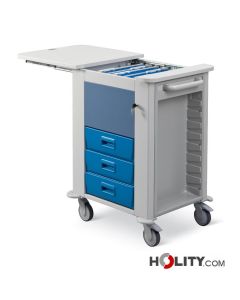
Ward round trolley with suspended folder drawer with sliding lid.

Ward round trolley with drawers for medical records. Dimensions: 655x605xh970 mm
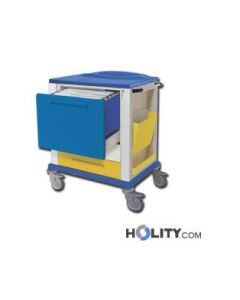
Medical record and X-ray plate trolley for documents of various formats. Dimensions: 820 x 640 x h 1000 mm

Hospital medical record trolley. Capacity: 25+25 folder holders. With 2 drawers. Dimensions: W.82 x D.64 x h.115 cm.
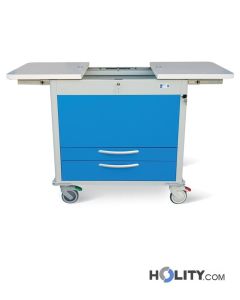
Ward round trolley for hospitals and clinics with lockable drawers. Dimensions: W103 x D65 x H95 cm
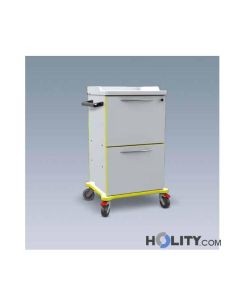
Medical record trolley for hospitals and nursing homes equipped with 2 drawers. Dimensions: W.70 x D.64 x h. 104 cm
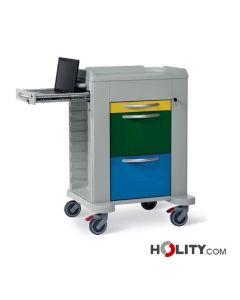
Medical record trolley with drawers and pull-out shelf. Dimensions: 750x650xh.1060 mm
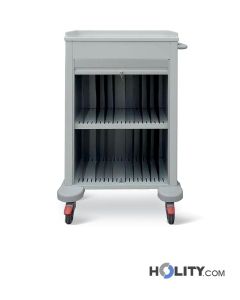
Ward round trolley with worktop and 2 chart holder compartments closable with a sliding roller shutter. Dimensions: W90 x D60 x H140 cm
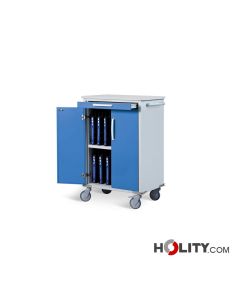
Ward round trolley complete with drawer and medical record compartment. Dimensions: 1000 x 650 x H.1200 mm.

Folder trolley with 2 compartments and a total capacity of 43 folders. Dimensions: W100 x D65 x H120 cm

Chart trolley with 1 drawer and 1 compartment with hinged doors.
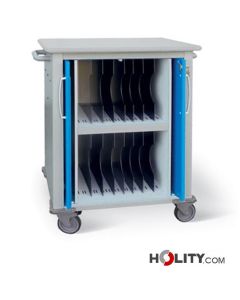
Medical record trolley in painted steel. W.1000xD.600xH.1100 mm
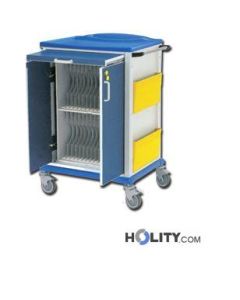
X-ray film holder trolley with 32 pull-out compartments. Dimensions: 820 x 640 x h 1,200 mm

Medical records trolley. Dimensions: 655x605xh.970 mm

Hospital rounds trolley with 2 shelves. Material: aluminum and plastic. Dimensions: W83 x D65 x H110 cm.
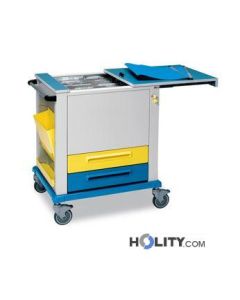
Medical record trolley for A3, A4 and other formats. Dimensions: 820 x 640 x h 1000 mm
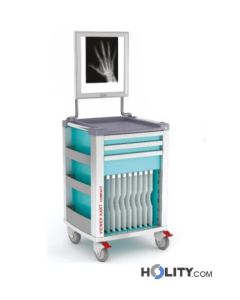
Medical chart trolley with negatoscope.
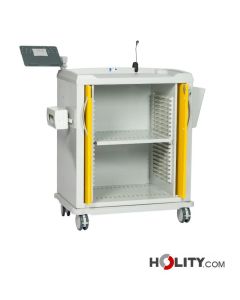
Trolley for clinical records and files in anodized aluminum. Tablet holder platform.
Medical record trolleys represent an essential solution in healthcare environments, where the orderly management of medical documentation is fundamental for operational efficiency and quality of care. These devices, commonly used during ward rounds in hospitals, clinics, and specialist centers, allow for the transport and organization of patients’ medical records in a systemic and easily accessible way. A well-structured medical record trolley reduces documentation search times, minimizes patient identification errors, and supports the medical workflow during outpatient visits. The choice of the correct type depends on the specific needs of the healthcare facility, the size of the rooms, the volume of records to be managed, and the type of documentation (paper, X-rays, digital media).
The use of a medical record trolley guarantees tangible benefits in the organization of healthcare services. First and foremost, the centralization of medical documentation during ward rounds allows healthcare personnel to have all the necessary information under control without having to interrupt the care cycle to retrieve files. Furthermore, these trolleys facilitate compliance with data security and confidentiality procedures, as the documentation remains contained in lockable compartments or protected by doors, reducing the risk of loss or unauthorized consultation. In facilities with high patient turnover, such as internal medicine, geriatrics, or surgery departments, the trolley becomes a tool that accelerates the medical visit and improves continuity of care among different healthcare operators.
From a practical point of view, medical record trolleys favor the ergonomics of medical and nursing work. Operators do not need to make continuous trips to centralized archives, saving time and reducing physical fatigue. Many models include additional support surfaces, drawers for frequently used instruments, and specific compartments for diagnostic media such as X-rays, which transforms the trolley into a multifunctional mobile workstation. This aspect becomes particularly relevant in facilities where medical personnel move frequently between different departments, where the provision of fixed documentation supports would be insufficient or impractical.
In the medical record trolleys catalog, it is possible to identify various configurations, each responding to specific operational needs. The most common models include trolleys with lockable sliding drawers, available in configurations of two to three elements, designed to hold standard format records. Other models feature open compartments or revolving doors, ideal for contexts where quick access to records is prioritized over documentation privacy protection. There are also notable functional specializations: some trolleys integrate X-ray film holders, designed for diagnostic or surgery departments; others include support surfaces for tablets and laptops, responding to the growing need for integration between paper documentation and hospital computer systems. The choice between these models must take into account both the specific dimensions of the documentation (A3, A4, mixed formats) and the required capacity, which can vary from 20 to over 50 records per trolley.
From a construction point of view, the most common materials are painted steel, for robustness and ease of sanitization, and anodized aluminum, for lightness without loss of strength. The choice of material impacts both the durability and the maneuverability of the trolley, a non-negligible aspect when movement between departments occurs frequently. Some models include wheels of different sizes and stabilization structures, influencing the ease of movement on different types of flooring (tiles, carpet, metal grids). The limits of the category lie mainly in dimensional rigidity: a record trolley remains a physical object that occupies space, a critical factor in facilities with restricted rooms, where alternative solutions such as fixed cabinets or vertical shelving might be preferable. However, the intrinsic mobility of the trolley offsets this limit in contexts where flexibility of use is a priority.
The selection of a medical record trolley requires a preliminary assessment of fundamental parameters. First of all, it is necessary to determine the average volume of records moved during a ward round, which varies significantly between departments with low attendance (where 20-25 records are sufficient) and high-density patient facilities (which require capacities up to 50 records). A recurring error consists in underestimating this assessment, generating the need for multiple trolleys or frequent trips to archives. The second critical aspect is the available space: the overall dimensions of the trolley (generally between 650 mm and 1000 mm in width, by 950-1200 mm in height) must be compatible with corridors, elevators, and examination rooms. A third element concerns documentation formats: if the facility manages exclusively standard A4 records, compact models are adequate; if, on the other hand, X-ray films, A3 format reports, or possibly hybrid media are present, it is necessary to opt for models with specialized compartments.
Further considerations must include the required degree of privacy protection: if the documentation contains sensitive data and the trolley circulates in public access areas (e.g., outpatient clinics open to the public), lockable drawers are essential; in internal ward contexts, open models may be more practical. Structural robustness and materials deserve attention: environments where the frequency of sanitization is high (surgery, intensive care) benefit from stainless steel or anodized aluminum, while in contexts with lower infection risk, painted steel is more economically advantageous. A common mistake consists in prioritizing exclusively the initial cost while neglecting the operational life: a lower quality trolley that requires frequent maintenance or premature replacement represents a higher total cost in the long term. Finally, consulting the nursing and medical staff who will use the trolley daily is fundamental to avoid purchases that do not correspond to the actual operational procedures of the facility.
Medical record trolleys, as devices used in healthcare environments, must meet security and quality requirements defined by European and national standards. The main reference standard is UNI EN ISO 9001, which governs the quality management systems of manufacturers, ensuring consistency and reliability. At the same time, structural safety requirements relating to stability, the resistance of drawers and support surfaces, and the prevention of accidents (such as accidental tipping during use) must be respected. In the European context, medical-healthcare devices are subject to CE marking, which certifies compliance with specific product safety directives. Regarding sanitization, materials and surfaces must be compatible with cleaning and disinfection protocols common in hospitals, without corrosion or degradation that compromises long-term efficiency.
From the point of view of data confidentiality, trolleys with key locks must guarantee controlled access to paper documentation, an increasingly relevant aspect with the introduction of the General Data Protection Regulation (GDPR). Some facilities also require specific certifications relating to fire resistance of materials or compatibility with environments with high radiation exposure (in the case of radiology departments). The size of the wheels and the stabilization structure must comply with maneuverability standards for hospital environments, in order to avoid damage to fixed structures (walls, doors) or risks to patients and operators. It is advisable to verify with the supplier the availability of additional certifications if the healthcare facility operates according to specific protocols (JCI accreditation, particular quality management models, regional protocols). The compatibility of the trolley with the movement systems of the trolleys themselves (warehouses, specialized elevators) must be verified beforehand to avoid logistical incompatibilities.
Explore all the products in the category and compare the available solutions to find the one best suited to your operational context. Each model has been developed considering the specific needs of hospitals, clinics, and specialist centers, with a focus on organizational efficiency, documentation security, and long-term durability.
Dimensions vary depending on the model, typically between 650-1000 mm in width, 600-650 mm in depth, and 950-1200 mm in height. Compact models are ideal for tight spaces, while wider trolleys guarantee greater capacity and stability. Check compatibility with the facility’s elevators and corridors before purchasing.
Capacity varies from 20 to over 50 records depending on the configuration. Models with 2-3 drawers hold an average of 20-30 standard A4 records, while configurations with multiple compartments and shelves reach 43-50 units. Evaluate the average daily patient volume before choosing the model.
Stainless or painted steel and anodized aluminum are preferred materials for hospital environments with a high infection risk. Both tolerate daily cleaning and disinfection procedures well without corrosion. Avoid porous materials that accumulate germs and are difficult to fully sanitize.
Yes, some models include support surfaces and specific holders for tablets and laptops, facilitating integration with hospital computer systems. This feature is particularly useful in facilities using digital medical records in combination with paper documentation.
Lockable drawers guarantee confidentiality and protection of sensitive documentation, essential if the trolley circulates in public areas. Open compartments allow for faster access to records, preferable in internal ward contexts where documentation remains under the control of medical personnel.
The trolley must be stable, resist the distributed weight of the records, have drawers that do not slide out unintentionally, and wheels that ensure controlled movement. It must comply with UNI EN ISO standards on stability and prevention of accidental tipping, certified by the manufacturer’s quality certifications.
Yes, specific models called “X-ray holders” integrate pull-out compartments dedicated to X-rays. These trolleys allow for the organization of standard medical records along with films in various formats, optimal for diagnostic departments, radiology, and surgery where documentation is multimedia.
A ward round trolley is specifically designed to accompany doctors during visits, with drawers for records, support surfaces for instruments, and stable surfaces for notes. A generic record trolley can also be used as a mobile archive. The ward round trolley emphasizes quick accessibility and operational multifunctionality.
 English
  Italian
 French
 German
 Spanish