
mon-fri 9-13 / 14.30-18.30
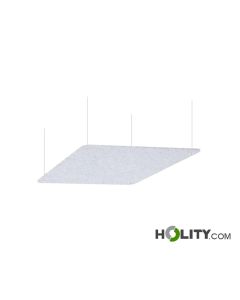
70x70 cm ceiling acoustic panel in recycled polyester fiber. 1.8 cm thickness, printable surface, and quick cable installation.
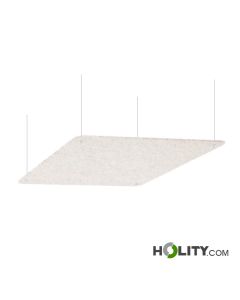
Sound-absorbing panel in recycled polyester fiber (150x50 cm) for ceiling suspension with cables. Technical and customizable indoor solution.
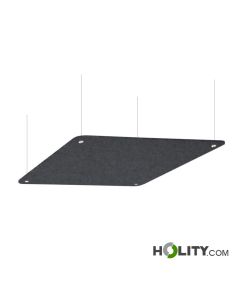
H738_192 ceiling-mounted sound-absorbing panel in recycled polyester fiber, 100x100 cm. Installation with cables and optional custom printing.
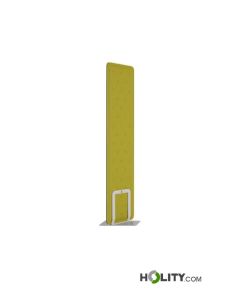
Sound-absorbing panel in recycled polyester and Trevira CS, 160x40 cm. Double-sided B-s2,d0 certified structure with self-supporting metal base.
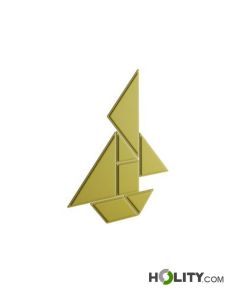
Single-sided sound-absorbing acoustic panel, 0.81 m², wall installation with brackets included. Modular design for offices and professional environments.
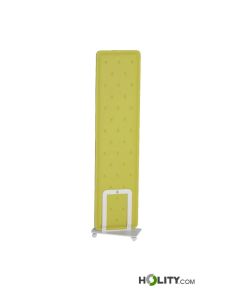
Double-sided acoustic panel in recycled polyester fiber (180x40 cm) with wheeled base. Fire-retardant certified mobile solution for office.
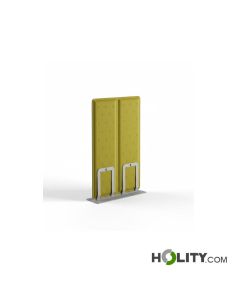
Double sound-absorbing panel in recycled polyester (100x80 cm) with metal base. Quick pressure mounting ideal for open space offices.
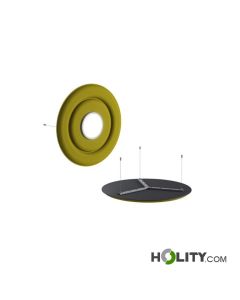
Suspended circular sound-absorbing panel with integrated 24W LED, Ø 90 cm. Technical solution in ultra-light material for acoustics and lighting.
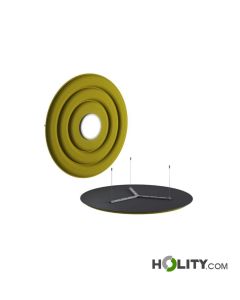
Circular sound-absorbing panel Ø120 cm with integrated 24W LED lamp. Hybrid solution in technical material for acoustic and lighting comfort.
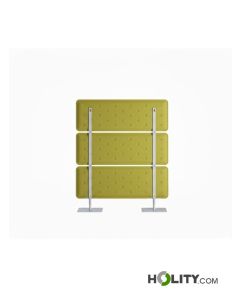
Self-supporting sound-absorbing partition with 3 recycled polyester fiber panels. Dimensions W 140 x H 137 cm. Fire-retardant certified structure.
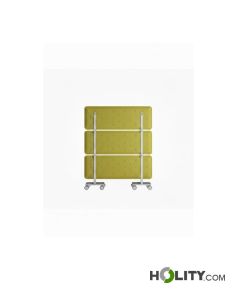
Mobile acoustic divider with 3 recycled polyester panels (160x120cm total), wheeled base and B-s2,d0 fireproof certification for open space offices.
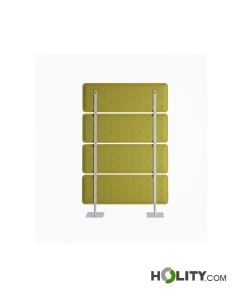
Modular sound-absorbing partition with 4 recycled polyester panels, W 140 x H 179 cm. Certified solution for acoustic privacy in offices.
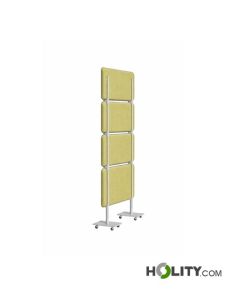
Mobile sound-absorbing divider in recycled polyester, 4 panels of 140x40 cm, height 179 cm. Certified solution for professional open spaces.
The integration of acoustic correction systems represents a fundamental asset in the design of modern environments, where psychophysical well-being and operational efficiency are strictly linked to sound quality. Sound-absorbing panels are not merely decorative elements, but technical devices designed to mitigate the phenomenon of reverberation, reducing unwanted sound reflections that compromise speech intelligibility and increase indoor noise pollution. In professional contexts such as open-space offices, conference rooms, restaurants, or healthcare facilities, sound energy management becomes an essential functional requirement to ensure concentration and privacy.
Our selection includes cutting-edge solutions that combine high absorption performance with a refined design, allowing a structural limitation to be transformed into a significant aesthetic opportunity. Choosing a high-quality acoustic module means investing in the durability of materials and the precision of absorption coefficients, parameters that define the product’s actual capacity to intervene on the specific critical frequencies of any environment. Through the use of innovative textile technologies and mineral or polymeric fiber cores, these products offer a targeted response to the challenges of contemporary architecture, where rigid surfaces such as glass and concrete tend to exacerbate acoustic issues.
Every acoustic remediation project requires a careful analysis of volumes and intended uses, as the distribution of the panels directly affects the distribution of the sound field. The versatility of wall-mounted, ceiling-mounted, or freestanding configurations allows for capillary action even in existing buildings, without the need for invasive or expensive structural interventions. The correct arrangement of sound-absorbing elements ensures a harmonious environment, where sound is controlled and modeled to promote user comfort and the elegance of workspaces and reception areas.
The adoption of sound-absorbing surfaces responds to the technical need to control reverberation time, which is the time required for a sound to decay by 60 decibels after the source has stopped. In closed environments characterized by reflective materials, sound waves continue to bounce off the walls, creating a chaotic overlap that makes words difficult to understand and generates constant auditory stress for occupants. The installation of professional sound-absorbing panels allows sound energy to be captured rather than reflected, transforming the friction of the sound wave within porous materials into infinitesimal thermal energy.
This physical process not only improves acoustic clarity but also drastically reduces the cocktail effect, the phenomenon where people are led to raise their voice volume to overcome background noise, fueling a vicious cycle of increasing disturbance. In the HoReCa sector, for example, correct acoustic treatment determines the success of a venue, directly influencing the length of stay of customers and the perception of service quality. An acoustically cared-for environment communicates professionalism and attention to detail, elements that translate into an increase in the perceived value of the structure and an improvement in the work performance of internal staff.
Beyond the technical function, modern panels offer significant advantages in terms of architectural flexibility, often serving as spatial dividers or furnishing elements that define the visual identity of an office or waiting room. The ability to absorb noise also reflects positively on long-term health, preventing cognitive fatigue and headaches typical of noisy work environments. Investing in certified sound-absorbing solutions therefore means opting for a strategy of prevention and optimization of human resources, guaranteeing a serene and productive internal climate that respects the highest standards of environmental comfort required by modern building and sustainability certifications.
The landscape of sound-absorbing panels is vast and diversifies mainly based on absorption technology and the installation method planned for the project. Wall-mounted panels represent the most common and versatile solution, ideal for covering large surfaces and interrupting lateral reflections that disturb the horizontal sound field. These can be made with rigid frames covered in acoustic fabric or thermoformed materials that allow for three-dimensional geometric shapes, increasing the surface area exposed to the sound wave and improving the effectiveness of the treatment even at medium-low frequencies.
Ceiling solutions, which include vertical baffles and horizontal islands, exploit the portion of volume usually unused to achieve homogeneous acoustic correction without occupying vital space on the walls or floor. Baffles, in particular, are extremely effective in large industrial environments or sports centers thanks to the double exposed surface, while islands offer an elegant design and can integrate LED lighting systems to combine technical functionality and luminous furniture.
For dynamic spaces that require frequent reconfiguration, freestanding partition panels or acoustic totems offer maximum operational freedom, allowing for the creation of temporary privacy zones within open spaces or lounge areas. There are also specialized variants such as micro-perforated wood panels, which combine the warm aesthetic of natural material with the acoustic properties of calibrated holes, and recycled polyester fiber panels, which guarantee a low environmental impact and high resistance to humidity, making them suitable even for school canteens or high-traffic public environments. Each type is designed to meet specific absorption needs, allowing designers to modulate the intervention based on the density and thickness of the material used.
The selection of the ideal sound-absorbing panel must not be based exclusively on aesthetics, but on a rigorous evaluation of technical parameters relative to the volume of the room and the type of activity carried out. The main criterion is the acoustic absorption coefficient ($\alpha_w$), a value between 0 and 1 that indicates the material’s ability to dissipate sound energy; the closer the value is to unity, the greater the effectiveness of the product. It is essential to identify whether the problem mainly concerns high frequencies, typical of the human voice, or low frequencies, related to machinery or ventilation systems, as the thickness and density of the panel affect the range of frequencies treated.
A common mistake is to confuse sound absorption with sound insulation: sound-absorbing panels are used to improve the internal acoustics of a room, not to prevent noise from entering or leaving from the outside. To avoid incorrect purchases, it is necessary to calculate the amount of absorbing surface needed using Sabine’s formula, avoiding over-saturating the environment which would risk becoming acoustically "dead" and unnatural. The choice must also take into account ease of maintenance and the resistance of fabrics to wear and sunlight, especially in highly exposed offices or public places where frequent cleaning is necessary to maintain hygiene standards.
In professional contexts, modularity is a critical factor: opting for systems that allow for future additions guarantees the scalability of the investment as the company grows or furniture layouts change. Attention must also be paid to the quality of the fixing systems, which must ensure stability and safety over time, avoiding accidental detachments that could compromise user safety. Evaluating the context of use also means considering the visual impact: in a formal meeting room, neutral tones and clean lines will be preferred, while in a creative area, you can play with bright colors and geometric compositions to stimulate team energy and collaboration.
The safety and reliability of sound-absorbing materials are regulated by stringent international standards that certify their compatibility for use in public and professional spaces. One of the most critical requirements concerns the reaction to fire, governed by the European standard EN 13501-1; panels intended for offices, schools, and hotels must generally possess a Class B-s1, d0 certification, which guarantees low participation in fire, reduced smoke emission, and the absence of flaming droplets. The use of non-certified products in these settings exposes owners to serious civil and criminal liability in the event of inspections or accidents.
In addition to fire safety, the ISO 354 standard establishes the methods for measuring acoustic absorption in a reverberation room, providing objective data that allows for transparent comparison of performance between different manufacturers. It is equally important to verify compliance regarding volatile organic compound (VOC) emissions, especially for panels installed in closed and poorly ventilated environments. Class A+ certification or the absence of formaldehyde and airborne fibers ensures that the product does not compromise indoor air quality, protecting the respiratory health of occupants in the long term.
In public tenders and eco-sustainable designs, minimum environmental criteria (CAM) often require that materials contain a minimum percentage of recycled matter and are themselves recyclable at the end of their life, promoting a circular economy in the technical furnishing sector. Compliance with these standards is not just a bureaucratic obligation, but a guarantee of construction quality that distinguishes professional solutions from amateur or decorative products. Ensuring that the chosen panels are accompanied by detailed technical data sheets and test certificates issued by accredited laboratories is the first step towards responsible design in compliance with current workplace safety laws.
Explore all the products in the category and compare available solutions to find the one best suited to your operational context.
Sound-absorbing panels are designed to reduce reverberation and echo inside a room, improving internal sound quality. In contrast, sound-insulating materials are used to prevent noise from passing between two distinct environments or to the outside by acting as a mechanical barrier to the transmission of sound energy.
The quantity depends on the volume of the environment and the materials present, such as glass walls or marble floors. Generally, it is recommended to cover a surface equal to 20 or 30 percent of the floor area. Technical advice based on current reverberation time allows for the precise calculation of the number of modules required.
Optimal positioning involves installing panels at the points of first sound reflection on the side walls and ceiling. In offices, it is useful to place them at ear height near workstations or noise sources to immediately intercept the sound wave and prevent it from propagating through the rest of the environment.
Modern acoustic panels made of polyester or covered in technical fabric require minimal maintenance, limited to removing dust with a soft-nozzle vacuum cleaner. Many models are water-repellent and stain-resistant, but it is essential to avoid using aggressive solvents that could damage the fibers or compromise the material’s fire-retardant properties.
Yes, there are several non-invasive installation solutions, such as panels with self-supporting bases or models equipped with high-strength adhesive strips specifically for smooth surfaces. These options are ideal for rented offices or historical buildings where permanent intervention on original wall structures is not permitted.
Professional products are made with hypoallergenic materials and are free from volatile fibers like unprotected rock wool. Certifications for low emissions of formaldehyde and volatile organic compounds guarantee that indoor air remains healthy, making them suitable for prolonged use in schools, hospitals, and offices without any risk to the respiratory tract.
 English
  Italian
 French
 German
 Spanish