
mon-fri 9-13 / 14.30-18.30
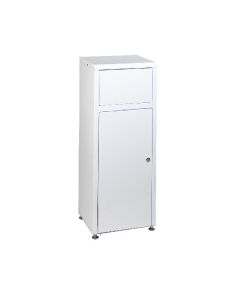
Tray clearing bin in white painted metal, swing door, 50L capacity, ideal for fast food and pizzerias.
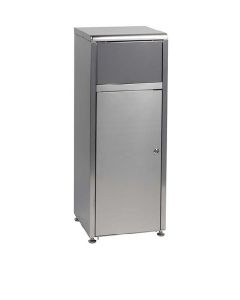
Satin stainless steel tray-emptying bin 50L, swinging flap, reversible door with triangular lock, adjustable feet. Fast food and catering.
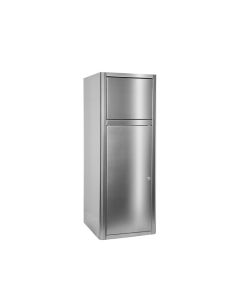
Satin-finished stainless steel tray emptying bin, 60 liters, swing lid and door with key lock, height 100 cm. For self-service, canteens and HoReCa.
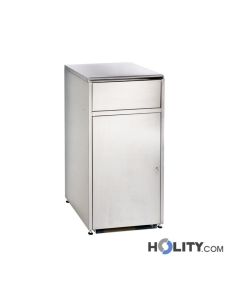
Tray clearing bin in AISI 430 stainless steel with flap door, reversible bottom door and tray holder shelf. Capacity 120 liters, height 122 cm.
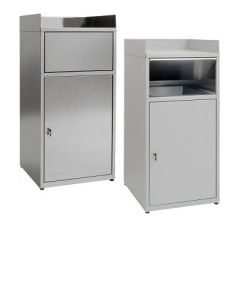
Professional tray clearing bin h11101 in stainless steel or zinc-plastic coated sheet metal. Swing door, top shelf with rim, lockable compartment. L. 60 x D. 60 x h. 120 cm. Optional: rubber wheels.
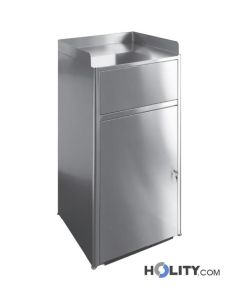
Professional tray emptying bin 260 lt in satin stainless steel, with swinging door, tray holder rail, keyed door and adjustable feet. Suitable for catering.
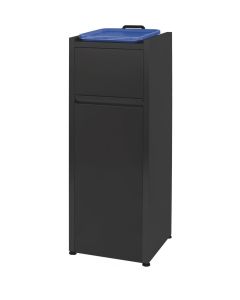
110-liter tray emptying bin, black painted steel, with tray storage edge and mobile magnetic wheels. For fast food and self-service.
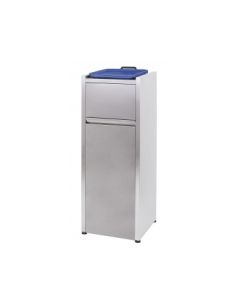
Stainless steel tray emptier with flap door, 110 lt capacity, ideal for fast food and public establishments. Internal trolley on wheels for easy management.
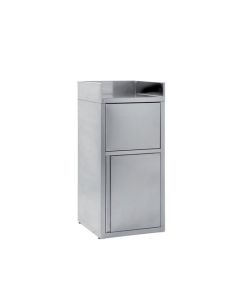
Tray discharge hopper with 150 mm raised top, swinging door and hinged door. Ideal for canteens, fast food and self-service.
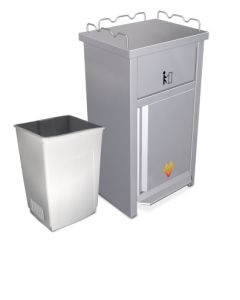
Stainless steel tray emptying bin with pedal opening, 55L, wheels and adjustable feet. Ideal for catering self-service.
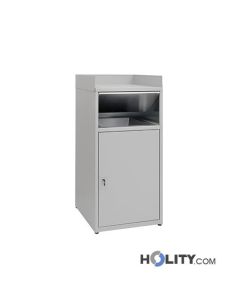
Plastic-coated galvanized sheet metal tray waste bin with swing door, locking bag-holder door and tray-stop shelf. 80 liters, 60x60x120 cm.
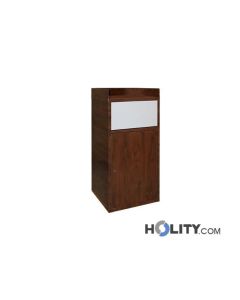
Self-service tray-emptying waste bin in plastic-coated galvanized sheet metal, tilting flap, 80 liters, 60x60x120 cm, walnut/wengè finishes.
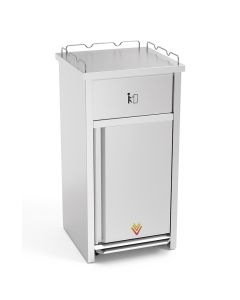
Stainless steel tray emptying bin with pedal, tray shelf, wheels and adjustable feet. Container capacity 500x510x740 mm.
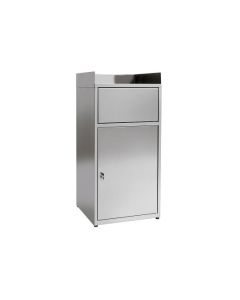
AISI 430 stainless steel tray emptying bin with top shelf and swinging door, 60x60x120 cm, ideal for fast food and self-service.
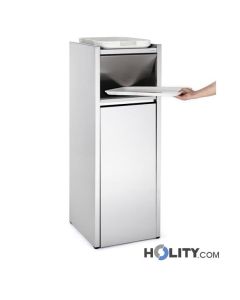
110 lt tray emptying bin, stainless steel, swinging door, shaped top for trays, ideal for self-service and fast catering.
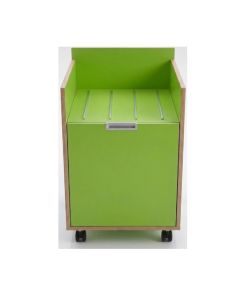
Laminated wood tray collection bin, height 75 cm. Customizable design module for fast food and schools, ideal for recycling islands.
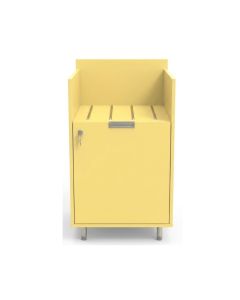
Design tray and waste collection module in laminated wood. Versatile and customizable solution for fast food, integrable into recycling islands.
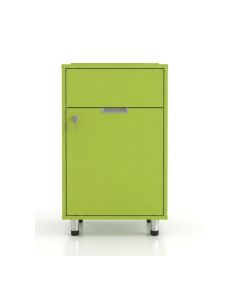
h684_146 waste bin with liquid drain for fast food. Made of customizable laminated wood, modular and ideal for creating recycling stations. Dimensions: 550 x 600 x 909 mm.
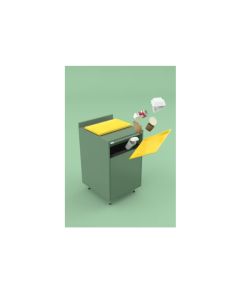
Waste and tray collection bin h684_144 in laminated wood for self-service. Customizable design with swing lid.

Design waste bin in laminated wood with top hole, height 75 cm. Ideal for fast food and schools, customizable and modular in islands.
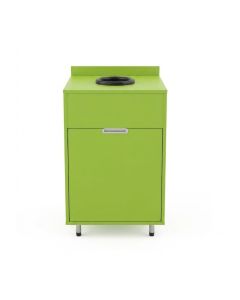
Fast food waste bin h684_145 in laminated wood with top opening. Customizable, modular design ideal for dining and self-service areas.
Tray emptying bins represent an essential solution for waste management in self-service catering, fast food, and school canteens. These specialized containers facilitate the simultaneous disposal of trays, tableware, and food waste, reducing operational steps and improving service efficiency. Made from durable materials such as stainless steel, zinc-plastic coated sheet metal, or polyethylene, tray emptiers guarantee hygiene, durability, and practicality in high-traffic environments. Their design allows customers to deposit waste quickly and neatly, keeping common areas clean and reducing the aesthetic impact of traditional waste management systems.
Adopting a tray emptying bin allows for significant streamlining of waste disposal operations in self-service and fast food areas. Unlike traditional systems, these containers allow customers to dispose of trays, cutlery, tableware, and food waste simultaneously, eliminating the need for multiple trips to different bins. This improves service flow, reduces clutter in public spaces, and cuts cleaning time for staff. Environments remain more orderly, and sanitary control becomes easier, as all waste flows into a single controlled destination.
From an operational standpoint, a well-sized and strategically positioned bin reduces waste management costs and limits the manual handling of bulky materials. Furthermore, investment in superior quality containers results in fewer maintenance interventions and greater equipment longevity over time, translating into concrete economic savings for facilities with high customer volumes.
Tray emptying bins differ mainly based on construction material, volumetric capacity, and opening mechanisms. AISI 304 or AISI 430 stainless steel models represent the most hygienic and corrosion-resistant solution, ideal for humid and high-traffic environments. These containers offer a satin or polished finish and guarantee a long operating life, even under frequent cleaning conditions. Zinc-plastic coated sheet metal models provide an economical alternative while maintaining good hygiene standards, available in various colors to match interior decor. A third category includes polyethylene containers, which are lighter and more manageable, particularly suitable for settings where container mobility is an important requirement.
Regarding access mechanisms, the vast majority of models use a front swing door, which keeps the container closed when not in use and facilitates emptying. Some professional models feature a lower compartment with a key lock to ensure greater hygienic safety. Capacities also vary considerably: from 50 litres for compact models up to 260 litres for cabinet solutions for large volumes. The choice of type depends on the dimensions of the available space, the number of covers managed, and the operating budget allocated for waste management.
Selecting the appropriate tray emptying bin requires evaluating first the number of daily customers and the type of service offered. A university self-service with 500 covers per day will need a higher capacity than a school canteen for 200 people. As a rule of thumb, a capacity of at least 50-80 litres is recommended for every 100 estimated covers during peak service. The physical placement of the container significantly affects system effectiveness: it must be near the exit or tray return area, well-signposted, and easily accessible without creating obstacles to pedestrian flow.
Another critical factor concerns the maintainability of the chosen model. Stainless steel containers, while representing a higher investment, require lower maintenance costs and guarantee superior hygiene, a decisive factor in environments where sanitary control is strict. If space is limited, 50-litre compact models can be placed side-by-side, or cabinet solutions integrating bag storage and waste disposal compartments can be chosen. It is important to verify that the material is easily cleanable with standard sanitization systems and that the feet are adjustable to ensure stability on uneven floors.
Waste management for non-domestic users is regulated by Legislative Decree 152/2006 (Environmental Code), which establishes obligations for separate collection and correct management of organic waste. Bins intended for contact with food must be constructed of materials compliant with Regulation (EC) No 1935/2004 and must not release harmful substances during use. In collective catering, Regulation (EC) 852/2004 on food hygiene requires that waste management systems be separate from food preparation and storage areas, as well as providing for regular cleaning and disinfection.
At the municipal level, many administrations impose specific standards for public self-service areas, including mandatory separate collection requirements. It is advisable to check with the relevant local authority if the chosen model falls within the authorized standards for the facility. Furthermore, where the container is in open or semi-open spaces, it is necessary to comply with thermal insulation and pest protection standards. The choice of a certified supplier and recording routine maintenance ensures regulatory compliance and protection in case of health and safety inspections.
Explore all products in the category and compare the available solutions to find the one best suited to your operational context. From volumetric capacity to materials, from aesthetics to daily practicality, our catalog offers diversified options for every type of catering service.
A tray emptying bin is a specialized container intended for the simultaneous disposal of trays, tableware, and food waste in self-service environments. Operation is simple: the customer deposits the tray full of waste into the upper opening, usually protected by a swing door, and the content slides inside. The container remains closed when not in use, maintaining hygiene and the orderly appearance of the area.
For a service with 300 daily covers, a capacity of at least 120-150 litres is recommended if collection occurs during service, or 200 litres for continuous service. If space is limited, two 80-100 litre containers can be installed strategically, avoiding excessive waste accumulation during peak hours.
Stainless steel, particularly AISI 304, is superior for hygiene and durability: it resists corrosion, is easily sanitized with steam and aggressive detergents, and has a longer operating life. Zinc-plastic coated sheet metal represents an acceptable economical alternative for less critical environments but requires more frequent maintenance and has lower longevity.
The swing door automatically closes the container after use, limiting odors, insects, and waste dispersion. The open hole is less hygienic, constantly exposes the content, and complicates cleaning of the surrounding areas. For professional environments, the swing door is always preferred.
Yes, it is possible, but with specific precautions. Weather-resistant materials should be chosen (preferably stainless steel), the container should be placed in a shaded area, equipped with a waterproof lid, and ensure drainage for liquids. In areas with frequent rain or extreme temperatures, maintenance becomes more demanding and the choice of closed models is mandatory.
The frequency depends on the service volume: in an average self-service with 400-500 covers, a 110-litre container fills approximately every 1.5-2 hours during peak service. It is advisable to check the level every hour during high-traffic periods to avoid overflows and maintain the order of the area.
A quality stainless steel bin has minimal routine maintenance costs, mainly daily cleaning and occasional lubrication of the swing mechanisms. Zinc-plastic coated sheet metal models require more frequent checks to verify paint integrity. Generally, annual maintenance costs are less than 1-2% of the purchase price for correctly managed systems.
Many modern models are designed with separate compartments or can be paired with specific containers for different waste fractions. If the service requires mandatory differentiation (plastic, paper, organic), it is advisable to install multiple dedicated bins nearby, clearly marked, or choose modular systems that integrate multiple sections into a single structure.
 English
  Italian
 French
 German
 Spanish