
mon-fri 9-13 / 14.30-18.30

Green polypropylene reflective road marker. High-visibility indicator with adhesive backing, resistant to loads up to 20 t. Dimensions: W 10 x D 10 x H 2 cm.
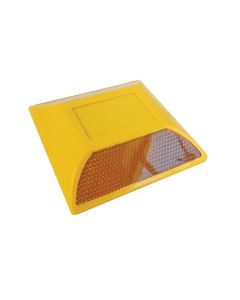
Reflective road marker in yellow polypropylene. High-visibility reflector for area delineation, 20 t capacity. Dimensions: W 10 x D 10 x H 2 cm.
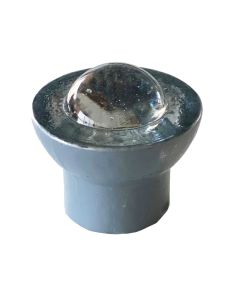
Road stud insert in tempered glass (Ø50 mm). Retroreflective reflector compliant with EN 1463, 30 t capacity, underground or base installation.
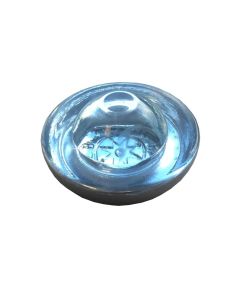
Recessed tempered glass road stud (Ø100 mm). Reflector compliant with EN 1463, 30 t load capacity, ideal for permanent night visibility.
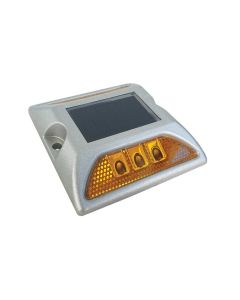
Orange solar LED road stud (105x105 mm). High resistance aluminum, visibility 500 m, IP68 protection and 30 t capacity for roads and parking lots.
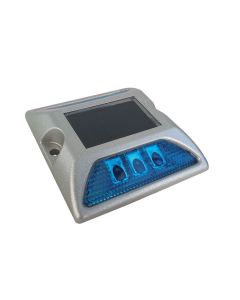
Solar-powered blue LED road indicator (105x105 mm). Aluminum signage with 500 m visibility, IP68 waterproof and 30 t load capacity for roads and schools.
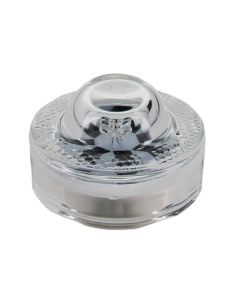
Recessed solar LED road stud (Ø101 mm). Visibility 800 m, load capacity 30 t, 100-hour battery life and dual light mode selectable via magnet.
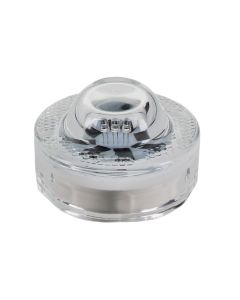
Solar LED road stud h972_163 in tempered glass (Ø101 mm). Visibility 800 m, 30 t capacity, 100-hour autonomy and dual light modes.
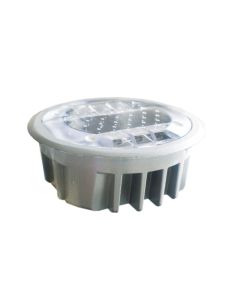
Recessed solar LED bollard (Ø135 mm) in aluminum. Flashing mode, 1000 m visibility, 50 t capacity, and IP68 protection for road safety.
Refractive road studs, commonly known as cat's eyes, represent one of the fundamental pillars of modern traffic safety, acting as passive or active signaling devices in low visibility conditions. These tools are not mere aesthetic accessories for the road surface, but technical devices specifically engineered to reflect vehicle headlight beams or emit autonomous light signals using LED and solar technology. The integration of these systems within road infrastructure allows for the surgical delineation of road margins, traffic dividers, and pedestrian islands, drastically reducing the risk of road departures during nighttime hours or in adverse weather events such as dense fog and heavy rain.
Their primary function lies in the ability to provide immediate visual feedback to the driver, allowing for earlier perception of road geometry that painted horizontal signage cannot always guarantee, especially when the asphalt is wet and reflective. The adoption of high-resistance materials, such as die-cast aluminum, reinforced polycarbonate, or tempered glass, ensures that these markers can withstand high pressure loads from heavy vehicle traffic while maintaining their optical properties over time. In a professional context of road and industrial area management, choosing the right road stud becomes a direct investment in accident prevention and traffic fluidity.
The effectiveness of road studs lies in their nature as high-contrast devices, capable of operating where traditional signage fails due to lack of light or chromatic degradation. Choosing to install professional cat's eyes means implementing an optical guidance system that increases road user reaction time, as the reflected or emitted light is visible at significantly greater distances than white strips applied to the asphalt. This competitive advantage in terms of safety is particularly evident on rural road sections lacking public lighting, where the stud acts as a continuous luminous guide, outlining dangerous curves, bumps, or lane narrowing that would otherwise remain invisible until the last moment.
Beyond public road safety, these devices find crucial applications in industrial and logistical contexts, where the delimitation of forklift paths, loading ramps, and storage areas requires durable and highly perceptible signage. Mechanical resistance is a determining factor: a professional-grade road stud is designed to withstand repeated impacts and tire passage without chipping or losing its optical orientation. This drastically reduces long-term maintenance costs compared to the continuous repainting of road markings, which tend to fade quickly under the mechanical action of vehicles and chemical agents such as de-icing salt or hydrocarbons.
Another fundamental benefit is the application versatility in architectural and urban furniture sectors, where cat's eyes can be used to enhance pedestrian paths, cycle lanes, or monumental entrances, combining technical functionality with a discreet and elegant design. In these cases, the marker does not only play a safety role but contributes to the hierarchy of open spaces, guiding the flow of people intuitively and harmoniously. The ability of these devices to function without any external power supply, in the case of retroreflective or solar models, represents a significant ecological and economic advantage, eliminating the need for complex wiring and reducing the energy impact of the infrastructure. The initial investment is amortized by the long operational life and the drastic reduction in accident rates in the installation areas.
The professional signaling equipment market offers a wide range of variants, each optimized for specific traffic loads and environmental conditions. The main distinction is between passive refractive studs and active LED studs. Passive models use internal prisms or glass microspheres to reflect headlight beams back to the driver; they are extremely reliable because they contain no electronic components and can be made of aluminum to withstand heavy vehicles or technical plastic for light traffic areas. There are also specific variants such as "unidirectional" markers, which reflect light only in one direction of travel, and "bidirectional" ones, ideal for centerlines on two-way roads where they must be visible from both traffic flows.
Alongside traditional models, we find solar road studs, equipped with small integrated photovoltaic panels and lithium batteries or capacitors. These devices are capable of emitting their own light during the night, ensuring visibility that can exceed 800 meters, regardless of the orientation of the vehicle's headlights. Within the category, products can also be distinguished based on the installation method: "surface-mounted" studs, which are fixed to the asphalt surface using two-component epoxy resins, and "recessed" studs, which require road surface coring to be housed flush or semi-recessed. The latter type is most suitable for areas subject to snowplow passage, as the body of the marker does not protrude excessively, avoiding being torn off by blades during clearing operations.
Functional differences also extend to the materials of the reflective surface: tempered glass offers maximum abrasion resistance and maintains transparency for years, while prismatic plastic films guarantee a very high initial refraction coefficient but require more frequent replacement in dusty or sandy environments. Even the color choice is not accidental: white is generally used for lane lines, yellow for road edges or temporary construction site signaling, and red or blue for specific uses such as emergency zone access or cycle paths. This differentiation allows designers to create a complex and immediately interpretable visual language, improving the overall readability of the operational context and reducing the cognitive load on the driver.
The selection of the ideal road stud must necessarily start from a rigorous analysis of traffic volume and the type of vehicles that will pass through the area. If the installation is planned for a high-traffic highway with frequent heavy truck transit, it is imperative to opt for high-resistance die-cast aluminum or solid tempered glass markers, preferably with recessed installation to maximize mechanical stability. Conversely, for company parking lots, private maneuvering areas, or pedestrian paths, high-quality polycarbonate markers, surface-fixed with technical adhesives, may be sufficient, offering an excellent compromise between cost and performance. A common mistake is underestimating the quality of the fixing resin: an excellent marker installed with an inadequate adhesive will eventually detach in a short time under the action of thermal expansion and mechanical stress.
Another decisive factor concerns the prevailing climatic conditions in the installation area. In areas subject to frequent fog, the use of solar LED cat's eyes is highly recommended, as active light can penetrate air density much better than simple passive refraction. Furthermore, compatibility with winter maintenance operations must be considered: if the road is cleaned regularly with snowplow blades, the only viable solution is the use of low-profile or fully recessed markers, which offer a minimal impact surface. Neglecting this detail inevitably leads to the total destruction of the signaling at the first passage of clearing vehicles, resulting in a useless waste of resources. The choice must therefore balance required visibility, expected road surface life, and ordinary maintenance methods.
Finally, it is essential to evaluate the certified refraction degree, often expressed in millicandela per lux. Not all markers reflect light in the same way: cheap products might appear bright up close but look dark at safety distances, defeating their primary function. Verifying that the product complies with slip resistance requirements is equally critical, especially if installed near pedestrian crossings or paths for cyclists and motorcyclists, where a surface that is too smooth could cause dangerous loss of grip in case of rain. Preliminary technical advice and the study of the manufacturer's safety data sheets allow for avoiding the purchase of items not compliant with current regulations or inadequate for specific environmental stresses, ensuring a solution that remains efficient for the entire life cycle of the road work.
The installation of road studs and cat's eyes must comply with rigorous national and international standards governing physical characteristics, photometric performance, and positioning methods. In the European context, the reference standard is often EN 1463, divided into several parts, which defines criteria for retroreflective road markers, classifying them based on their durability and ability to reflect light under different angles of incidence. These standards ensure that every device placed on the market possesses minimum compressive strength and that the materials used are not subject to rapid yellowing or degradation due to UV rays. CE marking compliance is an essential requirement for use in public works, as it certifies that the product has passed laboratory tests related to accelerated aging and mechanical strength under load.
In addition to the technical aspects of the product itself, local regulations and the Highway Code define where and how these devices can be applied. For example, there are specific rules on the spacing between markers based on the road speed limit and the radius of curvature of the road section. Using non-regulated colors or installing markers that protrude excessively from the road plane can constitute a violation of safety standards and lead to civil liability in case of accidents caused by component detachment or loss of vehicle control. It is therefore essential that signaling design be entrusted to expert technicians who know local restrictions and can integrate the studs harmoniously with existing horizontal signage, ensuring full legal compliance and maximum safety for all users.
Explore all products in the category and compare the available solutions to find the one best suited to your operational context.
The operational lifespan depends on the material and traffic volume, but generally, a professional aluminum or tempered glass marker guarantees optimal performance for a period of five to ten years. Solar LED models have a useful life linked to the internal battery cycle, which typically requires a review or replacement after about three to five years of continuous exposure.
Yes, these devices can be successfully installed on concrete, interlocking pavers, and even wood using specific adhesives such as epoxy resins or mechanical screw fixings. It is essential to ensure that the substrate is perfectly clean, degreased, and free of moisture before application to ensure the chemical bond is durable and resistant to atmospheric and mechanical stresses.
Passive markers require minimal maintenance, consisting mainly of periodic cleaning of the reflective surface to remove deposits of mud, dust, or tire rubber residue. In areas subject to high pollution, an annual check allows for verifying the integrity of the fixing and replacing any elements damaged by extreme accidental impacts or heavy road maintenance operations.
Modern solar road studs are designed with high-sensitivity photovoltaic panels that allow charging even in diffused light or cloudy skies. Thanks to the use of high-quality capacitors or lithium batteries, these devices store enough energy to guarantee operation for several consecutive nights, even during winter months with few hours of direct sunlight.
The difference lies mainly in the resistance to static and dynamic loads. Die-cast aluminum markers are designed for heavy road use and can withstand weights exceeding twenty tons without deforming. Plastic or polycarbonate markers are instead suitable for pedestrian paths, cycle lanes, or private areas where heavy vehicle transit is occasional, still offering excellent visibility and weather resistance.
Professional fixing usually involves the use of two-component epoxy resin or modified bitumen. For surface-mounted models, a precise amount of adhesive is applied to the base of the marker and to the road surface, which has been previously heated or treated. For recessed models, milling of the road surface is required, where the marker is then embedded in the resin, ensuring superior mechanical stability and total protection from lateral impacts.
Technical regulations specify that for roads open to high-speed traffic, the protrusion of the markers should not exceed certain thresholds, usually between 15 and 25 millimeters, to avoid excessive vibration to vehicles and mechanical damage. In areas where snowplow passage is expected, the use of low-profile models or those fully recessed at road level is recommended to ensure the safety of operations.
 English
  Italian
 French
 German
 Spanish