mon-fri 9-13 / 14.30-18.30
Setting up educational spaces for early childhood requires meticulous design that combines ergonomics, safety, and cognitive stimulation. Furniture for nurseries and preschools is not merely a collection of mobile items, but actual pedagogical tools that must support children in their journey toward autonomy and motor discovery. The choice of certified materials, free from harmful emissions and featuring rounded profiles, represents a fundamental requirement to guarantee a protected environment where play and learning can merge without structural risks.
Modern configurations for early childhood must meet criteria of extreme flexibility, allowing educators to reconfigure classrooms based on planned activities, whether they are moments of rest, creative workshops, or group activities. In this context, professional technical furniture stands out for its durability and resistance to intensive wear, maintaining its mechanical properties and aesthetics over time. Choosing high-quality solutions means investing in the health of young users and the management efficiency of the school facility, reducing maintenance and replacement costs in the long run.
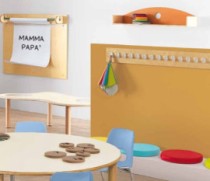
Investing in specific furniture for preschools is a decision that directly impacts the quality of the educational offering and daily operational safety. These products are designed following the anthropometric proportions of preschool-aged children, ensuring that tables and seating promote correct posture and prevent physical fatigue during prolonged activities. A well-organized environment with child-height storage modules encourages self-regulation and independent management of teaching materials—fundamental pillars of many modern educational methodologies that view space as a 'third teacher' capable of guiding social behavior.
In addition to the pedagogical aspect, constructive robustness plays a crucial role in preventing injuries within HoReCa or school structures. The use of plywood, high-density non-toxic plastics, and water-based paints ensures that every surface is easily sanitizable and resistant to chemical detergents, an indispensable factor for maintaining mandatory health protocols. The structural stability of lockers and changing units is designed to withstand dynamic loads and sudden stresses, offering management peace of mind that standard domestic furniture cannot guarantee in high-traffic professional contexts.
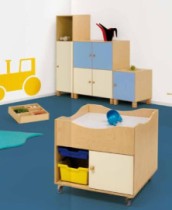
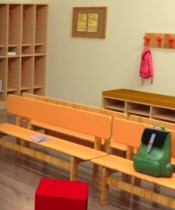
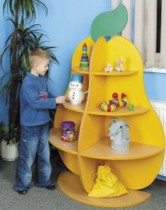
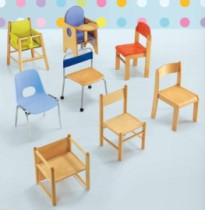
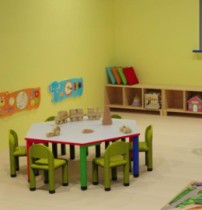
The range of furniture for early childhood is divided into several functional macro-categories, each intended for a specific area of the school or nursery. First, we find educational seating and tables, available in various heights regulated by European standards on dimensional sizes, often made of birch plywood or scratch-resistant colored polymers. Alongside these, storage systems play a vital role: open shelving units, drawer units on wheels with safety locks, and lockers for personal belongings, all characterized by the absence of sharp edges and the integration of anti-tip systems for total protection.
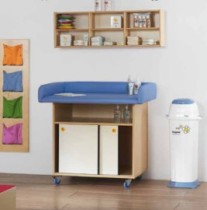
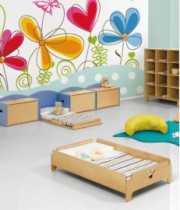
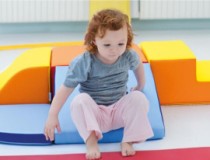
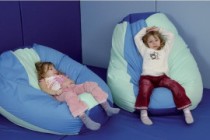
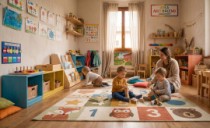
Another essential category concerns the rest and reception area, which includes stackable cots, fire-retardant mats, and changing units equipped with pull-out stairs to facilitate the work of operators without overstraining their spines. Not to be forgotten is the soft furniture for psychomotor corners, such as modular mats, tunnels, and large cushions in Class 1 IM certified eco-leather, fundamental for the development of motor skills in total safety. Each variant is designed to optimize available volumes, allowing even facilities with limited square footage to offer complete and functional services to the needs of children and teaching staff.
The selection of the ideal furniture must start from an accurate analysis of the intended use and the age of the end users. A common mistake is to purchase one-size-fits-all furniture for the entire facility, while it is essential to respect the dimensional scales (size 1, 2, or 3) established by technical standards to avoid postural problems. It is necessary to evaluate the ease of maintenance: in contexts where hygiene is a priority, laminated or plastic surfaces guarantee faster cleaning cycles compared to untreated solid wood. Furthermore, the modularity of the elements allows for the creation of dynamic configurations that follow the evolution of the class group throughout the school year.
Another critical factor concerns material certification: it is not enough for a piece of furniture to be aesthetically pleasing; it must possess technical documentation certifying low formaldehyde emissions and the fire-retardancy of padding. Professional buyers must pay attention to the hardware used, verifying that hinges and slides are equipped with soft-close systems to prevent finger pinching. Considering the initial investment in terms of the product life cycle helps to understand that apparently more expensive solutions actually offer real savings, thanks to their ability to withstand impacts, frequent washing, and continuous movement without structural deterioration.
School furniture is subject to rigorous safety standards defined at European and national levels, most notably UNI EN 1729-1 and UNI EN 1729-2, which regulate dimensions and safety requirements for chairs and tables. These standards ensure that the furniture promotes correct posture and limits the risk of entrapment or injury. In addition to dimensional compliance, it is essential that products meet fire reaction regulations, especially for textile components and mats, which must be classified as fire-retardant to comply with the fire prevention plans of public and private educational facilities.
Compliance with environmental and health regulations is equally stringent, with particular reference to the REACH Regulation for the absence of hazardous chemicals in plastic materials and paints. The presence of CE marking and certifications issued by accredited laboratories guarantees that every edge is rounded with a minimum radius of curvature and that the stability of tall furniture is verified against the risk of accidental tipping. School administrators and safety managers must always demand product technical data sheets, which certify that the fatigue and load tests required for collective use have been passed, thus ensuring a legally compliant work environment free of hidden risks for minors.
Explore all products in the category and compare the available solutions to find the one best suited to your operational context.
Heights follow the UNI EN 1729 standard. For preschools, size 1 is typically used with a seat at 26 cm and a table top at 46 cm, or size 2 with a seat at 31 cm and a table top at 53 cm, depending on the average height of the children.
High-pressure plastic laminate and birch plywood with water-based varnish are the best materials. These surfaces allow for deep and frequent disinfection without absorbing moisture or releasing toxic volatile substances, ensuring a healthy environment that is easy for staff to manage daily.
Yes, for furniture intended for children's collective use, it is essential to provide wall fixing for all storage units that exceed a certain height or are unstable. This prevents the risk of tipping if children were to climb on the shelves or open all drawers simultaneously.
A professional mat must be made of high-density expanded polyurethane with a washable eco-leather cover and certified Class 1 IM fire retardancy. It must be phthalate-free and equipped with an aeration system to ensure breathability and maximum comfort during children's afternoon sleep.
Compliance is verified through the presence of the manufacturer's technical documentation certifying that UNI EN tests have been passed. Visually, it is recognized by the absence of sharp corners, replaced by rounded edges, and by structural stability that prevents dangerous oscillations during intensive use in classrooms.
Modular furniture allows the educational space to be quickly transformed, adapting it to different methodologies such as group work or individual activities. Trapezoidal or semi-circular tables can be joined to create large work surfaces, optimizing room square footage and fostering social interaction among children.
 English
  Italian
 French
 German
 Spanish