
mon-fri 9-13 / 14.30-18.30
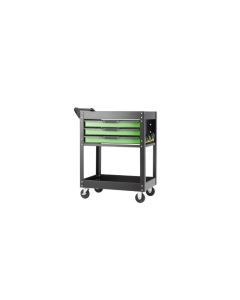
Workshop trolley with 3 drawers and lower and upper shelf. Dimensions: W. 77 x D. 45 x H. 94 cm.
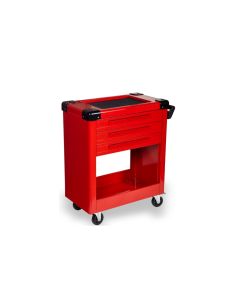
Red steel tool trolley with 3 drawers, handle and wheels Ø100 mm, load capacity 500 kg. Dimensions: W 90 x D 40 x H 80.4 cm.
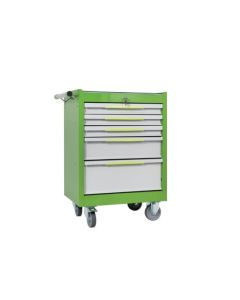
Workshop trolley with 5 drawers and a static capacity of 800 kg. Dimensions: W. 68 x D. 48.1 x H. 98.8 cm.
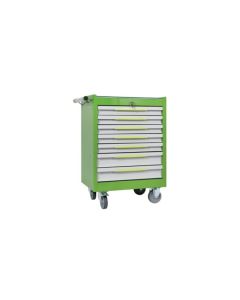
Workshop tool trolley with 7 drawers and side handle. Dimensions: W. 68 x D. 48.1 x H. 98.8 cm.
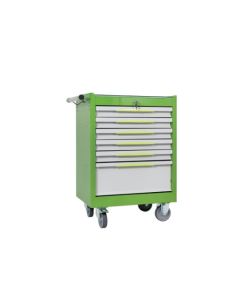
Workshop trolley with 6 drawers and 4 rubber wheels. Dimensions: W. 68 x D. 48.1 x H. 98.8 cm.
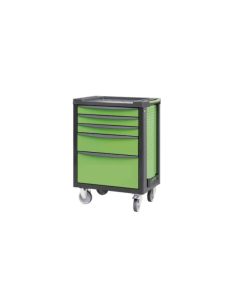
Workshop trolley with 5 drawers and lateral bottle holders. Dimensions: W. 73.1 x D. 50 x H. 91.6 cm.
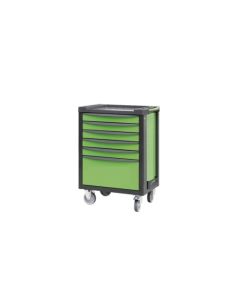
Workshop tool trolley with 6 drawers with total opening. Dimensions: W. 73.1 x D. 50 x H. 91.6 cm.
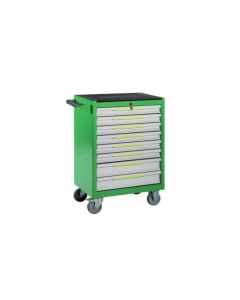
Workshop trolley with 8 drawers with internal rubber mat. Dimensions: W. 68 x D. 48.1 x H. 99.6 cm.
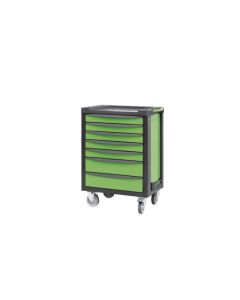
Workshop tool trolley with 7 drawers and 4 wheels. Dimensions: W. 73.1 x D. 50 x H. 91.6 cm.
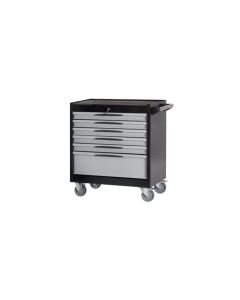
Workshop tool trolley with 6 drawers and rubber top surface. Static load capacity: 1,000 kg.
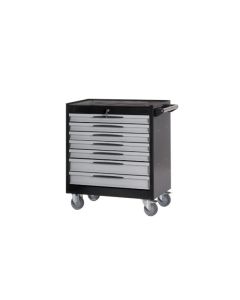
Tool trolley with 7 drawers and telescopic slides with locking system. Dimensions: W. 87 x D. 48.1 x H. 98.8 cm.
Workshop tool trolleys represent a fundamental solution for the rational organization of workspace in professional environments. These mobile storage systems combine structural strength, high load capacities, and design ergonomics to facilitate access to tools during maintenance, repair, and assembly operations. Their versatility makes them indispensable in mechanical workshops, precision laboratories, factories, and industrial warehouses, where efficient material management directly impacts the productivity and safety of technicians. The modular configuration with drawers, shelves, and anchoring systems allows each trolley to be adapted to specific operational needs, while high-capacity wheels guarantee maneuverability even in tight spaces.
Choosing a tool trolley significantly impacts the organization of the workflow. A well-structured system reduces tool search times, minimizes the risk of damage during transport, and prevents worker fatigue thanks to ergonomic positioning. Materials such as painted steel and high-capacity rubber wheels ensure longevity and reliability even in high-intensity operational contexts, while the presence of safety elements such as drawers with controlled locks and non-slip surfaces contributes to maintaining high protection standards in the workplace.
The introduction of a tool trolley in the workshop brings tangible benefits in terms of operational efficiency and safety. Centralizing tools in a single mobile support allows technicians to access everything they need without the necessity of repeated movements between different stations, thus reducing downtime during repair and maintenance operations. The robust painted steel structure guarantees a static capacity that can reach 1,000 kg, allowing the simultaneous transport of heavy tools, mechanical parts, and accessories without compromising the stability of the solution. Drawers with telescopic slides and locking systems facilitate extraction even when the trolley is fully loaded, preventing tools from sliding during operations.
In high-density industrial environments, the versatility of these systems proves crucial. Models with 6, 7, or 8 drawers allow for a logical categorization of tools by type, size, and specialized function, speeding up retrieval times and improving precision in using the most appropriate instrument. The possibility of equipping trolleys with predefined assortments of tools (from 106 to 187 pieces) transforms these devices into true mobile workstations, ideal for multidisciplinary workshops dealing with different types of interventions without sacrificing practicality. High-diameter rubber wheels (100-125 mm) absorb vibrations during movement, protecting tools from damage and preserving the durability of sensitive mechanical components.
The range of tool trolleys offered includes configurations differentiated based on the number of drawers, overall dimensions, and functional specifications. Compact models with 3 drawers and dimensions less than 95 cm in height adapt to limited spaces without compromising practicality, representing the ideal choice for small workshops, specialized repair labs, and mobile workshops. Medium-capacity models with 5-6 drawers constitute the optimal compromise between space and maneuverability, maintaining contained dimensions (approximately 90-100 cm in height) while offering a large useful surface for modular tool organization. Large-capacity trolleys with 7-8 drawers and heights near 100 cm represent complete solutions for workshops with high volumes of operations, where the need to simultaneously access multiple tool categories justifies the slightly higher vertical footprint.
Beyond the basic structure, differentiation also concerns construction materials and movement systems. Painted steel trolleys offer corrosion resistance and superior durability compared to other solutions, particularly relevant in environments with high relative humidity or exposure to chemical agents. The internal rubber mat in the drawers primarily serves to protect tools from impacts and vibrations during movement, preserving the finish and precision of delicate instruments. Models equipped with a rubber top surface also offer additional workspace for temporarily storing tools and components during operations, transforming the trolley into a versatile service station. The static capacity varies from 500 kg for compact models up to 1,000 kg for large-capacity solutions, allowing a choice sized to the specific average load needs of the workshop.
Selecting the appropriate tool trolley requires a preliminary assessment of some critical factors related to the operational context. The first element to consider is the size of the available space: workshops with narrow aisles or cramped workstations require compact models with shallow depth (40-50 cm) and width under 90 cm, while more spacious facilities can exploit the greater organizational capacity of large-format trolleys. Subsequently, the type and average weight of the tools that the trolley will contain must be quantified: a mechanical workshop working with heavy engines and components benefits from capacities exceeding 800 kg, while a small appliance repair lab can opt for moderate capacities of 500-600 kg.
The analysis of usage frequency and movement paths represents a second discriminating criterion. If the trolley is intended to remain substantially fixed at a station with occasional movements, wheel quality becomes less critical; otherwise, in environments where movement is frequent (for example, between different workshops or between the receiving department and the assembly station), the choice of high-diameter wheels and smooth movement systems becomes a priority. A further aspect concerns functional specialization: some models already include predefined assortments of 106, 136, or 187 tools, solving both the storage and operational components in a single solution; this option is advantageous for companies with centralized tool organization, while facilities that prefer custom compositions benefit more from empty trolleys with modular drawers. Finally, the side handle and telescopic slides with a locking system represent ergonomic features that reduce fatigue during movement and the extraction of loaded drawers, particularly useful in high-intensity operational environments where the human factor affects overall productivity.
Workshop tool trolleys fall under the general category of furniture and accessories for workstations, subject to a series of technical and safety regulations that vary depending on the context of use. The UNI EN 527 standard defines the structural stability criteria for office furniture, although industrial trolleys often must comply with even more stringent requirements, particularly in high-movement environments. The declared load capacity must be supported by structural test certifications, which attest to the resistance of the steel structure and connection systems when the weight is distributed according to the manufacturer’s specifications. Wheels must comply with the DIN 4119 standard for industrial trolleys, guaranteeing adequate capacity, wear resistance, and smooth movement capability even on irregular surfaces typical of production environments.
Recurring safety aspects concern the control of accidental movement and the prevention of tipping. Drawers equipped with controlled opening limiters prevent uncontrolled extraction when the trolley is in motion, reducing the risk of tripping and tools falling on people below. The painted finish of the steel must ensure the absence of sharp edges and cutting surfaces that could cause injury during handling or daily use. Non-slip surfaces, particularly relevant in drawers and on the top shelf, are frequently subject to checks according to the DIN 51130 standard, which classifies slip resistance based on the angle of inclination. In environments with high hygiene standards (medical labs, biomedical workshops), stainless steel represents the preferred alternative to painted steel, ensuring ease of cleaning and absence of contamination. The technical documentation of the product must also clearly state the static and dynamic capacity limits, the indication of the maximum load distributed per drawer, and instructions for the safe use of the movement system.
Explore all the products in the category and compare the available solutions to find the one that best suits your operational context. From the compact 3-drawer configuration to complete models equipped with 7-8 drawers and predefined assortments, the catalog has been structured to meet the different needs of workshops, industrial laboratories, and specialized warehouses.
The 5-drawer trolleys are compact (depth 48-50 cm) and maneuverable in limited spaces, with a capacity of 800 kg. The 7-8 drawer models offer greater organizational capacity and a capacity of up to 1,000 kg, ideal for workshops with a high volume of tools. The choice depends on the amount of space available and the quantity of tools to be organized.
Wheels with a diameter of 100-125 mm better absorb vibrations and facilitate sliding on irregular surfaces, common characteristics in industrial environments. Larger diameters reduce fatigue during movement and protect internal tools from impacts and damage. The choice of diameter must consider the transport distances and the type of flooring in the workshop.
Yes, some models include predefined kits of 106, 136, or 187 tools, transforming the trolley into a complete workstation. This solution is ideal for companies that prefer a standardized composition and facilitates the centralized management of tools.
For small workshops with light repair operations, a capacity of 500-600 kg is generally sufficient. If operations include heavy components or engines, it is preferable to opt for 800-1,000 kg trolleys for a greater safety margin and long-term reliability.
Most models have rubber mats made with supports that allow for removal for periodic cleaning. This feature is important for maintaining hygiene and avoiding the accumulation of metallic residues that could damage the tools. It is recommended to check the technical specifications of the selected model.
The side handle facilitates grip and directional control during pushing, reducing fatigue especially during frequent movements in narrow spaces. It represents an ergonomic feature particularly useful in high-density operational environments where the trolley moves daily between different stations.
 English
  Italian
 French
 German
 Spanish