
mon-fri 9-13 / 14.30-18.30
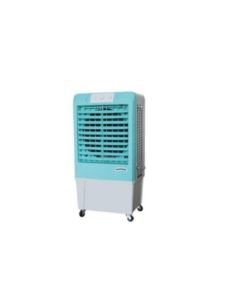
Portable evaporative cooler for environments up to 25 m². Dimensions: W 50 x D 36.5 x H 97.5 cm.

Silent portable air cooler with a large water tank. Dimensions: W. 38.5 x D. 31.5 x H. 75 cm.

Portable evaporative cooler for environments up to 40 m². Dimensions: W 68 x D 43.5 x h 105 cm.
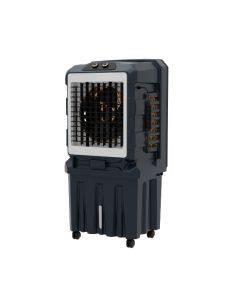
Portable evaporative cooler h923_07. Air flow 3,800 m3/h, power 180 W, UV lamp and 70 L tank. Suitable for indoor and outdoor use.

Evaporative cooler for warehouses with cooling pad on three sides. Airflow: 3800 m³/h.

Air cooler equipped with a robust UV-resistant frame. Airflow: 4500 m³/h. Dimensions: W. 68 x D. 42 x H. 105 cm.

Portable evaporative cooler h923_08 with 100 L tank. Air capacity 7,100 m³/h, power 245 W, UV lamp, and three speeds. Ideal for outdoor and indoor use.

Portable evaporative air cooler for environments up to 50 m². Dimensions: W 86 x D 49 x h 125 cm.
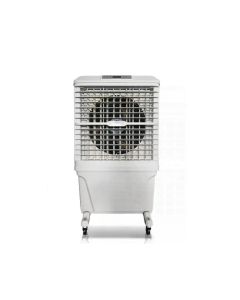
Low energy consumption air cooler for warehouses. Dimensions: W. 84.2 x D. 53.2 x H. 144.8 cm.
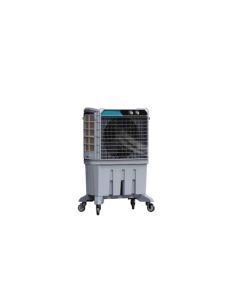
Professional evaporative cooler with continuous oscillation fins. Airflow: 8500 m³/h.

Portable, ecological, and low-consumption evaporative air conditioner for spaces up to 100 m². Dimensions: 87 x 48 x 128.5 cm.

Portable evaporative cooler h923_09 with 125 L tank. Air flow capacity: 9,000 m³/h, power 380 W, UV lamp and three speeds. Ideal for outdoors and indoors.

Portable evaporative air cooler, eco-friendly and high-performance, for spaces up to 100 m². Dimensions: 93 x 58 x 135 cm.

Air cooler with evaporative panel on three sides. Air flow: 17000 m³/h. Dimensions: W. 87 x D. 44 x H. 210 cm.

Industrial evaporative cooler H932_20 in corrugated paper, 18,000 m³/h airflow and 120L tank with Auto Refill for large areas.
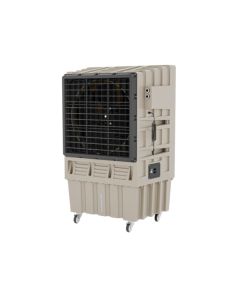
Portable evaporative cooler h923_10 with 130 L tank. Airflow 12,500 m3/h, power 400 W, UV lamp and three speeds. Suitable for outdoor and indoor use.

Portable evaporative cooler for spaces up to 200 m². Dimensions: W 113 x D 72 x H 141 cm.

Industrial air cooler with three speeds. Air flow: 23000 m³/h. Dimensions: W. 113 x D. 62 x H. 164 cm.

Industrial portable evaporative cooler h923_06 in UV and corrosion resistant material. Flow rate 12,000 m3/h, UV lamp and 90 L tank.

Portable evaporative cooler h923_11 with 120 L tank. Airflow 18,000 m3/h, power 500 W, UV lamp and three speeds. Suitable for outdoor and indoor use.

Portable evaporative air cooler/conditioner h923_12 with 140 L tank. Airflow 22,000 m3/h, power 760 W, UV lamp and three speeds. Suitable for outdoor and indoor use.

h923_13 portable industrial evaporative cooler with 260 L tank. Air flow rate 23,000 m3/h, power 750 W, UV lamp and three speeds. Suitable for outdoor and indoor use.

h923_14 portable industrial evaporative cooler with 220 L tank. Airflow 30,000 m3/h, power 750 W, UV lamp, and three speeds. Suitable for outdoor use and large indoor spaces.

Quiet portable evaporative cooler h923_15 with 200 L tank. Air flow 30,000 m3/h, power 750 W, UV lamp and three speeds. Suitable for outdoor and large indoor spaces.

Professional portable evaporative cooler h923_16 with 300 L tank. Air flow 38,000 m3/h, power 750 W, UV lamp and three speeds. Suitable for outdoor and large indoor areas.
Industrial air coolers represent a fundamental thermal solution for climate management in high-volume workspaces, such as production plants, logistics warehouses, and manufacturing facilities. These systems operate through the principle of water evaporation, transforming hot air into cool air without resorting to traditional refrigeration cycles. Evaporative technology allows for significant thermal reductions while maintaining energy consumption levels significantly lower than conventional air conditioners, a decisive factor for industrial contexts where operational continuity and economic efficiency are absolute priorities.
Adopting industrial air coolers directly impacts the health of the work environment, staff productivity, and the preservation of processes sensitive to thermal control. Their structural versatility allows for applications ranging from small warehouses to vast production plants, with airflows varying from a few thousand up to over 20,000 cubic meters per hour.
The use of industrial air coolers in production environments addresses concrete thermal management needs that go beyond simple comfort. In sectors where temperatures reach high peaks during hot months, the availability of an efficient cooling system becomes a critical element for maintaining operational continuity. Evaporative coolers guarantee a constant supply of fresh air, improving indoor air quality and reducing heat accumulation in workspaces. The operating principle based on natural water evaporation drastically reduces dependence on electricity, generating tangible economic advantages on monthly and annual operating costs.
Operationally, these systems prove particularly effective in situations where environments have considerable dimensions and poor thermal insulation, frequent circumstances in industrial plants and storage spaces. The ability of these devices to move large volumes of air ensures a homogeneous distribution of freshness, eliminating stagnant zones and deteriorating microclimates. Furthermore, models equipped with large tanks and automatic filling systems do not require frequent maintenance interventions, allowing staff to focus on production activities without distractions. Environments such as textile industries, food companies, mechanical workshops, and logistics structures derive significant benefits from this consolidated and reliable technology.
The range of industrial air coolers is mainly divided into two functional categories: portable models and higher-capacity stationary systems. Portable coolers represent the versatile solution for companies needing flexibility in cooling spaces, thanks to integrated wheels that facilitate movement between different areas of the plant or warehouse. These models, with airflows generally between 3,000 and 5,000 cubic meters per hour, are ideal for medium-sized environments or for situations where the cooling system must adapt to changing configurations. Integrated water tanks vary from 25 to 120 liters, balancing operational autonomy and structural compactness.
Large-capacity stationary coolers, specifically configured for extensive industrial plants, offer airflows exceeding 15,000 cubic meters per hour, with multi-sided evaporative panels that guarantee thermal coverage over large surfaces. These systems feature adjustable ventilation speeds, usually on three or more levels, to adapt energy consumption to the actual weather conditions of the day. Some models include supplementary technologies such as UV sterilization of the tank water, which prevents bacterial proliferation and ensures the hygiene of the air supplied. The chassis structure is made of materials resistant to corrosion and ultraviolet rays, essential characteristics to ensure durability in outdoor or semi-outdoor environments where coolers may remain exposed to atmospheric agents for long periods.
Selecting an industrial air cooler requires a careful evaluation of interconnected technical parameters, starting with the cubic volume of the environment to be cooled. A consolidated rule of thumb suggests considering an airflow of at least 10-15 cubic meters per minute for each square meter of surface, a factor that varies depending on the building's thermal insulation and internal heat sources. A non-insulated plant with machinery generating intense heat will require higher airflows than a space with better insulation and lower thermal loads. It is essential to also evaluate the desired number of air changes per hour: 3-5 changes represent the standard parameter for production environments, while areas with critical needs may require up to 8-10 changes.
A second aspect concerns practicality of use in the specific context: environments where space is limited or where cooling needs vary between different zones benefit from multi-directional portable systems, while large-scale single-use plants benefit from high-capacity stationary systems. The availability of a direct water supply influences the choice between models with manual tanks and those with a continuous hook-up connection. It is also necessary to consider the climate of the geographical area: regions with high relative humidity reduce the efficiency of evaporative technology, making a preliminary evaluation of the performance curves provided by manufacturers necessary. Finally, the annual operating budget must include not only the initial purchase but also maintenance, cleaning of evaporative panels, and tank water replacement, factors that contribute to the long-term economic sustainability of the solution.
Industrial air coolers must comply with a series of technical and safety regulations that ensure reliable operation and worker protection. In the European context, Directive 2014/30/EU establishes electromagnetic compatibility requirements for electrical equipment, a standard that all coolers equipped with motors and electronic control panels must respect. The Machinery Directive 2006/42/EC classifies many industrial coolers as machines, thus requiring the preparation of complete technical documentation, a CE declaration of conformity, and, in certain cases, submission to external certification procedures. Furthermore, workplace safety regulations oblige employers to ensure adequate air circulation in confined environments, making the installation of coolers not only advisable but sometimes legally binding.
Regarding water management, systems that provide for automatic tank filling through connection to the water mains must comply with water quality regulations and include filtration or sterilization systems to avoid biological contamination. The ISO 3822 standard provides methodologies for measuring sound pressure for ventilating equipment, a relevant aspect since industrial coolers generate noise that, at maximum speed, can exceed 75-80 dB. Verifying compliance with the acoustic limits set by local regulations is a fundamental element in the design phase. For installations in very humid climates or in critical hygienic-sanitary sectors, such as food facilities, it is advisable to request additional certifications regarding the microbial resistance of materials in contact with air and water, ensuring the highest standard of compliance even in contexts where requirements exceed strictly mandatory ones.
Explore all the products in the category and compare the available solutions to find the most suitable one for your operational context. Each model is described with complete technical specifications and dimensions, allowing you to evaluate which system best integrates with the geometry and thermal characteristics of your workspace.
The evaporative cooler uses natural water evaporation to lower the temperature, consuming up to 75% less energy than air conditioners. Traditional air conditioners use refrigeration cycles that require powerful compressors. Coolers are ideal for dry and uninsulated environments, while air conditioners maintain better thermal control in high humidity conditions.
For a standard uninsulated warehouse, a minimum airflow of 5,000-7,500 m³/h is recommended, equivalent to 10-15 m³/min per square meter. If the warehouse houses machinery that generates intense heat, increase this to 8,000-10,000 m³/h. Precise evaluation depends on insulation, heat sources, and desired air exchange rate (3-5 changes/hour for general use).
UV sterilization uses ultraviolet radiation to destroy bacteria, algae, and microorganisms present in the tank water, preventing biological proliferation and unwanted odors. The system is integrated into the tank and activated automatically during operation, keeping the water hygienically safe for long periods of continuous operation.
Yes, portable coolers with lower capacity (3,000-5,000 m³/h) consume 0.5-1.5 kWh, while high-capacity stationary systems (15,000-23,000 m³/h) absorb 2-4 kWh. However, the specific consumption per cubic meter of air moved remains similar; the total difference reflects the volume of space covered. The choice depends on the actual size of the environment to be cooled.
A 25-30 liter tank allows for 4-6 hours of operation in low humidity conditions. For full 8-hour shifts or particularly dry environments, 80-120 liter tanks are recommended. Alternatively, a continuous connection to the water mains ensures unlimited autonomy, provided the building's plumbing supports adequate flow rates.
Yes, monthly cleaning of the evaporative panels is necessary to avoid obstructions and calcification, especially in areas with hard water. The air filter should be checked weekly, and the tank should be emptied and cleaned at the end of the summer season. UV sterilization reduces interventions but does not eliminate them completely. Careful maintenance extends the device's life by 2-3 years.
For an extensive and uninsulated warehouse, high-flow systems are required: models with 15,000-20,000 m³/h are appropriate. Coolers with evaporative panels on three sides ensure uniform distribution. If the budget allows, two 10,000 m³/h units strategically positioned offer greater flexibility and operational redundancy.
Evaporative coolers lose efficiency in areas with relative humidity above 60-70%, typical of coastal or very humid southern environments. In such contexts, thermal reduction drops significantly. Continental zones with dry summers (30-50% humidity) represent the ideal environment where these systems achieve maximum performance and minimum consumption.
 English
  Italian
 French
 German
 Spanish