mon-fri 9-13 / 14.30-18.30
Laboratory glassware refers to the collection of borosilicate glass containers and instruments used in research facilities, chemical analysis, clinical biology, and quality control. These items form the instrumental base of any professional laboratory, ensuring measurement precision, thermal and chemical resistance, and a durability that justifies the initial investment. Borosilicate glass, thanks to its specific composition, allows for operation in hostile environments and with corrosive liquids without compromising the integrity of the container. The choice of the right glassware directly affects the quality of analytical results and the safety of operators.
In hospitals, pharmaceutical companies, university research, and clinical analysis laboratories, laboratory glassware meets rigorous international standards. Each item must pass specific technical inspections to ensure uniform walls, precise measurement scales, and that the material does not release contaminants into the processed samples.
Laboratory glassware offers technical advantages that no alternative material can fully replicate. Borosilicate glass maintains its dimensional stability even after repeated heating and cooling cycles, a fundamental aspect when working with techniques involving intense thermal transitions. Optical transparency allows for easy observation of the contained liquids, identification of precipitates, or color variations, which is essential for visual assessments during analytical procedures. Furthermore, glass does not chemically interact with most reagents, avoiding contamination that would alter the final results. Quality-certified items are factory-calibrated according to ISO and DIN standards, ensuring precision in volumetric measurements.
From a practical standpoint, laboratory glassware proves to be economically convenient in the medium-to-long term: unlike disposable plastic items, glass containers and instruments withstand thousands of washing and sterilization cycles. In high-volume clinical laboratories, this feature translates into a significant reduction in operational costs. The ability to autoclave, use ultrasonic cleaners, and disinfect with aggressive solutions represents a competitive advantage for facilities that must maintain high hygienic standards. Erlenmeyer flasks, graduated cylinders, round-bottom flasks, beakers, and test tubes become long-term investments rather than recurring costs.
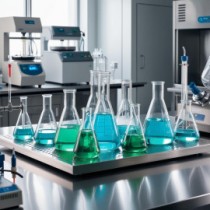
The laboratory glassware catalog covers multiple categories, each designed for specific functions. Erlenmeyer flasks are conical containers with a narrow neck, available in capacities from 250 ml to 5 liters, mainly used for chemical reactions and mixing. Graduated cylinders, characterized by a cylindrical shape with precise measurement scales, allow for the dosing of exact liquid volumes; those made of high-quality borosilicate glass maintain calibration even after numerous washes. Beakers, without a graduated scale, are used for general mixing operations, heating, and liquid transfer, and are distinguished from cylinders by their wide opening. Test tubes, available in straight or round-bottom versions, are the standard container for biological samples and rapid tests. Flat-bottom flasks, round-bottom flasks, and flasks with side arms complete the range for chemical synthesis and distillation.
In addition to basic items, specialized glassware includes analytical funnels, pipettes, burettes, screw-cap bottles for storage, volumetric flasks for preparing solutions of known concentration, and even items with ISO conformity marks for laboratories requiring specific certifications. The materials used vary: standard borosilicate glass for general operations, high thermal resistance borosilicate glass for repeated heating, and in some cases, tempered glass for items intended for particular mechanical resistance. Sizes and volumes range from 5 ml miniature test tubes to 10-20 liter flasks for industrial and large-scale research applications.
The choice of laboratory glassware depends primarily on the type of application and the substances it will come into contact with. If the operation involves frequent heating, it is necessary to opt for borosilicate glass of DIN ISO 3585 certified quality, which guarantees thermal resistance up to 230°C. For critical operations where volumetric precision is essential, such as in the preparation of standard solutions or in gravimetric analysis, Class A volumetric flasks should be chosen, calibrated and individually checked by the manufacturer. A recurring mistake involves purchasing non-certified items or items of dubious origin, which risk showing visual imperfections invisible at first glance (air bubbles, irregular thickness), compromising results. For laboratories working with highly corrosive solutions such as strong acids, it is necessary to verify chemical compatibility and consider whether standard borosilicate glass is sufficient or if an even more resistant material is required.
Capacity represents another decision criterion: containers that are oversized for the needs occupy unnecessary space, while items that are too small require repeated filling operations and increase the risk of errors. For laboratories handling large sample volumes, the choice falls on 15 ml test tubes with optimal capacity for standard centrifuges and incubators. The type of stopper or closure is equally important: butyl rubber stoppers are universal but can release compounds if exposed to high temperatures, while silicone stoppers offer better thermal resistance. Laboratories requiring absolute sterility should prefer items in pre-sealed sterile packaging rather than manually filling from open bottles. Finally, consider the number of washing and sterilization cycles expected: cheaper items might degrade more quickly, while higher-quality products maintain calibration even after 500-1000 cycles.
Laboratory glassware is subject to stringent international regulations that ensure interoperability between laboratories and repeatability of results. The main standard is ISO 1042 for volumetric flasks, which defines tolerances, calibration procedures, and quality control criteria. DIN ISO 3104 regulates test tubes and basic containers, specifying that borosilicate glass must belong to class 3.3 according to DIN 1248, guaranteeing a linear expansion coefficient not exceeding 3.3×10⁻⁶ K⁻¹. For cylinders and measuring instruments, ISO 4788 defines accuracy classes (A and B), where Class A represents maximum precision. Items intended for clinical and hospital laboratories must also comply with European directives on quality control and safety standards for medical equipment. Every certified manufacturer provides certificates of conformity indicating the batch number, production date, and the results of the physical and chemical checks performed.
In addition to dimensional and precision standards, there are safety requirements regarding mechanical resistance, the absence of sharp edges, and compatibility with sterilization systems. Items used in research environments funded by public bodies or in laboratories participating in accreditation programs (such as ISO 15189 for clinical laboratories) must have traceable documentation and quality control certificates. The CE marking, when applicable, indicates that the product has been verified according to European directives. Some items also require certificates of non-cytotoxicity or the absence of contaminating substances, which are particularly important when glassware comes into contact with sensitive biological samples or pharmaceutical preparations. Product labeling must include the manufacturer's name, the precision class (if applicable), recommended usage temperatures, and maintenance instructions.
Explore all the products in the category and compare the available solutions to find the one best suited to your operational context. Making an informed choice of laboratory glassware represents an investment in the quality of analytical results and the safety of the research team.
Laboratory glassware is the collection of borosilicate glass containers and instruments used in clinical, research, pharmaceutical, and industrial laboratories. Main uses include dosing and measuring liquids, conducting chemical reactions, storing samples, controlled heating of solutions, and distillation operations. Due to its chemical and thermal resistance, it is the international standard in professional laboratories.
Borosilicate glass contains boron oxide in its composition, which reduces the thermal expansion coefficient and increases resistance to thermal shock. Ordinary glass, on the other hand, expands more with heat and fractures more easily during heating and cooling cycles. Only borosilicate glass (DIN class 3.3) is suitable for professional laboratories where resistance and precision are critical.
The choice depends on the sample volume and the number of planned operations. For high-volume clinical laboratories, 15 ml test tubes are standard in automatic centrifuges. For small-scale chemical synthesis, 250-500 ml flasks are suitable. Consult equipment manuals (centrifuges, incubators) to verify compatibility and maximum recommended capacities.
The main standards are ISO 1042 for volumetric flasks, DIN ISO 3104 for test tubes and containers, and ISO 4788 for graduated cylinders. The DIN 1248 standard specifies that the glass must belong to class 3.3 with a maximum expansion coefficient of 3.3×10⁻⁶ K⁻¹. Quality-certified items bear the conformity mark and include quality control certificates from the manufacturer.
Laboratory glassware made of certified quality borosilicate glass withstands 500-1000 sterilization cycles in an autoclave (121°C, 15 minutes) without losing precision or integrity. Cheaper items may degrade more quickly. Lifespan depends on frequency of use, type of sterilization, and proper maintenance (avoiding sudden thermal shocks).
Yes, borosilicate glass can be heated up to 230°C on heating plates and up to 300°C on a direct flame, but it is essential to avoid thermal shock (sudden transition from hot to cold). Always use suitable supports and do not place hot items on cold, damp surfaces. For prolonged heating above 150°C, prefer glassware with specific high-temperature markings.
A volumetric flask is individually calibrated at a standard temperature (20°C), with Class A precision (tolerance ±0.5%). It is used to prepare solutions of known concentration. An ordinary Erlenmeyer flask is not calibrated and is suitable for general mixing and heating operations. The volumetric flask costs more but ensures the volumetric precision essential in quantitative analysis.
Certified glassware features the ISO/DIN logo stamped on the base or neck, includes a quality control certificate with a batch number and date, and is accompanied by traceable documentation from the manufacturer. Non-certified glassware lacks these elements. In accredited laboratories (ISO 15189, 17025), it is mandatory to use only certified glassware to ensure reproducibility and legal validity of results.
 English
  Italian
 French
 German
 Spanish