
mon-fri 9-13 / 14.30-18.30
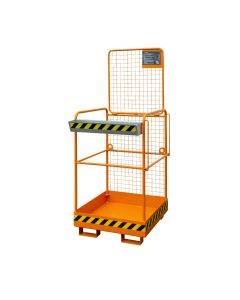
Aerial maintenance basket. Maximum load: 240 kg. Dimensions: W.835 x D.1040 x H.2000 mm.
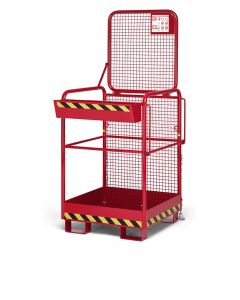
Work basket for aerial maintenance. Dimensions: W. 800 x D. 800 x h. 1900 mm. Load capacity: 240 kg.
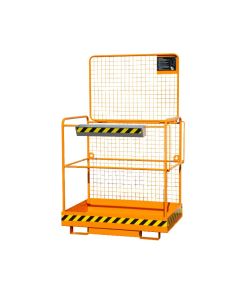
Work platform for forklift. Maximum load: 300 kg. Dimensions: W.1230 x D.1040 x H.2000 mm.
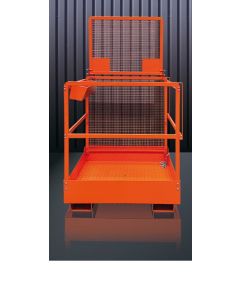
<p>Forklift man basket. For 2 people. Dimensions: W. 1090 x D. 1200 x h. 2000 mm. </p>
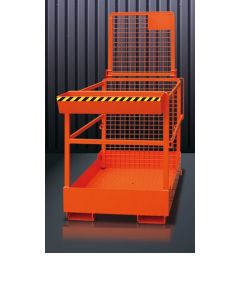
Personnel basket for aerial maintenance. For 1 person. Dimensions: W. 910 x D. 860 x h. 2000 mm.
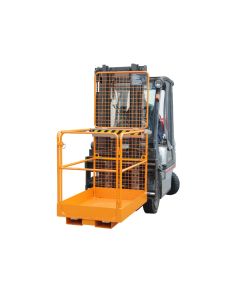
Personnel basket for overhead maintenance. Maximum load: 300 kg. Dimensions: W.1,200 x D.1,040 x H.1,990 mm.
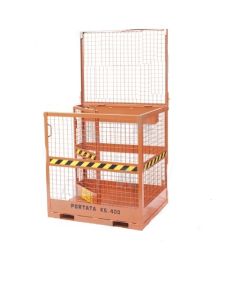
Personnel basket for aerial maintenance. Dimensions: W. 110 x D. 90 x h. 205 cm.
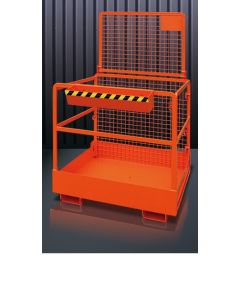
Forklift work platform for 2 people. Dimensions: W. 1090 x D. 1200 x h. 2000 mm. Total allowable weight: 405 kg.
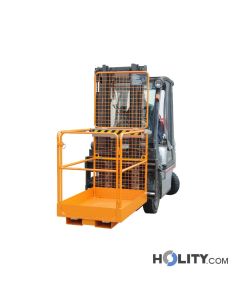
Work platform for forklift truck. Maximum load: 300 kg. Dimensions: W.800 x D.1295 x H.1985 mm.
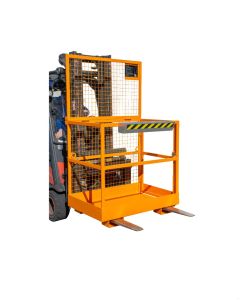
Aerial work platform. Max load: 300 kg. Dimensions: W.1210 x D.1040 x H.1990 mm.
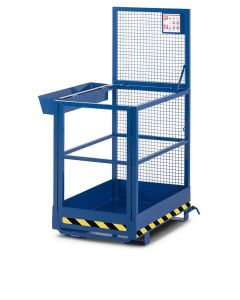
Aerial maintenance cage for industrial furniture. Maximum load: 300 kg. Dimensions: W. 800 x D. 1200 x h. 1910 mm.
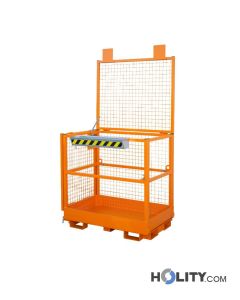
Aerial maintenance basket. Maximum load: 300 kg. Dimensions: W.1305 x D.1040 x H.2355 mm.
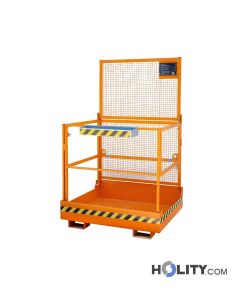
Folding basket for aerial maintenance. Maximum load: 300 kg. Dimensions: W.1210 x D.1275 x H.1995 mm.
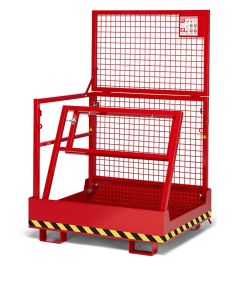
Foldable overhead maintenance work basket. Dimensions: W. 1200 x D. 1080 x H. 1910 mm. Maximum load: 300 kg.
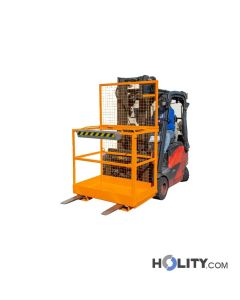
Work platform for forklift. Maximum load: 300 Kg. Dimensions: W.1210 x D.1045 x H.1990 mm.
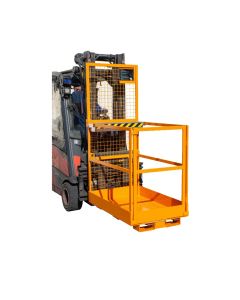
Forklift work platform. Max load: 300 kg. Dimensions: W.805 x D.1290 x H.1990 mm.
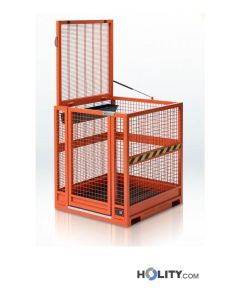
Personnel basket for aerial maintenance. Maximum capacity: 400 kg.
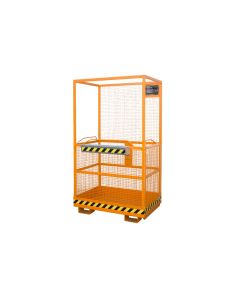
Aerial maintenance basket. Maximum load: 300 kg. Dimensions: W.1215 x D.1050 x H.2090 mm.
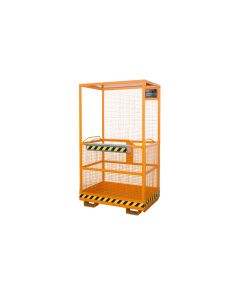
Aerial maintenance basket with roof. Dimensions: W.1215 x D.1050 x H.2105 mm.
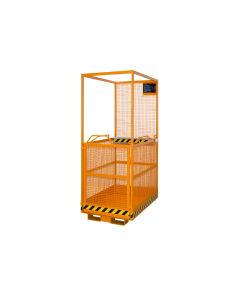
Personnel basket for aerial maintenance with short-side fork attachment. Dimensions: W.825 x D.1300 x H.2090 mm.
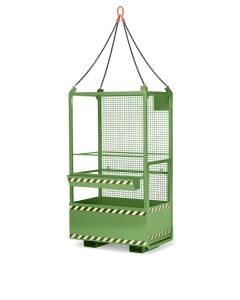
Overhead maintenance work cage. Maximum load: 300 kg. Dimensions: W. 1200 x D. 800 x h. 2200 mm.
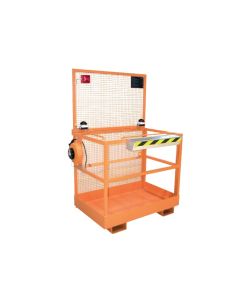
Work platform for forklift with enabling switch. Dimensions: W.1335 x D.1040 x H.1990 mm.
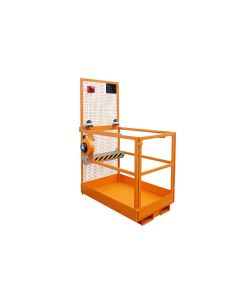
Work platform for forklifts with enabling switch. Dimensions: W.930 x D.1300 x H.1990 mm.
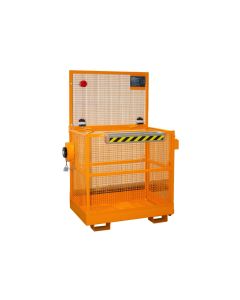
Work platform for forklift with cable reel. Dimensions: W.1415 x D.1050 x H.1990 mm.
Aerial maintenance containers represent a fundamental solution in the field of vertical handling and workplace safety. These devices, designed to be coupled with forklifts and lifting equipment, allow for work at height to be carried out in a controlled manner and in compliance with European safety standards. The category includes personnel baskets, work platforms, specialized cages, and multifunctional containers, each calibrated for specific operational scenarios. The use of this equipment is widespread in the sectors of industrial maintenance, construction, lighting, building cleaning, and system repairs.
Choosing an appropriate container is not a secondary decision: it directly affects productivity, the reduction of machine downtime, and above all, the regulatory compliance that every company must respect. An inadequate container exposes the company to legal risks, accidents, and reputational damage.
Aerial maintenance containers offer an integrated solution for working at height, eliminating the need for temporary structures, complex scaffolding, or staging that requires long setup and dismantling times. A work platform coupled with a forklift allows reaching variable heights between 2 and 5 meters in a few seconds, significantly reducing operational times. Versatility is one of the main advantages: thanks to capacities ranging between 240 and 400 kg, it is possible to hold one or more operators together with small loads and work tools. This reduces the number of movements required and increases the overall efficiency of the intervention.
Furthermore, the use of certified containers reduces exposure to disciplinary proceedings by supervisory bodies (ASL, Fire Dept., INAIL). Companies operating in regulated sectors, such as the maintenance of electrical systems on facades, gutter cleaning, or the repair of advertising signs, find in these devices a tool that consolidates their positioning as reliable and compliant entities. From a safety perspective, modern containers integrate railings, non-slip flooring, anchoring systems for operators, and in some cases, protection from falling objects from above.
Several categories of containers can be distinguished on the market, each optimized for specific needs. Standard rectangular baskets represent the most common and versatile solution, available in sizes from 800x800 up to 1415x1050 mm, with internal heights ranging between 1900 and 2355 mm. These models guarantee sufficient workspaces for one or two operators and maintain an excellent compromise between load capacity and ease of handling. Work platforms, characterized by a more robust structure and a wider base, are instead designed to better distribute weight and provide a sense of greater stability during operations. Personnel baskets specifically designed for transporting staff feature reinforced railings, floors with greater grip, and active safety systems. There are also folding or space-saving solutions, ideal for companies with limited storage space, which reduce the footprint when parked while maintaining equivalent load capacities.
Another important category concerns aerial maintenance cages, fully enclosed or semi-open structures that guarantee superior protection from atmospheric agents and the dangers of falling objects from above. Some models include accessory elements such as roofs, integrated cable reels to manage tool power cords, protection grids, and deadman switches for safety control. The choice between these variants depends on the operational context: maintenance in an outdoor environment requires different protections compared to indoor work; similarly, the frequency of use affects the priority between handling practicality and structural durability.
The selection of an aerial maintenance container must start from three fundamental parameters: the number of operators who will use the platform simultaneously, the total weight to be transported (including tools and materials), and the capacity of the available forklift. A preliminary analysis of the technical specifications of the forklift (typically indicated on the identification plate) is essential: if the nominal capacity is 2000 kg at 1500 mm distance from the load, adding a 600 kg container requires a reduction in the useful capacity available. Many customers make the mistake of underestimating this interaction, generating situations of operational non-compliance. The second aspect concerns the physical dimensions of the workspace: a 1200x1040 mm basket might be insufficient if the operator needs to move inside the container or if they need to store small materials; at the same time, models that are too large become impractical in narrow environments such as ventilation shafts or gaps between buildings.
The third parameter concerns environmental conditions: for work exposed to rain, snow, or wind, a cage with a roof and side protections reduces the risks of slipping and loss of balance for the operator. For frequent activities in crowded urban environments, a container with full side protections might be preferable to an open platform. Similarly, if interventions require the transport of heavy tools (drills, grinders, hydraulic tools), it is necessary to verify that the residual capacity of the platform (total capacity minus basket weight minus operator weight) is sufficient. A common mistake consists in choosing low-cost models without evaluating compatibility with the forklifts actually available in the company; this subsequently leads to the need for external rental or immobilization of resources.
In Italy, the compliance of aerial maintenance containers is regulated by the UNI EN 1861-1 standard, which establishes safety criteria for work platforms suspended from forklifts. The standard prescribes construction standards for railings (minimum height 1100 mm), floor tilt angle (maximum 5 degrees), resistance to lateral thrusts, and the anchoring system to the handling equipment. Every container placed on the market must be accompanied by a CE declaration of conformity and a user manual in Italian, which reports load capacity, dimensions, self-weight of the device, and conditions of use. Furthermore, the Machinery Directive 2006/42/EC requires the manufacturer to conduct a risk assessment and provide detailed instructions for the operator and the employer. From the point of view of civil liability, if the container is assembled or modified by third parties, the responsibility falls on whoever makes the modifications.
In terms of accident prevention, Legislative Decree 81/2008 (Consolidated Safety Act) imposes on the employer the obligation to provide the operator with specific personal protection systems, such as safety belts connected to robust anchoring points, even if the container has railings. Every use must be preceded by a visual check of the device’s condition (absence of deformations, rusting, loose components) and by personnel training. Documentation relating to periodic maintenance (generally recommended every 12-24 months) must be kept and made available in case of inspections. Specific sectors, such as the maintenance of television antennas or high-altitude structures, may require additional certifications (for example, the license for those working on live cables in the case of electricity).
Explore all products in the category and compare the available solutions to find the one best suited to your operational context. The right choice of an aerial maintenance container directly affects the safety, efficiency, and regulatory compliance of your sites and interventions.
The work platform has a wider base and often a more robust structure, designed to distribute the load over a larger area and provide greater stability to operators during movements. The personnel basket is generally more compact and designed specifically for the safe transport of one or two operators along with small tools, with higher railings and protections dedicated to safety in motion.
The capacity must cover the total weight of the operators plus the tools and materials you will transport. If the forklift has a capacity of 2000 kg, subtract the self-weight of the container (about 600-800 kg) and the weight of the operators. For example, with 2 operators (160 kg) and tools (40 kg), the residual useful capacity is approximately 800-1200 kg. Always check the forklift’s identification plate for the capacity at different load radii.
No. Using a container without CE certification exposes the company to administrative sanctions, criminal proceedings for non-compliance with safety, and civil liability in the event of an accident. Inspections by health authorities and the Fire Department specifically check for the presence of the declaration of conformity. The initial savings are negated by legal and insurance risks.
A visual check is recommended before each use (checking for deformations, rust, loose components) and deep periodic maintenance every 12-24 months, depending on the frequency of use. Document all checks and keep maintenance reports for any inspections. Any visible damage must stop usage until repaired.
For a single operator with sufficient room for movement, an 800x800 mm basket is acceptable. For two operators or for activities requiring tool positioning, minimum dimensions of 1000x1000 mm are preferable. Evaluate the actual maneuvering space considering the railing occupies about 10-15 cm of internal space on each side.
Any modification (adding protections, removing components, structural painting) invalidates the CE certification and transfers responsibility to whoever performs the modification. If you have specific needs, consult the manufacturer for a certified customized version rather than modifying a standard product.
Folding models reduce storage space (about 50%) but require time for assembly and often have slightly lower capacities. Choose the folding version if parking space is critical and usage is occasional; opt for the fixed model if you use the container frequently and have dedicated space.
The roof is essential for frequent outdoor work exposed to rain and snow. The cable reel is important if you use power tools to be taken to height. The top protection grid is mandatory where there is a risk of falling objects from above (proximity to other structures, overhead warehouses). Evaluate your specific operational context before adding accessories that increase the self-weight.
 English
  Italian
 French
 German
 Spanish