
mon-fri 9-13 / 14.30-18.30

Kaltembach step for stress tests in cardiology. Platform positionable on 3 levels: 60-40-50 cm. Medical device.

3-step rehabilitation ramp. Step height: 16 cm. With fixed height handrail. Optional: platform.
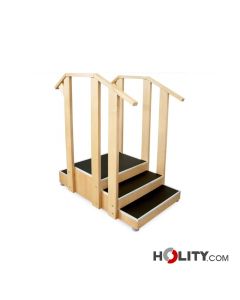
Double-sided wooden rehabilitation staircase with non-slip steps and beech handrails. Dimensions: W 120.5 x D 80 x H 127.5 cm.
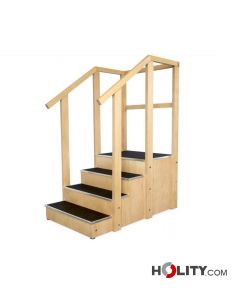
Mobile rehabilitation stairs with non-slip steps and beech handrails. Dimensions: L 117 x W 80 x H 160 cm.
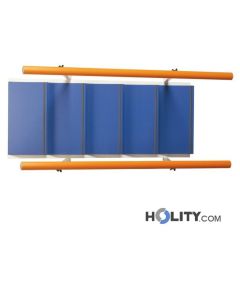
Rehabilitation exercise ramp with 5 steps, height 9.5 cm. With fixed height handrails. Optional: platform.
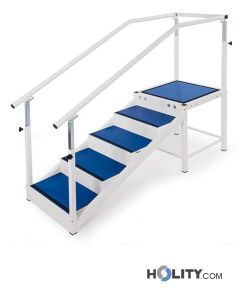
Physiotherapy staircase with one flight and 3 steps. Painted steel structure. Adjustable handrail height: 60 - 100 cm.
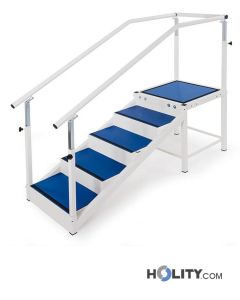
Rehabilitation stairs with 1 flight and 4 steps. Single step height: 13 cm. Height-adjustable handrails.
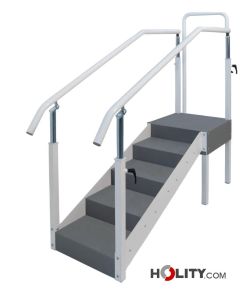
Physical therapy and rehabilitation staircase. Steel structure. Central element: 60x60 cm.
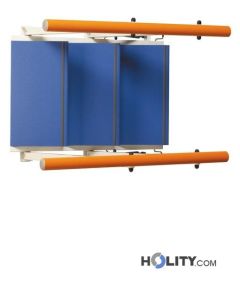
3-step staircase with a height of 16 cm for rehabilitation exercises. Maximum dimensions: 124 x 75 cm. Optional: platform.
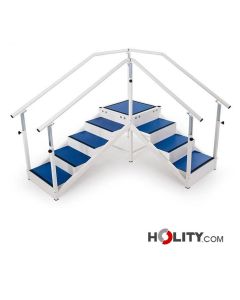
2-ramp rehabilitation staircase that can be positioned at an angle or straight. Adjustable handrails. Painted steel structure.

Staircase for rehabilitation exercises with adjustable handrails. Painted steel base structure. Optional: platform.
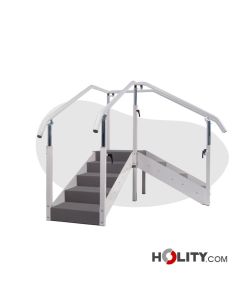
2-flight staircase for rehabilitation and walking. Can be positioned in a straight line or at an angle. With 4 steps h.15 cm and 5 steps h.13 cm.
Rehabilitation stairs are a central tool in physical therapy and functional re-education. These devices are specifically designed for patients who need to recover their walking ability, regardless of the underlying cause—orthopedic, neurological, or rheumatological. The modular and adjustable structure of physiotherapy stairs allows exercises to be adapted to the patient's recovery level, promoting a gradual progression towards motor autonomy. Rehabilitation centers, assisted living facilities, and physiotherapy clinics find rehabilitation stairs to be an indispensable tool for setting up complete and personalized therapeutic paths.
Rehabilitation stairs offer a controlled platform where the patient can exercise the lower limbs in a safe environment, supported by adjustable handrails and non-slip surfaces. Exercise progression is programmable: the therapist can gradually increase the height of the steps, the length of the path, or the overall difficulty based on functional improvement. This gradual approach reduces the risk of relapse and encourages the patient to regain confidence in their movements. Furthermore, physiotherapy stairs allow for the simulation of obstacles and difficulties that the patient will encounter in daily life, making rehabilitation as realistic as possible. Whether dealing with post-operative deficits, stroke outcomes, rheumatic pathologies, or balance disorders, these stairs represent the stepping stone toward a return to independent and functionally effective walking.
From an organizational perspective, a well-chosen rehabilitation staircase allows for the optimization of available space within the therapeutic facility. Modular models allow for the composition of versatile rehabilitation paths, combining ramps, platforms, and steps of different heights. The therapist can thus create ever-changing training situations, preventing monotony and maintaining a high level of patient participation. Structural solidity—guaranteed by painted steel and bilaminate wood steps—ensures durability over time and ease of sanitization, critical factors in healthcare environments where disinfection protocols are rigorous. The configuration with one or two ramps offers further flexibility: structures with two ramps can be positioned at 90 degrees to expand exercise variants or maintain a linear pattern for more compact spaces.
Rehabilitation stairs differ mainly based on the number of ramps, step height, and structural configuration. There are single-ramp models, particularly suitable for narrow spaces or for patients starting the rehabilitation process from scratch, and double-ramp models that allow for greater design freedom and the possibility of angular orientation. The height of individual steps typically varies between 9.5 and 16 centimeters, a choice that depends on the specific needs of the patient and their phase of recovery. Lower steps (9–10 cm) are ideal for debilitated patients or those in the initial phase of rehabilitation, while higher steps (15–16 cm) represent a progressive challenge for those advancing in the therapeutic program. Some models include a non-slip platform, an element that provides additional stability and safety, especially during critical transitions between one level and another.
The wooden variant represents an aesthetic and functional option for contexts where the patient psychologically benefits from a more natural and less clinical environment. Beech wood, while maintaining the same safety and sanitization certifications, gives visual warmth to the rehabilitation space. Some models include the possibility of adjusting the handrail height between 60 and 100 centimeters, a fundamental adaptation for patients of different statures or with specific mobility limitations. The choice between models with fixed handrails and those with adjustable telescopic systems depends on the facility's resources and the variety of cases intended to be treated. Closed steps with rounded edges are a recognized quality standard, as they reduce the risk of tripping and ensure precise and safe foot placement.
The selection of a rehabilitation staircase must start from an analysis of the prevalent cases the facility intends to treat and the available space. Centers specialized in post-orthopedic recovery benefit from single-ramp stairs, which are economical and take up limited space, while larger and more complex facilities take advantage of double-ramp models. A fundamental decision criterion is to evaluate the range of step heights offered: if the facility needs to follow patients from the onset of recovery to advanced stages, it will be necessary to have models with varied heights. The load-bearing capacity of the device is also critical—verify that the structure is certified to support the average weight of the population treated, also considering adequate safety margins. Handrail ergonomics deserves special attention: an adjustable handrail allows for customized support, while a fixed one is advantageous if the target patient group is homogeneous in height and grip capacity.
A common mistake is underestimating the importance of the non-slip surface: during the rehabilitation phase, the patient is in a state of motor fragility, and any slipping compromises not only the effectiveness of the exercise but above all, safety. Verify that materials can be sanitized with common detergents and possibly with alcohol-based disinfectant solutions without compromising structural integrity. Also consider the ease of moving the stairs in case of relocation or repositioning: some models include wheels or ergonomic grip points. If the facility provides an articulated rehabilitation path with platforms, parallel bars, and posture mirrors, choosing modular stairs that integrate well with other elements ensures aesthetic and functional continuity. Finally, verify the availability of spare parts and technical assistance from the supplier—a well-maintained staircase lasts for years and represents a significant investment in the facility's healthcare capital.
Rehabilitation stairs marketed in Europe must comply with the EN ISO 12182 standard, which defines safety and performance requirements for rehabilitation equipment. This standard prescribes specifications regarding structural stability, load resistance, finishing of contact surfaces, and non-slip properties. Medical device certification (Class I or II based on configuration) is often required by public and private facilities, ensuring compliance with European protocols and production traceability. Reliable manufacturers provide a CE declaration of conformity, instruction manuals, and material analysis certificates. Particular attention should be paid to manufacturing tolerances: step height must vary minimally (±2 mm) to prevent trips due to inconsistencies, an aspect often verified by health authorities during compliance inspections.
In terms of accident prevention, regulations stipulate that the handrail should be sized so that the patient can maintain a stable grip without excessive effort, typically with a diameter between 3 and 5 centimeters. The distance between the handrail and the wall must favor the use of one hand without obstructing passage, while the height must correspond to the patient's elbow height in an upright position, generally between 80 and 105 centimeters from the ground. The materials used—stainless or painted steel, treated wood, and thermoplastic components—must be certified for medical or food-grade use depending on the destination. Regular cleaning and disinfection are facilitated by smooth finishes without sharp corners and sealed joints that prevent liquid stagnation. Facilities operating according to ISO 9001 standards or regional health certifications demand suppliers who provide traceable documentation and certified after-sales assistance.
Explore all products in the category and compare the available solutions to find the one best suited to your operational context. Every rehabilitation staircase in the catalog is selected for manufacturing quality, regulatory compliance, and versatility of use, allowing you to set up effective and safe therapeutic paths for your patients.
Single-ramp stairs occupy less space and are ideal for centers with limited square footage; double-ramp stairs offer greater versatility, allowing the stairs to be positioned in linear or 90-degree angular configurations, creating more complex paths adaptable to different therapeutic needs.
For patients in the initial phase of rehabilitation, steps with a height of 9.5–10 centimeters are recommended, representing a moderate stimulus without excessive fatigue. As functional recovery progresses, it is possible to gradually increase up to 15–16 centimeters.
Yes, wooden stairs made of bilaminate covered with non-slip material are just as sanitizable as painted steel ones, provided the supplier certifies compatibility with standard detergents and alcohol-based disinfectants without compromising the structural integrity of the wood.
The handrail must have a diameter between 3 and 5 centimeters to allow a stable grip, a height between 80 and 105 centimeters, and a distance from the wall that allows gripping with one hand. It must be non-slip and certified for therapeutic use, with smooth surfaces free of sharp edges.
Yes, if the structure is correctly assembled according to instructions and equipped with quality non-slip feet or wheels. However, periodic checks of screw tightness and visual inspection of the structure are recommended to maintain stability over time.
The platform is a non-slip element positioned at the base of the stairs, providing a stable transition zone between the floor and the first step. It improves safety during critical transitions, especially for patients with poor balance or sensory deficits.
The reference standard is EN ISO 12182, which defines requirements for safety, structural stability, non-slip properties, and surface finish for rehabilitation equipment. Many manufacturers also provide Class I or II Medical Device certification.
Rehabilitation stairs are used in both contexts: hospital rehabilitation departments, specialized centers, nursing homes, clinics, and private outpatient physiotherapy facilities. The choice of model depends on the cases treated and the characteristics of the available space.
 English
  Italian
 French
 German
 Spanish