
mon-fri 9-13 / 14.30-18.30
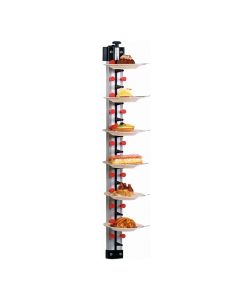
Vertical plate rack in stainless steel. Wall mounting. Capacity: 12 plates.
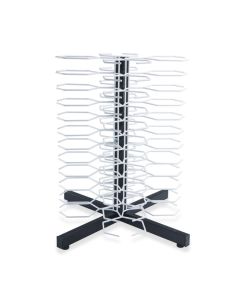
Painted steel plate rack column. Capacity 48 plates Ø cm 18-24. Height: 95 cm
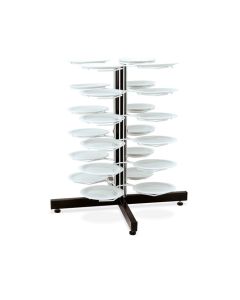
Painted steel plate rack column. Capacity 48 plates Ø cm 24÷31
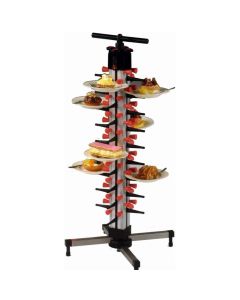
Vertical countertop plate rack in stainless steel Capacity: 36 plates.
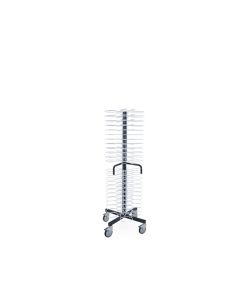
Vertical catering plate rack column in painted steel. Capacity: 96 plates Ø cm 18÷24.
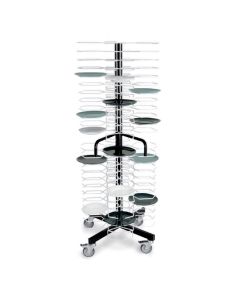
Painted steel plate trolley with a capacity of 96 plates Ø cm 24÷31.
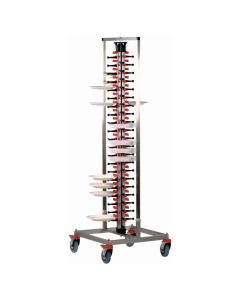
Vertical plate rack trolley on wheels made of rustproof material. Capacity: 84 plates.
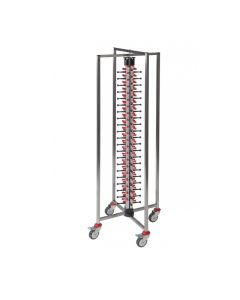
Vertical appetizer plate rack trolley on wheels in stainless steel, aluminum and plastic. Capacity: 84 plates/trays.
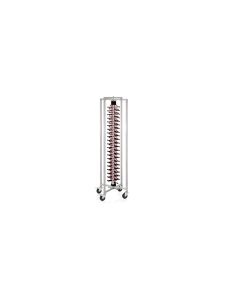
Plate rack column on wheels. Number of plates: 84. Dimensions: W.65 x D.59 x H.188 cm.
Professional plate racks are essential equipment for optimizing dining room service and managing workflows in high-end kitchens. Designed to meet the speed and precision requirements typical of the HoReCa sector, these tools allow for the temporary storage of ready courses, ensuring that every dish maintains its original presentation until the moment of serving. The use of a vertical plate rack radically transforms internal logistics, allowing kitchen staff to immediately clear work surfaces and waiters to clearly view the order of service, drastically reducing downtime between preparation and table service.
The vertical structure is designed to maximize load capacity while occupying minimal surface area, a critical factor in both compact kitchens and large production centers for catering. Thanks to the use of high-resistance materials such as stainless steel and technical polymers certified for food use, the plate racks ensure impeccable stability even when fully loaded. Whether managing cold appetizers at a ceremony or hot courses in a high-turnover restaurant, this equipment serves as the fundamental link for perfect coordination between the kitchen brigade and the dining room, elevating the quality standard perceived by the final guest.
Integrating a plate rack system into a catering business is not just a choice of technical furniture, but a real strategy for operational optimization. The primary advantage lies in the drastic reduction of horizontal footprint: in a context where space on the passes is often limited, being able to develop plate storage vertically allows for the simultaneous management of a greater number of orders. This is particularly evident during catering and banqueting events, where the need to serve hundreds of guests at the same time requires advance preparation and millimetric organization of the courses, which must remain protected and stable until the moment of service.
Another fundamental benefit concerns workplace safety and the prevention of breakage. Placing plates on special rubberized racks or shaped supports minimizes the risk of accidental slips that would occur by stacking dishes precariously. Furthermore, the vertical arrangement facilitates the final visual inspection by the chef, who can check the garnish of every single course without having to move the plates. The resulting sorting speed translates into reduced stress for the floor staff and a smoother service, where the heat of the dish is preserved thanks to the speed of movement guaranteed by the wheeled base of the mobile models.
The classification of plate racks is mainly based on the installation method and the mobility required by the work environment. Wall-mounted plate racks are fixed solutions, ideal for artisanal laboratories or kitchens with limited space, where every square inch of floor must remain clear; these vertical columns are firmly anchored to the wall, offering a safe and always-ready support station. Conversely, countertop plate racks are compact and portable versions, designed to be placed directly on the work surface or near the plating area, serving as a temporary accumulation buffer for small restaurants during peak evening service hours.
The most high-performance solution for large-scale catering is represented by wheeled plate trolleys. These models feature an extremely robust self-supporting structure and swivel wheels with brakes, allowing for the transport of dozens of plates from the preparation area to the dining room or refrigerated cell in a single movement. Some versions feature adjustable arms that allow the rack to be adapted to plates of different shapes and diameters, from classic deep plates to square plates for modern appetizers. There are also specific models with a refined aesthetic design, created to be placed in plain sight in buffets or ceremony halls, where the equipment itself becomes an integral part of the event's scenography.
The selection of the ideal plate rack must be guided by the average volume of covers and the type of tableware used in the facility. A decisive criterion is the versatility of the supports: if the menu includes plates of different sizes, it is essential to opt for models with adjustable arms or adaptable spacers to prevent plates from wobbling during transport or, worse, not fitting into the slots. For catering businesses operating on uneven ground or needing to navigate ramps and thresholds, it is essential to check the quality of the wheels; these should have a generous diameter and be made of elastic rubber to absorb vibrations, thus protecting the stability of culinary decorations and sauces.
A common mistake to avoid is underestimating the ease of cleaning the structure. In an environment saturated with steam and grease like a kitchen, the plate rack must be made of materials that allow for deep and rapid sanitization; porous surfaces or those with too many visible joints are discouraged as they can become a breeding ground for dirt. Also consider the maneuvering space: a four-sided plate trolley allows access from every direction, facilitating simultaneous loading by two operators, but requires a larger parking area. Finally, evaluate the stability of the base: a low center of gravity is essential to prevent the load from tipping over when the trolley is moved at full capacity between restaurant tables.
Equipment intended for supporting ready-to-eat plates must comply with rigorous hygiene and safety standards, in line with HACCP protocols. It is mandatory that materials in direct or indirect contact with the dishes are certified for food use and do not release volatile substances or metallic residues. Stainless steel is the material of choice not only for its resistance but for its ability to withstand thermal cycles and washing with aggressive detergents without oxidizing. Plastic or rubber parts must be BPA-free and resistant to mechanical wear, ensuring that no cracks are created where bacteria could proliferate over time.
From a workplace safety perspective, plate trolleys must comply with standards relating to the stability of mobile structures. Wheels must be equipped with efficient locking systems to prevent unexpected movement during loading, while handles must be ergonomically designed to prevent excessive strain on the wrists and back of operators. Compliance with CE marking ensures that the product has been tested to withstand the declared loads without structural failure. Periodic maintenance, including checking the tightness of the arms and lubricating the wheel bearings, is essential to keep the equipment safe and high-performing, protecting both the financial investment and the health of the employees.
Explore all the products in the category and compare the available solutions to find the one best suited to your operational context.
A vertical plate rack allows you to exploit the height of the kitchen, freeing up work surfaces for active preparation. This system prevents the disorganized accumulation of plates, reduces the risk of accidental breakage, and allows for better visual organization of orders, speeding up the transition of courses from the kitchen to the dining room.
Yes, the most advanced models are equipped with adjustable arms or pins that adapt to round, square, or rectangular plates. It is possible to vary the distance between the supports to accommodate both thin appetizers and deep plates or dishes with high edges, ensuring optimal stability for every type of porcelain.
To guarantee hygiene, it is essential to choose models made of stainless steel or certified plastic materials. After each service, the structure must be sanitized with suitable detergents. Many plate trolleys are designed to be easily washed with water jets, avoiding the accumulation of organic residues in the joints of the support arms.
Professional plate trolleys use non-marking gray rubber or high-quality polyurethane wheels. These wheels are specifically designed not to leave black streaks or permanent marks on delicate floors such as marble, parquet, or polished ceramics, while ensuring extremely silent movement.
While standard plate racks are neutral, there are specific versions equipped with thermal covers or integrated heating systems for trolley models. These solutions are ideal for large events where the time between plating and table delivery could compromise the ideal temperature of the hot course.
Installing a wall-mounted plate rack only requires a solid surface and the use of anchors suitable for the maximum weight expected at full load. It is a simple procedure that allows you to recover valuable space above the counters, but it is essential to check the flatness of the wall to ensure that the column remains perfectly vertical.
 English
  Italian
 French
 German
 Spanish