mon-fri 9-13 / 14.30-18.30
Stainless steel sanitaryware represents the standard solution for public and semi-public hygienic environments, from hospital and prison restrooms to recreational facilities and offices. Stainless steel guarantees corrosion resistance, ease of cleaning and long-term durability, essential characteristics in contexts where hygiene is critical and user traffic is high. Choosing the correct materials and types directly affects the functionality of the system, user safety and routine maintenance costs.
This material is particularly valued in the sector because it does not absorb bacteria, resists chemical agents used for disinfection and maintains a hygienic appearance even after years of intense use. Whether it is toilets, urinals, washbasins or shower trays, every stainless steel component contributes to creating public environments that comply with current regulations and are sustainable from a management perspective.
Stainless steel offers concrete technical advantages that emerge daily in environments subject to high hygienic and mechanical stress. Corrosion resistance eliminates the need for frequent replacements, reducing management costs in the medium-to-long term, while the non-porosity of the material prevents the proliferation of microorganisms even in corners and joint areas. In public restrooms of hospitals, penitentiaries, railway stations and recreational facilities, stainless steel sanitaryware guarantees a constant level of hygiene without compromise. Ease of cleaning with standard detergents and chemical disinfectants accelerates daily sanitization operations, a determining factor when the number of users is high.
From an aesthetic and functional point of view, stainless steel conveys a message of cleanliness and professionalism, a significant factor in public contexts where the image of the facility reflects the quality of the service. Extreme durability means that the initial investment is quickly amortized, especially when compared to traditional materials that require more frequent routine maintenance. Furthermore, stainless steel does not require recurring painting or protective treatments, an important aspect in environments where the cleaning frequency is daily and aggressive chemical products are the norm.
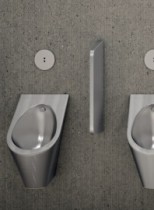
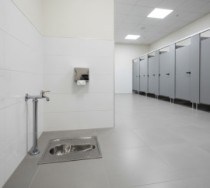
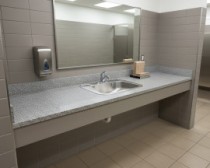
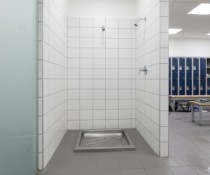
The catalog of stainless steel sanitaryware for public restrooms includes several categories, each designed for specific functional and regulatory needs. Stainless steel squat toilets remain common in penitentiaries and facilities where hygiene policies require solutions without direct body contact with the bowl; these models are made in a single cast piece, eliminating joints where dirt and bacteria can accumulate. Traditional stainless steel toilets and urinals represent the standard alternative, available in floor-mounted or wall-hung versions, with mechanical or electronic flushing systems. Stainless steel washbasins and washbasin columns complete the offer with solutions for preparation and personal hygiene areas, while stainless steel shower trays guarantee a smooth and non-slip surface, essential in contexts where humidity is constant.
Each type varies in terms of dimensions, flush configurations, mounting systems and finish level. Some models are specifically designed for accessibility, respecting disability regulations with adequate maneuvering spaces and integrable safety handles. The main difference between types also lies in the quality of the alloy used: AISI 304 steel is standard for normal environments, while AISI 316 is recommended in areas with greater exposure to humidity, sea salt or particularly aggressive chemical agents. Wall-hung versions, although costing more than floor-mounted versions, facilitate cleaning under the fixture and reduce dirt accumulation points.
Choosing the appropriate stainless steel sanitaryware depends on multiple technical and regulatory factors that must be evaluated before purchase. The first parameter is the type of facility: hospitals, penitentiaries, public offices and recreational facilities have different needs in terms of usage capacity, cleaning frequency and hygienic protocols. A hospital might require toilets with non-contact flush systems and automatic antibacterial disinfectants, while a prison might prefer anti-vandalism squat toilets without moving parts. Space availability and the existing plumbing configuration influence the choice between wall-hung and floor-mounted models: wall-hung models take up less space and simplify cleaning, but require suitable walled structures for mounting.
A frequent error is overlooking the quality of the stainless steel alloy: although all sanitaryware is stainless steel, not all have the same resistance to corrosion. In environments with high humidity, acid vapors or exposure to salt, AISI 316L steel is mandatory to guarantee durability. Flush systems must also be considered: mechanical models are robust but require maintenance, while electronic systems with sensors allow non-contact hygiene but depend on the power supply. Compatibility with automatic disinfection systems is critical in medical environments; some models support integrated showers and sprays, others require separate installations. Finally, checking compliance with accessibility regulations (public toilets for the disabled) is essential if the facility must meet inclusion requirements.
Stainless steel sanitaryware for public restrooms must comply with specific regulations that vary depending on the sector and the nation. In Italy, Ministerial Decree 236/1989 governs the technical specifications for accessible public restrooms, including minimum dimensions, mounting heights and safety systems. Hospital facilities also follow the Guidelines of the Higher Institute of Health (ISS) which require non-porous materials that are easily sanitizable and resistant to chemical disinfectants. For penitentiary institutions, the Department of Penitentiary Administration imposes stringent standards on anti-vandalism and hygiene, pushing towards configurations without moving parts and with rounded edges.
The UNI EN 997 certification defines construction and safety requirements for toilet flush bowls, while UNI EN 812 applies to seats. The quality of the steel must be verified according to ISO 1035, guaranteeing corrosion resistance in aggressive environments; the surface finish must prevent bacterial biofilm and facilitate disinfection with sodium hypochlorite and alcohol. Public environments with high frequency of use must provide flush systems with adequate flow to avoid recurring blockages. Furthermore, in the case of medical facilities, it is mandatory to check compatibility with specific disinfectants (e.g. glutaraldehyde) to ensure that the material does not undergo chemical degradation. CE marking is a minimum prerequisite for any product intended for the European market, guaranteeing that the manufacturer has followed conformity assessment procedures.
Explore all products in the category and compare the available solutions to find the one best suited to your operational context. Evaluate technical specifications, mounting types and certifications to ensure regulatory compliance and long-term durability.
AISI 304 is standard for normal environments, while AISI 316 contains molybdenum and resists corrosion better in humid, saline environments or those with aggressive chemical agents. For hospitals and coastal areas, 316 is recommended; for standard offices, 304 is sufficient.
Wall-hung models facilitate cleaning under the fixture and reduce dirt accumulation points, but require suitable walled structures. Floor-mounted models are more stable and economical. The choice depends on the available space and the required sanitization frequency.
Most disinfectants (sodium hypochlorite, alcohol, quaternary ammonium compounds) are compatible with AISI 304 and 316 stainless steel. Avoid prolonged strong acids and pure concentrated bleach. Always check the sanitaryware manufacturer's instructions.
Stainless steel squat toilets without moving parts are preferred for their robustness and difficulty of vandalism. They are made in one piece, without removable seats and covers, with reliable mechanical flushing even under high-use stress.
Maintenance is minimal compared to traditional sanitaryware. Daily cleaning with water and neutral detergents is sufficient. No recurring painting or special protective treatments are needed, significantly reducing management costs over time.
Wall-hung models facilitate cleaning and reduce dirt areas, ideal for high-frequency environments and daily sanitization. Floor-mounted models occupy less structural space and cost less. Evaluate the existing plumbing configuration and the expected number of daily users.
Ministerial Decree 236/1989 governs minimum dimensions, mounting heights (80-85 cm for the seat) and safety systems. Sanitaryware must allow wheelchair maneuvering (minimum space 150x150 cm) and provide stable, non-slip handles.
No, stainless steel is non-porous and does not absorb odors or bacteria. This property makes it ideal for hygienic public environments. The smooth surface prevents biofilm and facilitates disinfection, maintaining a constant hygienic level even with less frequent cleaning.
 English
  Italian
 French
 German
 Spanish