mon-fri 9-13 / 14.30-18.30
Equipping spaces intended for compulsory education requires a deep understanding of modern learning dynamics, where the classroom is no longer a static place but a flexible ecosystem. Primary and secondary school furniture must meet rigorous criteria for durability, ergonomics, and modularity, supporting students during a crucial phase of physical and cognitive growth. Choosing professional components means ensuring workstations that respect postural health, preventing musculoskeletal disorders resulting from intensive and prolonged use of seats and desks that do not comply with international ergonomic standards.
In this context, professional technical furniture stands out for the integration of traditional solutions with advanced technological supports, necessary for contemporary digital teaching. The durability of materials, such as scratch-resistant laminate tops and painted steel structures, ensures that the school facility's investment remains intact for decades, resisting the typical stresses of school life. Each element, from interactive whiteboards to modular desks, is designed to create an environment that fosters concentration, collaboration, and the general well-being of students and teachers, positioning the school as a safe and cutting-edge center of educational excellence.
Purchasing specific furniture for elementary and middle schools guarantees structural protection that generic solutions cannot offer. Professional design focuses on mechanical stability and passive safety: every desk and chair is subjected to load and fatigue tests that simulate years of daily use. This is essential for preventing accidental injuries resulting from structural failure or tipping. Furthermore, the use of non-toxic materials with low volatile substance emissions ensures optimal air quality within classrooms, protecting students' health during long hours spent in closed environments.
Beyond safety, high-end school furniture promotes inclusivity and active participation. Modern primary school desks, for example, are often equipped with adjustment systems or geometric shapes that allow for the creation of collaborative work islands, essential for cooperative learning. Correct seat ergonomics reduce physical fatigue and improve attention levels, allowing students to maintain correct posture without conscious effort. Choosing certified products also means having furniture that is easily sanitized, an essential necessity for maintaining high health standards within public and private school institutions.
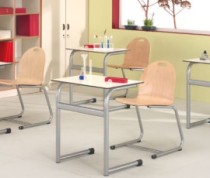
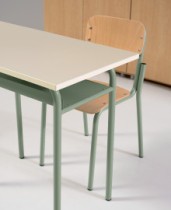
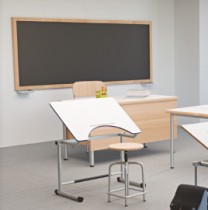
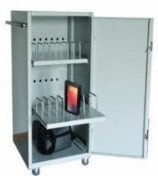
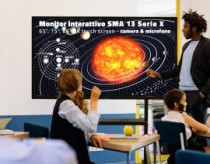
The product range is divided into several macro-categories to cover every logistical need of modern teaching. First, we find school desks, which range from traditional single-seater models to trapezoidal versions for creating group configurations. School chairs follow the same logic, available with ergonomic polypropylene or plywood shells, with fixed bases or on wheels for multimedia labs. A rapidly expanding sector is technological furniture, which includes IWB carts, charging stations for tablets and notebooks, and latest-generation boards (both magnetic and interactive), indispensable elements for a school that wants to digitize its educational processes.
There is no shortage of accessories for the organization of common and laboratory spaces: reinforced cabinets for storing scientific instruments, high-capacity bookcases for school libraries, and teacher desks equipped with security drawer units. Each type is available in different height classes (size scales), identified by standardized color codes, to adapt to the stature of students attending various educational cycles. The variety of finishes and colors also allows for customizing the aesthetics of classrooms, creating stimulating environments that reflect the institute's identity and improve the livability of educational spaces.
The selection of ideal furniture must begin with an accurate analysis of the available square footage and the number of students per classroom, always ensuring wide corridors for movement flows and safety in case of evacuation. It is essential to choose desks and chairs of the correct dimensional size according to anthropometric tables to prevent students from having to curve their backs or keep their feet suspended. A technical discriminating criterion concerns the choice of materials: for chemistry or art labs, tops resistant to acids and stains are necessary, while for standard classrooms, HPL laminate offers the best compromise between aesthetics and ease of cleaning, resisting frequent washing well.
Another critical factor is flexibility: current trends favor mobile and modular furniture that allows for quickly transforming a frontal lesson into a debate or group work. Attention must be paid to the quality of metal finishes, verifying that coatings are epoxy powder, resistant to impacts and peeling that could expose the underlying metal. A common mistake is neglecting the acoustic aspect; chairs equipped with noise-canceling and scratch-resistant glides are essential for maintaining the silence necessary for concentration in large classrooms. Finally, it is advisable to evaluate the availability of integrated accessories, such as backpack hooks and under-top book holders, which help maintain order and free space around the student's station.
Furniture for primary and secondary schools must comply with European standards UNI EN 1729-1 and 1729-2, which define functional dimensions and safety requirements. These standards establish rigid parameters for ergonomics, such as backrest inclination and work surface height, to prevent postural disorders during growth. In addition to dimensional compliance, the furniture must pass laboratory tests for resistance to bending, tension, and impact. In Italy, chemical safety is guaranteed by compliance with regulations on low formaldehyde emissions and the use of fire-retardant materials in accordance with fire prevention standards for school buildings.
The CE marking and certifications issued by accredited third-party bodies are fundamental guarantees for school heads and safety managers (RSPP). Desks and chairs must be free of sharp edges, and adjustment mechanisms must be protected to prevent accidental finger pinching. Every professional supply must be accompanied by detailed technical sheets and instructions for use and periodic maintenance. Compliance with these regulations is not only a bureaucratic obligation but a necessary condition to ensure a learning environment that protects the physical integrity of students and reduces the school's civil liabilities, promoting a culture of safety that starts right from the physical spaces of education.
Explore all products in the category and compare the available solutions to find the one best suited to your operational context.
Heights are regulated by the UNI EN 1729 standard and vary based on the average stature of students. For primary school, sizes 3, 4, and 5 are usually used, with seat heights between 35 and 43 cm and table tops between 59 and 71 cm. Respecting these measurements is fundamental to ensuring correct posture during growth.
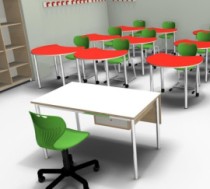
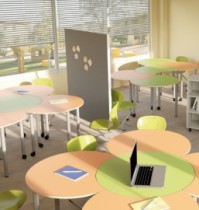
Traditional desks are usually rectangular and designed for frontal lessons. Modular desks have geometric shapes (such as trapezoidal or wedge-shaped) that allow them to be joined together to create collaborative work islands or circular tables. This flexibility allows the classroom to be adapted to different teaching methodologies in moments.
The most suitable materials are HPL plastic laminate or scratch-resistant melamine with ABS edges. These materials offer high resistance to scratches, ink stains, and impacts. Furthermore, they are very easy to sanitize with common professional detergents, guaranteeing the hygiene of workstations for the entire school year.
An ergonomic school chair is designed to support the natural curve of the spine and promote dynamic sitting. It must have a shaped shell that reduces pressure on the thighs and a flexible but robust backrest that follows the student's movements, decreasing physical fatigue and improving concentration capacity in the classroom.
An IWB cart is a mobile support designed to safely transport interactive whiteboards or large monitors between different classrooms. It is equipped with braked wheels, cable management systems, and height adjustment, allowing expensive technological resources to be shared across multiple classes and always ensuring the best visibility for students.
Fire safety is guaranteed by choosing furniture made with materials that have low smoke emissions and are certified fire-retardant. In particular, padded chairs or textile coverings must comply with current regulations (Class 1 IM). This ensures that, in case of emergency, the furniture does not fuel the spread of fire, protecting escape routes.
 English
  Italian
 French
 German
 Spanish