
mon-fri 9-13 / 14.30-18.30
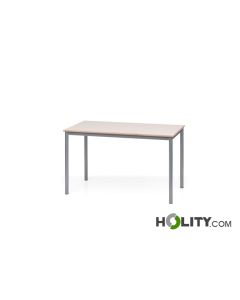
Professional canteen table 140x80 cm with melamine top and Ø40 mm steel legs. Robust and hygienic structure for canteens, schools and break rooms.
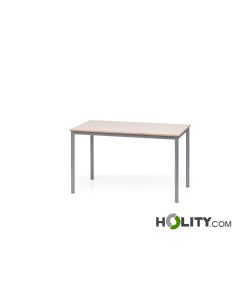
Multipurpose canteen table 160x80 cm, melamine top and Ø40 mm steel legs. Robust and sanitizable solution for catering and collective spaces.
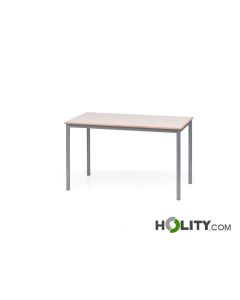
Multipurpose canteen table with 180x80 cm melamine top and Ø40 mm steel legs. Robust structure designed for intensive use in collective spaces.
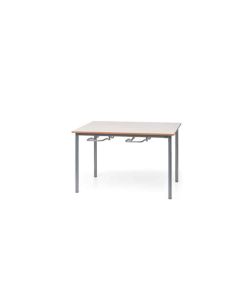
4-seater steel canteen table (120x80 cm) with integrated chair guides. Robust and space-saving structure ideal for refectories and school environments.
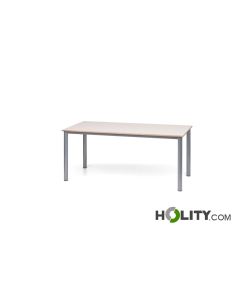
Multipurpose melamine table 180x80 cm with sturdy Ø60 mm steel legs, ideal for high-traffic canteens and collective spaces.
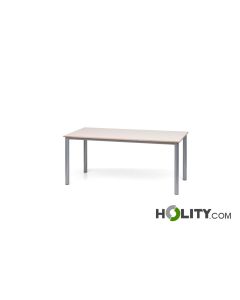
Multipurpose canteen table in steel and melamine, 200x80 cm. Ultra-robust structure with Ø60 mm legs for high-traffic collective environments.
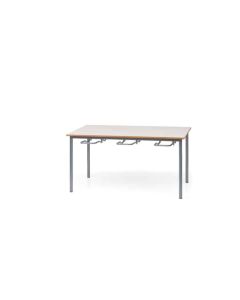
6-seater steel canteen table Ø40 mm, dimensions 160x80 cm. Includes integrated rails for chair attachment, ideal for intensive use in school environments.
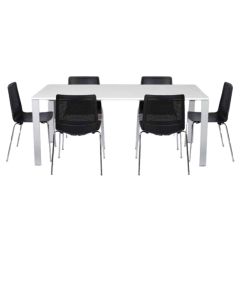
Dismountable canteen table in steel and water-repellent laminate 120x80 cm. Robust structure with leveling feet for offices, schools and universities.
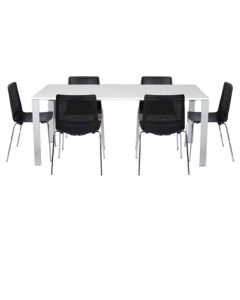
160x80 cm canteen table in steel and 19 mm thick water-repellent laminate. Structure with leveling feet, ideal for communal and school environments.
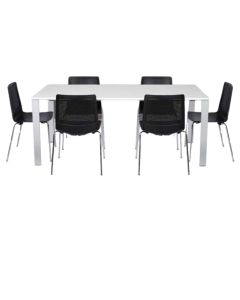
Canteen table in steel and water-repellent laminate, 180x80 cm. Reinforced structure with connecting beams and leveling feet.
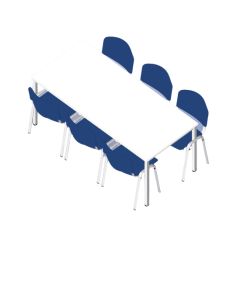
Professional canteen furniture kit with 180x80 cm melamine table and 6 stackable polypropylene and steel chairs. Certified and modular solution.
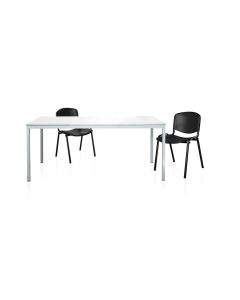
Professional canteen table in steel and laminate 180x80 cm. Robust tubular structure ideal for high-frequency collective and school environments.
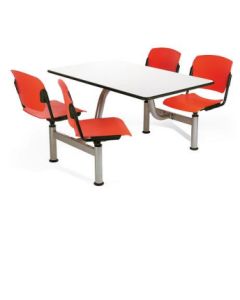
4-seater monoblock table with steel structure, 120x80 cm melamine top and polypropylene seats. Integrated solution for canteens and break areas.
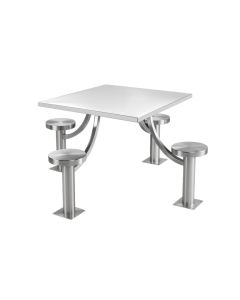
Monobloc canteen table h679_44 in AISI 304 stainless steel with 4 integrated seats. Vandal-proof 100x100 cm structure for high-traffic environments.
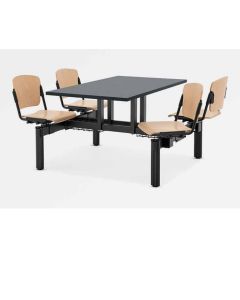
4-seater monoblock canteen table with integrated beech seats, black sheet metal structure and melamine top. Dimensions 188x120x88 cm.
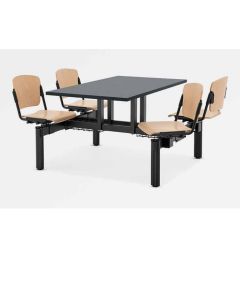
4-seater monobloc canteen table with beech swivel seats, black metal frame and melamine top (188x120 cm).
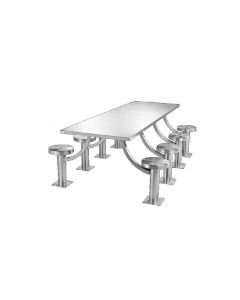
Anti-vandal table h679_52 with 8 integrated seats in satin AISI 304 stainless steel. Dimensions: 240 x 80 x H 75 cm. AISI 316 available on request.
Canteen monoblock tables represent an integrated solution that combines the table top and seating into a single structure, eliminating the need to manage multiple separate components. This furniture is specifically designed to meet the needs of high-traffic collective spaces, such as school refectories, corporate canteens, fast food outlets, and public facilities. The main feature lies in the monolithic configuration, which guarantees superior stability, ease of sanitization, and optimization of available space.
Structural rigidity is achieved through steel frames, metal alloys, or combinations of composite materials, while the tops can be made of melamine, water-repellent laminate, or stainless steel depending on the intended use. The integrated seats, generally made of polypropylene, treated wood, or steel, ensure ergonomic comfort and resistance to wear. This category of furniture is particularly common in environments where speed of service, low maintenance, and longevity are critical factors for the operating budget.
Adopting monoblock tables in collective catering environments brings a series of operational and economic advantages that directly impact daily management. Firstly, the integrated configuration drastically reduces cleaning and sanitization times, as there are no critical joints between the table and chairs where dust and residues can accumulate. This feature is particularly relevant in school and healthcare contexts where hygiene control is a regulatory requirement. Furthermore, the monolithic structure better resists concentrated loads and continuous movements typical of high-frequency environments, reducing the risk of differential settling and localized failures that would compromise ergonomics. From a space perspective, a monoblock table occupies about 15-20% less surface area than the equivalent combination of separate table and chairs, allowing for maximized seating density in restricted areas.
From a maintenance profile, the simplification of the number of moving components translates into lower service costs and a longer average lifespan. Fastening systems are concentrated on a few critical points, simplifying inspections and preventive interventions. For school facilities and day centers, the reduction of gaps between elements also represents a plus from a safety standpoint: narrow spaces where a limb could get caught are minimized, aligning with European regulations on entrapment prevention. Finally, the intrinsic stability of the monoblock naturally discourages chair-tilting behavior or accidental table tipping, phenomena common in environments frequented by children and teenagers.
The variety of canteen monoblock table types reflects the wide spectrum of functional and budget needs across different sectors. Entry-level models, made with Ø40-50 mm tubular steel structures and 18-25 mm thick melamine tops, represent the most economical solution and are suitable for school canteens and corporate break areas with moderate use. These tables, typically available in 120x80, 160x80, and 180x80 cm sizes, comfortably support 4-6 people and offer an optimal cost-benefit ratio for public facilities. Alongside this category, we find models with reinforced Ø60 mm steel structures and water-repellent laminate tops, designed for very high-traffic environments where the risk of spills and surface wear is significant. The 19 mm thick water-repellent laminate, resistant to water and aggressive detergents, guarantees superior durability even in critical conditions.
The premium segment includes AISI 304 stainless steel monoblock tables, suitable for healthcare facilities, professional kitchens, and environments where corrosion is a recurring issue. These models, while representing a higher initial investment, ensure an extended useful life of over 20 years without showing aesthetic degradation. Integrated seats range from molded polypropylene (more economical and water-repellent) to natural or painted beech wood (more elegant, but requiring maintenance). Specialized configurations also exist with swivel beech seats, designed for environments requiring flexibility in movement, and versions with guides for separate chairs that combine monoblock stability with the possibility of removing some seats to adapt the space. Complete table + 6 chair kits represent a hybrid solution: a structural table separate from the seats but supplied in a coordinated package to ensure aesthetic and functional compliance.
Selecting the most appropriate monoblock table requires a preliminary analysis of the facility's operational parameters. The first criterion to consider is the number and profile of users who will use the furniture simultaneously: a school canteen with scheduled shifts will have different needs than a corporate break room with irregular traffic. Secondly, it is necessary to evaluate the intensity of weekly use and the planned cleaning methods. If the facility applies daily sanitization protocols with steam or high pH detergents, materials like melamine are not recommended; water-repellent laminate or stainless steel become mandatory choices. Available space is a practical constraint often underestimated: a refectory with limited square footage needs tables with a small footprint and non-removable integrated seats, while a large canteen allows for more flexible configurations with detachable seats or larger tables (200x80 cm).
A crucial technical aspect concerns structural capacity and tube diameter. Tables with Ø40 mm legs are suitable for moderate dynamic loads (approx. 400-500 kg distributed); in the case of canteens frequented by adolescents or with aggressive usage behavior, Ø60 mm tubes are recommended to ensure a safety margin. The top material also affects thermal impact: a stainless steel top cools down quickly and can be unpleasant to the touch during winter periods, while melamine or wood maintain more pleasant temperatures. For extremely high-traffic environments, such as urban fast food outlets, stainless steel monoblock models represent the optimal compromise between hygiene, durability, and low maintenance. Common errors to avoid include underestimating the actual number of people per table (always consider 20-30% more capacity than initial data), purchasing models with non-removable seats when the space might need reconfiguration, and choosing standard materials in contexts where exposure to corrosive agents (salt spray, chlorine) is predictable.
Canteen monoblock tables, as furniture for collective spaces, must comply with a series of European and national regulations that guarantee structural safety, injury prevention, and hygiene. The EN 1022 standard (Seating and tables for collective use) defines the criteria for stability, resistance to horizontal and vertical stresses, and the wear resistance of materials. Specifically, stability is verified through static load tests (at least 1.5 times the maximum expected weight) and dynamic load tests simulating oscillating movements. For school facilities, the EN 1729-1 standard (Furniture for educational environments) establishes specific ergonomic dimensions based on the age of the users, with seat heights ranging between 35 and 46 cm according to the age group. The EN 71-1 standard (Safety of toys) applies indirectly to monoblock tables for kindergartens, requiring the absence of sharp edges with a radius less than 2.5 mm and critical distances to avoid finger or head entrapment.
From a hygienic-sanitary perspective, materials must meet the criteria of the EN 13130 standard (Plastics in contact with food) if the seats are in polypropylene intended for direct contact with food, and finishing materials must comply with the Directive 2004/42/EC on the reduction of atmospheric pollution, limiting emitted volatile organic compounds. For hospital and healthcare facilities, the absence of porosity and the ability to sanitize using high-temperature steam become critical parameters; in this context, AISI 304 stainless steel is practically mandatory. At the Italian national level, Legislative Decree 81/2008 (Safety in the workplace) requires that tables used in corporate canteens be stable and free of elements at risk of falling, while school facilities must comply with the guidelines of their respective Region, which often prescribe even stricter hygiene standards. CE certification of conformity is mandatory and must be provided by the manufacturer along with a declaration of conformity and a maintenance manual, specifying the correct methods for cleaning and sanitization.
Explore all products in the category and compare the available solutions to find the one best suited to your operational context. From entry-level melamine tables to premium stainless steel models, the proposed selection meets the needs of school canteens, corporate offices, public facilities, and high-traffic environments, with guaranteed regulatory compliance and technical support during the selection phase.
A monoblock table integrates the table and seats into a single rigid structure, reducing critical dirt accumulation points and improving stability and hygiene. Separate tables and chairs offer more flexibility in the space but require more complex maintenance and have more areas where residues can build up. The monoblock is ideal for high-traffic canteens with strict hygiene control.
AISI 304 stainless steel is the most resistant material to sanitization with steam and aggressive detergents, followed by 19 mm thick water-repellent laminate. Melamine is not recommended in environments where cleaning is daily and high-intensity, as the wood base deteriorates quickly with water and chemicals. For healthcare and hospital facilities, stainless steel is practically mandatory.
A monoblock table occupies about 15-20% less surface area than a traditional table with separate chairs, because the seats are integrated and do not require pull-out space. This space economy is particularly relevant in school canteens with limited square footage, where every square meter affects total capacity.
For primary and secondary schools, 160x80 cm (6 seats) or 180x80 cm (8 seats) models represent the optimal compromise between capacity and space management. Smaller dimensions (120x80 cm) are suitable for corporate break areas; larger tables (200x80 cm) require large refectories and are difficult to move for deep cleaning.
In standard models, the seats are fixed and not removable. However, hybrid configurations exist with integrated guides that allow the attachment/detachment of separate chairs, combining monoblock stability with reconfiguration flexibility. This option involves a slightly higher cost but is recommended for facilities that need space adaptability.
 English
  Italian
 French
 German
 Spanish