
mon-fri 9-13 / 14.30-18.30
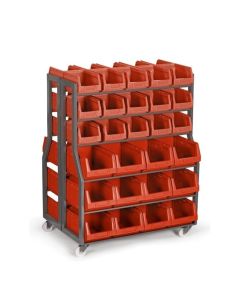
Mobile steel shelving with 56 polypropylene bins, perfect for organizing small parts and work materials. Dimensions: W 64 × D 54 × H 117 cm.
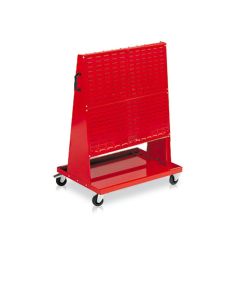
Sheet metal small parts trolley. Capacity: 300 kg.
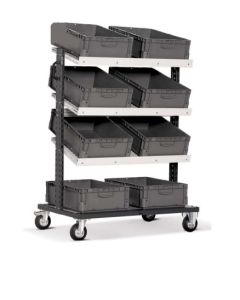
Hardware and screw trolley for workshops. Dimensions: 101.5 x 66.8 x h. 135.7 cm
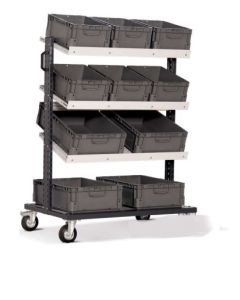
Steel small parts trolley. Dimensions: 101.5 x 66.8 x h. 135.7 cm
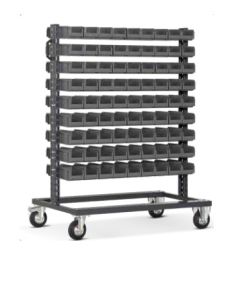
Small parts trolley for workshops. Load capacity: 150 kg.
Small parts trolley for workshops. Load capacity: 150 kg per side.
Small parts trolley for workshops. Capacity: 150 kg per side.
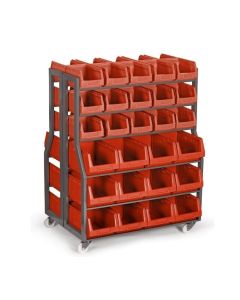
Mobile steel shelving with polypropylene bins, 30 four-liter and 24 ten-liter units. Dimensions: W 88 × D 60 × H 120 cm.
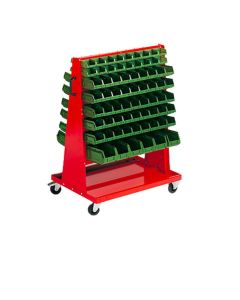
Small hardware parts trolley for workshops. Load capacity: 300 kg. Dimensions: W. 101 x D. 69 x h. 130 cm.
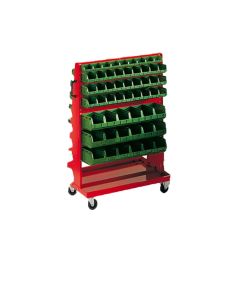
Small parts storage trolley in sheet metal. Load capacity: 300 kg. Dimensions: W. 101 x D. 69 x h. 130 cm.
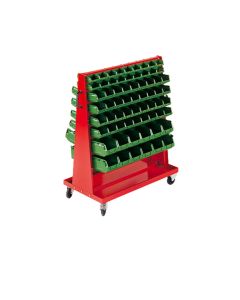
Small parts trolley in sheet metal. Load capacity: 300 kg.
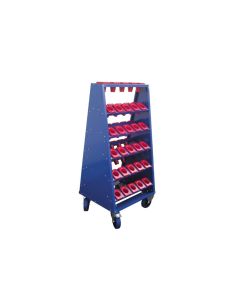
Metal trolley in steel sheet for the transport of 55 bushings. Blue rubber wheels Ø 125 mm. Dimensions: W 70 x D 60 x H 145 cm.
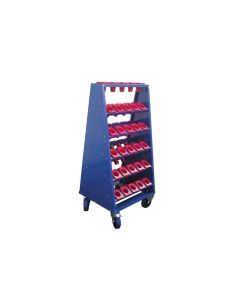
Steel sheet trolley for transporting 66 bushings. Blue rubber wheels Ø 125 mm and ergonomic handle. Dimensions: W 70 x D 60 x H 145 cm.
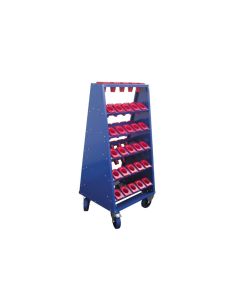
Steel sheet metal trolley, designed for the transport of 77 bushings. Blue rubber wheels Ø 125 mm and ergonomic handle. Dimensions: W 70 x D 60 x H 145 cm.
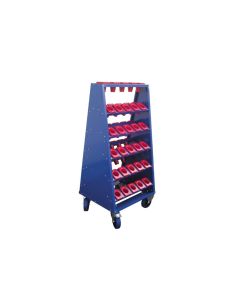
Steel sheet trolley, designed for the transport of 88 bushings. Blue rubber wheels Ø 125 mm and ergonomic handle. Dimensions: W 70 x D 60 x H 145 cm.
Small parts storage trolleys represent a fundamental solution for logistical organization in industrial, artisanal, and maintenance work environments. These tools allow for the centralization of components, hardware, small tools, and consumables, significantly reducing search times and increasing operational efficiency. A well-sized small parts storage trolley contributes directly to personnel productivity by limiting unnecessary movements and keeping inventory of small parts critical for production process continuity under control.
Choosing a trolley suitable for specific business needs requires careful evaluation of the maximum load capacity, available dimensions, the number and type of containers, as well as ease of movement. In the HoReCa sector, manufacturing industry, specialized workshops, and maintenance centers, these trolleys prove indispensable for managing complex workflows where rapid component availability directly affects the final quality of the service.
Small parts storage trolleys offer concrete operational advantages in any work context where it is necessary to manage small components. The main utility lies in the rational organization of space, allowing for the storage of hundreds or thousands of pieces in a confined area, easily accessible to all operators. This aspect is particularly critical in mechanical workshops, where screws, bolts, washers, and threads must be quickly findable without compromising storage safety. The mobile structure of the trolley also eliminates the need for fixed installations, allowing for rapid adaptation of the space layout based on the evolution of production processes.
A second tangible benefit concerns the reduction of management costs and the prevention of obsolescence of stored materials. With a small parts storage trolley, it is possible to maintain constant visibility of stock, avoiding unnecessary purchases or oversights that would lead to duplicates and waste. The ease of movement also allows the trolley to be moved to the work point, minimizing downtime related to retrieving material. In high-density operational environments, such as assembly lines or repair laboratories, this factor significantly impacts the speed of completing assigned tasks.
The market for small parts storage trolleys offers diversified solutions aimed at meeting specific needs for capacity, modularity, and configuration. The most common type is that with removable polypropylene bins, made in various sizes (from 4 liters up to 10 liters and more) and assembled on painted steel structures. These models combine lightness, strength, and ease of cleaning, essential characteristics in the agri-food, pharmaceutical, and industrial maintenance sectors. Another significant variant is represented by trolleys with fixed metal bushings, specifically designed for the storage of textile cones and bobbins, common in spinning mills and weaving laboratories; these trolleys usually feature a pressed steel sheet structure and large diameter rubber wheels to ensure stability on irregular surfaces.
There are also hybrid trolleys with a combination of fixed drawers and removable elements, which offer maximum configuration flexibility. Some models include ergonomic handles, particularly useful in environments where staff must perform frequent pushing or pulling maneuvers, while others have a more compact structure, ideal for narrow workspaces. The choice between common steel sheet and stainless steel depends on the operating environment: stainless steel is preferable in contexts at risk of corrosion, such as chemical laboratories, professional kitchens, or areas with high relative humidity. Each type also features variants in external dimensions and maximum allowable capacity, allowing users to select the model that perfectly fits their specific working conditions.
Choosing a small parts storage trolley requires a systematic evaluation of the critical parameters that influence compatibility with actual use. The first element to consider is the maximum load capacity required, expressed in kilograms and referring to the total load the trolley must support during ordinary operations. A trolley with insufficient capacity risks structural failure or premature damage, while an oversized one leads to economic waste and handling difficulties. To correctly determine the capacity, it is necessary to estimate the average weight of the stored material, also considering temporary accumulation peaks during intense work cycles. An often overlooked aspect concerns the physical dimensions of the trolley in relation to the available space: width, depth, and height must be compatible with circulation aisles, storage area access, and the maximum tolerable footprint within the workstation.
A second level of choice concerns the type and number of containers optimal for the specific workflow. Environments where the hardware is extremely heterogeneous (for example, generalist workshops working on multiple families of components) benefit from trolleys with bins of different sizes, while laboratories specialized in few types of components can opt for uniform and standardized configurations. It is also fundamental to evaluate the visual accessibility of components: transparent or semi-transparent drawers facilitate quick recognition without the need for repeated opening. Ease of cleaning and hygiene represents a decisive criterion in the food, pharmaceutical, and medical sectors; in these contexts, removable polypropylene materials offer clear advantages over fixed configurations. Finally, the quality and type of wheels deserve attention: low rolling resistance rubber reduces operator fatigue, while larger diameters ensure overcoming obstacles and floor irregularities without excessive difficulty.
Small parts storage trolleys, although not lifting equipment as such, are subject to specific regulatory requirements based on the operating context and national legislation. In Italy and European countries, compliance with safety standards is mandatory to ensure structural integrity and accident prevention. The UNI EN 1808 standard governs safety requirements for non-motorized hand trolleys, establishing criteria for stability, material strength, braking, and marking. In the food and pharmaceutical sectors, HACCP regulations and directives relating to food contact further apply: in these cases, the materials constituting the trolley must be certified as suitable for direct or indirect contact with edible and pharmacological substances.
Structural safety represents a critical aspect: each trolley must clearly summarize the maximum allowable capacity, self-weight, correct use conditions, and operational limits. In medical and hospital sectors, where the trolley may enter sterile areas, ease of sanitization becomes a binding regulatory requirement, therefore materials must be hydrophobic, resistant to common disinfectants, and free of hidden areas where microorganisms can accumulate. Braking represents a fundamental safety element, especially in environments with slopes: many professional trolleys include pedal-controlled brakes that immobilize at least two wheels simultaneously. Regarding labeling, legislation requires each trolley to bear permanent marking with identification data, maximum capacity, date of manufacture, and, where applicable, CE certification of compliance with machinery directives.
Explore all the products in the category and compare the available solutions to find the one best suited to your operational context.
A small parts storage trolley is a mobile structure equipped with removable drawers or compartments, designed for the storage and transport of small components, such as screws, bolts, washers, and assorted materials. It is widely used in mechanical workshops, laboratories, assembly plants, and industrial maintenance environments to centralize material availability and reduce search times.
The correct capacity is determined by multiplying the average weight of the stored material by the number of full drawers that will be loaded simultaneously. Add a safety margin of 20-30% to the calculated value. For most workshop uses, a minimum capacity of 150 kg per side is recommended, while for larger storage needs, models with 300 kg total capacity are preferable.
Trolleys with polypropylene bins are ideal for general small parts storage due to their lightness and ease of cleaning; metal bushings are specifically designed for textile cones, bobbins, and tubular components. The choice depends on the nature and shape of the components to be stored.
Measure the width, depth, and height of the available space, including circulation corridors. Check the trolley dimensions in the technical catalog and mentally simulate the positioning, considering margins for opening drawers and operator movement. Allow at least 5-10 cm on each side to ensure maneuverability without obstacles.
Standard rubber wheels are effective on flat, smooth floors; on irregular, rough surfaces or those with frequent obstacles, larger diameter wheels (125 mm or more) are preferable. For raw concrete or asphalt floors, choose reinforced tires with larger diameters. Environments with continuous vibrations require shock-absorbing bearings.
Check for CE marking, compliance with UNI EN 1808 for non-motorized trolleys, and indication of maximum capacity and self-weight. In the food or medical sectors, request specific certifications for suitability for contact. Ensure the trolley is accompanied by use and maintenance instructions in English.
Removable drawers allow for better logistical organization, ease of cleaning, and quick replacement in case of damage, making them preferable for dynamic environments. Fixed compartments require less maintenance but offer less flexibility. For intensive professional use, removability represents a significant productivity advantage.
Yes, a quarterly inspection of wheels, bearings, brakes, and structure is recommended to detect wear or deformation. Regularly clean and lubricate the wheels and ensure that the load never exceeds the declared maximum capacity. Replace damaged components immediately to prevent accidents.
 English
  Italian
 French
 German
 Spanish