
mon-fri 9-13 / 14.30-18.30
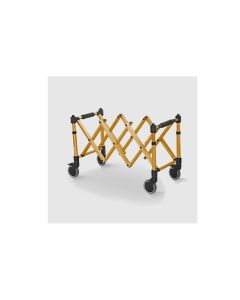
Folding aluminum funeral cart, 300 kg capacity. Made in Italy, lightweight and silent. Available in silver or bronze. Open dimensions: 108 x 48 x 55 cm.

Silver aluminum funeral trolley, foldable and lightweight. Capacity: 300 kg, wheels Ø 20 cm. Made in Italy design and technology for professional use.
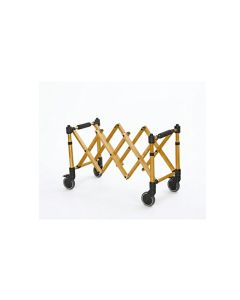
Aluminum funeral trolley h687_94, bronze finish. Capacity: 300 kg, wheels Ø 20 cm and closed thickness of only 13 cm. Silent design and Made in Italy.
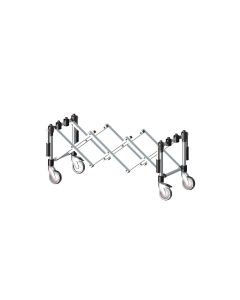
Folding coffin trolley in aluminium and stainless steel. Load capacity: 300 kg, 12.5 cm wheels and closed footprint of only 13 cm. Professional product Made in Italy.

Folding funeral trolley in aluminum and stainless steel. Load capacity: 300 kg, compact (13 cm folded) and produced in Italy for coffin transport.
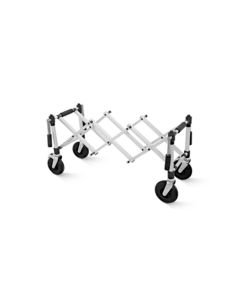
Folding funeral trolley in aluminum and stainless steel. Load capacity 300 kg, 20 cm wheels and folded thickness of only 13 cm. Professional Italian production.
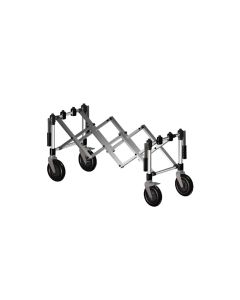
Professional coffin trolley in aluminum and stainless steel. Capacity: 300 kg, Ø 20 cm wheels and closed thickness of 13 cm. Made in Italy, silver finish.
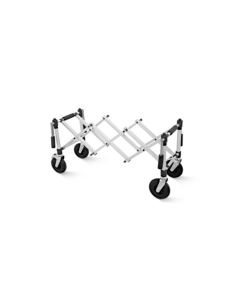
Extensible and foldable funeral trolley in aluminum and stainless steel. Load capacity 300 kg, 20 cm wheels and folded thickness of only 13 cm. Made in Italy.

Extendable coffin trolley up to 1.66 m in aluminum and stainless steel. Capacity: 280 kg, wheels Ø 20 cm and 180° rotating handles. Available in silver, bronze, or black.
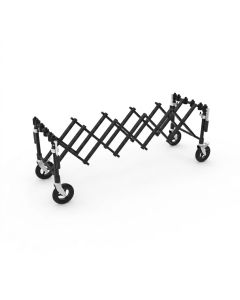
Multi-level church truck in aluminum and stainless steel. Capacity: 454 kg, 4 adjustable lengths and 4 heights. Wheels: Ø 20 cm, made in Italy, black color.
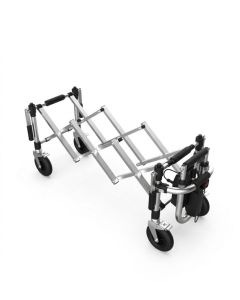
Motorized funeral trolley h687_92 in aluminum. Includes 18V battery, charger and remote control for electronic lifting. Load capacity 300 kg.
The handling of caskets represents one of the most delicate and critical operations within the funeral sector, requiring equipment that combines mechanical strength, aesthetic discretion, and maximum operational safety. A casket trolley is not just a simple logistical support, but a professional tool designed to facilitate the transport of the body in heterogeneous contexts, while ensuring the necessary decorum during the farewell ritual. Choosing an appropriate funeral trolley allows operators to manage significant weights with minimum physical effort, preventing workplace injuries and ensuring the fluidity of movement essential in restricted or solemn environments.
This equipment must meet precise construction standards to support variable loads, maintaining impeccable stability on different types of flooring, from church marble to the parquet of funeral homes. The integration of high-quality locking systems and swivel wheels defines the reliability of a coffin trolley, making it a strategic investment for funeral agencies aiming for excellence in service. Our selection includes fixed, folding, and extendable solutions, designed to adapt to every phase of the funeral service, from recovery to the final ceremony.
Adopting a professional-grade funeral trolley is essential to guarantee the dignity of the service and protect the health of the undertakers. Manual handling of loads is one of the main causes of musculoskeletal disorders in the funeral sector; therefore, the use of a coffin trolley equipped with high-smoothness bearings and reinforced structures drastically reduces the physical impact during transport. In addition to the ergonomic aspect, structural stability avoids dangerous oscillations or annoying noises that could disturb the solemnity of the moment, offering a perception of extreme care and professionalism to the family of the deceased.
In operational contexts such as funeral homes or the home of the deceased, where spaces can be narrow and maneuvers limited, the use of specific trolleys for coffin handling ensures smooth management of architectural obstacles. A high-quality funeral trolley is built with corrosion-resistant materials that are easy to sanitize, thus also responding to health and long-term maintenance needs. Choosing a certified support means investing in a tool that does not yield under extreme loads and maintains its functional characteristics even after years of intensive use in different climatic conditions.
The landscape of handling equipment offers several variants, each optimized for a specific phase of the ritual. The extendable funeral trolley is undoubtedly one of the most versatile models, as its accordion structure allows for reduced bulk during transport in the van and adapts to the specific length of the coffin once opened. These models are usually made of anodized aluminum or chromed steel, materials that offer an excellent ratio between lightness and load capacity, making them ideal for rapid transport and setup in private locations or chapels of rest.
For static display and movement within ceremonial environments such as churches, coffin handling trolleys with more elegant finishes and wheels equipped with independent foot brakes are often preferred. There are also variants with fixed or adjustable heights, designed to facilitate the passage of the casket from the hearse to the support or to position the coffin at the optimal height for the wake. Casket trolleys can be equipped with top rollers to facilitate the sliding of the wood without scratching it, or with non-slip surfaces that guarantee a firm grip of the casket even during movements on inclined or irregular surfaces.
The selection of a coffin trolley must be based primarily on the analysis of the prevailing environment of use and the frequency of transport carried out by the company. If the service mainly takes place in historical centers with the presence of stairs or small elevators, it is essential to aim for an extendable and lightweight funeral trolley, which can be easily moved by a single operator when empty. On the contrary, for use within a crematorium or a large funeral home, priority must be given to structural robustness and wheel size: larger diameter wheels more easily overcome small level differences or wide gaps in stone floors, ensuring transport without jolts.
A common mistake is underestimating the maximum load capacity declared by the manufacturer, especially considering the current trend toward coffins of non-standard sizes and weights. It is essential to verify that the chosen casket trolleys have a reliable wheel locking system, fundamental when the support is positioned on slight slopes or during the stop in church. Furthermore, ease of maintenance and the availability of spare parts for components subject to wear, such as rubber bumpers or extension joints, represent technical decision criteria that distinguish a budget product from a professional solution intended to last over time in the agency’s equipment fleet.
Equipment intended for the funeral sector must respond to rigorous workplace safety criteria, in compliance with European directives regarding the manual handling of loads. Every funeral trolley must be accompanied by a certification of conformity attesting to its maximum load capacity and dynamic stability, ensuring that the tool does not deform or collapse under stress. Operator safety is guaranteed by the absence of sharp edges and the presence of ergonomic handles or secure grip points that avoid finger crushing during the opening and closing phases of extendable models.
From a hygienic-sanitary point of view, the materials constituting the casket trolleys must allow for frequent disinfection cycles with specific chemical agents, without undergoing oxidation or surface degradation processes. Compliance with safety and decorum standards is also fundamental for access to places of worship and healthcare facilities, where the equipment must operate silently and discreetly. Compliance with these requirements is not only a regulatory obligation, but a guarantee of quality that protects the image of the funeral home and ensures the performance of the service in full compliance with current laws regarding health and safety in the workplace.
Explore all products in the category and compare the available solutions to find the one best suited to your operational context.
An extendable funeral trolley is a telescopic accordion-style support designed for handling coffins of different sizes. The main advantage lies in its extreme compactness when closed, allowing easy storage in funeral vans and convenient transport to the place of death or funeral homes.
Professional casket trolleys must guarantee a minimum safety load capacity of 250 or 300 kilograms. This capacity ensures that the support can stably sustain both the weight of the solid wood coffin and that of the body, preventing dangerous structural failures during movement or wake phases.
Yes, high-quality coffin handling trolleys are equipped with non-marking rubber wheels and shielded ball bearings. These features allow operation on fine surfaces such as church marble or parquet in the deceased’s home without leaving marks, scratches, or producing annoying metallic noises.
Maintenance of a funeral trolley involves periodic cleaning with neutral detergents and lubrication of moving mechanical parts. It is essential to regularly check the integrity of the wheels and the tightness of the bolts, verifying that the locking systems and brakes respond promptly to always ensure maximum operational safety.
The casket trolley is equipped with wheels to facilitate the dynamic transport of the coffin between different environments, while the fixed support is intended exclusively for stationary use. Many operators prefer the trolley for its versatility, as it can serve as both a base for the funeral parlor and a tool for movement toward the hearse.
Although they are mainly designed for indoors, funeral trolleys can be used outdoors on paved or asphalted paths within cemeteries. In case of uneven ground or gravel, it is advisable to opt for models with larger diameter wheels that offer better stability and reduce the effort required for pushing.
 English
  Italian
 French
 German
 Spanish