
mon-fri 9-13 / 14.30-18.30
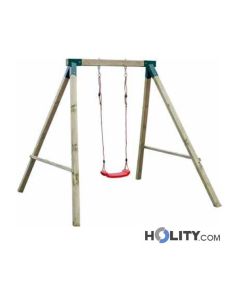
Single swing in pressure-treated pine, dimensions 160x230x195 cm. Sturdy structure for private use in gardens, terraces, and courtyards.
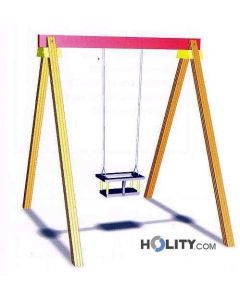
Children swing with child seat. Scandinavian pine wood ì. Dimensions: 220x208x230 cm
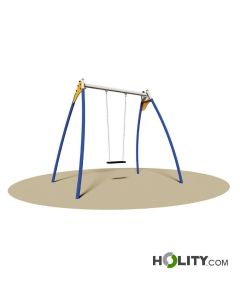
Single-seat playground swing. Flat seat. Age of use: 3-12 years.
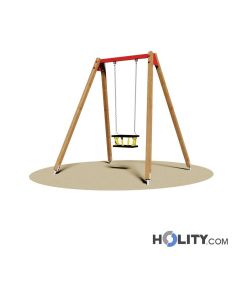
Single-seater swing with cradle seat. Pine wood structure. Available for inground or surface mounting. Dimensions: L200 x D190 x H230 cm
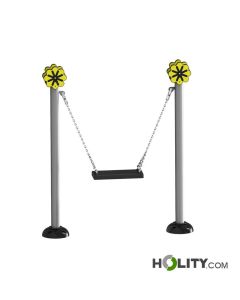
Mini single swing h975_18 for public play areas. Compact structure made of resistant materials, flat seat, and stable installation on concrete.
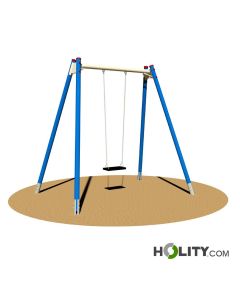
Single-seat swing for children between 3 and 12 years old. Dimensions: W. 286 x D. 201 x h. 280 cm
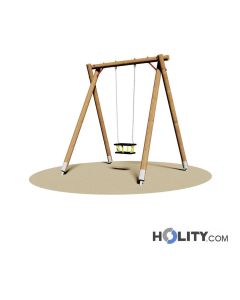
Pine wood swing for furnishing parks and gardens. Available with flat or cradle seat. Dimensions: W250 x D240 x H275 cm
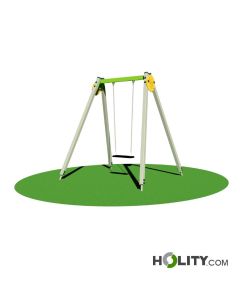
Galvanized steel playground swing. With 1 seat. Flat seat.
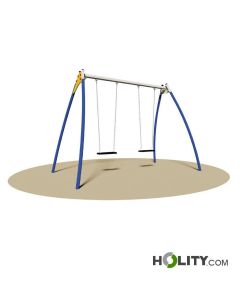
Two-seater playground swing. Flat seat. Age of use: 3-12 years.
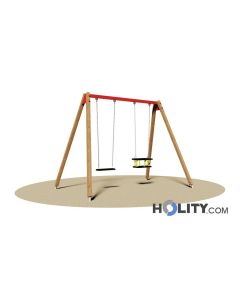
Playground swing with 2 seats, one flat and one cradle seat. Dimensions: W.300xD.190xH.230 cm.
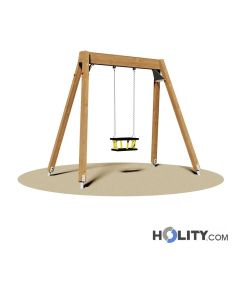
Swing with cradle seat for children from 0 to 4 years old. Available in the version for underground installation or floor level installation. Dimensions: W265 x D160 x H230 cm
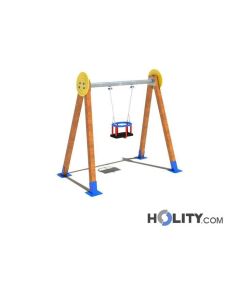
Professional single swing for nurseries and parks, wooden and galvanized steel structure with shock-proof cradle seat. UNI EN 1176 certified.
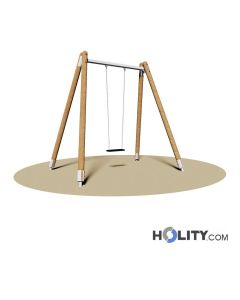
Swing to enrich outdoor play areas. With flat seat. Dimensions: W270 x D180 x H265 cm
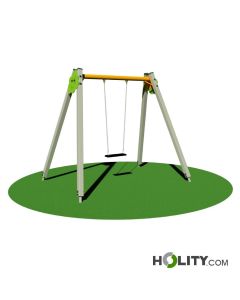
Playground swing with flat seat. 1-seater swing.
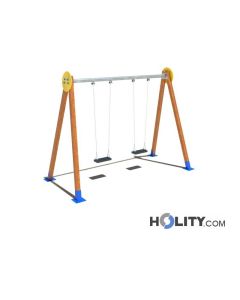
Double swing for public parks in wood and steel, L361xW167xH270 cm. UNI EN 1176 certified structure with anti-trauma rubber seats.
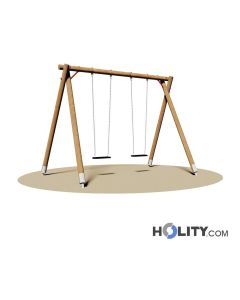
Wooden playground or public space swing, for children aged between 3 and 12 years. Max overall dimensions: L365 x D240 x H275 cm
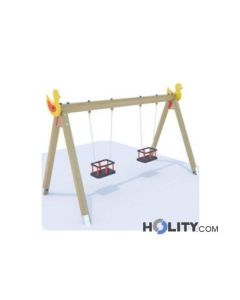
Professional two-seater swing h27107 made of Nordic pine wood. Includes safety cradle seats, ideal for public parks and schools.
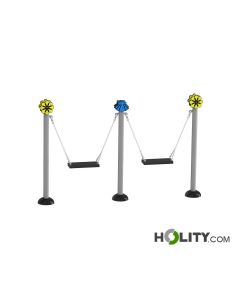
Professional double mini swing for early childhood, 240x31x153 cm. Compact and safe structure, ideal for small spaces in parks and schools.
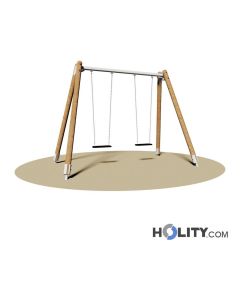
2-seater playground swing with galvanized steel and Nordic pine wood structure. Max dimensions: L345 x W180 x H265 cm
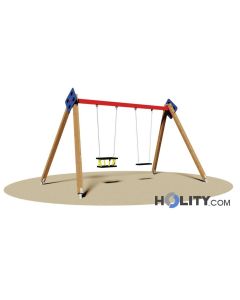
Swing for outdoor spaces of kindergartens and play centers. Number of seats: 2. Material: wood and galvanized and painted steel. Fixing: to be buried.
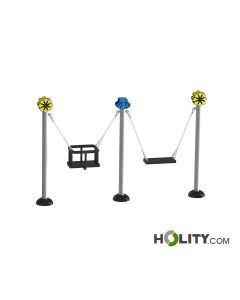
Mini double swing h975_19 with mixed seat (flat and cradle). Compact and resistant structure for public parks and play areas from 2 years up.
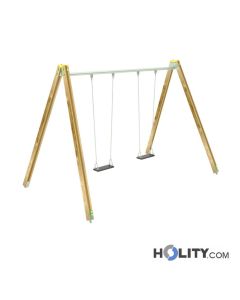
Swing with double flat seat. For children from 3 to 11 years. Dimensions: L376 x D227 x H255 cm
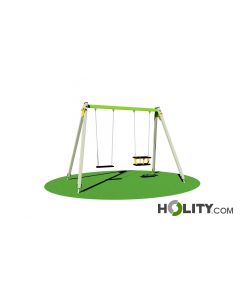
Double galvanized steel swing for playgrounds. Dimensions: W.290 x D.175 x H.210 cm.
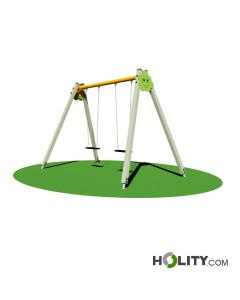
2-seater playground swing. Flat seat. Age range: 3-12 years.
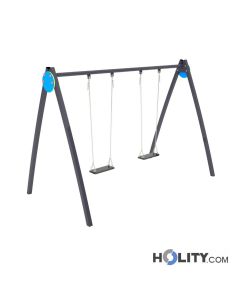
Painted steel swing for playgrounds. With double flat seat. Dimensions: L368 x W187 x H245 cm
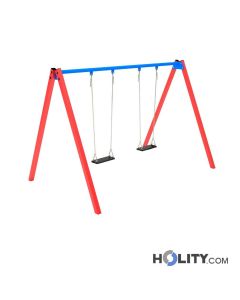
Painted metal swing in yellow and blue. With 2 flat seats. Dimensions: W368 x D225 x H240 cm
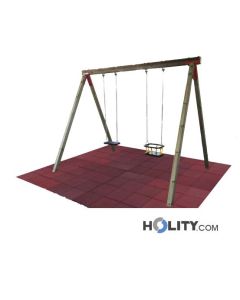
Double swing h17203 in Nordic pine wood with mixed seats (cage and flat), ideal for parks and collective play areas. Dimensions 350x300 cm.
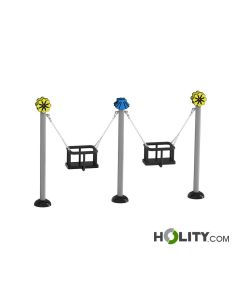
Mini double swing h975_16 in resistant materials, dimensions 240x31x153 cm. Ideal for small spaces with a fall height reduced to 0.55 m.
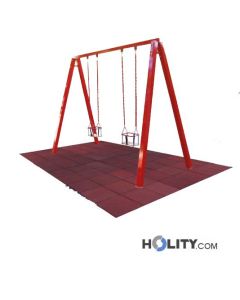
Two-seater swing in galvanized metal with square-section posts. Dimensions: 350x300 cm
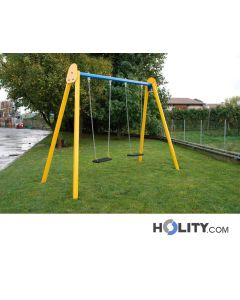
Double aluminium swing for public parks, dimensions 327.5x148.1 cm, flat seats and EN1176 certification for intensive outdoor use.
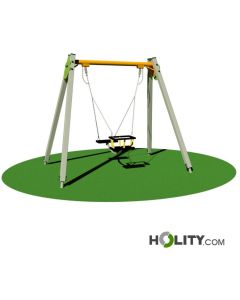
Playground swing with connected double seat. Max dimensions: L.185 x D.265 x h.235 cm. Number of users: 2.
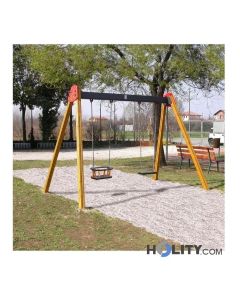
Double swing in Nordic pine and steel, 320x175x240 cm. Includes flat seat and cradle seat for professional use in nurseries and playgrounds.
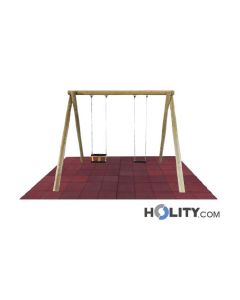
Double swing in Nordic pine wood 350x300 cm with mixed seats (cradle and flat) and smooth splinter-free structure for protected playgrounds.
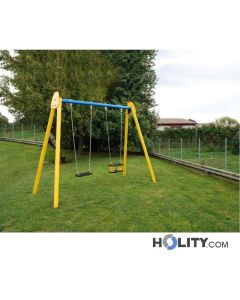
Professional aluminum swing h35109 with double seat (flat and cradle). Durable structure for playgrounds and EN1176 certification.
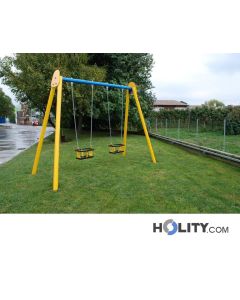
Double aluminum swing with cradle seats, dimensions 327x148x225 cm. Weather-resistant structure for public playgrounds.
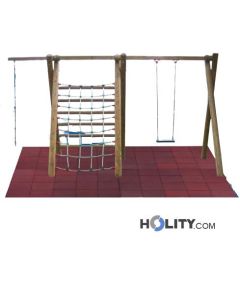
Multifunctional swing h17204 in Nordic pine and steel, 500x300 cm, with rubber seat and integrated double climbing wall.
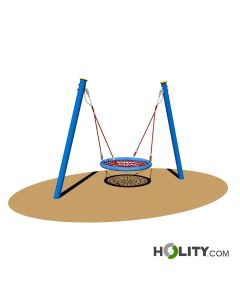
Swing for children with disabilities. Fall height: 130 cm. Inclusive play.
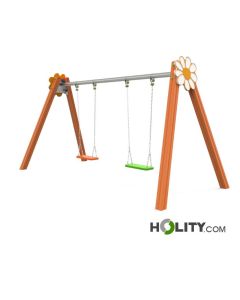
Two-seater swing h749_18 for children aged 1-6 years. Aluminium and galvanized steel structure with reduced height for maximum safety in schools and parks.
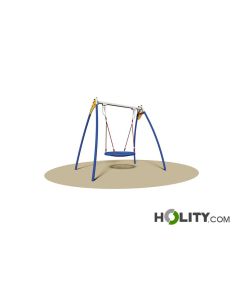
Nest swing for children with disabilities. Dimensions: 255 x 180 x 230h cm.
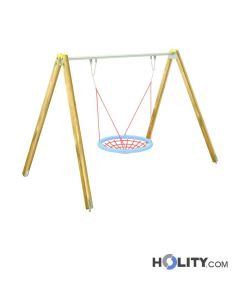
Playground swing with nest seat. Material: wood and metal. Dimensions: L376 x D227 x H255 cm
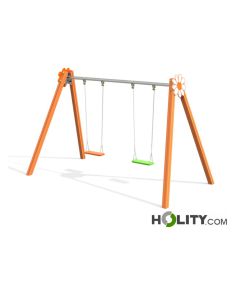
Double swing with aluminum posts and rubber seats, dimensions 349x159x242 cm, ideal for public parks and wear-resistant play areas.
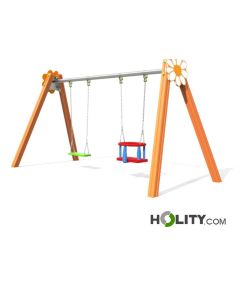
Professional 2-seater swing with aluminum uprights and steel crossbar. Includes flat seat and cradle seat for children from 1 to 6 years.
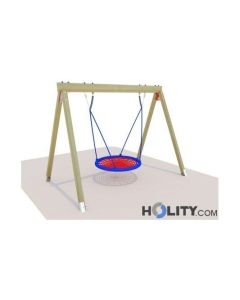
Inclusive nest swing in Nordic pine (330x155x240 cm). Made in Italy structure certified EN 1176 for public parks and collective play areas.
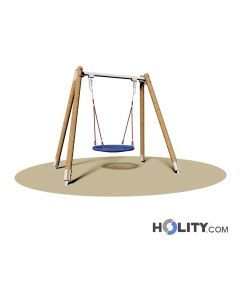
Nest swing with basket seat for up to 5 children. Dimensions: L270 x D180 x H265 cm
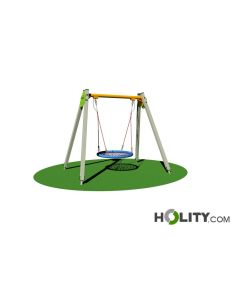
Nest swing for children with disabilities. Dimensions: 185 x 265 x 240h cm.
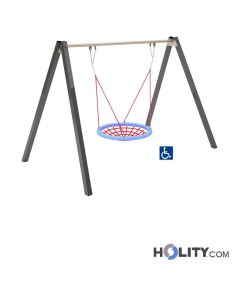
Nest swing for children with disabilities. Material: metal. Dimensions: W376 x D227 x H255 cm
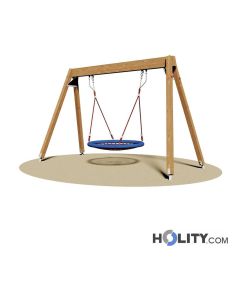
Nest swing for playgrounds and gardens. Pine wood structure. Dimensions: W370 x D160 x H230 cm
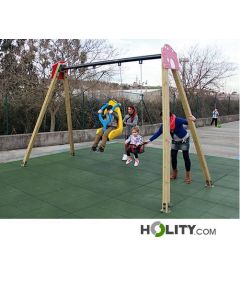
Inclusive double swing h763_13 in glulam wood and steel. Includes safety seat for disabilities and EN 1176 certification for public parks.
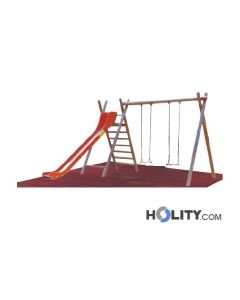
Professional two-seater swing with slide in pressure-treated Nordic pine. Dimensions 500x600 cm, ideal for play areas and public parks.
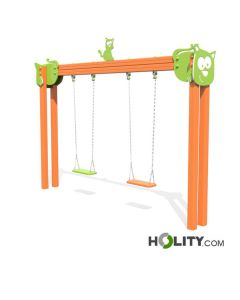
Double swing in aluminum and HDPE for public parks, 322x46x242 cm. Resistant structure with flat seats and design with colored silhouettes.
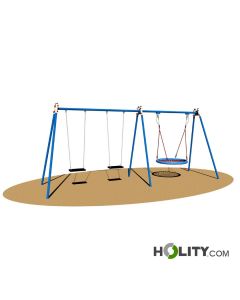
3-seater swing for playground. Inclusive play equipment suitable for children with disabilities.
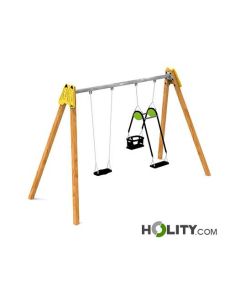
Professional glue-laminated wood swing with flat seat and inclusive double seat, ideal for public playgrounds and certified recreational areas.
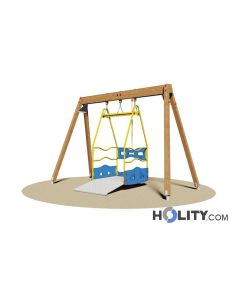
Playground swing accessible to children with disabilities. Dimensions: 370x160xh.245 cm.
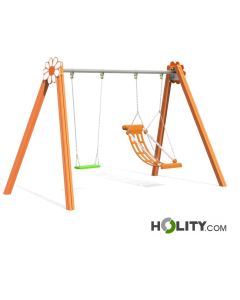
Inclusive swing for public parks in aluminum and steel. Includes flat seat and cradle seat for children with disabilities. W.349 cm.
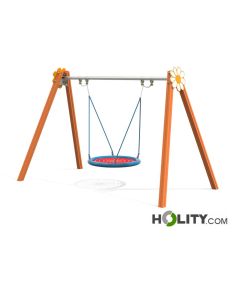
Inclusive nest swing, aluminum and steel structure, 349x159x242 cm. Accessible for public parks and collective play areas.
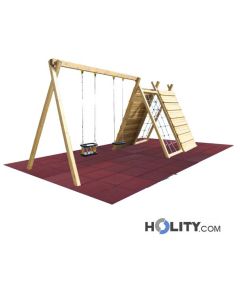
Two-seater swing with two climbing structures. Overall dimensions: 600 x 300 cm
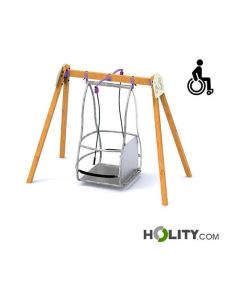
Inclusive swing h763_14 in glue-laminated wood and steel for wheelchairs, featuring an autonomous access ramp and a safety locking system.
Swings represent a fundamental solution for furnishing play areas, both private and public, contributing to the motor development and well-being of children. Available in multiple configurations, from single to double versions, to specialized solutions for inclusion, swings are distinguished by high-quality materials, robust structures, and compliance with European safety regulations. The choice of the right type depends on factors such as the age of the users, the available space, the intended intensive use, and the climatic conditions of the installation area. Whether it is a private garden, a nursery, a primary school, or a public park, the catalogue offers solutions built according to international standards, with particular attention to durability and structural safety.
Swings are not mere recreational structures: they represent learning environments where children develop coordination, balance, and awareness of their own body in space. The differentiation between flat, cage, and cradle seats responds to specific needs related to the age and level of autonomy of the user, ensuring accessibility even for children with motor disabilities. The construction quality directly affects the longevity of the product and the ability to maintain high safety standards over time. The materials used—treated Scandinavian pine, galvanized steel, anodized aluminum—are chosen to resist atmospheric agents and the wear and tear resulting from frequent use.
Swings constitute an essential tool for promoting physical activity and outdoor play in children of different age groups. Regular use of swings promotes the development of balance, motor coordination, and proprioception, fundamental skills for psychomotor growth. From a recreational and psychological point of view, swings offer a sensory experience of movement that contributes to emotional well-being and the reduction of stress in children. In school environments and public spaces, the presence of diverse play equipment, including swings, increases the attractiveness of the area and promotes the inclusion of children with different physical abilities. The versatility of the product allows it to adapt to different contexts: from the intimate dimension of a private garden to the larger scale of a municipal park.
From a management point of view, investing in quality swings means reducing maintenance and replacement costs in the medium to long term. Materials resistant to humidity, thermal variations, and UV rays minimize structural deterioration, ensuring greater longevity of the system. For public administrations and school facilities, the availability of complete and safe play equipment represents an element of quality of the service offered to families. Compliance with the European standards UNI EN 1176 provides guarantees on structural safety, fall-zone margins (safety zones), and correct installation, critical aspects for minimizing the risk of accidents during use. The offer of diversified seats—flat, cage, cradle—expands accessibility by including children of different ages and with specific stability needs.
The swings catalogue mainly includes three main categories, each designed for specific needs. Single swings represent the most compact and versatile solution: available with flat, cage, or cradle seats, they adapt to small spaces such as private gardens, terraces, and courtyards. The flat seat is suitable for children aged 3 and up with consolidated motor autonomy; the cage seat offers greater containment and is recommended for younger children (0-4 years) or those with less coordination; the cradle seat guarantees maximum support and stability, ideal for early childhood and for children with motor disabilities. The structures are mainly made of autoclave-impregnated Scandinavian pine wood, a solution that combines lightness with resistance to atmospheric agents, or in galvanized and painted steel for very high-wear environments.
Double swings are designed to accommodate two children at the same time, expanding the possibilities for interactive play and socialization. Available in the same seat variants (flat, mixed, cage), double swings occupy slightly larger spaces but can still be installed in many public contexts without excessive clutter. Models such as the “Mini double swing” specifically target tight spaces (small parks, indoor play areas), maintaining high safety standards despite their compact dimensions. Swings for children with disabilities represent a specialized category with ergonomic nest seats, lateral support systems, safety belts, and reduced heights to facilitate access. These models follow the logic of inclusive design and allow children with motor or sensory disabilities to enjoy play spaces autonomously and safely.
The selection of the appropriate swing depends on a series of technical and contextual factors that must be carefully evaluated. The first decision criterion concerns the age and motor skills of the users: children aged 0-2 years need highly restrictive seats such as the cradle or the closed cage; children between 2-4 years can use open cages or cradles; children from 3-12 years have a greater freedom of choice, being able to use flat seats if they have good balance. The available space represents the second determining factor: single swings require a smaller footprint (ground footprint) than doubles, but in medium-sized gardens, it is preferable to provide a more articulated play area. The configuration of the surrounding space—presence of impact-attenuating surfaces (sand, rubber), distance from obstacles, orientation with respect to heat sources—affects the feasibility and safety.
A critical aspect often underestimated is the assessment of the type of intended use: if the swing will be subjected to intensive use (school, public park with high frequency), it is advisable to opt for galvanized steel structures with shockproof rubber seats, more resistant to wear; for private gardens with occasional use, impregnated wood offers an excellent compromise between aesthetics, functionality, and environmental sustainability. The climatic conditions of the installation area require particular attention: in areas with high humidity and air salinity, galvanized steel or anodized aluminum guarantees better resistance to corrosion compared to wood, although the latter, if correctly treated, remains a valid choice. The fixing option—to be buried with a concrete foundation, or flush with the floor with mechanical anchoring—must be coordinated with the type of ground and local building regulations. Frequent errors include underestimating the space needed for the fall-zone (safety area around the swing where no obstacles should be present), choosing seats unsuitable for the age of the children, and failing to check compatibility with the available anchoring structures.
The safety of swings is regulated at the European level by the UNI EN 1176 standard (Playground equipment and surfacing), which establishes the requirements for design, construction, installation, inspection, and maintenance. This regulation defines technical parameters such as free fall height, safety zones (fall-zones) around the equipment, mechanical resistance of materials, safety margins at articulation points, and the minimum distance between seats and support structures. Manufacturers compliant with this standard provide CE declarations of conformity and detailed assembly instructions. Any swing intended for public spaces or collective facilities must be accompanied by such certification. Furthermore, the standard specifies that swings must be subject to a preliminary visual inspection during installation and periodic reviews (six-monthly or annual depending on use) to verify structural integrity, material wear, and the functionality of safety systems.
Specific requirements concern contact materials and harmful substances: swing coatings must not contain lead or other toxic substances, and the colors used must be non-toxic and fade-resistant. The UNI EN 1177 standard instead regulates impact-attenuating surfaces (sand, bark, synthetic rubber), defining the minimum thickness and resistance required according to the intended fall height. Compliance with these standards is essential to minimize the risk of injury and to ensure civil liability in the event of an accident. Recurring aspects emerging from management practice include the importance of technical documentation (maintenance manuals, periodic check sheets), the training of personnel responsible for supervision on how to recognize structural defects, and the adoption of maintenance registers accessible for transparency and traceability purposes. Public administrations, in particular, must ensure complete traceability of inspections and maintenance interventions to fulfill the obligations of prevention and protection from risks.
Explore all the products in the category and compare the available solutions to find the one best suited to your operational context. From compact single swings to specialized double versions, from Scandinavian wood to galvanized steel, the catalogue offers options for every space, age, and intensity of use requirement.
The flat seat is ideal for children aged 3-4 and up with good motor autonomy and developed balance. The cage offers greater containment and lateral support, suitable for younger children (0-4 years) or those with coordination difficulties. The cage limits movement but increases stability; the flat seat allows for greater freedom of movement but requires more motor control.
Single swings require an area of approximately 3-4 meters in length and 2-3 meters in width, considering the front and rear fall-zone (safety area). Double swings require more space, up to 4-5 meters in length. Always consult the product’s technical manual for precise dimensions and fall-zone data based on the fall height.
Autoclave-impregnated wood (Scandinavian pine) needs periodic checks to verify any cracks, peeling, or water infiltration, but with correct preventive maintenance, it lasts for many years. Galvanized steel requires fewer routine maintenance interventions but must be checked for corrosion in high-humidity environments. Both materials, if compliant with regulations, guarantee multi-year durability.
Both materials, if UNI EN 1176 certified, offer identical levels of safety. The choice between steel and wood depends on aesthetic, climatic, and maintenance needs. Steel is more robust in very high-wear environments (public parks); wood is more aesthetic in private gardens. Compliance with the standard is the true safety differentiator, not the material.
Yes, the catalogue includes “Mini double swings” specifically designed for reduced spaces, with compact dimensions (approximately 240-300 cm in length) while maintaining high safety standards. However, it is essential to verify that the available space allows for the minimum fall-zone required by the standard, otherwise installation becomes unfeasible for safety reasons.
 English
  Italian
 French
 German
 Spanish