
mon-fri 9-13 / 14.30-18.30
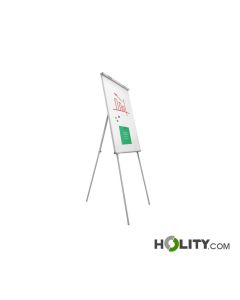
Meeting whiteboard with aluminum tripod structure. Height adjustable up to 190 cm.
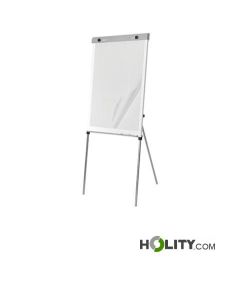
Flipchart on height-adjustable tripod ideal for offices and meeting rooms. Dimensions: W70 x H100 cm.
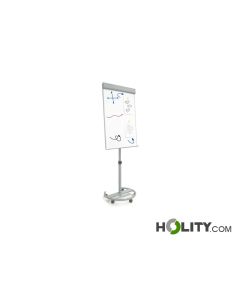
Magnetic office whiteboard in painted aluminum with wheels. Height: from 1550 to 2200 mm.
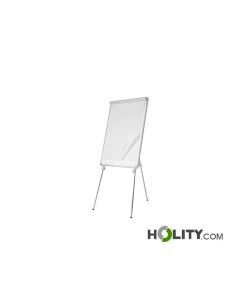
Flipchart with aluminum frame and magnetic surface. Frame dimensions: 70 x H.100. Adjustable height.
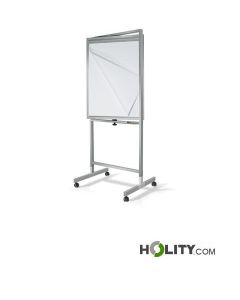
Double-sided revolving flipchart with anodized aluminum tube structure with wheels ideal for offices. Dimensions: W70 x H100 cm.
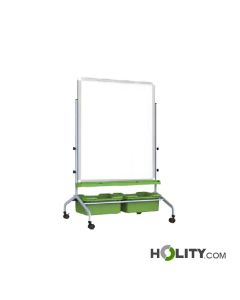
Whiteboard for offices and meeting rooms with 2 green storage trays, adjustable height. Dimensions: W 75 x H 100 cm.
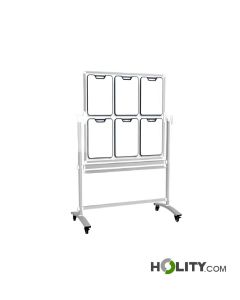
Office whiteboard with wheeled structure and 12 dry-erase small whiteboards. Dimensions: W 100 x H 100 cm.
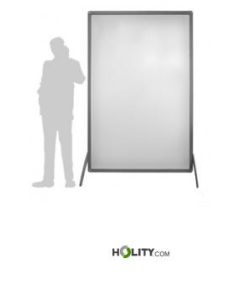
Non-magnetic whiteboard for offices, with rounded corners. Dimensions: 131 x h. 200 cm. On stabilizing bases.
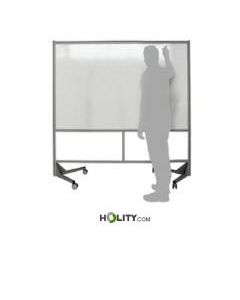
Office whiteboard with white surface for markers. Dimensions: 206 x 65 x h. 208 cm. Equipped with wheels.
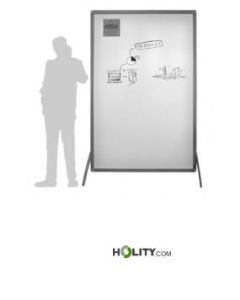
White writable magnetic board for conference rooms and offices. Dimensions: 131 x h. 200 cm. On stabilizer bases.
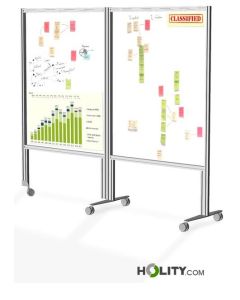
Double-sided magnetic whiteboard for offices. Single module dimensions: 100 x 185 cm. On wheels.
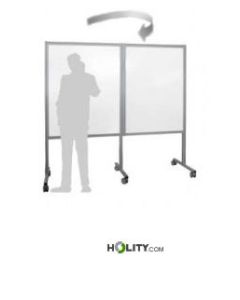
Double office whiteboard with white surface. Folding structure. Dimensions: 200 (105+95) x h. 200 cm. On wheels.
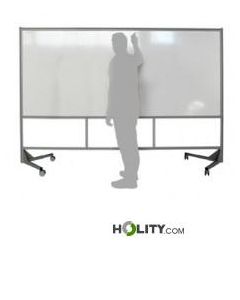
Whiteboard with white surface for markers. Ideal for offices and companies. Dimensions: 306 x 65 x h. 208 cm. On wheels.
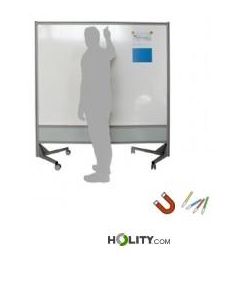
Magnetic whiteboard on wheels with lower base. Total overall dimensions: 206 x 65 x h. 208 cm. On wheels.
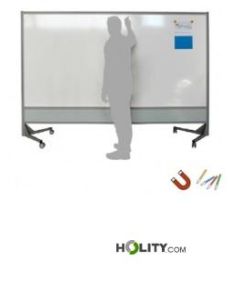
White magnetic whiteboard for offices, equipped with wheels. Total overall dimensions: 306 x 65 x h. 208 cm. With lower base.
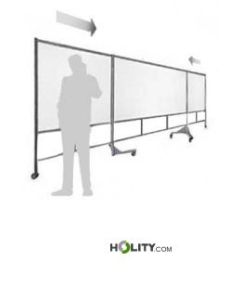
Sliding white triptych whiteboard with wheels, for offices. Dimensions: 550 (150+306+150) x h. 208 cm.
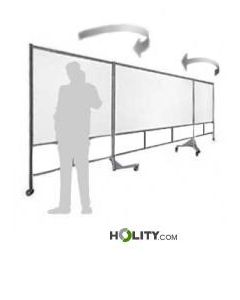
White folding triptych whiteboard with surface for markers. On wheels. Dimensions: 606 (150+306+150) x h. 208 cm.
Office boards represent a fundamental tool for the visual management of information in contemporary professional contexts. From meeting rooms to operational departments, these devices facilitate internal communication, project organization, and the rapid sharing of complex data. A well-designed board transforms the workspace into a collaborative environment where ideas develop through immediate annotations, project sketches, and real-time graphic representations. The choice of the right board depends on the environment of use, the number of users, and the methods for updating content, factors that determine both the functionality and the longevity of the investment.
In the Holity catalog, you will find solutions that cover the entire spectrum of corporate needs: from lightweight models with a tripod easel, ideal for environments with limited space and mobility needs, to fixed systems on wheels or wall-mounted, suitable for conference rooms and executive offices. The materials used guarantee resistance to daily wear and tear, erasing without residue, and maintaining aesthetic integrity over time. The construction versatility allows each solution to be adapted to the specific dimensions of the available space, ensuring that the board integrates naturally into the decor without functional compromises.
Office boards solve a recurring problem in modern work contexts: the need to simultaneously visualize information that otherwise remains confined to digital documents or verbal communications. During a brainstorming meeting, a board allows participants to see the logical connections between ideas as they are developed, facilitating collective decision-making and reducing discussion times. In open-plan offices and coworking spaces, a board acts as a visual aggregating element, transforming abstract data into concrete representations that accelerate mutual understanding between colleagues from different departments or projects.
Daily practicality is not a minor detail: a dry-erase surface eliminates the recurring costs of paper, facilitates the immediate updating of plans without discarding previous sheets, and reduces the visual clutter that characterizes spaces with too many hanging documents. Magnetic models offer an additional advantage, allowing attachments, printed diagrams, or photographs to be fixed without resorting to adhesives or nails that damage the surface. In healthcare, educational, and engineering environments, the board represents a consolidated standard, recognized as an essential tool for the effective transmission of protocols, procedures, and complex technical solutions. Investing in a quality board therefore corresponds to a measurable increase in organizational productivity.
The office board market offers a clear segmentation between portable and structural solutions. Aluminum tripod easel boards represent the ideal option for organizations that require flexibility: they are transportable between different rooms, require minimal storage space, and allow the height to be adjusted according to the final user. These models usually have dimensions between 70x100 cm and 90x120 cm, sufficient for small teams but easily manageable by a single person. Flip charts integrate a sliding system that keeps previous sheets visible while writing on new ones, an option particularly appreciated in contexts where it is necessary to consult previous notes without interrupting the flow of the meeting. Painted aluminum magnetic boards add the ability to fix accessory elements, expanding the possibilities of use towards planning with post-its, diagrams, and photographs.
Moving to structured solutions, mobile boards represent the optimal compromise between stability and mobility: equipped with heavy bases that prevent accidental tipping, they still maintain the possibility of being moved between environments when necessary. Large-sized models, sometimes double-sided, offer writing surfaces exceeding 2 square meters, ideal for meeting rooms with many participants or for environments where visibility from a certain distance is critical. Non-magnetic whiteboards are aimed at organizations that prefer aesthetic minimalism and radical cleanliness, eliminating the complexity of metallic elements and offering a homogeneous surface. Foldable triptych variants represent the ultimate expression of modularity: three independent panels that close on themselves for transport, allowing the available writing surface to be quadrupled without occupying significant space in the stored configuration. Each type embodies a different compromise between portability, capacity, aesthetics, and operating cost.
The selection of the appropriate board begins with a sincere evaluation of the available space and the frequency of use. An office with 3-4 people meeting occasionally will benefit most from a lightweight tripod model, while a department of 20 people conducting daily meetings requires a fixed and generous surface. A frequent mistake consists in underestimating the necessary size: a board perceived as small during purchase often proves insufficient when used in a meeting room where participants are 2-3 meters from the surface. The legibility of notes from that distance effectively reduces the usable area by up to 40%, which is why a 200x100 cm model often turns out to be more functional than initially anticipated.
The surface material deserves particular attention: enamelled steel boards offer the best compromise between durability, ease of cleaning, and marker behavior; glass boards provide a contemporary aesthetic and extremely clean erasing, but involve a higher risk of breakage in high-traffic environments; flip charts represent an excellent temporary solution but require management of the support paper. Magnetism, often considered accessory, becomes essential when attachments, printed diagrams, or planning with frequent movement of elements are planned. The mounting system equally determines practicality: a fixed mobile board requires constant floor space, while a foldable model allows for efficient storage. The operating budget must include not only the initial cost of the board but also maintenance, specific detergents for streak-free cleaning, and the possible replacement of worn components such as wheels or height adjustment mechanisms.
Office boards, although not falling into highly regulated categories like medical furniture, must still comply with specific safety and stability standards. The UNI EN 14934 regulation defines safety requirements for easels intended for boards, including checks on the resistance of the frame, structural stability in the presence of lateral loads, and resistance to pushes that simulate accidental contact during a meeting. Mobile boards must comply with specific standards on the resistance of the wheels themselves, on the ease of brake operation, and on longitudinal stability when loaded asymmetrically. These requirements become critical in environments with particularly strict workplace safety regulations, such as hospitality, the medical sector, and research centers.
Emerging practical aspects concern the chemical composition of compatible markers: many organizations require that products used on surfaces be free of volatile toxic substances, especially in closed environments with limited ventilation. Scratch-resistant surfaces represent a growing requirement in high-traffic contexts, where the risk of accidental damage to the board becomes a significant cost factor in the calculation of useful life. In the public sector, specifications related to accessibility are increasingly common: adjustable heights that allow use by people with reduced mobility, and surfaces that facilitate visibility even for the visually impaired. Certifications of origin for materials, particularly for glass models, represent a further evaluation element for organizations attentive to environmental sustainability issues.
Explore all the products in the category and compare the available solutions to find the one most suitable for your operating context, considering dimensions, surface type, mobility, and integration with existing furnishings.
A magnetic board in enamelled steel allows accessory elements to be fixed with magnets, ideal for attachments, diagrams, and planning with mobile components. A non-magnetic board in glass or composite material offers a completely clean surface and extremely sharp erasing, preferred by those who do not need additional accessories and want maximum aesthetic minimalism.
For 15 people distributed around a table, we recommend a minimum of 200x100 cm fixed on wheels, as legibility from 2.5-3 meters away reduces the usable area. A smaller model is insufficient for complex annotations and creates visual frustration during long sessions.
Use specific detergents for whiteboards, not pure alcohol or vinegar. Clean after each session with a soft damp cloth, avoiding abrasive cleaners. A glass board simply requires a wipe with a wet cloth, while enamelled steel tolerates more aggressive detergents in case of stubborn residue.
Aluminum tripod easels offer adequate stability for controlled environments, but not for areas with high movement density. In noisy open spaces, the oscillation caused by people passing near the easel can distract meeting participants. For these contexts, a board on wheels with a heavy base is a better choice.
Entry-level easel boards cost 70-90 euros, while medium-sized mobile models range between 150 and 400 euros. Professional double-sided or triptych folding systems exceed 1,500 euros. The price reflects dimensions, surface type, structural robustness, and durability guarantees.
Wall mounting requires structural changes usually not allowed in rented spaces. Choose models on wheels or easels, which do not require permanent fixings. If a fixed solution is necessary, consult the owner before installation to avoid loss of the security deposit.
Paper sheets get damaged by folding, bumps, and ink absorption from markers, with an average life of 1-2 years in intensive use. However, they represent an economical solution for temporary documents. If you want to keep long notes, photograph the sheets or choose a permanent surface in steel or glass.
Yes, a double-sided board doubles the writing surface while keeping the footprint identical. In small to medium-sized offices, it allows different topics to be assigned to each side without continuous exchanges. The disadvantage is that only one side is visible at a time, so it is not suitable for meetings where both contents must coexist visually.
 English
  Italian
 French
 German
 Spanish