
mon-fri 9-13 / 14.30-18.30
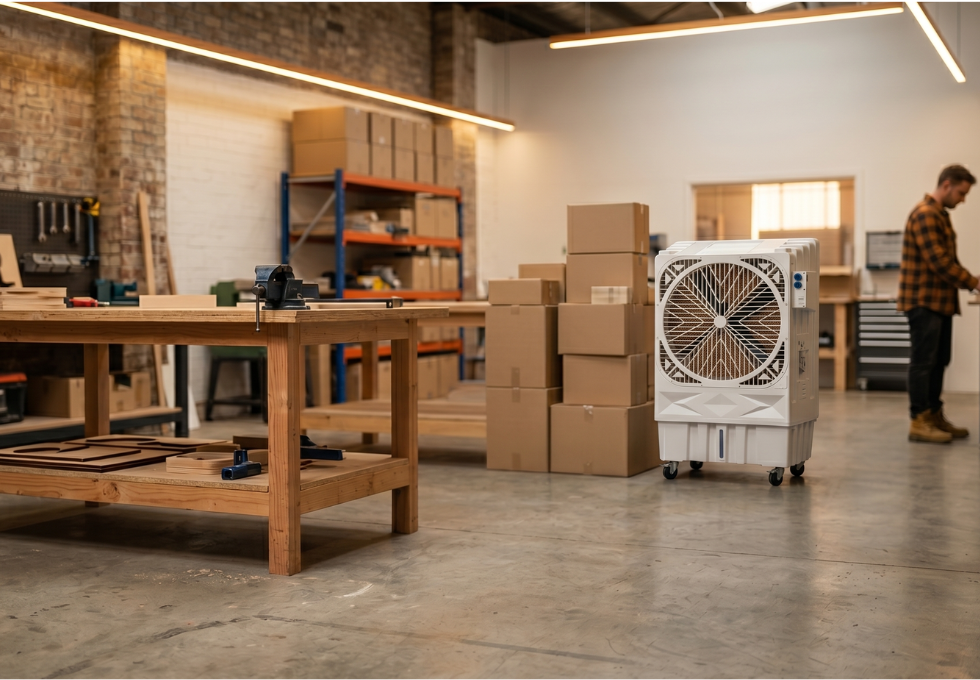
Managing the microclimate within high-volume production environments represents one of the most complex logistical and structural challenges for modern companies. Choosing the right industrial coolers isn't simply a comfort option; it's a strategic and forward-looking investment aimed at protecting workers' health, optimizing company energy costs, and ensuring operational continuity even during the most intense heat waves. Unlike traditional air conditioning systems, which are economically unsustainable and inefficient in large or poorly insulated spaces, evaporative (or adiabatic) cooling technology offers an environmentally friendly and high-performance alternative. By exploiting the natural physical principle of water evaporation, these machines constantly deliver large volumes of cool, purified air, reducing heat stress in the workplace. This purchasing guide was created to help you navigate the various solutions available in the Holity.co.uk online catalogue, analysing volumetric performance, system configurations and regulatory parameters.
In the industrial air conditioning sector, evaporative coolers are divided into functional macro-categories designed to meet specific needs for flexibility, floor plan layout and ventilation power.
They represent the dynamic solution par excellence, developed for companies that require operational flexibility and timely intervention in localised areas.
Advantages: Equipped with sturdy wheels and ergonomic handles, they can be easily moved from one department to another without requiring any masonry work or fixed installation. They offer intermediate air flow rates (usually between 3,000 and 5,000 cubic meters per hour) and integrate autonomous water tanks from 25 to 120 liters, guaranteeing several hours of autonomy before refilling.
Disadvantages: Limited volumetric capacity compared to large fixed systems, requiring periodic monitoring of the liquid level if not connected to a water line.
Ideal for: Mechanical workshops, packaging areas, craft laboratories, industrial outdoor areas and for the targeted cooling of individual workstations ("spot cooling").
Large and centralized systems designed for the global and uniform air conditioning of very large commercial or manufacturing surfaces.
Advantages: They develop extraordinary power with air flow rates that easily exceed 15,000 - 23,000 cubic meters per hour. They use high-thickness multi-sided evaporative panels to maximize heat exchange and are directly and constantly connected to the water network for continuous and automated operation.
Disadvantages: They require preliminary planning, higher initial investments and structural interventions for fixing to the roof or wall and for channeling the flows.
Ideal for: Large manufacturing warehouses, foundries, textile industries, logistics centers and high-volume goods storage warehouses.
To integrate an efficient evaporative system and avoid sizing errors, it is essential to set up the search by analyzing precise technical structural parameters.
Correct sizing of the machine is not only based on the floor area, but on the total volume of the room and the internal heat load. Correct planning requires evaluating:
Water management directly influences the logistical efficiency of the structure. Compact portable models with 25-30 litre tanks are suitable for temporary use or low-intensity operations. To cover full 8-hour work shifts in hot, dry climates, large 80-120 litre tanks are essential. Where infrastructure allows, adopting models equipped with a continuous water connection with an automatic float eliminates manual maintenance time, making the system autonomous.
The delivery of a healthy air flow depends on the biological state of the water circuit. High-end industrial coolers integrate advanced **water sterilisation systems using UV lamps**. This ultraviolet technology acts directly inside the tank, destroying the DNA of bacteria (including Legionella), algae and microorganisms, preventing the onset of unpleasant odours and ensuring microbiologically pure air delivery. The presence of corrosion- and UV-resistant frames protects the body from premature degradation.
High-capacity industrial fans inevitably generate noise emissions which, at maximum power, can range between 75 and 80 dB. It is essential to choose models equipped with electronic control panels or inverters that allow the ventilation speed to be adjusted on multiple levels (at least three speeds), allowing the air flow and its acoustic impact to be calibrated based on the actual thermal conditions of the day and the limits set by occupational medicine protocols.
Logistics hubs, storage and shipping warehouses: In these large spaces, characterised by a continuous movement of goods and often open doors, traditional air conditioners would fail. The optimal choice falls on high-capacity stationary coolers or mobile units strategically positioned near loading bays, capable of creating fresh air barriers that prevent the entry of external heat.
Mechanical workshops, body shops and metalwork shops: Typically hot environments due to manufacturing processes and sheet metal roofs benefit enormously from multidirectional portable coolers. Since they do not require sealed environments to operate, they allow doors and windows to be kept open, promoting the expulsion of fumes, dust and stagnant heat towards the outside.
Food, pharmaceutical and textile industries: In these industrial sectors where microbiological control and air hygiene are mandatory, it is mandatory to install coolers equipped with UV sterilization systems and high-efficiency filters. They maintain safe temperatures for raw materials, reduce static electricity in the air and ensure full compliance with strict health inspection protocols.
Raise your company's safety standards, drastically reduce electricity costs compared to compressor air conditioners and protect your systems from overheating in summer. On Holity.co.uk you will find a professional selection of industrial evaporative coolers, engineered to withstand intensive use cycles in harsh environments in full compliance with European safety directives.
Use our search tools to select the volumetric flow rate suitable for the size of your warehouses and configure the technical specifications best suited to your production lines. If you represent a company, a Public Administration or need a dedicated quote for tender specifications and multiple supplies, contact our customer service today to receive complete technical data sheets and technical advice tailored to your workspace.
Is it necessary to keep doors and windows closed while operating an industrial cooler?
No, the operating principle of the evaporative cooler is the exact opposite of that of a traditional air conditioner. Coolers require constant ventilation and openings (doors, windows or extractors) to push hot air and excess humidity out of the building. If the environment were sealed, the air would quickly become saturated with humidity, canceling out the cooling effect of the machine.
How do you calculate the exact volume of air exchange required for a mechanical workshop?
To calculate the total air flow rate (expressed in m³/h), you need to multiply the total volume of the building (length x width x height) by the number of air changes per hour recommended for that type of activity. For example, for a workshop with a structural volume of 4,000 cubic meters in which 5 air changes per hour are expected, it will be necessary to install machinery that guarantees a minimum total flow rate of at least 20,000 m³/h.
What are the correct procedures for maintaining cellulose evaporative panels?
Evaporative panels require periodic monthly washing to remove dust and limescale deposits that could obstruct the micro-channels through which the air passes, compromising thermal output. At the end of the summer season, it is essential to completely empty the tank, sanitize the tub, and run the machine in ventilation-only mode for at least an hour to dry the panels perfectly before covering and storing the machine for the winter, avoiding the formation of mold.
Does using an adiabatic cooler risk increasing humidity, damaging electronic machinery?
If the system is correctly sized and combined with an adequate output ventilation flow, the increase in internal relative humidity remains within absolutely safe limits (usually between 50% and 60%). This slight increase does not damage electronic components or cardboard packaging, but rather brings a concrete benefit by reducing the buildup of static electricity in the air, a protective factor for many industrial processes.
How does the efficiency of coolers differ depending on the geographical area?
The efficiency of evaporative technology is closely linked to the relative humidity of the outside air. In continental or hilly areas characterised by hot, dry summers (humidity between 30% and 50%), coolers achieve maximum efficiency, reducing the perceived temperature by up to 8-12°C. In coastal or maritime areas with very high humidity (over 70%), the evaporation capacity of water is reduced, limiting the temperature drop to around 3-5°C.
 English
  Italian
 French
 German
 Spanish