
mon-fri 9-13 / 14.30-18.30
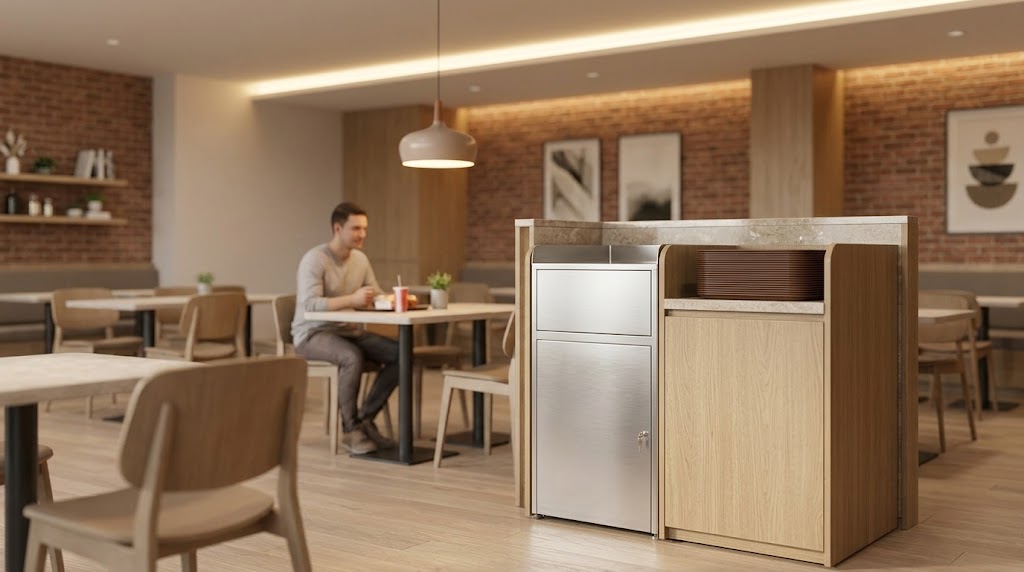
The logistics management of organic waste and tray disposal is one of the most critical operational flows in the design of collective dining rooms and high-traffic venues. Choosing the right tray bins isn't simply a specification related to the furnishings; it's a strategic decision to optimize customer flow, minimize room tidying time, and maintain impeccable visual decor. In high-traffic restaurant settings, waste disposal must be immediate and hygienic. Having structured tray bin counters and cabinets prevents table saturation and congestion, making staff's work easier and reducing the visual impact of waste bags. This guide was created to help you select the ideal model from our catalog on Holity.co.uk, analyzing access kinematics, material configurations, and millimetric dimensional parameters.
In the HoReCa and community supplies sector, tray emptying units and containers differ mainly based on the chemical-physical composition of the body and the static stability of the perimeter structure.
They represent the technical point of reference in contexts in which deep cleaning cycles with industrial detergents and resistance to corrosion are binding requirements.
Advantages: Generally made of high-thickness AISI 304 or AISI 430 stainless steel, they have non-porous surfaces that prevent the absorption of fluids and organic liquids. They tolerate the degrading action of food acids and the satin finish visually mitigates abrasions and scratches from continuous contact due to the rubbing of heavy trays.
Disadvantages: Visual footprint that is purely specular and industrial, requiring a coherent insertion into the aesthetics of the room.
Ideal for: Large company kitchens, hospital canteens, university dining halls and food laboratories.
Furnishing solutions designed to combine the load-bearing structural core of the metal with extensive stylistic and chromatic versatility.
Advantages: The protective polymer film applied to the galvanized sheet metal acts as an anti-rust shield and allows the furniture to be available in multiple colors. This factor facilitates color matching with the interior design of the restaurant and with the palettes of fast food restaurants, maintaining an excellent economic balance.
Disadvantages: Any violent frontal impacts with sharp or blunt objects may affect the perimeter plastic covering.
Ideal for: Fast food chains, shopping centre refreshment areas and company canteens with a contemporary design.
Injection-moulded monoblock systems, focused on maximum structural lightness and the absence of mechanical joints.
Advantages: The high-density polyethylene (HDPE) structures boast extremely high elasticity to impacts and are intrinsically immune to water oxidation. The completely rounded profiles eliminate the risk of sharp edges and the paste colouring prevents fading, guaranteeing a lightweight piece of furniture that is easy to handle during emptying.
Disadvantages: Lower specific weight and static stability than heavy metal cabinet modules with a ballasted base.
Ideal for: School canteens, outdoor fast food outlets, amusement parks and summer kiosks.
To configure an efficient waste disposal station, it is necessary to carefully analyse the millimetric parameters and volumetric metrics provided by the technical filters in our store.
The volume of the waste compartment must be proportionate to the number of places served during peak hourly traffic to avoid overflows or the need to replace the bag during service. Our online catalogue adapts to any logistical flow with millimetric precision, offering a detailed breakdown of internal capacities: compact models of 50 lt, 55 lt and 60 lt for small service boxes; intermediate formats of 80 lt, 100 lt, 110 lt and 120 lt for standard traffic; up to the heavy-duty and cabinet solutions of 189.3 lt and 260 lt designed to manage massive volumes of waste.
The positioning of the furniture must not obstruct the walking paths of staff and customers. Using the geometric cursors in our store it is possible to configure the spatial footprint of the facility to the millimetre:
The economic rationalisation of contract supplies must guarantee a multi-year useful life cycle of the furniture. Our specialized selection maps the needs of any executive budget, offering a flexible price range that varies from a minimum of €272.00 for mobile base containers up to a maximum of €1166.00** for high-capacity stainless steel structured cabinet stations, complete with integrated accessories and mechanical retention systems.
A professional tray emptying bin stands out for its kinematics and mechanical features developed for intensive use:
Fast Food and High-traffic Restaurant Chains: The purchase choice must be oriented towards cabinet models in stainless steel or plastic-coated galvanised sheet metal with a capacity of 260 litres and a maximum width of 629 mm. They guarantee excellent structural anti-tipping stability and a large upper surface for the accumulation of heavy trays.
School and Company Canteens with Concentrated Time Flows: In contexts where the table service is concentrated in small time slots, the installation of coordinated 110-litre or 120-litre modules side by side in a battery is recommended. The use of differentiated colours on the body visually guides users towards the correct distribution of waste (organic fraction, unsorted waste, plastic).
Small Snack-Bars, Kiosks and Confili Service Boxes: In rooms with limited space or in narrow exit corridors, the optimal solution involves the use of compact containers with a capacity of 50-litre or 60-litre, a height of 750 mm and a depth reduced to 324 mm, ensuring clearing functionality with a minimum spatial footprint.
Improve the logistical fluidity of your catering establishments, reduce table clearing times and offer your customers a tidy and aseptic clearing station. In the Holity.co.uk online catalogue you will find a specialist selection of professional furniture and tray emptying bins, designed to withstand continuous cycles of intensive use while maintaining the structural solidity of the chassis unchanged.
Use our search cursors to set the desired capacity volumes (from 50 litres to 260 litres) and select the millimetric dimensional parameters and price ranges (€272.00 - €1166.00**) ideal for your premises. Are you the purchasing manager of a restaurant chain, a contract designer or do you need to issue a multiple supply for tender specifications via the Public Administration portals (MePA)? Contact our customer service team today to receive complete technical data sheets and a personalized quote tailored to your project.
How is the static equilibrium and tip-over risk of the unit calculated when more than twenty heavy trays are stacked on the top shelf?
The stability of the tray emptying unit is defined by the geometric concentration of masses. The native center of gravity of the structure is engineered to remain extremely low, thanks to the structural thickness of the lower metal base and the weight of the internal waste bag. Even when an asymmetrical stack of trays is accumulated on the top shelf (exerting a high vertical vector force at a height of 1300 mm), the projection of the combined center of gravity remains confined within the support perimeter delimited by the leveling feet, neutralizing lateral tipping moments induced by accidental pushes from customers.
What mechanical and elastomeric solutions are applied to the front doors to prevent the continuous release of odorous fumes into the dining room?
The olfactory isolation of the internal waste compartment is entrusted to a double passive retention system. The upper swing door is balanced by counterweights or torsion springs that ensure an immediate hermetic closure after the waste has passed through. At the same time, the front doors intended for bag extraction are equipped with continuous magnetic profiles or thermoplastic elastomer gaskets. This perimeter sealing blocks the air leakage of gases resulting from the organic degradation of food waste, preserving the healthiness of the air in the restaurant room.
Which surface treatment of the sheet metal offers the maximum resistance to hydrolysis caused by prolonged contact with acidic food waste?
Food residues (fruit juices, sauces, acetic condiments) release organic chemicals that can attack common metals. In models made of galvanized sheet metal, protection is guaranteed by the industrial application of a high-thickness polymer film heat-sealed onto the steel base. This finish completely seals the metal from the biochemical attack of acidic liquids, preventing hydrolysis and the onset of micro-perforations, guaranteeing impeccable structural durability compared to common single-layer liquid paints.
How does the usable width of the top (up to 629 mm) match the standard geometric dimensions of mass catering trays?
The top shelf's plan dimensions are designed based on the dimensions of the most popular tray formats on the catering market (such as standard Euronorm or Gastronorm formats, approximately 530x325 mm or 430x350 mm). A configured unit width of up to 629 mm and a depth of up to 641 mm ensure that the tray can be placed on the top horizontally or lengthwise while remaining entirely confined within the raised retention edges, eliminating the risk of geometric protrusion or accidental falling.
What construction features facilitate routine sanitization of the internal cavities without requiring the dismantling of the tilting mechanisms?
Industrial-level tray emptying units are designed following simplified internal geometries and without blind slots or structural micro-cracks. The swing door hinges are positioned externally to the waste drop line or shielded by inclined steel chutes. This design channels debris directly into the bag and allows housekeeping staff to clean the interior walls of the bin by directly applying sanitizing foams and performing quick rinses, without moisture penetrating or seizing the spring torsion pins.
 English
  Italian
 French
 German
 Spanish