Buying Guide: How to Choose the Best Cable Ducts and Cable Glands for Industry, Construction Sites, and Events
In industrial settings, construction sites, warehouses, offices, and temporary installations for trade fairs, events, and demonstrations, the presence of electrical cables, data cables, and pipes laid on the floor requires adequate protection. The passage of people and vehicles can damage the wiring, and unprotected cables can create obstacles in transit areas. cable ducts and cable glands allow you to protect and organize cables and pipes, creating tidier, more easily identifiable paths. Professional models are available in different sizes, number of channels, load capacities, and configurations, so as to adapt to both pedestrian traffic and, when expressly provided for in the technical data sheet, vehicle traffic. The range available in the Holity.co.uk catalogue includes solutions from 1 to 6 channels, rubber and vulcanised rubber models, high visibility versions and drive-over ducts with capacities that, for some references, reach 30 or 40 tonnes. This purchasing guide analyses the number and dimensions of the channels, the capacity, the materials, the connection systems and the main requirements to check in order to choose the cable duct most suitable for the context of use.
1. Number of channels and separation of the circuits (From 1 to 6 Channels)
The choice of the duct must start from the number, size and type of cables or pipes to be protected. It is important to check the useful section of each channel and leave sufficient space to easily insert and remove the wiring:
Single Channel Cable Ducts (1 Channel): They represent a compact solution for protecting a single cable or pipe. The Holity catalog offers models with different sized channels, such as the versions with Ø 20 mm or Ø 60 mm passages. They are suitable when it is necessary to protect a single line while keeping the floor space contained. The intended use, pedestrian or vehicular, must always be verified on the product's technical data sheet.
2- and 3-Channel Channels: They allow you to organize multiple cables or pipes within separate locations. They can be useful when different wiring needs to be managed in the same path, for example power lines, data cables, audio cables or other connections. The presence of separate channels facilitates order and maintenance, but should not be automatically considered equivalent to electrical separation or shielding against electromagnetic interference: for these aspects, the requirements set by the system and the cables used must be respected.
4, 5 and 6 Channel Cable Ducts: They are suitable when it is necessary to manage multiple cables or pipes at the same time, for example during events, fairs, temporary installations, construction sites and industrial activities. The presence of multiple independent locations allows you to divide the connections and makes it easier to locate, insert or remove each cable. Before purchasing, it is essential to check not only the number of channels, but also their internal dimensions, which can vary significantly from one model to another.
Channel Sizing: It is not advisable to choose the cable duct considering only the number of available channels. It is necessary to compare the diameter or cross-section of the cables with the usable space of each channel, avoiding forced insertions and leaving sufficient margin for installation and removal operations. If there are multiple cables in the same compartment, it is also necessary to check that this configuration is compatible with the characteristics of the system and with the technical specifications of the cables used.
2. Mechanical Load Capacity and Driveability: Pedestrian Traffic vs Heavy Vehicles
The resistance of the conduit must be chosen based on the type of traffic expected. A product intended exclusively for pedestrian traffic cannot be used as a driveway conduit, while a high load capacity does not automatically imply compatibility with any type of vehicle or wheel:
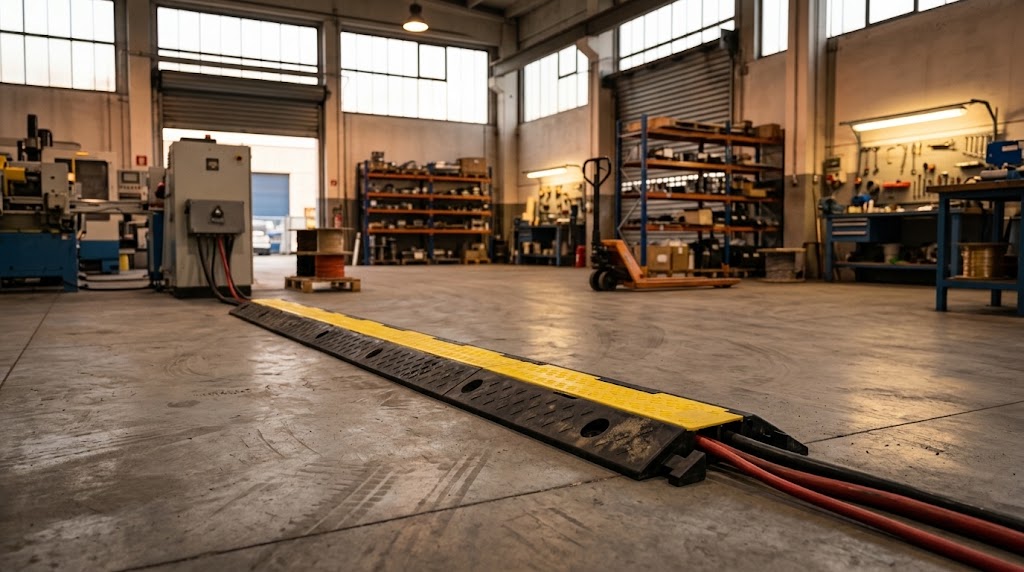
Walkable Versions for Pedestrian Traffic and Event Areas: They are primarily designed to protect cables in areas used by people, such as trade fairs, events, work spaces and temporary installations. Several models have a shaped surface and a high-visibility yellow cover, useful for making the cable gland more recognisable. When the conduit is installed along routes also used by people with reduced mobility, trolleys or other aids, it is necessary to check that the shape, height and slope are compatible with the route and with the applicable requirements of the environment.
Drive-over Versions for Heavy Vehicles (Up to 40 Tons): Some models available in the catalogue are designed to withstand the passage of vehicles and have declared capacities of up to 30 or 40 tons. The capacity data must however be interpreted together with the conditions specified by the manufacturer, such as crossing speed, type of traffic and characteristics of the wheels. Some Holity drive-over channels, despite having a high capacity, are not recommended for forklifts or pallet trucks with certain types of wheels. Before purchasing, it is therefore essential to compare the technical data sheet with the vehicle that will have to pass through the cable duct.
3. Construction materials: Vulcanised Rubber vs Industrial PVC
The material influences the impact resistance, flexibility, adhesion to the floor and the intended use of the channel. When choosing, it is advisable to refer to the composition declared for the individual model and the expected environmental conditions:
Rubber and Vulcanized Rubber: These are materials widely used in professional cable ducts thanks to their ability to absorb shocks and stresses and their good resistance to wear. The Holity catalogue includes various models in rubber and vulcanized rubber intended for construction sites, logistics, events and industrial areas. Some references are also suitable for outdoor use and declare resistance to rain, oils or other environmental conditions. However, operating temperatures and specific resistance to chemical agents must be verified on the technical data sheet of the individual product and cannot be automatically extended to the entire category.
Industrial PVC and Technopolymers: Thermoplastic materials and technopolymers can be used for ducts, coatings or components of the cable duct system. Compared to rubber, they can have different characteristics in terms of rigidity, weight and impact behaviour. The choice must therefore be made based on the environment of use, the frequency of passage and the technical characteristics declared by the manufacturer.
High Visibility Top Cover: Many professional trunkings feature a yellow top cover that allows for easier access to the trunking and insertion or removal of cables and pipes. The contrast between the dark base and the yellow cover also improves visual identification of the cable gland in transit areas. Cover material, opening system and presence of hinges vary depending on the model and must be verified in the relevant technical specifications.
Modular Interlocking Connections: Many models can be connected to each other using interlocking systems, while some references use specific inverted dovetail connections. This configuration allows multiple modules to be placed side by side to protect cables over greater distances. The type of connection is not the same for all trunkings, so it is advisable to check the compatibility between the elements before designing a modular route.
4. Dimensional Parameters and Breakdown of Cost Bands
The range available in the Holity.co.uk catalogue includes cable ducts of various sizes, designed to accommodate cables and pipes of different diameters and to adapt to various contexts of use. At the time of verification, the main dimensional parameters present in the category are:
Length per single module: approximately from 400 mm up to 1200 mm, depending on the model.
Depth / Width of the ramp: approximately from 150 mm in the more compact models up to 500 mm in the larger multi-channel trunkings.
Total height from the ground: approximately from 30 mm up to 81 mm, depending on the size of the trunkings and the structure.
Internal usable size of the trunkings: from approximately Ø 20 mm in the more compact models up to sections of 65 x 65 mm in the versions designed for cables or pipes of larger diameter. Configurations with rectangular trunkings and models with different passage geometries are also available.
The economic investment for the products currently present in the category is approximately between €80.20 and €301.50 + VAT for a single product or module, based on the selected model. Prices and availability may vary over time and it is therefore advisable to always check the updated product sheet:
Entry level range (approximately €80.20 - €120.00 + VAT): Includes both compact models and some multi-channel trunking. In this range, for example, there are 1-, 2- and 5-channel cable glands with different internal dimensions and intended uses. The price therefore does not depend exclusively on the number of channels, but also on the size, structure, material and construction characteristics.
Mid-range (approximately €120.00 - €200.00 + VAT): Includes conduits and cable ducts with 2, 3, 4 or 5 channel configurations and different levels of capacity and resistance. In this range, both products intended primarily for pedestrian traffic and vehicular models are available. Compatibility with vehicles, forklifts or other means must be verified individually.
Top of the range (approximately €200.00 - €301.50 + VAT): Includes models with large channels, multi-way conduits and solutions with high load capacities. For example, there are vehicular models up to 30 or 40 tons and conduits designed to accommodate cables or pipes of large diameter. Even in this range, the nominal load capacity should not be considered synonymous with compatibility with any vehicle: speed, type of wheels and transit conditions must be checked on the technical data sheet.
Request a personalized quote on Holity.co.uk
Protect cables and pipes in passageways by choosing a cable duct suitable for the characteristics of the environment and the type of traffic expected. In the Holity.co.uk catalog you can compare models from 1 to 6 channels, ducts for pedestrian traffic and vehicular versions, different internal dimensions and high-visibility modular systems. Before purchasing, check the diameter of the cables, the number of channels required, the overall dimensions of the duct and, in the case of vehicular traffic, the capacity and limitations indicated in the technical data sheet.
Are you a Prevention and Protection Service Manager (RSPP), a site manager, an event organizer or do you need to manage a professional supply for companies and public bodies? Request a personalized quote: the Holity team can support you in checking the technical characteristics of the available models and in choosing the most suitable solution based on the number and size of the cables, the type of traffic, the required load capacity and the installation conditions.
Frequently Asked Questions (FAQ)
Can a vulcanized rubber cable duct withstand the continuous passage of forklifts and trucks? Not necessarily. Some drive-through models in the catalogue can support declared loads of up to 30 or 40 tonnes and are therefore suitable for the passage of certain vehicles. However, some technical data sheets expressly exclude or advise against use with forklifts and pallet trucks, particularly in the presence of certain types of wheels. It is therefore necessary to check the load capacity, maximum crossing speed, type of vehicle and wheel characteristics for each individual duct.
Why might it be useful to choose a multi-channel cable duct to separate power and data cables? A multi-channel cable duct allows you to organize different wiring in separate locations, making installation tidier and facilitating maintenance. Physical separation can also increase the distance between different types of cable. However, cable duct dividers do not automatically provide electromagnetic shielding and do not by themselves guarantee the absence of interference. The layout of power and data cables must be designed in compliance with the technical specifications and standards applicable to the system.
What is the fundamental difference between a floor cable duct and a road cable hump? Floor cable ducts are generally designed to protect and organize cables in transit areas and can have a relatively compact profile. Road cable humps typically have a wider, raised structure, with lateral ramps that facilitate crossing by the vehicles for which the product was designed. However, a cable duct should not automatically be considered a speed bump: the intended use, load capacity and crossing conditions must be those specified by the manufacturer.
How are the various cable duct modules connected to each other to cover large distances? Many professional cable ducts have modular systems that allow multiple elements to be joined. Depending on the model, the connection can be made via shaped joints or inverted dovetail joints. This way, it is possible to create longer routes without necessarily having to use tools. It is, however, important to use modules that are compatible with each other and to follow the installation instructions provided for the individual reference.
Do cable ducts have to be bolted to the floor? It depends on the model and the type of installation. Various cable ducts can simply be placed on the floor for temporary use, while some products have pre-drilled points or holes for possible fixing. In the presence of heavy traffic, uneven surfaces, outdoor installations, or other conditions that may cause the module to move, it may be appropriate to use the fastening systems indicated by the manufacturer. The need for anchoring must therefore be assessed based on the technical data sheet and the context of use.
How does the price range in the category (€80.20 - €301.50 + VAT) correlate with the product features? The price depends on a combination of features and not exclusively on the number of channels. Overall dimensions, useful cross-section of the passages, material, structure, load capacity, opening system, and intended use can affect the final cost. In the entry-level range, there are both compact models and multi-channel solutions, while in the higher ranges, there are channels with larger cross-sections, high load capacities, or specific construction features. To correctly compare two products, it is therefore advisable to evaluate together the price, number and size of channels, load capacity, and compatibility with the expected traffic.

 English
 Italian
 French
 German
 Spanish