To understand how to cool an industrial warehouse It's necessary to consider surface area, height, insulation, air exchange, and heat produced by machinery. In large production environments, the most commonly used solutions include ventilation, evaporative cooling, air conditioning, and measures to limit heat gain. The choice depends on the objective: improving operator comfort, cooling specific workstations, or maintaining a controlled temperature. A proper assessment allows you to identify the right system industrial cooling more suited to the conditions of the shed.
How to Cool an Industrial Warehouse: Available Solutions
To cool a shed you can usenatural or mechanical ventilation, evaporative coolers, industrial air conditioners and insulation or solar screening interventionsThere is no single best solution: effectiveness depends on the characteristics of the building and the desired temperature.
In warehouses with frequently opened doors, systems that promote air exchange and cooling of work areas can be useful. In closed environments, where precise temperature and humidity control is required, an air conditioning system may be preferable.
Why is it difficult to cool an industrial warehouse?
The cooling of industrial warehouses It's complex due to the presence of large surfaces, high ceilings, roofs exposed to the sun, and considerable air volumes. These factors often include heat-generating machinery and open doors for the passage of goods and vehicles.
A system designed without considering these conditions risks consuming energy without sufficiently improving comfort. For this reason, it's important to distinguish between cooling the entire building and cooling individual work areas.
How to cool a warehouse without air conditioning
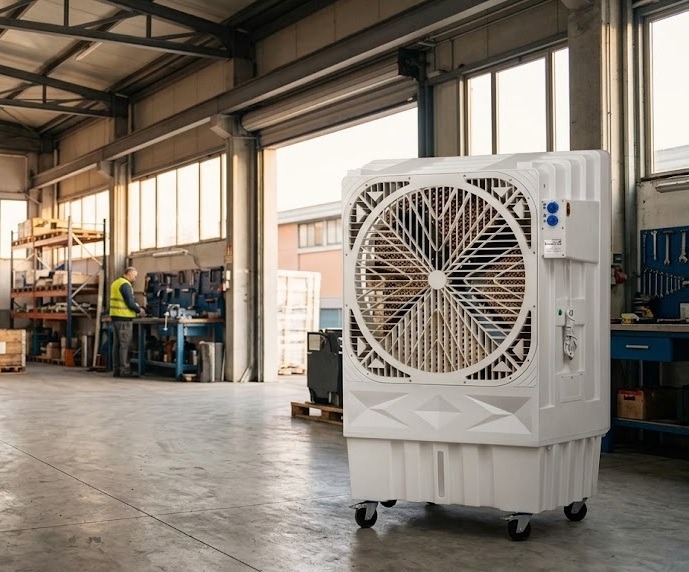
When it is not possible or convenient to install a traditional air conditioning system, solutions can be considered that reduce heat buildup and improve conditions in occupied areas.
Ventilation helps eliminate hot air when outside conditions allow. Evaporative coolers, on the other hand, can reduce air temperature through water evaporation, especially in ventilated environments with low humidity.
Solar shading, roof insulation, and heat reduction can also contribute to the result. Often, the most effective solution is a combination of several measures rather than relying on a single device.
Evaporative coolers for industrial warehouses
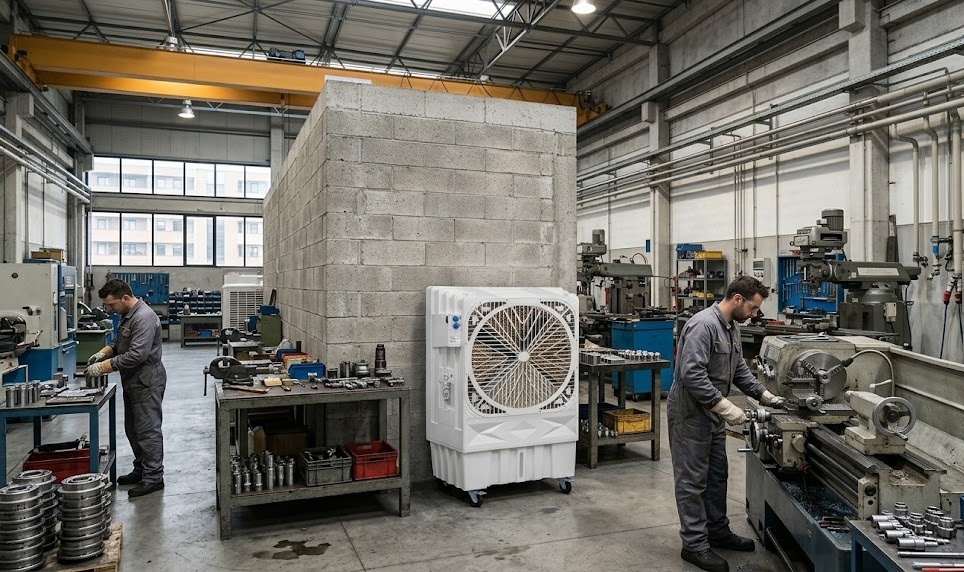
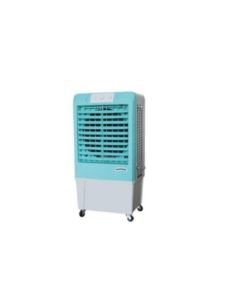
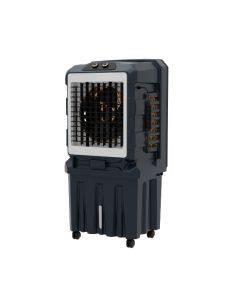
The industrial evaporative coolers They use water and ventilation to cool the air released into the environment. They can be useful in large warehouses with frequent air changes and workstations requiring cooling.
This technology works best when the outside air isn't excessively humid and when adequate air exchange is possible. However, it doesn't provide the same temperature control as an air conditioner and introduces humidity into the treated air.
Industrial ventilation and air exchange
Natural or mechanical ventilation can help limit heat retention, especially when it allows warmer internal air to be expelled and replaced with cooler external air.
Industrial fans, extractors, and air movement systems can improve the comfort perceived by workers. However, moving air does not necessarily mean lowering its temperature: when the outside air is very hot, ventilation alone may not be enough.
Industrial air conditioners: when are they necessary?
Traditional air conditioning is recommended when the warehouse or specific areas of it must maintain specific temperature conditions. This may be necessary in certain production departments, laboratories, or environments where processes require controlled temperatures.
An air conditioner generally works more efficiently when the environment is well insulated and has limited openings. In warehouses with constantly open doors, it may be useful to consider localized air conditioning or compartmentalizing the affected areas.
Evaporative cooler or air conditioner: which should you choose?
The choice depends on the shed's conditions and the cooling objective. Evaporative cooling systems can be advantageous in large, well-ventilated spaces, while air conditioning is more suitable when a precise temperature needs to be maintained.
| Situation |
Solution to be evaluated |
Advantages |
Limits and when to avoid it |
| Shed with doors often open |
Evaporative cooling and ventilation |
Compatibility with air exchange |
Less effective with high humidity |
| Concentrated workstations |
Localized cooling |
Intervention on occupied areas |
It does not uniform the temperature of the entire building |
| Closed environment with temperature to be controlled |
Compression air conditioning |
More precise control of the microclimate |
Less convenient with high dispersions |
| Shed with hot air storage |
Mechanical ventilation and extraction |
It promotes heat dissipation |
Limited if the outside air is equally warm |
| Coverage very exposed to the sun |
Insulation and solar screening |
Reduces heat input |
It alone may not guarantee the required comfort |
| Departments with machinery that develops a lot of heat |
Source extraction and targeted cooling |
It intervenes on the heat generated by the process |
Requires a technical evaluation of the workmanship |
How much do the size and height of the warehouse affect?
When choosing a cooling system, knowing the square footage isn't enough: it's also crucial to consider the height. Two warehouses with the same surface area can have very different air volumes.
The volume is calculated by multiplying the surface area and the average height. For example, a warehouse of 1,000 m² with an average height of 8 metres has an indicative volume of 8,000 m³This data is useful in the preliminary assessment, but it is not sufficient on its own to determine the number or capacity of the devices.
It is also necessary to consider the arrangement of machinery, shelving, occupied areas and air distribution methods.
How doors, air exchange and humidity affect
Frequent openings affect cooling performance. In a logistics warehouse, for example, doors and gates can remain open for many hours, causing a constant exchange between internal and external air.
This makes it more difficult to maintain a uniform temperature with traditional air conditioning, while it can favor the use of solutions designed for ventilated environments. For evaporative cooling, however, it is also essential to monitor relative humidity, as high values reduce its effectiveness.
Cooling large surfaces or individual stations?
In very large warehouses, it's not always necessary to cool the entire space. In some operations, it's more effective to focus interventions on the workstations where operators spend most of the day.
The localized cooling It allows air to be directed toward operational areas, reducing the need to treat underused areas. The choice must, however, avoid annoying drafts and meet the needs of the production process.
Air distribution and arrangement of devices
Proper positioning is essential for effective results. Shelving, machinery, and partitions can impede airflow, creating poorly ventilated areas, even with high-capacity appliances.
The design must consider the intake air flow path, available openings, and operator positioning. Evaporative systems must also prevent humidity buildup and ensure the treated air is expelled according to design specifications.
How to reduce heat in an industrial warehouse
Before increasing cooling capacity, it's helpful to identify the main heat sources. Poorly insulated roofs, surfaces exposed to the sun, machinery, and insufficient air circulation can contribute to increased internal temperatures.
Insulation, screening, ventilation, and possibly heat extraction at source can reduce the cooling system's needs. This approach is particularly beneficial in warehouses used continuously during the summer.
How much does it cost to cool an industrial warehouse?
The cost depends on the technology chosen, the size of the space, and the desired result. It's important to distinguish the initial cost of equipment and installation from the subsequent costs of energy, water, and maintenance.
When comparing solutions, evaporative systems may have lower electricity consumption than compression air conditioning, but they require water and favorable environmental conditions. The economic evaluation must therefore also consider the actual achievable performance.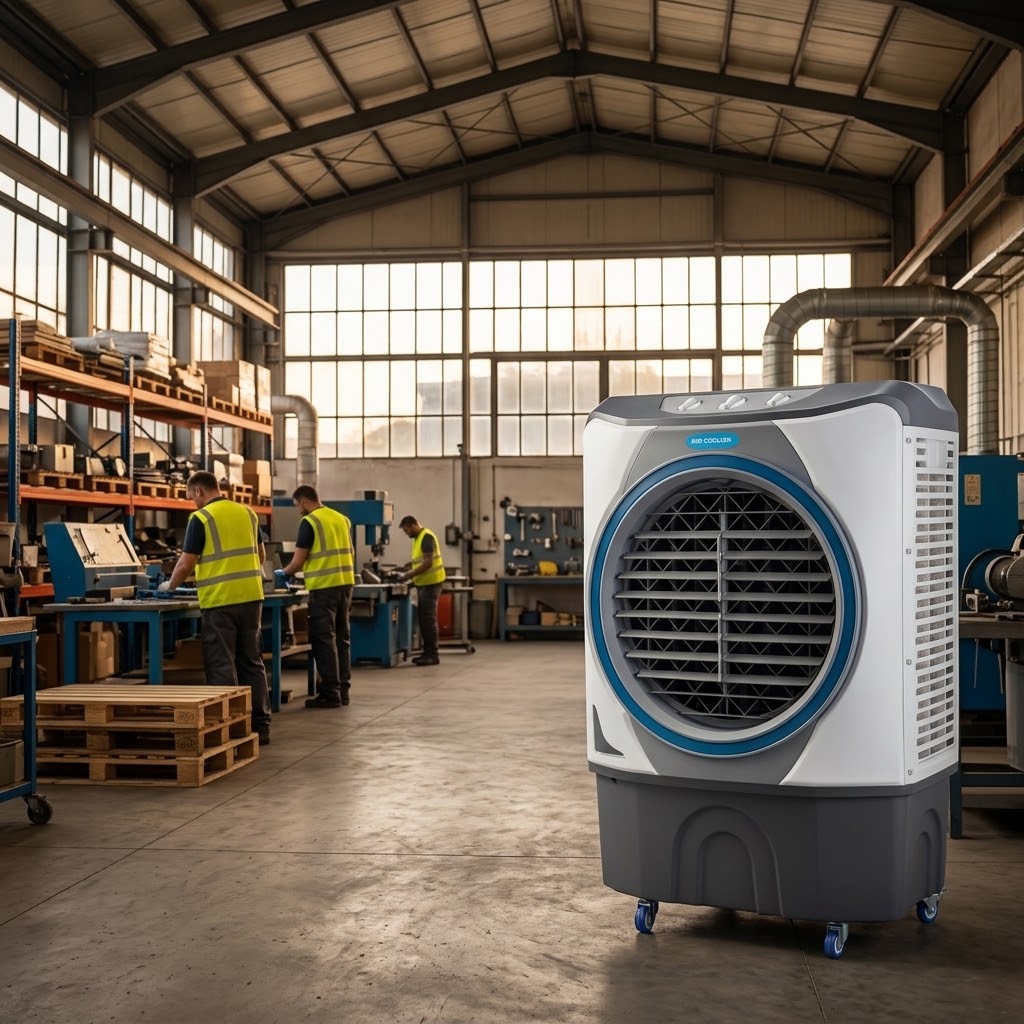
How to choose a cooling system for warehouses
The choice should start from the collection of some essential data: surface area in m², average height, volume, roof characteristics, doors, external temperature, humidity and internal heat sourcesIt is also necessary to establish whether you want to improve operator comfort or achieve a specific temperature.
Once these conditions have been identified, it is possible to compare ventilation, evaporative cooling, air conditioning, and interventions on the building envelope. For solutions based on water evaporation, it is possible to further investigate the characteristics of the industrial coolers, evaluating its capacity, mobility, consumption and compatibility with the place of use.
Frequently asked questions about industrial warehouse cooling
How to cool an industrial warehouse without air conditioning?
Natural or mechanical ventilation, evaporative coolers, localized cooling, and insulation or solar shading measures can be considered. The solution depends on the environmental conditions and the desired objective.
What is the best solution for cooling large surfaces?
There's no one-size-fits-all solution. In ventilated environments with low humidity, evaporative cooling may be appropriate; in closed, temperature-controlled spaces, air conditioning may be preferable.
Do evaporative coolers work with open doors?
They can be suitable for environments with air exchange, as long as they are correctly sized and the humidity is not excessive.
Are square meters enough to choose the cooler?
No. You also need to consider height, volume, air flow, openings, humidity, heat sources, and the location of the workstations.
Does industrial ventilation lower temperatures?
Ventilation promotes air circulation and can dissipate heat when external conditions permit. However, it alone does not guarantee a reduction in air temperature.
 English
  Italian
 French
 German
 Spanish