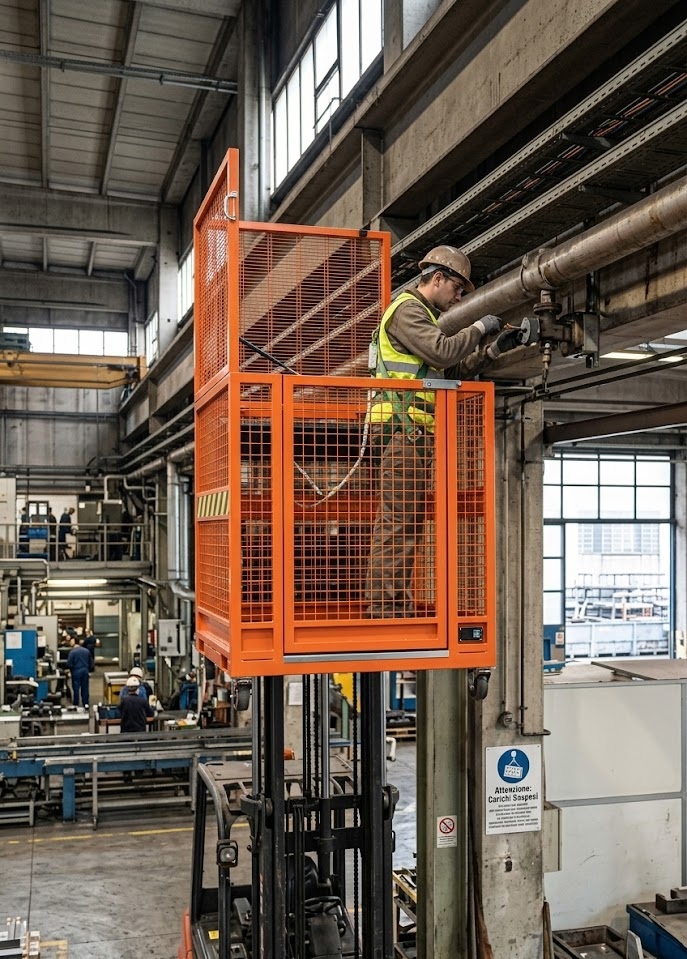
The'industrial furniture working at heights It's not limited to the arrangement of shelving or equipment on the ground, but also includes all the solutions that allow for safe and efficient operations at height. In manufacturing, logistics, and maintenance settings, many activities take place on elevated systems, structures, or surfaces, making the use of appropriate tools essential.
Integrating baskets, cages, and platforms into the organization of industrial spaces means designing more functional and accessible environments. These devices are not isolated elements, but components of an operating system that must ensure safety, business continuity, and ease of intervention.
The link between industrial furniture and maintenance at height
In industrial settings, plant maintenance often requires work at height. Without adequate equipment, these operations become complex and risky. The integration between industrial furniture and tools for working at heights allow you to reduce intervention times and improve the organization of activities.
The concept of industrial furniture therefore extends to the vertical management of space. It involves not only optimizing space, but also ensuring safe access to machinery, production lines, and infrastructure. This approach allows for more efficient inspection, maintenance, and installation operations.
The main equipment for working at height
Working at height requires specific tools, designed to ensure stability, safety, and ease of use. Among the most common solutions are baskets, cages, and platforms, each with different characteristics and applications.
THE systems for working at height They must be selected based on the type of intervention, frequency of use, and the characteristics of the industrial environment. A correct choice improves both safety and operational efficiency.
Industrial baskets for operational interventions
Baskets are a versatile solution for working at height. They can be used for maintenance, installation, or inspection operations, providing a stable platform for the operator.
THE baskets for working at height They must ensure strength, safety, and compatibility with lifting equipment. Their effectiveness depends on construction quality and proper integration with existing equipment.
Safety cages for operator protection
Safety cages are designed to reduce risk during operations at height. They offer additional protection by creating a controlled environment for the operator.
The industrial cages They are particularly useful in contexts where stability and protection need to be ensured, helping to improve working conditions and reduce accidents.
Lifting platforms allow you to reach different heights in a controlled manner. They are used in numerous industrial settings and are an effective solution for frequent interventions.
The elevating work platforms must be chosen based on the operating height, load capacity and conditions of the environment in which they will be used, always ensuring safety and reliability.
Safety and risk management in working at heights
Safety is a key aspect of working at height. Using appropriate equipment reduces the risk of accidents and helps create a more controlled work environment. Therefore, the choice of solutions must be geared towards protecting operators.
THE devices for working at height They must comply with technical and regulatory requirements, ensuring stability, protection, and ease of use. Proper risk management involves selecting certified equipment and organizing spaces.
Industrial space organization and accessibility
Integrating equipment for working at height within industrial spaces improves accessibility to systems and facilities. This reduces intervention times and makes maintenance operations more efficient.
THE'organization of industrial space It must consider both ground and overhead activities. A consistent design helps avoid obstacles, improve flow, and facilitate access to operational areas.
Optimization of operational flows
A well-organized environment allows for more efficient workflows. Equipment for working at height must be easily accessible and integrated with the rest of the industrial furniture.
THE'flow optimization reduces intervention times and improves productivity, making work more orderly and predictable.
Safe access to facilities and structures
Ensuring safe access to overhead structures is essential for system maintenance and monitoring. Equipment must allow for stable and protected operation.
The solutions for access at height must be designed to reduce risks and improve the quality of operations.
Criteria for choosing equipment for working at heights
The choice of equipment must be based on technical and operational criteria. The working height, frequency of use, and industrial environment conditions must be considered.
THE equipment selection criteria quota These include stability, load capacity, ease of use, and compatibility with operational needs. A comprehensive assessment allows us to identify effective and long-lasting solutions.
An integrated approach between industrial furniture and operational safety
Integrating equipment for working at heights into industrial furnishings means adopting a systemic approach to space management. It's not just about choosing tools, but about creating a coherent and functional work environment.
THE'industrial furniture for working at heights It helps improve safety, accessibility, and productivity. Careful design allows for more organized and functional spaces, reducing risks and inefficiencies over time.
 English
  Italian
 French
 German
 Spanish