How Much Space Is Needed to Park 10 Bicycles?
When planning a bicycle parking area, one of the most common questions concerns the amount of space required to accommodate a specific number of bikes. In the case of a 10-bike rack, the overall dimensions depend on the type of rack selected and the spacing provided between bicycles.
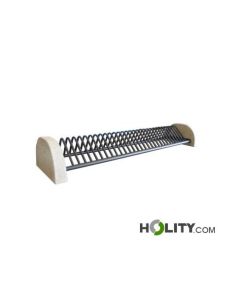
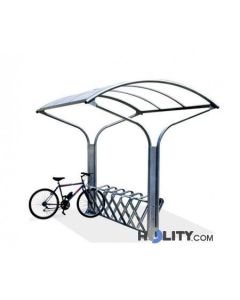
Assuming an average bicycle width of around 60 cm and adequate room for maneuvering, a linear bike rack for 10 bicycles generally requires a length of between 3 and 4 metres. In addition, sufficient frontal clearance should be provided for users to access and remove bicycles comfortably, typically at least 1.2 to 1.5 metres.
Double-sided racks or staggered parking systems can further optimise the available space while maintaining good accessibility. These solutions are particularly suitable for company premises, schools, railway stations and high-traffic public areas.
| Number of Bicycles |
Approximate Rack Length |
Recommended Total Space |
| 5 bicycles |
1.5 - 2 m |
3 - 4 m² |
| 10 bicycles |
3 - 4 m |
6 - 8 m² |
| 20 bicycles |
6 - 8 m |
12 - 16 m² |
Carefully assessing the available space before installation makes it possible to choose the most suitable solution, improve usability and ensure an organised and secure bicycle parking area for all users.
How to correctly design the installation space
The design of the space must start from an overall vision of the available area. It is not just a question of inserting the greatest possible number of racks, but of ensuring practical and orderly use. The layout must facilitate access, reduce congestion points and maintain a logical distribution of bicycles.
A correct approach includes the analysis of routes, accesses and any physical barriers. The dimensions of the bicycle parking must be integrated with the architectural context and the needs of users, avoiding improvised solutions.
Linear layout and serial arrangement
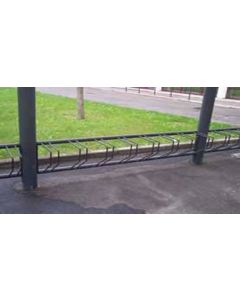
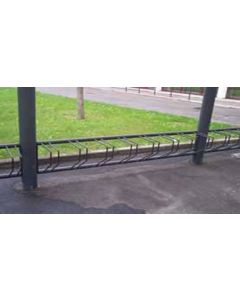
The linear layout is among the most common, because it allows the racks to be organised in an orderly and easily replicable way. This type of layout is particularly suitable for long, narrow spaces, where it is necessary to optimise the available surface area.
The serial arrangement allows for increased capacity while maintaining good legibility of the space. However, it is important not to excessively reduce the distances between the modules, to avoid problems with daily use.
Maneuvering space and accessibility
Maneuvering space is often underestimated, but it is one of the most important elements. Users must be able to approach, position and remove the bicycle without obstacles. This requires an adequate free area in front of the racks.
The bicycle parking measures must therefore include access corridors and rotation spaces. Without these elements, even a technically correct solution may be impractical.
Types of racks and dimensional variations
The dimensions change based on the type of rack chosen. Floor-mounted, vertical or modular solutions have different characteristics and require specific evaluations. There is no universal measurement valid for every context.
The choice of type must be consistent with the available space and the type of use. Bike racks must be selected considering both the space occupied and the access method.
Floor-mounted racks
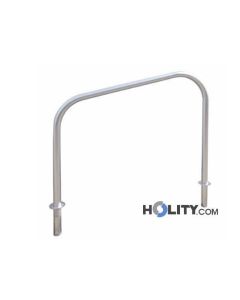
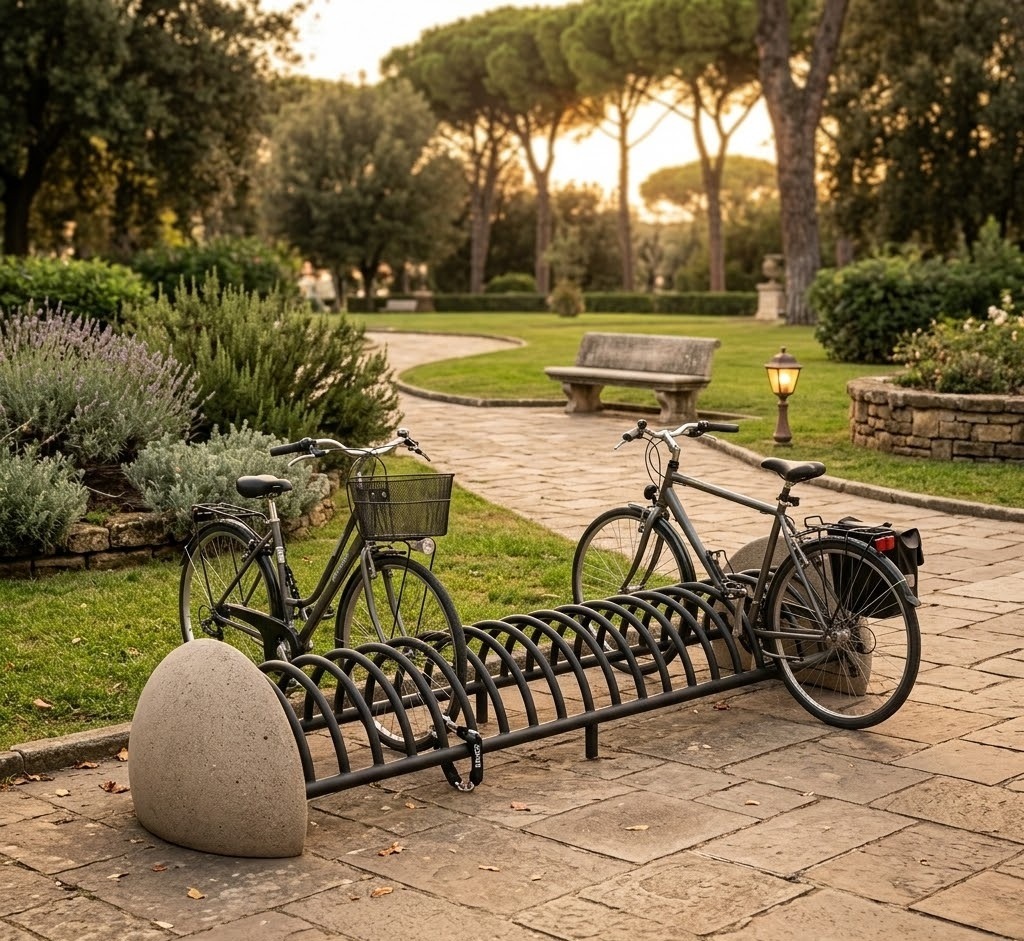
The Floor-mounted racks are among the most popular and offer a good balance between simplicity and functionality. They require more horizontal space, but are intuitive to use and suitable for different contexts.
Their dimensions must guarantee stability and sufficient distance between the bicycles. Careful design avoids overlapping and improves the overall order of the area.
Vertical and wall-mounted racks
Vertical solutions allow you to reduce the space occupied on the ground by exploiting the height. They are particularly useful in small spaces, but require greater attention during the use phase.
The dimensions must consider not only the structure, but also the space needed to lift and position the bicycle. This aspect affects practicality and safety.
Modular systems for dynamic spaces
Modular systems offer flexibility and the possibility of adaptation over time. They can be configured according to the available space and modified in case of future needs.
The Modular racks require careful initial planning to ensure stability and consistent distances. Modularity is an advantage only if accompanied by correct planning.
Adapt the dimensions to the context of use
The dimensions must always be adapted to the context. A company bicycle parking has different needs than a public space or a residential area. The number of users, the frequency of use and the type of bicycles affect design choices.
The The dimensions of bicycle racks must therefore be interpreted as a set of parameters to be adapted, not as rigid values. This approach allows you to avoid standard solutions that are not consistent with actual use.
Correct design to avoid installation errors
Careful design allows you to avoid errors that emerge only after installation. Insufficient space, incorrect distances or poorly functional configurations can compromise the use of the entire area. Intervening later involves costs and inefficiencies.
Precisely evaluating the measurements, dimensions and distances of the bicycle racks allows you to obtain an orderly, accessible space that is consistent with operational needs. An informed choice improves daily management and makes the area truly usable over time.
 English
  Italian
 French
 German
 Spanish

 Standard measurements of bicycle racks