The choice of a American coffee maker for hotels It must start from the number of guests and the quantity of coffee required during breakfast service. In a B&B, a small hotel, or a buffet room with a high attendance, container capacity and hourly production impact the continuity of service and staff organization. To identify the most suitable solution, it is necessary to evaluate expected consumption, preparation times, refill frequency, and available space, avoiding both undersized equipment and machines with performance that exceed the actual needs of the facility.
How to choose a drip coffee maker based on the number of guests
 The first criterion for sizing a American coffee machine intended for hotels and B&Bs This refers to the number of people who can request the beverage during breakfast. Available rooms alone are not sufficient to determine the required capacity, as the actual number of guests present can vary depending on occupancy and the type of stay. It's also important to consider the habits of the public, the availability of other hot beverages, and the service model adopted by the establishment. A B&B that prepares coffee on request has different needs than a hotel where many guests access the buffet at the same time.
For a reliable assessment, it's useful to observe breakfast trends on days with varying occupancy and identify times when demand is highest. Facilities that already have an organized breakfast service can use information on actual consumption, distinguishing the total number of guests from those who choose American coffee. When setting up a new breakfast room, sizing can start with a conservative estimate, which can then be verified based on operational experience. capacity of the American coffee maker It should therefore be chosen based on expected consumption and the frequency with which staff can prepare new quantities of the drink.
Estimate the amount of coffee you need during breakfast
The total amount of coffee to prepare depends on how many people choose this beverage and the volume served per guest. To estimate this, a hotel can base its estimate on the expected number of drinks and the capacity of the cups actually used. It's not appropriate to adopt a universal value for all hotels, as the serving size can vary depending on the service, guest preferences, and the ability to order multiple drinks. The most useful solution is to define a reference volume consistent with your breakfast room and use it to calculate the requirement for the given time slot.
The estimate must then be compared with the amount of coffee the machine can brew in a single cycle. If the expected consumption exceeds the available volume, additional preparations will need to be scheduled, taking into account the time required and other staff activities. It's also important to consider the possible presence of a spare carafe, if required by the service organization. This method allows you to choose a professional American coffee maker capable of supporting demand without systematically preparing excessive quantities destined to remain unused.
Tank capacity and cycle volume: what differences to consider
One of the most important things to check before purchasing concerns the meaning of the capacity indicated in the technical specifications. The tank volume, the amount of beverage obtainable with a single cycle, and the collection container capacity should not be automatically considered equivalent. Machine configurations may vary, and depending on the brewing system, the data reported by the manufacturer may refer to a specific function. Therefore, it is essential for the supplier to clarify: How many liters of drip coffee can actually be brewed per cycle? and in which container they are collected.
This aspect becomes particularly important when a coffee maker must be used during a time slot characterized by consecutive requests. A machine with a small container capacity may be sufficient when consumption is spread out over time, but it may require frequent preparations if many guests want to serve themselves at the same time. Conversely, a large capacity is not necessarily an advantage for a facility with limited consumption. The comparison must therefore link the volume obtainable per cycle to the actual quantity requested, also considering the possibility of organizing container refills during service.
Hourly production and machine preparation times
There hourly production of the American coffee machine Indicates the quantity of beverage the equipment can prepare in a given time frame, according to the manufacturer's specifications. This data is particularly useful for hotels where demand is concentrated in a short window and requires subsequent preparations. However, hourly productivity should not be confused with the quantity immediately available to guests. A machine may be able to prepare an adequate total volume in an hour, but require multiple cycles to achieve it.
To assess service continuity, it's therefore necessary to consider cycle capacity, preparation duration, and the time required to prepare a new refill. If a cycle ends when the previous container is already empty, the buffet may be temporarily left without coffee. To avoid this situation, it's useful to plan preparations based on observed consumption and the time the next cycle should begin. The most effective sizing isn't one that exclusively considers the maximum declared productivity, but one that allows for: maintain a regular supply of drip coffee throughout the breakfast period.
Managing peaks in attendance at the breakfast buffet
The needs of a buffet depend primarily on the distribution of guest arrivals. A breakfast room may experience low overall consumption during the morning and concentrate a significant portion of requests in a few moments, for example, when several groups access the service simultaneously. Under these conditions, available capacity must be assessed based on the heaviest demand, rather than simply averaging it over the entire opening period. It's helpful for the establishment to monitor consumption patterns and identify the times when carafes tend to run out more quickly.
One organizational solution is to prepare the first batch of coffee close to the start of service and plan subsequent cycles based on the buffet's progress. When the establishment uses carafes compatible with the machine, it may be helpful to consider the availability of additional containers, provided that the beverage is handled according to the manufacturer's instructions and internal procedures. In high-traffic areas, equipment designed to prepare larger quantities and distribute the coffee through dedicated dispensing systems may also be considered. The choice should, however, depend on actual consumption and the intended serving method.
Which solution to choose for B&Bs, small hotels and high-traffic buffets
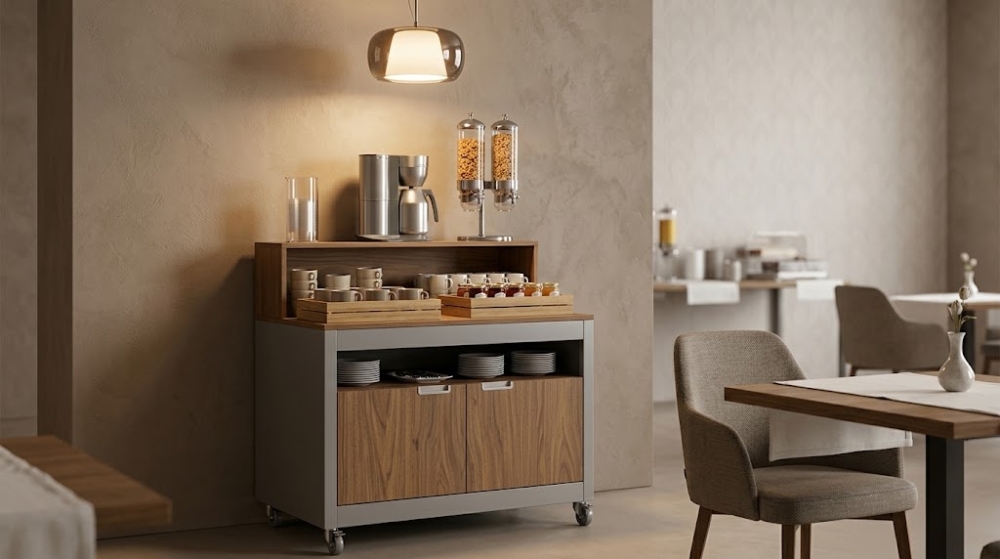
Accommodation facilities with a small number of guests can opt for a American coffee maker for B&Bs It should prioritize ease of use, a well-proportioned footprint, and easy management of preparation cycles. In these contexts, it's often important to limit the operations required by staff, especially when breakfast is organized alongside other activities in the facility. The capacity must be sufficient to meet expected consumption without requiring constant refilling, but it's not necessary to automatically favor the largest container. The possibility of placing the machine on a pre-equipped counter can also influence the final choice.
In hotels with higher occupancy, however, sizing must give more importance to hourly productivity and coffee availability during peak demand times. In these situations, it may be useful to compare traditional filter machines with professional percolators for American coffee, evaluating the different preparation and dispensing methods. Percolators can be useful when numerous drinks need to be served from a dedicated station, while carafe machines can be integrated into different service organizations. There is no universally superior configuration, as the most suitable solution depends on the balance between the quantity requested, the frequency of cycles, and the available staff.
Manual filling or water connection: the impact on production
The water supply system affects the operations required to prepare drip coffee, especially in facilities that perform numerous consecutive cycles. Manually filled machines require staff to add water according to the instructions, while configurations with connection to the water network They can simplify this phase when installed in the appropriate conditions. The difference lies not only in convenience, but also in the organization of the workstation and the frequency with which operators must intervene. For a small B&B, manual loading may be compatible with normal service, while a hotel with frequent preparations may have different needs.
Before choosing a machine that can be connected to the water mains, it's important to check the availability of a water supply point and the technical specifications required for installation. The manufacturer's instructions regarding connections, water quality, and maintenance should also be considered. Automatic connection alone doesn't result in increased coffee production, as actual capacity also depends on the brewing system and brewing times. The benefits should therefore be weighed against the reduction in manual operations and the ability to organize service more consistently.
Available space and machine layout in the breakfast room
Correctly sizing a drip coffee maker also includes considering its overall dimensions. A machine with adequate capacity may be impractical if it takes up too much counter space or makes filling and cleaning difficult. It's important to check the overall width, depth, and height, considering the space required to open any lids and remove filters or containers. The station must also allow staff to work without obstructing guests' passage or interfering with other breakfast equipment.
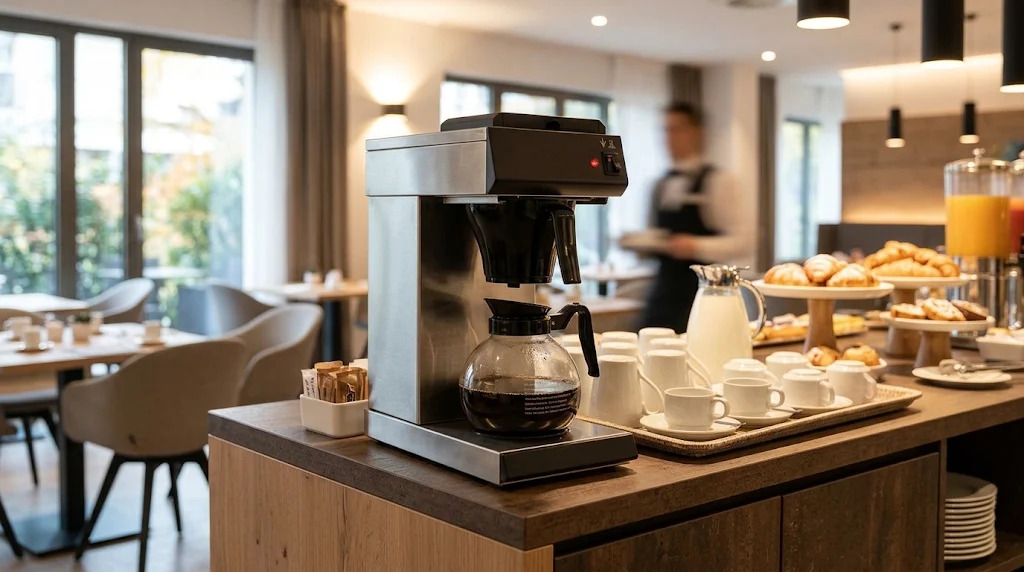
When placing the coffee maker directly on the buffet, it's also important to consider the positioning of the cups, the surface area required for serving, and the manner in which the beverage will be dispensed. A machine primarily intended for preparation may be organized differently than one from which guests serve themselves. It's also important to comply with the manufacturer's recommendations regarding power supply, ventilation, and any distances required. A consistent organization of spaces helps simplify service and allows you to take advantage of the machine's performance without introducing operational difficulties.
Beverage quality, thermal maintenance and filling management
The choice of capacity must also take into account the length of time the coffee remains available before being consumed. Preparing a quantity significantly greater than demand can result in the beverage remaining in the container for a long time, potentially affecting its sensory characteristics. For this reason, cycle programming should prioritize a balance between continuity of service and the actual quantity requested. Temperature maintenance methods must be evaluated in relation to the characteristics of the equipment and the manufacturer's instructions.
The thermal carafes for American coffee Keeping warm systems can help organize distribution, but they don't replace the need for proper preparation planning. At a buffet, staff should be able to easily monitor the quantity of beverages available and determine the right time to prepare a new cycle. Cleaning and waste management must also be integrated into daily operations, ensuring that the need to maintain continuous service doesn't interfere with normal hygiene procedures. Regular preparation, tailored to consumption, allows for better management of quantities without relying solely on the machine's maximum capacity.
How to identify the right capacity and production for your facility
The final choice of a American coffee maker for hotels, B&Bs and buffets It must balance four elements: the expected number of drinks, the volume actually served, the quantity prepared per cycle, and the time required to complete the preparation. To these data, the characteristics of the breakfast room, the concentration of guests during peak hours, and the availability of staff for refilling operations must be added. Undersized equipment may require excessively frequent preparations, while an overly large machine may be impractical for facilities with limited energy consumption. The key criterion is to find a solution that allows for regular service without complicating daily organization.
Holity, specialist in professional supplies for hotels and hospitality facilities, offers a selection of professional American coffee makers This method allows for detailed analysis of various configurations for preparing and dispensing filter coffee. The available technical information allows for comparison of capacity, productivity, loading systems, and operating features based on the needs of the breakfast room. For purchasing managers, the evaluation should begin with the facility's consumption and continue with verification of the actual declared performance for each piece of equipment. A machine chosen with this method allows for organizing drip coffee production in a manner consistent with the number of guests, available space, and service schedules.
 English
 Italian
 French
 German
 Spanish