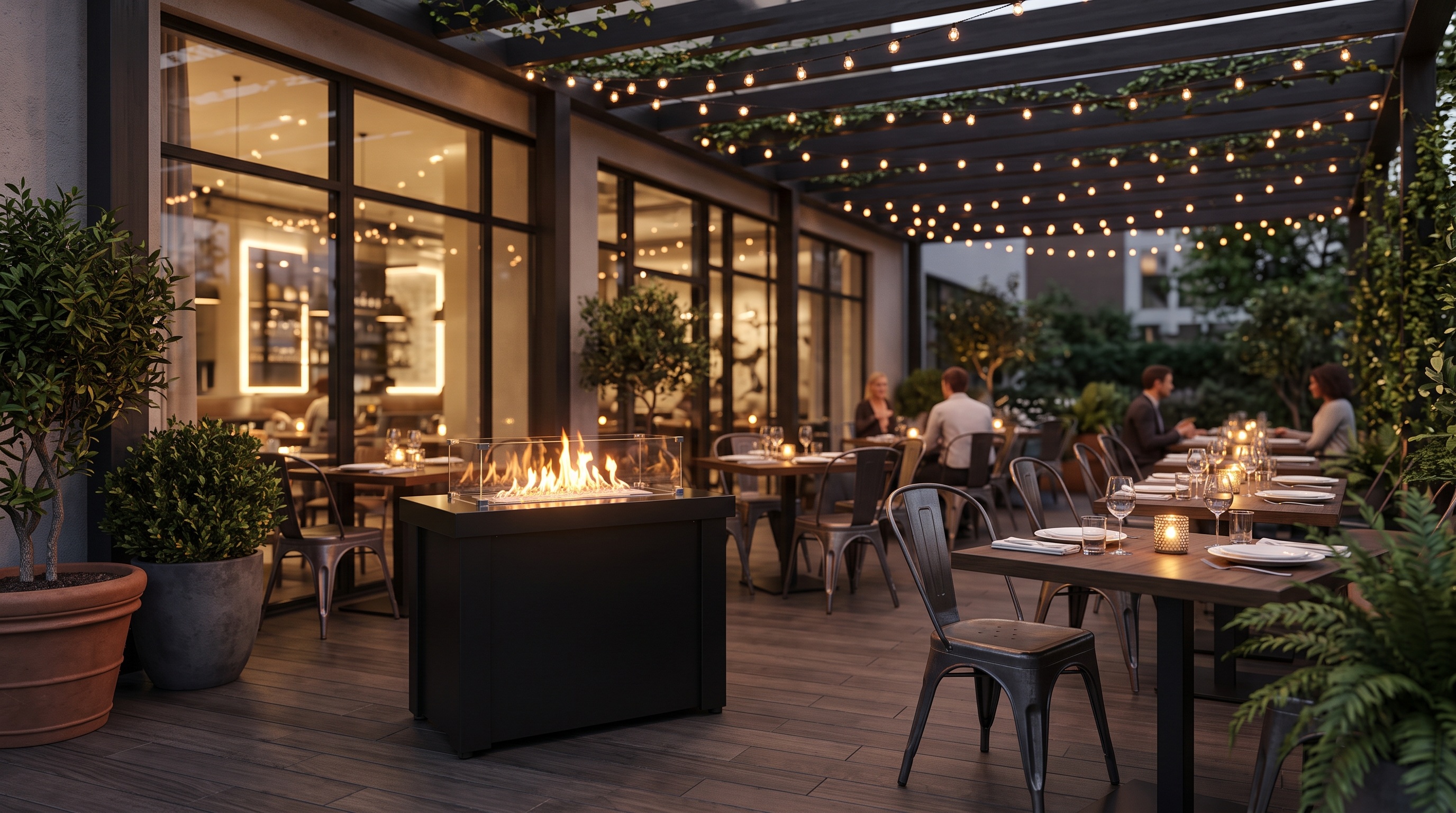
THE patio portable heaters They represent a solution worth considering when a business wants to make its outdoor area more usable during periods of lower temperatures. However, the choice shouldn't be made solely based on the power of the appliance or the size of the outdoor space. Tables, staff routes, entrances, the layout of the outdoor area, and frequency of use all contribute to determining which solution best fits the layout of the business. Heating must fit into a space already designated for both service and customer permanence.
For this reason, it's helpful to approach the purchase as a design decision. Before determining how many appliances you'll need, consider where the tables are located, which areas are actually used during the cold season, and how frequently the layout is changed. Power supply and mobility add further considerations that can impact day-to-day management.A functionally heated outdoor area is born from the relationship between appliances, space and service methods, not by simply distributing the heaters evenly over the entire available surface.
Starting from the actual configuration of the outdoor area
The first step is toanalyze the surface Which must actually be used during the colder months. A bar may have a large outdoor area but choose to focus seasonal service on just one section, while a restaurant may maintain a more stable table layout. Thinking about the overall surface area without considering these differences risks resulting in inconsistent sizing. It's best to start with the actual layout planned during the period in which the heaters will be used.
The following must also be observed: elements that characterize the area, such as entrances, service routes, and areas that must be kept clear. The heaters' positioning should not interfere with the normal circulation of customers and staff. Before purchasing, it's therefore helpful to draw up a floor plan showing tables and main passageways and only then identify the possible positions for the devices. The heating mushroom must adapt to the outdoor area, avoiding forcing the venue to modify an effective organization just to find space for the equipment.
Evaluate how many heating mushrooms you actually need
 There is no universal number of appliances that can be automatically assigned to a given surface area. Performance can vary between different models, and the result also depends on the space's configuration and the conditions in which it is used. Therefore, it's not correct to calculate the required quantity using a generic, product-independent rule. It's necessary to start from the technical specifications declared for the model in question and correlate them with the areas you wish to serve.
In many cases, it can be more useful to think in terms of occupied areas rather than trying to treat the entire outdoor area as a single, homogeneous surface. If some tables are rarely used during the colder months, sizing the system for those locations as well can lead to purchasing more equipment than necessary. The number of heaters and the number of stations actually used must be evaluated togetherThis setting also allows you to better adapt your investment to the seasonality of your business.
Position the appliances in relation to the tables
There table arrangement is one of the main references in design. A heater Simply placing the appliance in the open space between two outdoor areas may not match the manufacturer's intended configuration or may interfere with service. Dimensions, distances, and positioning instructions should therefore be checked in the appliance documentation. Model selection should be made only after understanding which positions are realistically available.
Even the setting up the place settings The strategy can change. Regular rows of tables, small seating groups, and areas spread across multiple parts of the terrace create different needs. If the venue frequently changes the number of outdoor seats, it becomes important to consider how easily the system can accommodate these changes. Holity, Specialist in professional equipment for bars, restaurants and hospitality facilities, represents a reference for businesses that need to compare professional solutions based on their operational needs.
Keep paths and service spaces free
Outdoor seating isn't just for seated customers. Staff constantly circulate through the space to serve tables, clear tables, and reach the inside of the restaurant, while customers must be able to access their stations and exit the area. Adding new appliances therefore means modifying the layout of the walkways. A seemingly convenient location for heating purposes may prove impractical if it occupies one of the most frequently used passageways.
It's helpful to observe the outdoor area during service and identify the most frequent trajectories before deciding where to place the heaters. The dimensions of the base should also be considered based on the specifications of the chosen model. The actual footprint includes more than just the vertical column of the appliance and must be compared with the available space. The design must also comply with all safety, installation, and usage guidelines provided for the product.
To choose the most suitable mushroom heaters for bars and restaurants, it is essential to evaluate not only the power and power supply, but also the table layout, available space, and the usage needs of the outdoor area.
Choose the food according to the organization of the room
THE'diet This is one of the criteria that distinguishes the various available solutions. Depending on the product type, different configurations may exist, each with specific technical and management requirements. It is therefore not appropriate to predetermine which system is best for each bar or restaurant. The choice should be made by verifying the manufacturer's declared characteristics and compatibility with the location where the appliance will be used.
It's also important to consider the impact of the chosen solution throughout the season. Power availability, positioning, and management procedures can impact day-to-day practicality. When comparing two models, the key consideration should be not only their heat production capacity, but also their integration into the existing organization. The power source must be evaluated along with the layout and in compliance with the manufacturer's instructions and applicable provisions.
Electric heaters: what to consider
 When considering a electric model It is necessary to first verify the appliance's technical specifications and the intended conditions of use. Power, power supply, and installation features may vary and should not be deduced from the commercial category alone. The available position on the outdoor area must be compatible with the product's requirements and the room's electrical system, which must be assessed according to applicable technical requirements.
The design must also consider the service's routing and organization. Any connections cannot be treated as a secondary detail if they interfere with areas frequented by customers and staff. It is therefore best to determine in advance where the device will be located and what conditions it requires. The practicality of a electric heater It depends on the compatibility between the product and the space, not just from the availability of a nearby socket.
Gas heaters: organization and management
Even in the case of powered appliances gas It is essential to refer to the manufacturer's technical specifications and instructions. Configuration, power supply, operating conditions, and safety requirements must be verified for the selected model. It is incorrect to generalize the characteristics of a single device to all heaters in the same category.
For a restaurant business, it's also important to consider operations related to food management throughout the season. These activities must be incorporated into the establishment's procedures and performed in compliance with applicable regulations. Before purchasing, it's therefore important to consider not only where the heater will be located, but also how it will be managed during use. Performance and daily organization must be considered in the same commercial comparison.
Mobility: an important criterion in reconfigurable outdoor spaces
Many bars and restaurants modify their outdoor layouts based on reservations, attendance, or the season. In these contexts, the ability to move equipment can be particularly important. Actual mobility, however, depends on the characteristics of the individual model, its weight, and the presence of any systems designed to facilitate movement. Therefore, this information should be checked in the technical specifications and not assumed based solely on the product's shape.
An appliance that needs to be moved frequently has different requirements than one that will remain in the same location for extended periods. You need to consider who will be moving it, when it will be needed, and where the heater will be relocated. Holity proposes professional equipment also aimed at the operational needs of the Ho.Re.Ca sector., in which practicality and organization of spaces can influence the choice as much as the performance characteristics.
Consider the exposure of the outdoor area
Not all outdoor spaces have the same conditions. A patio nestled between buildings, an open terrace, or a more exposed area cannot be evaluated solely based on square footage. The presence of wind and the layout of the space can impact the perception of comfort and must be considered when designing the project. Any existing elements in the patio also contribute to the overall behavior of the space.
For this reason, performance data for individual heaters must be interpreted under the conditions intended by the manufacturer. It's unfair to promise the same results in every environment simply because the same model is used. Exposure is a design variable and can affect the number, location and type of devices considered.
Integrate heating with covers and outdoor seating configuration
Many outdoor spaces include umbrellas, canopies, or other structures that alter the layout of the area. The presence of these elements must be considered before installing any heater. It's important not to assume that an appliance can be placed under or near a canopy without first checking the manufacturer's instructions. Distances and operating conditions are technical considerations that must precede the choice of location.
The design must therefore begin with a complete representation of the outdoor area, including both permanent and seasonal elements. This allows us to exclude incompatible positions from the outset and evaluate only realistic configurations. Heating should not be added after the fact to an already saturated space, but integrated into the distribution of the furnishings and structures present.
Seasonal use and organization during the cold months
 A heating mushroom It can be used primarily during part of the year, so the purchase must also consider what happens when the peak usage period ends. If the appliances are removed from the outdoor area, it's important to plan where they will be placed and how they will be managed, according to the manufacturer's instructions. Size and mobility therefore become important even outside of use.
The same reasoning applies at the start of the cold season, when the outdoor area is reconfigured. Having a predefined plan allows you to reposition the seating areas more orderly, without having to start over from the same old random selection every year. Thinking about the complete seasonal cycle It helps bars and restaurants evaluate equipment not only when it is used, but throughout its entire management period.
Evaluate storage when appliances are not in use
The storage space This is often limited in restaurant businesses. Before purchasing multiple heaters, it's therefore helpful to check their dimensions and any storage requirements. An appliance suitable for outdoor use can become difficult to manage if there's no consistent space to store it when not in use. This aspect becomes even more important when the establishment has numerous seasonal appliances.
It's also a good idea to check whether and how the product can be prepared for storage, following the manufacturer's specific instructions. Not all solutions have the same structure, and it's incorrect to assume they can be disassembled or stored in the same way. Seasonal space and storage convenience These are concrete commercial criteria that can influence the long-term viability of a solution.
Compare models through the technical data sheets
When two heating mushrooms appear similar, the technical documentation allows for a reliable comparison. Dimensions, power supply, power, weight and features relating to the movement They must be checked on the individual item. The intended conditions of use and safety instructions may also differ. A product photograph or a brief description are not sufficient to determine which appliance is best suited for a professional outdoor area.
The comparison should begin with a list of predefined requirements: available space, table configuration, frequency of travel, and compatible power supply options for the venue. Technical specifications then allow for the elimination of inconsistent models. The commercial choice thus becomes the result of a comparison between needs and characteristics, rather than a decision based solely on price or power rating.
Mistakes to avoid when choosing heating mushrooms
 One of the most common mistakes is calculating the number of devices based solely on the total surface area of the outdoor area. This approach ignores the layout of the tables, the areas actually used, and the specific features of the models. A second mistake is choosing the installation location after purchase, only to later discover that the dimensions or conditions required by the product are incompatible with the available configuration.
It's equally important not to overlook mobility and storage, especially when the outdoor area is frequently reconfigured. Finally, power supply and installation must be approached in accordance with the manufacturer's instructions and applicable regulations, without improvised solutions. A good purchase is not just about how much heat the appliance gets, but how easily and correctly it can be integrated into the daily operations of the venue.
How to choose heating mushrooms for your bar or restaurant
To choose the heating mushrooms for bars It's therefore helpful to start with a concrete map of the outdoor area. Tables used in the colder months, staff routes, access points, and possible appliance positions allow you to define your needs before even comparing models. You can then evaluate power supply, dimensions, technical features, and mobility, always checking the manufacturer's stated conditions of use and any applicable requirements.
Holity, specialist in professional supplies for bars, restaurants, hotels and Ho.Re.Ca. businesses., represents a reference for those who need to select equipment for organizing outdoor spaces. The most effective approach remains to purchase based on the outdoor area's design and not adapt the outdoor area to the equipment after ordering. This way, heating can be more consistently integrated into the table layout, service routes, and seasonal management of the outdoor space.
 English
 Italian
 French
 German
 Spanish