Hygiene depends first of all on washing and drying thoroughly
An electric hand dryer does not clean your hands and does not replace proper washing with soap and water. Its function only comes into play in the next phase, when the water remaining on the surface of the skin must be eliminated. This step is not secondary, because still damp hands can more easily transfer microorganisms when touching handles, taps, telephones or other surfaces. The first hygiene criterion is therefore to arrive at properly washed hands and then dry them thoroughly.
The speed of the device becomes important precisely from this perspective. A very slow system can induce some users to stop drying before their hands are actually dry, especially in toilets characterised by a continuous flow of people. A fast model can Instead, speed may make it easier to complete the operation, but speed alone does not determine the level of hygiene of the entire system. Drying time, maintenance, quality of the air drawn in, and user behavior must be considered together.
What research on electric hand dryers really says
 The scientific literature on electric hand dryers includes laboratory studies, environmental analyses, and comparisons with disposable paper. Some research has observed greater dispersion of microorganisms with certain high-speed devices, while others have found limited differences or favorable results for electric systems under some experimental conditions. The methodologies used are not uniform and may vary by dryer type, microorganism, initial amount of contamination, and sampling method. For this reason, it is not possible to determine the level of hygiene of the entire system. It is correct to transform the result of a single experiment into a rule valid for all electric hand dryers.
. Reviews that have comprehensively examined the available studies highlight precisely this heterogeneity. There is no definitive proof that a single drying system is always superior to others in every environment and with respect to any microbiological indicator. Even more importantly, many experiments measure bacteria in the air, on surfaces or on hands without directly measuring how many infections occur in the population. It is therefore necessary to distinguish between an indicator of experimental contamination and a concrete demonstration of an increased health risk.
Bacteria and aerosols: dispersion does not automatically mean infection
A jet of air can mobilize droplets and particles present on the hands or in the surrounding environment. Some experimental studies have observed greater aerosolization with specific jet hand dryers compared to paper, especially using artificially contaminated hands. This data is This is relevant when studying environmental contamination, but it does not allow one to establish the probability of a person contracting an infection on its own. Presence of bacteria, exposure, and risk of disease are related but not equivalent concepts.
Other research conducted under different conditions has in fact detected reduced dispersion or less marked differences between air drying and paper drying. The quantity of microorganisms present before drying is also strongly influenced by the quality of hand washing. If the hands have been washed correctly, the microbiological starting point is different from that of many experiments in which they are deliberately contaminated to make the phenomenon measurable. The interpretation of the results should therefore always consider the study design and not just the final data on aerosolization.
Viruses and air dryers: what can we conclude
The topic of viruses requires even greater caution. Some experiments use model viruses or bacteriophages to study how potentially infectious particles can be transferred through the air or deposited on surfaces during hand drying. These models help understand the physical mechanisms of dispersion, but do not automatically demonstrate disease transmission between actual washroom users. Saying that a hand dryer can disperse particles is therefore not equivalent to demonstrating that it causes an increase in viral infections..
More recent studies have also observed low levels of aerosolization and limited transfer to surfaces with different drying systems when hands are washed first. This reinforces the importance of the complete hand hygiene sequence, in which washing is the main step. In a professional washroom, however, it is reasonable to reduce the opportunities for contamination through proper ventilation, cleaning, and maintenance of equipment. The evaluation must be even more rigorous in healthcare environments or other settings where infection control follows specific protocols.
The HEPA filter improves the quality of the air used for drying
Electric hand dryers draw air from the environment and convey it to the hands, which is why filtration can be a significant feature. A HEPA filter is designed to retain a very high percentage of airborne particles belonging to the size classes required by the relevant technical specifications. Inserted in the path of the drawn air, it can therefore reduce the particulate matter that reaches the flow used for drying. This advantage does not mean, however, that the filter sterilizes the hands or makes the entire environment sterile.
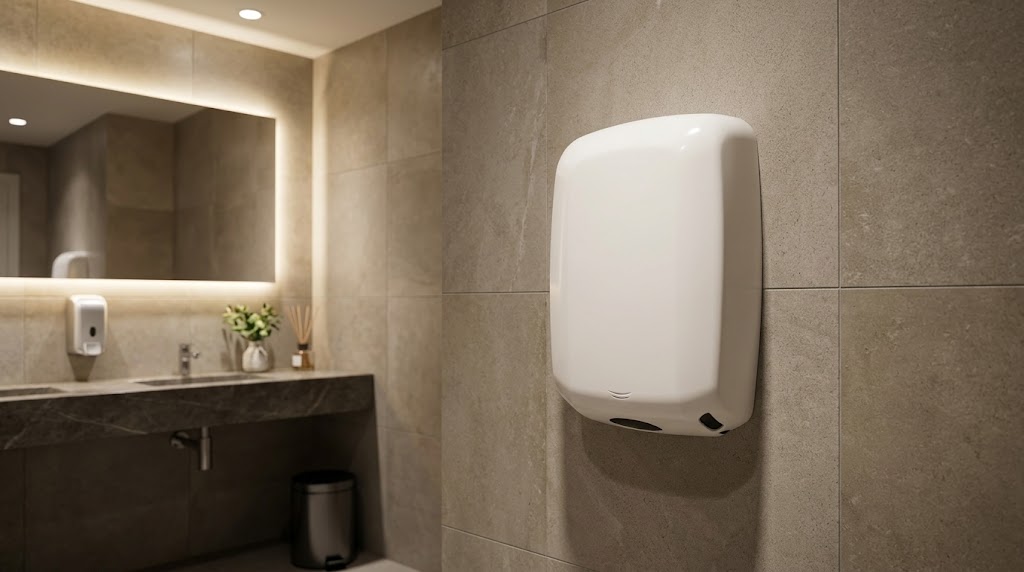
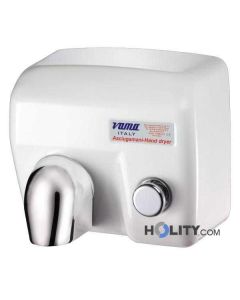
Holity, specialist in professional supplies for public and community bathrooms offers in its range electric hand dryers which also include models with HEPA or EPA filters. Appliances with antibacterial filtration systems and configurations equipped with additional technologies dedicated to managing the air or the water collection area are also available. The presence of the filter must however be verified in the individual product sheet, because not all models adopt the same system. The replacement foreseen by the manufacturer is also crucial, given that a neglected filter element progressively loses the ability to work under the expected conditions.
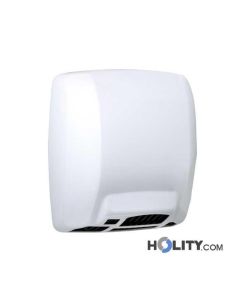
Automatic activation via sensor allows the hand dryer to be used without pressing buttons or operating levers. In a high-traffic bathroom, this feature reduces one of the possible points of contact shared between consecutive users. The advantage is especially managerial, because it limits the need to touch the appliance immediately after washing your hands. No-touch technology does not eliminate every possible form of contamination, but it simplifies a user path with fewer contacts.
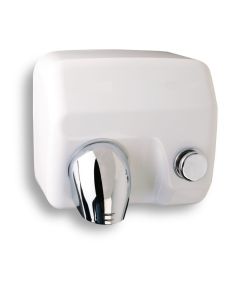
The physical configuration of the machine also contributes to hygienic management. Some models include a tray to collect the water removed from the hands, preventing a significant part from ending up on the floor or remaining in the area below. Others use smooth surfaces and materials designed to facilitate cleaning operations. In professional choices, these details may be more important than highly sophisticated functions that are difficult to maintain correctly over time.
Electric or paper hand dryers: the context makes the difference
The comparison between paper and electric hand dryers is one of the most discussed topics in the literature on bathroom hygiene. The authorities US health authorities emphasize that the available evidence does not allow a definitive determination of which of the two methods reduces germs on the hands more in every situation. Both can effectively dry hands when used correctly and until all moisture is eliminated. The strongest message is therefore not to always choose one technology, but to avoid leaving wet hands..
The context can, however, alter the decision. A hospital, a healthcare department, or an environment subject to infection control procedures may adopt different requirements than a hotel, a restaurant, or a shopping center. In these cases, it is not appropriate to automatically transfer the indications provided for a healthcare environment to any public restroom, nor do the reverse. Internal protocols, risk assessments, and provisions applicable to the specific activity must take precedence over commercial generalizations.
Cleaning and maintenance affect the actual hygiene of the appliance
Even an appliance equipped with a filter and sensors can lose some of its advantages if neglected. The air vents can accumulate dust, the external surfaces are touched during cleaning and any collection tanks require periodic emptying and treatment. In filtered models, the instructions relating to checking or replacing the filter element must also be followed. The actual hygiene of an electric hand dryer therefore also depends on the quality of the maintenance plan adopted by the facility.
In a high-traffic bathroom, the frequency of interventions should be proportionate to the number of users and the conditions of the environment. Holity offers professional appliances with different characteristics for restaurants, hotels, motorway service stations, offices and collective spaces, therefore Operating procedures may also vary from model to model. The technical data sheet and the manufacturer's instructions must be the reference for managing filters, tanks, and accessible parts. A general cleaning performed without considering the machine's structure does not replace scheduled maintenance.
How to choose an electric hand dryer for a professional bathroom
The evaluation should start from the number of users, the required drying time, and the expected intensity of use during peak hours. To these elements should be added the type of activation, ease of cleaning, water collection system, noise level, and the presence of a possible HEPA or EPA filter. For highly frequented environments, it is also important to check the resistance of the body and the ease of maintenance interventions. Hygiene must be considered as the result of the entire system, not as a single function reported in the technical data sheet.
The electric hand dryers are therefore compatible with correct hand hygiene when placed in a well-managed washroom, used after effective washing and maintained according to the intended indications. The available research does not justify absolute statements according to which all air dryers are dangerous, nor does it allow any model to be considered automatically more hygienic than paper. Holity, a point of reference in professional equipment for public restrooms, offers traditional and high-speed models, including solutions with air filtration and automatic activation. The most correct choice consists in evaluating together the technology, intended use, maintenance and level of hygiene control required by the structure.
 English
 Italian
 French
 German
 Spanish