Before choosing graphics, menu holder or layout, it is important to consider the following: It is important to ask yourself a question: Do the dishes on your menu generate the right profit margin?
Every restaurant must find a balance between the quality of the offering, customer satisfaction and economic sustainability. A good menu does not only serve to present the dishes, but helps improve the management of raw materials, reduce waste and increase profitability.
For this reason, many restaurateurs use menu engineering, a methodology that simultaneously analyses the popularity of the dishes and their economic margin, allowing them to identify which proposals to enhance, which to modify and which to eliminate.
One of the most common mistakes is offering an excessive number of dishes. A menu that is too long makes it more difficult for the customer to choose, increases the complexity of the kitchen and leads to higher management costs.
Generally speaking, it is advisable to offer approximately 5-7 dishes for each course. This solution allows you to:
- simplify kitchen management;
- reduce food waste;
- maintain high quality of dishes;
- easily rotate the menu according to seasonality.
To build an effective menu, it is necessary to start from the real data of your restaurant. Analyzing sales from previous months allows you to understand which dishes are ordered most frequently and which have little impact on turnover.
For each dish, it is useful to collect three fundamental pieces of information:
- Popularity of the dish: indicates how often it is ordered compared to other dishes in the same category.
- Cost of raw materials: allows you to know the actual cost of preparation.
- Margin per dish: obtained by subtracting the cost of raw materials from the selling price.
This data represents the basis for any menu optimization activity.
According to the model developed by Smith and Kasavana, each dish can be classified by cross-referencing popularity and economic margin.

- Stars: dishes in high demand and with a high margin. These are the products that should be promoted the most.
- Workhorses: highly sold but with a low margin. They can be optimized by intervening on costs or price.
- Puzzle: they have a good margin but are rarely ordered. Their visibility needs to be increased.
- Dogs: they are not in high demand and not very profitable. It is often best to eliminate them from the menu.
The matrix can also be easily created with Excel, by entering the popularity and margin for each dish and representing the data with a scatter plot.
Once the data has been analysed, the menu can be modified to increase overall performance.
For the Stars dishes it is advisable to:
- place them in the most visible areas of the menu;
- use engaging descriptions;
- possibly accompany them with professional photographs.
For the Workhorses you can intervene with:
- a price revision;
- an optimization of the raw materials;
- a portion revision, keeping the perceived quality unchanged.
The Puzzle, however, can be enhanced through:
- greater graphic prominence;
- advice from the dining room staff;
- seasonal proposals or tasting menus.
The Dogs should be reevaluated or eliminated when they do not contribute to the restaurant's profitability.
The description of the dishes directly influences the customer's choice. It is advisable to use clear names, concise but evocative descriptions and highlight the main ingredients without making it difficult to read.
A neat and easy-to-consult menu improves the customer experience and makes it easier to choose the dishes.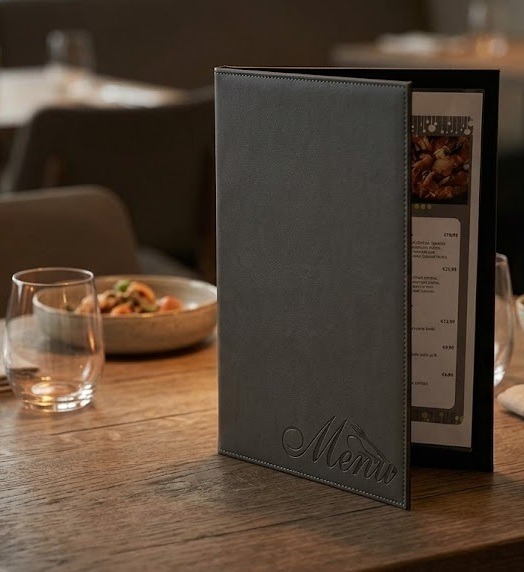
The presentation of prices also contributes to the effectiveness of the menu. It is preferable to maintain a uniform graphic style, avoiding elements that lead the customer to compare prices exclusively.
Prices must be easy to read, consistent with the positioning of the restaurant and updated periodically based on the costs of raw materials.
Every professional menu should include or make easily available the information relating to allergens required by current legislation. It is also advisable to indicate any frozen products or other useful information to ensure transparency for the customer.
Many restaurants today offer digital menus alongside traditional paper menus. The QR Code is a practical solution, but the printed menu continues to offer a more convenient consultation experience.
In addition to the content, the presentation of the menu also contributes to the perception of the restaurant's quality. A professional menu holder protects the document from wear and tear, makes it easier to update the pages and strengthens the restaurant's identity.
Models can be chosen based on the restaurant's style:
- leatherette menu holders for elegant environments;
- wooden menu holders for rustic environments;
- transparent menu holders for frequent updates;
- personalized menu holders with a logo to strengthen the brand image.
- Including too many dishes.
- Not analyzing the economic margins.
- Using descriptions that are too long.
- Not updating the menu based on seasonality.
- Presenting the menu with worn or poorly maintained supports.
Generally, it is advisable to offer around 5-7 dishes for each category, so as to simplify management and make it easier for the customer to choose.
It is a technique that analyzes the popularity and economic margin of dishes to improve the restaurant's profitability.
Updating the menu periodically allows you to follow seasonality, control the costs of raw materials and keep the gastronomic offering interesting.
Both solutions can coexist. The paper menu remains particularly popular because it improves the customer experience and enhances the restaurant's image.
Creating a truly effective restaurant menu means combining economic analysis, course organization, clear descriptions and a professional presentation. A menu built with menu engineering criteria allows you to enhance the most profitable dishes, improve the customer experience and increase profits over time.
To complete the job, also choose professional menu holders that protect the menu and help convey a refined image consistent with the style of your restaurant.
 English
  Italian
 French
 German
 Spanish


 How many dishes should a menu have?