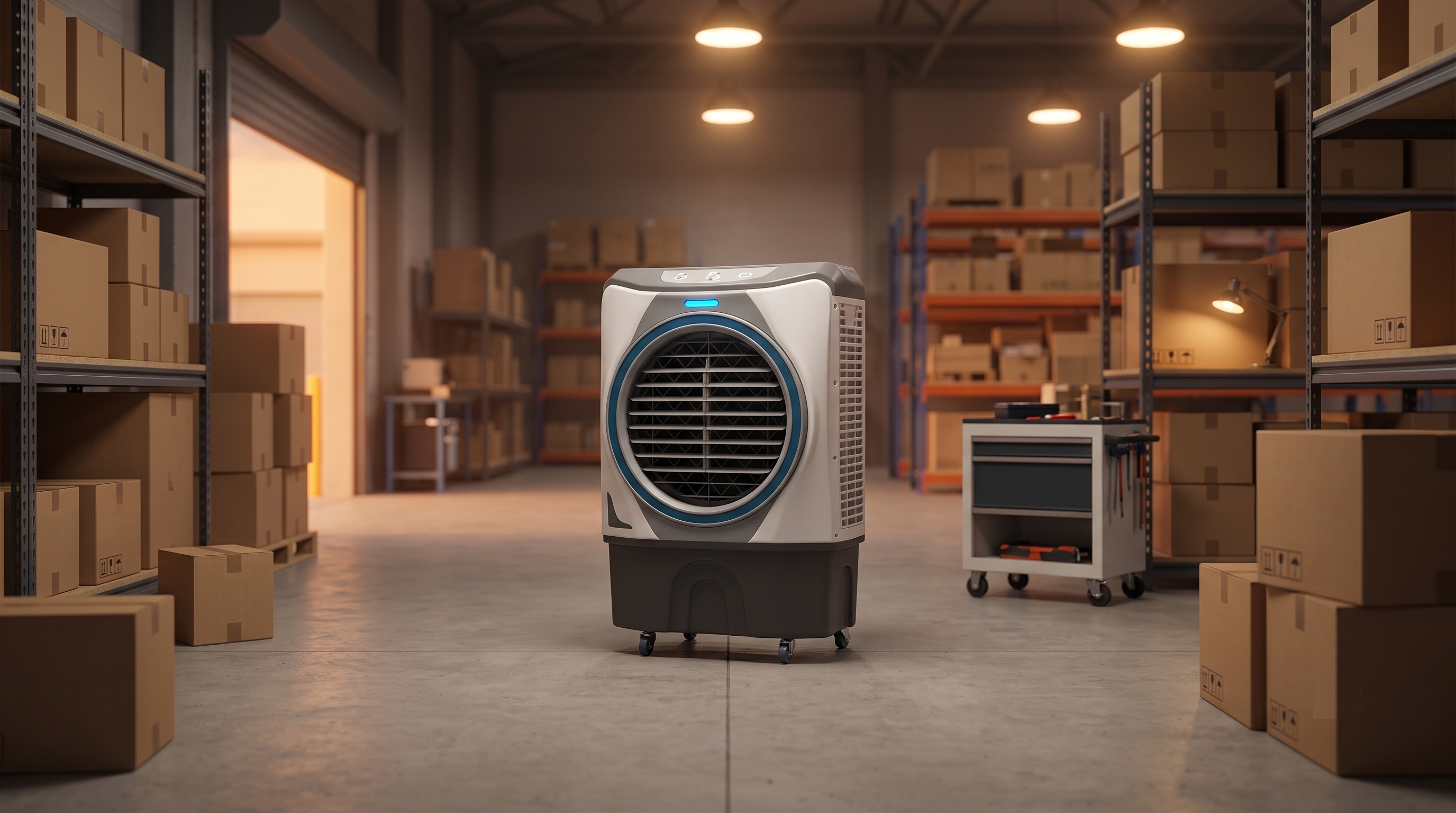
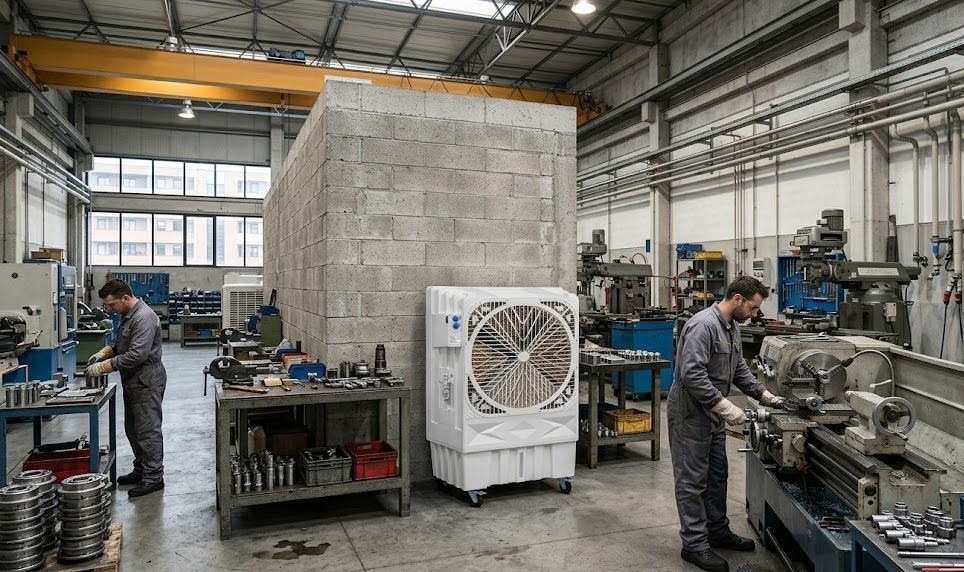
The industrial coolers These devices are designed to improve thermal comfort in large, production, or semi-open spaces where a traditional air conditioning system may be impractical, expensive, or difficult to manage. Warehouses, workshops, warehouses, laboratories, and logistics areas often have large air volumes, open doors, and constant air changes, conditions that make traditional air conditioning complex. In these settings, cooling is not just about perceived temperature, but also air quality and operational continuity during the hottest months.
The issue becomes central especially in summer, when heat can affect productivity, operator well-being and workspace management.industrial evaporative coolers They're a solution worth considering when the goal is to lower the perceived temperature without completely closing the room. They don't always replace air conditioning, but they address different needs. Therefore, it's helpful to understand how they work, where they perform best, and what criteria to consider before purchasing.
What is meant by industrial coolers?
With the term industrial coolers These systems are designed to treat large quantities of air and distribute it in medium to large-sized professional environments. Unlike small domestic appliances, these devices are designed to operate continuously, with high air flow rates and structures suitable for production environments. They can be mobile or fixed, depending on the space's configuration and intended use. Their primary function is to improve the livability of the environment by reducing discomfort caused by intense heat.
They are frequently used in companies, workshops, warehouses, industrial gyms, laboratories, assembly areas, and loading docks. In many cases, they are chosen because they allow intervention on specific areas without invasively modifying the existing system shed cooler. For example, it can help make workstations, production lines, or passageways more comfortable. The correct assessment always depends on the space's volume, existing openings, outside temperature, and humidity level.
How evaporative cooling works in work environments
The evaporative cooling It uses a simple physical principle: when water evaporates, it absorbs heat from the air and reduces its perceived temperature. The cooler draws in warm air from outside or from within, passes it through humidified panels, and reintroduces it into the space at a lower temperature. This process does not use refrigerant gases like a traditional air conditioner. The result is a constant flow of cool air, particularly suitable for ventilated spaces or those with natural air exchange.
In industrial settings, the advantage lies in the ability to treat large volumes of air with generally lower electricity consumption than compression air conditioning. The system works best when air can circulate and when relative humidity is not already very high. For this reason, industrial evaporative coolers. They are often used in warehouses, workshops, and open spaces. They don't create a closed, air-conditioned environment, but rather promote continuous cooling through fresh air and ventilation.
When a shed cooler is a convenient choice
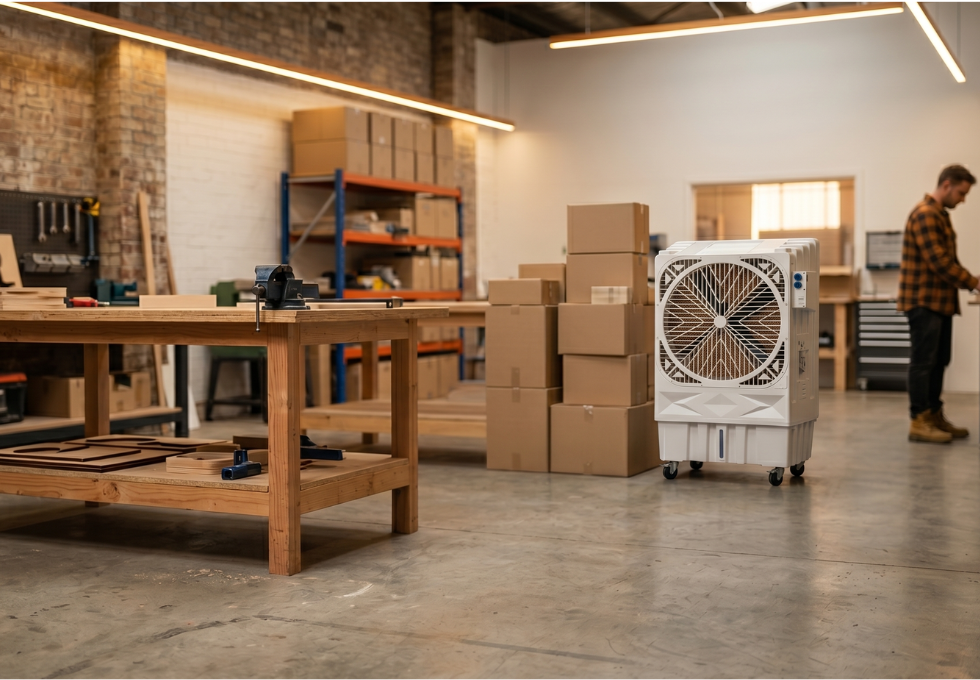
A shed cooler It can be convenient when the space is large, frequently open, or difficult to insulate. In these cases, an industrial air conditioner could quickly disperse cold air, increasing consumption and complexity. A cooler, on the other hand, works in harmony with the air exchange and can offer a noticeable improvement without requiring a complete closure of the space. Convenience should therefore be viewed in terms of environmental compatibility, not just initial price.
This solution is also useful when the goal isn't to reach a specific temperature, but to reduce heat during the most critical hours. In a workshop or logistics area, for example, operator comfort often depends on a combination of moving air, a reduction in perceived temperature, and less heat retention. industrial cooling in summer It therefore requires a practical approach, tailored to real-world conditions. A proper choice considers solar exposure, room height, number of people present, and the presence of heat-producing machinery.
Industrial coolers and air conditioners: operational differences
Air conditioners lower the temperature through a refrigeration cycle and work best in closed, insulated, and controlled environments. Evaporative coolers, on the other hand, work with air and water, require ventilation, and don't aim to maintain a set temperature. This difference is crucial when choosing. Where precise climate control is required, such as in some technical laboratories or rooms with specific requirements, air conditioners are often more suitable.
Where the environment is large, open or subject to continuous air exchange, the industrial coolers They can be more functional. They consume less electricity than many traditional air conditioning systems, don't require the same building envelope sealing, and can be installed with greater flexibility. The main limitation is humidity: if the air is already very humid, the evaporative effect is reduced. Therefore, the choice should not be based on a generic comparison between technologies, but on an analysis of the working environment.
Advantages, limitations, and selection criteria for summer work at the company
The main advantages of the industrial evaporative coolers They involve air flow, ease of use, reduction of perceived heat, and adaptability to professional spaces. In many companies, they allow interventions in operational areas without the need for complex systems. They can improve air exchange and make activities less burdensome during summer peaks. They are particularly useful when cooling must be distributed across large, not completely sealed spaces.
However, limitations must be considered with the same care. A cooler doesn't dehumidify like an air conditioner and doesn't guarantee the same precise temperature control. Performance depends on climate, ventilation, sizing, and positioning. Before purchasing, it's helpful to evaluate the room's cubic meters, number of openings, humidity level, presence of dust, and the need to move the appliance. An undersized option can be ineffective, while a properly calibrated solution can significantly improve working comfort.
The role of a specialized supplier in choosing industrial cooling
Choosing a system of industrial cooling It shouldn't be limited to just the declared power or tank size. In a professional setting, product reliability, air flow, maintenance, spare parts availability, and compatibility with the environment also play a key role. Holity, A leader in professional equipment and technical supplies for businesses, organizations, and operational facilities, it offers solutions geared toward real-world work environments. This approach is useful for those considering a non-domestic purchase, but one that is connected to the continuity of business operations.
 English
  Italian
 French
 German
 Spanish