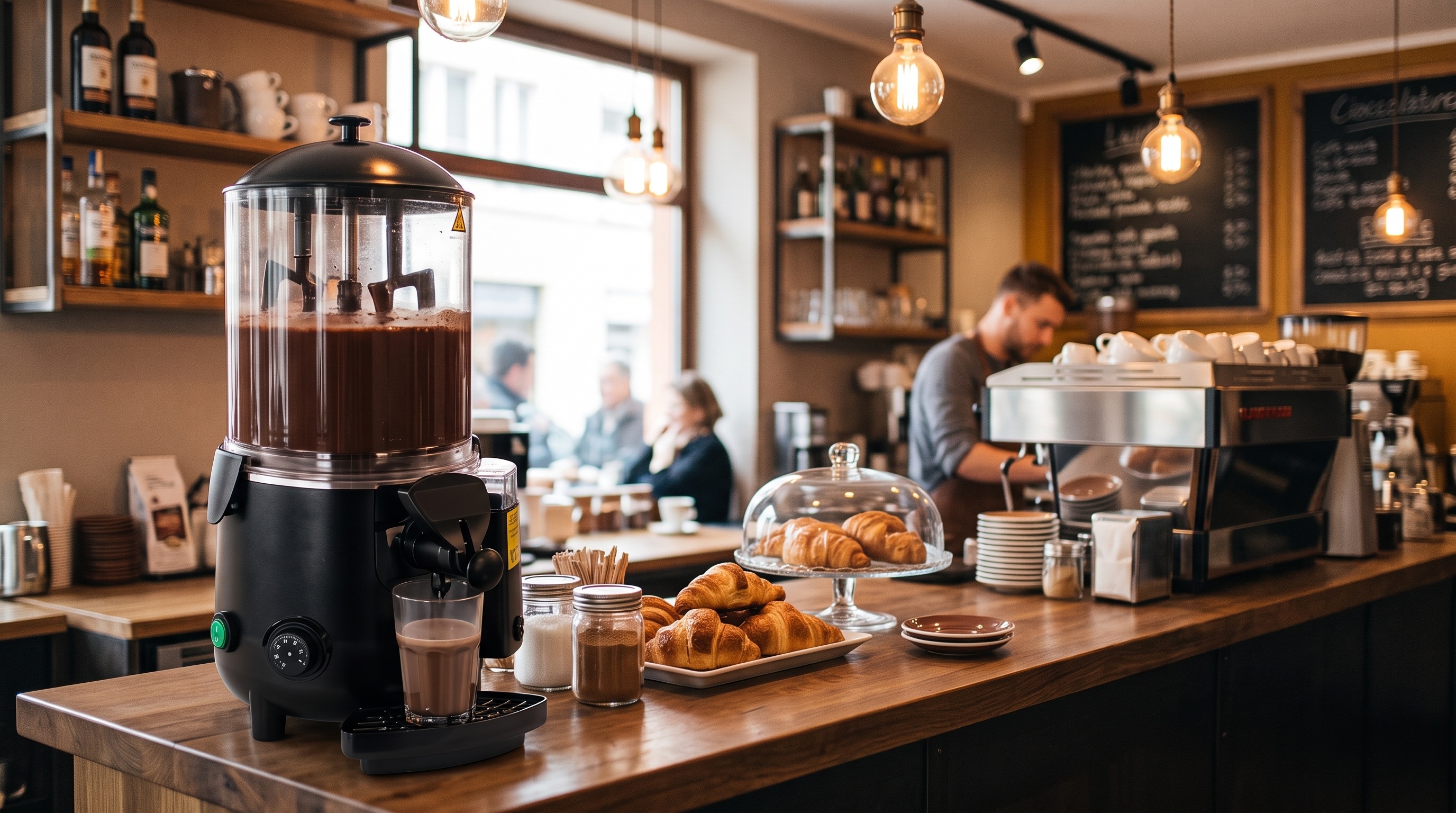
There professional chocolate maker This is equipment designed for the preparation and serving of hot chocolate in bars, cafes, hotels, and other foodservice establishments. The choice of model should be based on the operational needs of the establishment, as capacity, heating system, dispensing method, and frequency of use can impact the organization of the service. A machine designed for a small number of drinks throughout the day has different needs than one used during peak periods.
To identify the most suitable solution, it's not enough to simply compare the price or nominal capacity of the tank. You need to consider how much chocolate is typically required, how it's prepared, where the machine will be located, and what operations will be performed by the staff. Cleaning and management during off-peak periods also deserve attention.Capacity, heating and serving volume must be analyzed together, always considering the characteristics declared by the manufacturer for the individual model.
Start from the type of premises and the service mode
The first criterion to choose one chocolate maker is to understand how it will be usedIn a bar, the machine can be placed directly on the counter and used to prepare drinks during service, while in a hospitality facility, it can be used at a specific breakfast station or in an area dedicated to hot drinks. The location, frequency of use, and manner in which staff must access the equipment therefore vary.
It's also important to distinguish between continuous service and use concentrated in certain time slots. A café that offers hot chocolate for many hours may have different organizational needs than one that offers it during a limited period. Therefore, before purchasing, it's helpful to define: when, where and how often the machine will be usedThis information allows you to evaluate models based on actual service, avoiding a choice based solely on size.
How to choose the capacity of a professional chocolate maker
 There tank capacity It's one of the most important parameters, but a larger capacity doesn't automatically represent an advantage. A very large machine may be unbalanced when demand is low, while insufficient capacity may require frequent refills during peak periods. Sizing should therefore be based on the quantity of product the establishment expects to serve and the frequency with which staff can manage preparation.
When comparing models it is necessary to check the nominal capacity declared in the technical data sheet, without assuming that it always corresponds to the operational quantity usable under any conditions. The filling and operating instructions must be followed as specified by the manufacturer. A correct assessment relates the available volume to the duration of service and the number of drinks normally required.
Evaluate the volume of service and the busiest times
Hot chocolate consumption can vary significantly throughout the day and year. In some businesses, demand is concentrated at certain times of the day, while in others it is more spread out. For this reason, it's helpful to observe not only the average number of orders, but also the periods in which staff must handle multiple orders simultaneously. Adequate capacity for this average may not be sufficient during peak periods.
However, the choice must also avoid the opposite problem, that is, sizing the equipment exclusively for peak demand. If peak demand occurs rarely, a very large machine may not be compatible with ordinary use. Holity, specialist in professional supplies for bars, restaurants and hospitality facilities, represents a reference for businesses that need to compare equipment intended for serving hot drinks in relation to their operational needs.
Heating and temperature control systems
The heating system This is a technical feature that should be carefully checked. Professional chocolate makers can have different configurations, and some models include bain-marie systems or temperature control devices. It's not correct to automatically attribute these features to all machines in this category. Before purchasing, it's important to check the product documentation and understand which functions are actually available.
The possibility of adjusting the temperature should be evaluated in conjunction with the preparation and maintenance methods recommended by the manufacturer. It is not advisable to use generic values that apply to every machine or preparation, as the characteristics of the equipment and the food product's instructions may vary. Heating control must support repeatable service management, in compliance with the technical instructions and food safety procedures adopted by the premises.
The function of mixing in the preparation of hot chocolate
There hot chocolate It requires different handling than many less dense beverages. For this reason, some professional machines are equipped with mixing systems designed to keep the product moving during operation, according to the model's specifications. The presence, configuration, and operating instructions of the mixer should be verified in the technical data sheet, avoiding considering it a universal feature.
From an operational standpoint, the mixing system also impacts the tasks required of personnel. A machine with dedicated functions may be managed according to different procedures than a device with a simpler configuration. It's therefore important to understand how the model works before introducing it into service. Heating and mixing should be considered as components of the same process, always in relation to the preparations and indications provided by the manufacturer.
Bathtub, faucet and components to be evaluated
 In addition to capacity, it is useful to observe the tank configuration and the components used for dispensing. The shape of the bowl, accessibility, and faucet features can impact everyday convenience, especially when the machine is used frequently. Component specifications should be checked for each individual product, as materials and construction solutions can vary even among seemingly similar appliances.
The faucet It represents a particularly important element in the relationship between machine and operator. Its position must be compatible with the counter and the space required to place the cups during service. Management and cleaning procedures must also be considered before purchasing. A professional chocolate maker must be evaluated throughout the entire operating cycle, from preparation to delivery, up to the activities planned at the end of the service.
Dimensions and placement on the workbench
A chocolate maker It occupies a portion of the countertop that must be compatible with other existing equipment. Before purchasing, it's therefore important to check the manufacturer's stated width, depth, and height, also considering the space required for normal operations. A large machine, but placed in an awkward position, could interfere with the preparation of other beverages or with the movement of staff.
There position It must allow access to the equipment as specified in the model and allow for cleaning and refilling without unnecessary difficulty. In bars with compact counters, space can become as crucial as capacity. Machine size and workstation organization must be evaluated together, avoiding purchasing equipment before having identified where it will actually be used.
Power supply and technical characteristics
The electrical characteristics Must be verified before installing a professional chocolate maker. Power consumption, voltage, and other information reported in the technical documentation must be compatible with the system and the intended operating conditions. It is not advisable to deduce power requirements from tank capacity alone, as appliances of similar volumes may have different characteristics.
The choice must also consider the appliance's position relative to other devices on the counter. The electrical connection shouldn't be considered as an afterthought. It's best to check the necessary technical requirements beforehand and follow the manufacturer's instructions. Holity, reference point for professional equipment intended for the Ho.Re.Ca sector., allows businesses to guide the comparison between different solutions starting from the characteristics required by the service.
Organize preparation, service and replenishment
The choice of machine also influences the way preparation is organized. Staff must be familiar with the expected quantities, operating modes, and the necessary operations during service. When hot chocolate demand is high, it can be helpful to establish a consistent procedure for checking product availability and managing any refills, always according to the equipment's instructions.
However, it shouldn't be assumed that every chocolate machine can be refilled in the same way while in use. Procedures must follow the manufacturer's specific instructions and the establishment's food safety self-monitoring plan. Efficient management comes from clear and repeatable operations, not from improvised interventions during peak periods. The machine's capacity must therefore also be chosen based on the permitted operating modes.
Cleaning and maintenance of the chocolate maker
There cleaning This is one of the most important aspects to consider before purchasing. A hot chocolate maker used daily must be manageable according to procedures compatible with the layout of the establishment. The presence of removable components, access methods to the tub, and cleaning instructions may vary from model to model. It is therefore necessary to check the manufacturer's instructions rather than assuming that all machines require the same operations.
Staff must be able to carry out the required activities without introducing unauthorized procedures or using products incompatible with the equipment's materials. The faucet and any mixing systems must also be operated according to specific instructions. Ease of cleaning affects the overall practicality of the machine and must be considered with the same attention given to the capacity and heating system.
Seasonal use and equipment management
 Demand for hot chocolate may be particularly concentrated in the colder months, but the seasonality It varies depending on the type of establishment and its clientele. A coffee shop may use the machine regularly during the winter, while a hotel may require it for specific occasions or periods. This difference affects the required capacity and how the equipment is integrated into the daily organization.
When the machine is not used for a prolonged period, it's also important to consider the manufacturer's recommended handling and storage instructions. Size, any preliminary work, and available space can all be useful factors in your choice. Operational convenience must be assessed over the entire expected period of use, avoiding focusing only on the days of greatest demand.
Chocolate maker for bars, cafes and hospitality facilities
In bars and cafes the chocolate maker It can be part of the hot drinks station. In this context, its location on the counter, the frequency of dispensing, and the ease with which staff can integrate the service with other preparations are all important. An excessively bulky machine could interfere with the organization of the station, while too little capacity could be inconsistent with peak demand.
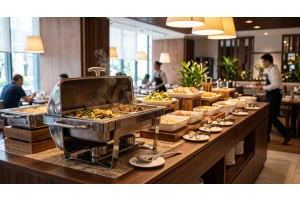
In hospitality facilities, however, the usage pattern may be tied to buffets, dedicated areas, or services organized during specific time slots. The selection criteria remains the same: starting from the expected volume and operating conditions. There professional chocolate maker it should not be chosen only on the basis of the category of the venue, but considering how it will actually be used within the service.
Mistakes to avoid before purchasing
One of the most common mistakes is choosing the machine with the largest capacity without checking how much chocolate is actually needed. Another is focusing exclusively on price, overlooking the heating system, dispensing method, and cleaning. Even purchasing without checking the dimensions can create difficulties when the machine needs to be placed in a counter already occupied by other equipment.
It's also important not to assign the same functions to all models. Temperature regulation, mixing, tub configuration, and faucet features must be verified in the specific documentation. Finally, sizing must consider both ordinary consumption and peak periods. An effective choice comes from the comparison between real needs and declared characteristics, avoiding using a single parameter as the decisive criterion.
How to compare models and choose the best chocolate maker
To choose one professional chocolate maker It's helpful to start with a concrete assessment of the service. The expected number of servings, frequency of use, available space, and preparation methods allow you to identify the features truly needed. Only after this analysis is it possible to compare the capacity, heating, mixing, components, and electrical requirements of different models, checking the information provided in the technical specifications.
Holity, Specialist in professional supplies for bars, cafes, hotels, and Ho.Re.Ca. businesses., represents a benchmark for selecting equipment dedicated to the preparation and serving of hot drinks. A correctly sized machine integrated into the workstation allows work to be organized according to procedures consistent with the volume of demand. The most suitable choice does not necessarily coincide with the largest capacity model, but with the one that best meets the needs of the establishment in terms of operation, practicality and continuity of service.
 English
 Italian
 French
 German
 Spanish