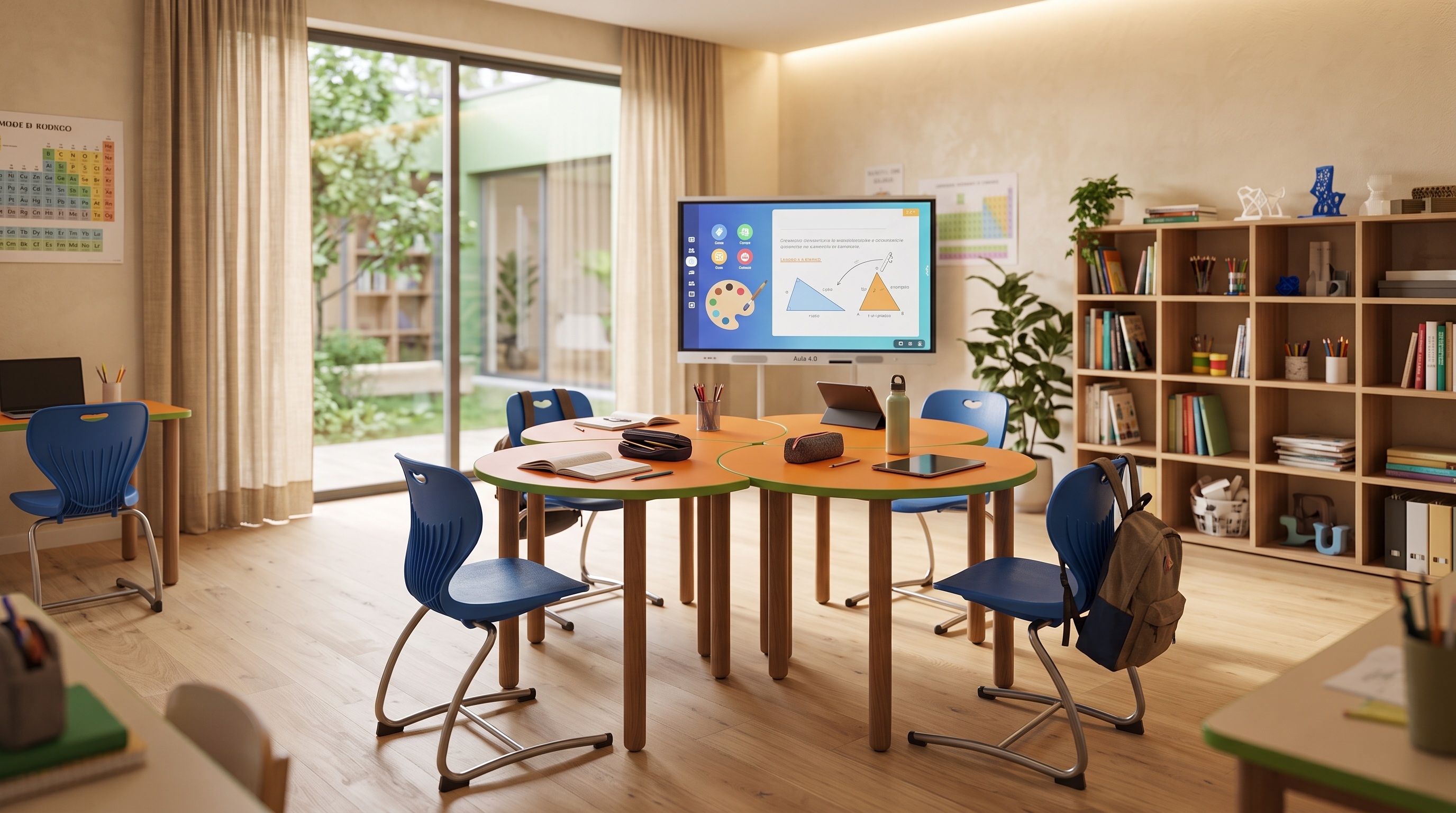
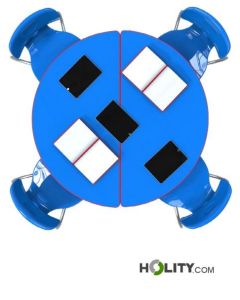
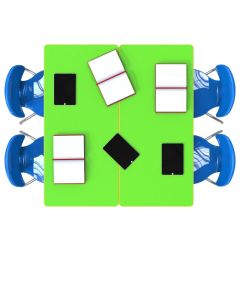
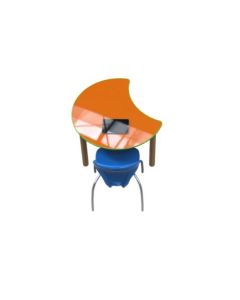
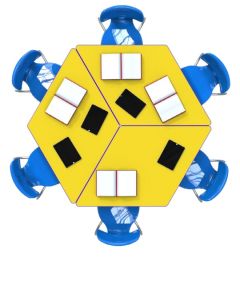
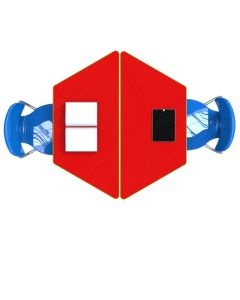
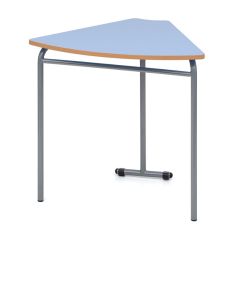
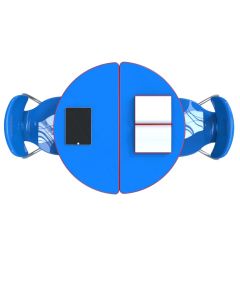
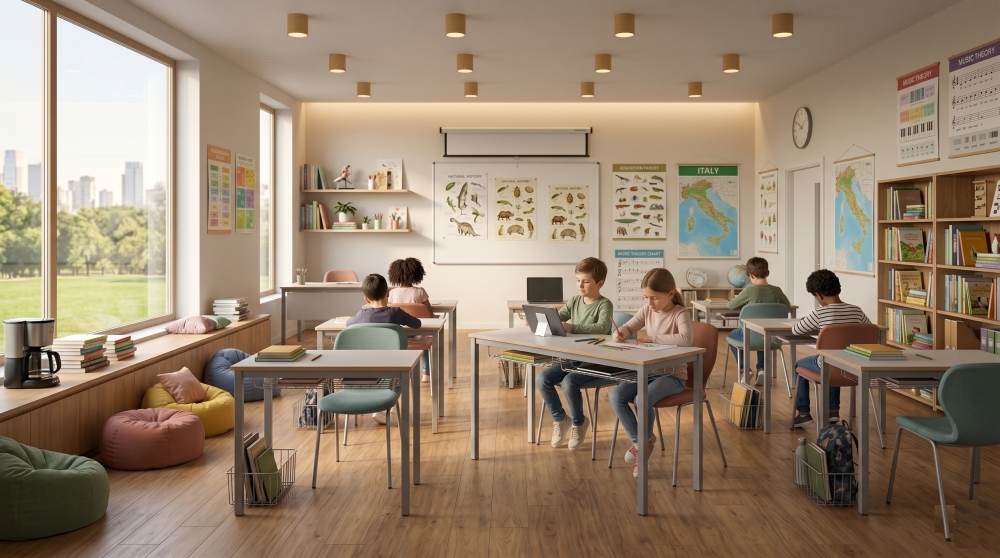
modular desks for innovative classrooms allow us to rethink the relationship between school furniture and teaching activities. In a flexible environment, the table layout does not necessarily remain identical for the entire day, but can change when the class moves from the teacher's explanation to work in small groups or to a laboratory activity. Modularity therefore takes on value when it makes these transformations simple and compatible with the available spaces. It should not be considered only an aesthetic feature of the desk.
The design of an innovative classroom therefore starts from the activities that will take place within it. The number of students, working methods, frequency of reconfigurations, technologies present and the size of the environment help to establish which furnishings are truly useful. A table with a particular shape does not automatically make a space flexible. It is the combination of aggregability, movement, size, and organization of the pathways that determines how easily the classroom can adapt to different teaching situations.
From teaching to space: where to start the project
Before choosing the desks, it is useful to identify the configurations that will be used most often. A school may need to maintain a predominantly frontal layout, periodically introducing collaborative work, or it may include frequent group and laboratory activities. These two situations require different levels of flexibility. Defining the scenarios in advance allows you to avoid purchasing modular solutions whose composition possibilities then remain unused.
It is equally important to observe the physical characteristics of the classroom. Doors, windows, radiators, cabinets, technological devices, and other fixed elements delimit the actual usable space. The position of the teacher and the display surfaces must also be considered in the different configurations. The project should therefore start from a real plan and verify how the circulation changes when the desks are separated, placed side by side, or grouped together.
What makes a school desk truly modular
A desk is truly modular when it can be combined with other workstations according to multiple configurations useful for teaching. The shape of the table top, the dimensions and the structure must allow for orderly combinations, without creating large unused spaces between one element and another. The possibility of easily separating the workstations again is equally important. Modularity concerns both aggregation and the rapid return to an individual configuration.
It is also necessary to consider how many people are needed to make a change. If each reconfiguration requires long journeys or complex operations, flexibility risks remaining theoretical. In a classroom used daily, the transition between different layouts should fit naturally into the management of the lesson. Ease of movement and simplicity of combinations therefore become as important criteria as the design of the table top.
Configuring the classroom for frontal lessons
 Even an innovative classroom may require moments of frontal lessons. The modular desks should therefore be able to be arranged in rows or in other configurations oriented towards the teacher and the surfaces used for the explanation. In this arrangement, it is important to maintain good readability of the space and to allow students to comfortably use notebooks, books and devices required for the activity.
The frontal configuration also represents a useful test bed for the overall sizing. If the classroom is already excessively congested when the workstations are separated, it will be difficult to obtain functional groups without compromising the flow of people. For this reason, the number of desks should not be defined solely on the basis of the theoretically usable surface area. The spaces required for seating, passageways and user movement must also be considered.
Quickly transition to group work
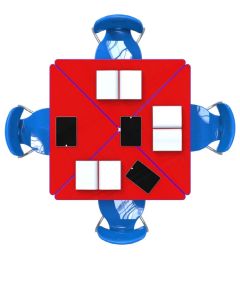
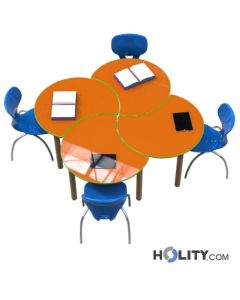
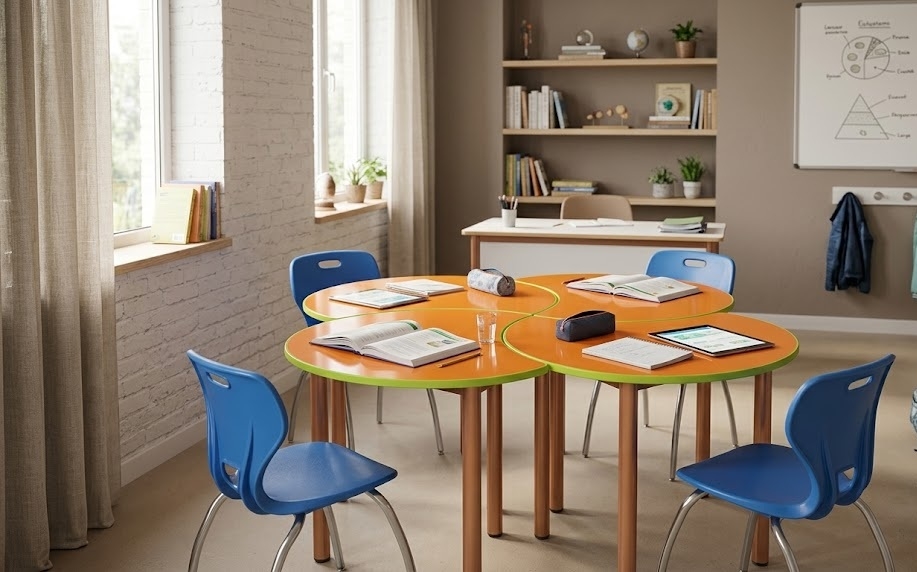
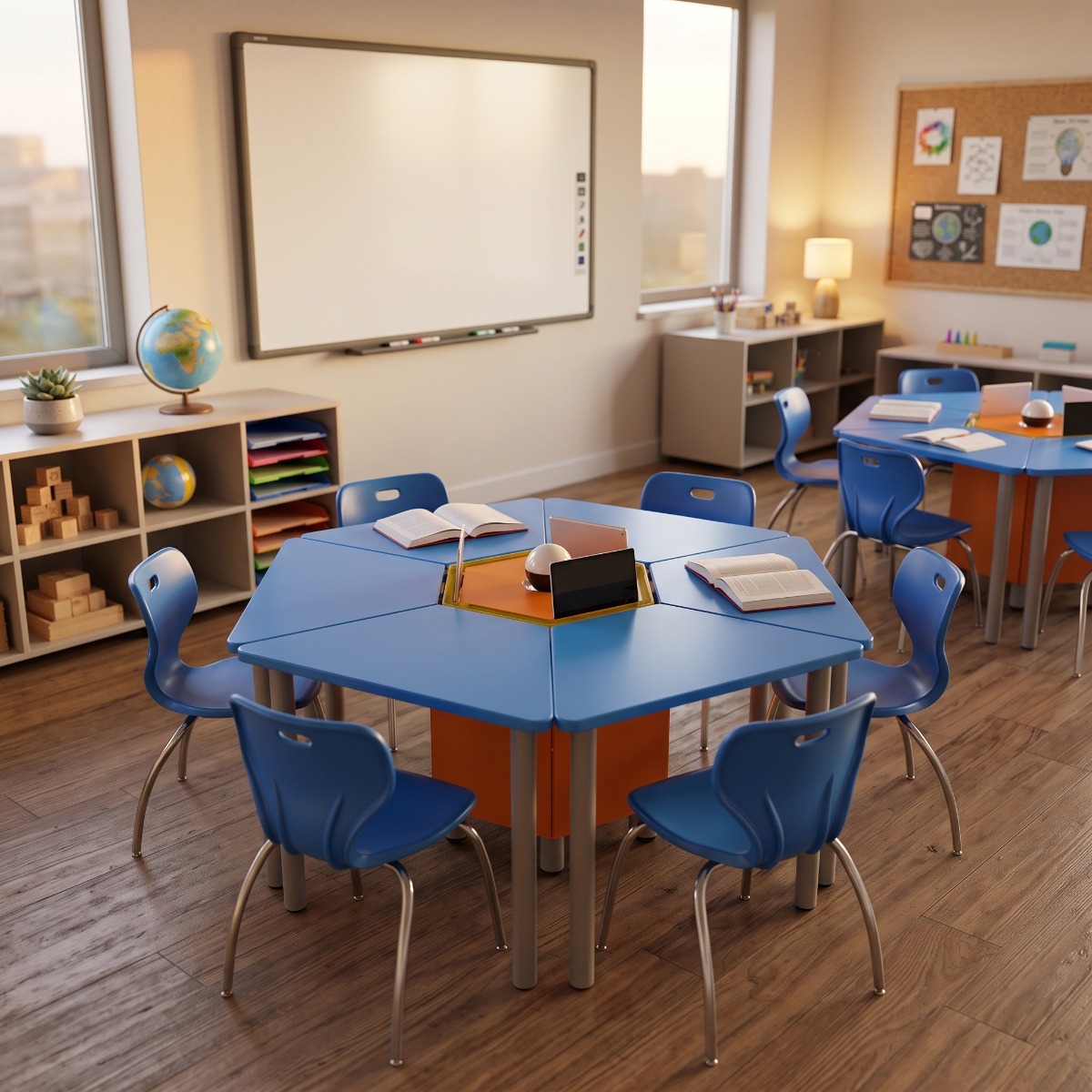
In collaborative work, several desks can be brought together to create islands intended for small groups. The geometry of the surfaces affects the quality of the composition and the amount of surface area actually available to each student. A good aggregation should allow participants to communicate and share materials without creating an excessively deep or difficult-to-reach workstation. The position of the table legs can also influence the comfort of the configuration.
The transition from frontal lessons to group work should occur without transforming the reconfiguration into a prolonged interruption. This aspect becomes particularly important when the layout changes several times during the week. Easily movable desks allow the environment to follow the teaching rather than forcing the teaching to adapt to the arrangement of the furniture. It is It is in this relationship that modularity expresses its concrete value.
Organizing laboratory activities and workstations
Laboratory activities may require even different configurations. In some cases, it is useful to create large shared surfaces, while in others it is preferable to maintain separate workstations and leave more free space for materials, tools, or movement. The modular desks for innovative classrooms allow these configurations to be built using the same elements, provided that the dimensions and characteristics have been chosen considering these scenarios from the outset.
When digital devices or other equipment are used, the relationship with sockets, charging systems, and any connections that may be present must also be evaluated. Moving a table is simple only if the new position remains compatible with what is needed to carry out the activity. Holity , a specialist in professional supplies for schools and educational facilities , offers furnishing solutions that allow you to design school environments by considering workstations, seats and the functional organisation of the space together.
Shape of the top and aggregation of the desks
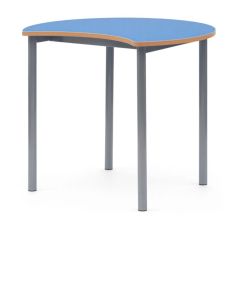
Rectangular, trapezoidal or characterised by other geometries , the top directly influences the obtainable configurations. Rectangular tables are easy to use individually and can be placed side by side in different combinations. Shapes specifically designed for aggregation allow you to create different compositions and can be interesting when collaborative work represents an important part of the planned activities.
The shape must however be evaluated together with the dimensions of the classroom. An effective composition in a large space could generate unusable areas in a narrower environment. Before purchasing, it is therefore advisable to simulate at least the main configurations with the actual measurements of the products. This allows you to check how many workstations actually fit, which routes remain available and how much space is needed to move from one configuration to another.
Wheels, weight and movement in daily management
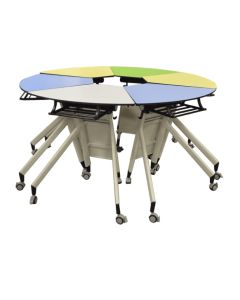
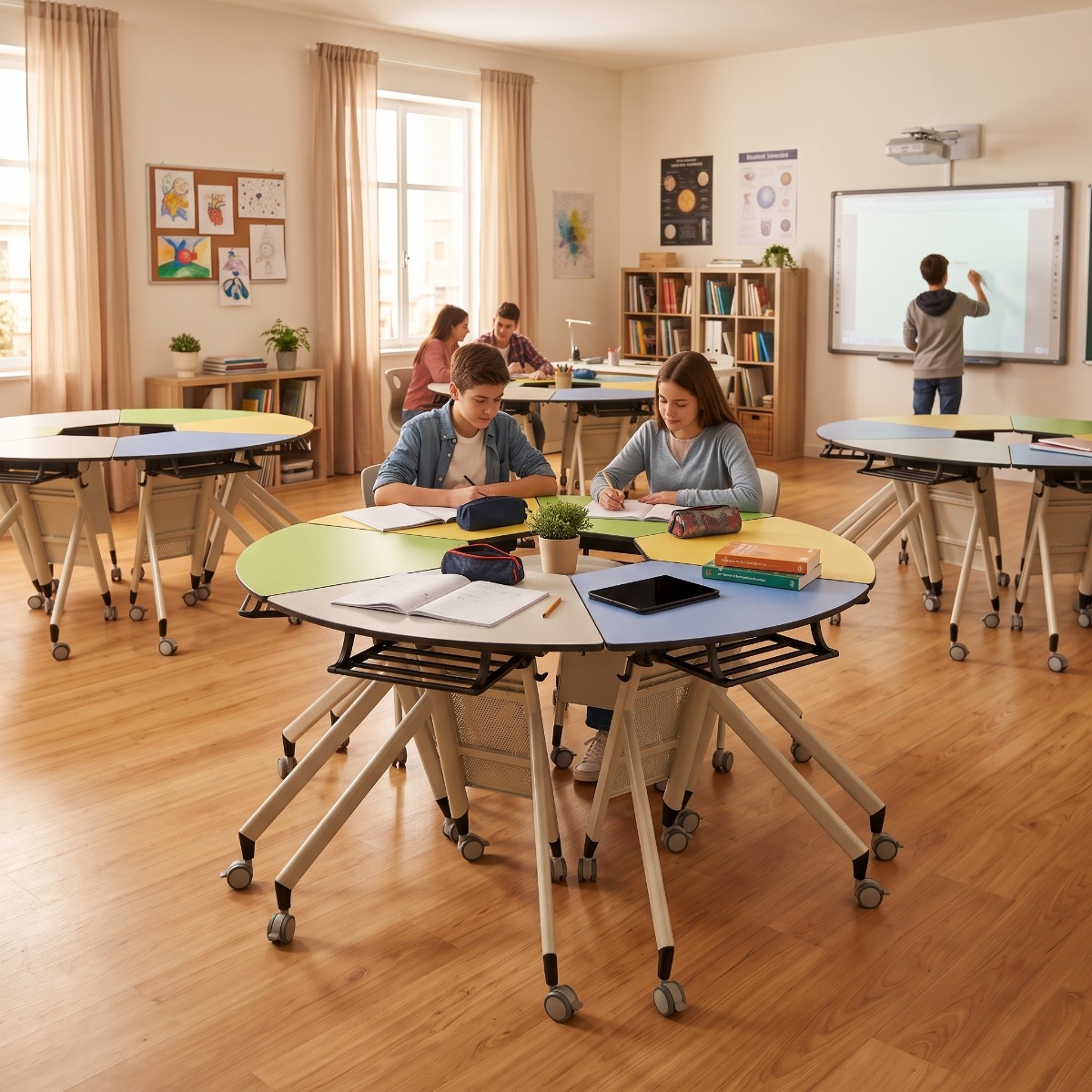 When reconfigurations are frequent, movement takes on a central role. Tables and desks must be able to be moved without requiring disproportionate effort and without making the workstation unstable during use. In models equipped with wheels it is important to consider the system configuration and the ways in which the desk is stabilized. The presence of wheels alone is not sufficient to define the quality of a mobile solution.
Even a desk without wheels can be suitable for a flexible classroom when its weight and size allow for easy movement. The choice depends above all on the frequency with which the layout is expected to be changed. If the classroom changes configuration several times during the day, ease of movement becomes a priority. If the changes are occasional, other aspects such as robustness, available surface area and simplicity of construction may take on greater weight.
Sizing the furniture without compromising the routes
Flexibility requires space to be used. Filling the classroom with the maximum possible number of stations can make any reconfiguration very difficult, even when the desks have been designed to be modular. It is It is necessary to consider the space occupied by chairs, the movements of students, and the routes that must remain usable in the different arrangements. The layout should be verified in the most challenging configuration, not just in the most compact one.
Particular attention must be paid to elements that cannot be moved easily. Cabinets, fitted walls, and permanently installed devices modify the effective surface area of the classroom. Even the teacher's desk, when foreseen, must find a position compatible with the different configurations. Careful planning prevents the modularity of the desks from being subsequently limited by the presence of furnishings chosen without an overall vision.
Integrating desks, seats, the desk, and technologies
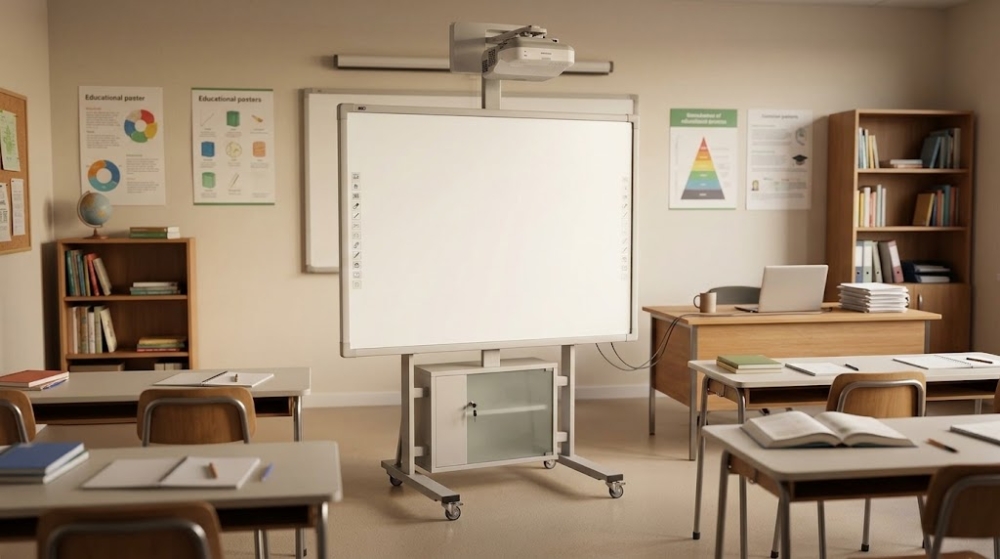
A flexible classroom is not made up of desks alone. The seats must accompany the movements and allow students to change orientation without making each transformation laborious. The teacher's workstation can also be designed in relation to a less rigidly frontal role of the space. When screens or other technologies are used, their visibility must be verified in the configurations that the school intends to adopt most frequently.
Coherence between the elements prevents a single piece of furniture from conditioning the entire environment. Easily reconfigurable desks combined with bulky furniture placed in passageways, for example, do not produce a truly flexible classroom. The design must therefore think systemically. Modular furniture, seating, storage and technologies must contribute to the same organization of the space and respond to the planned teaching activities.
Mistakes to avoid when designing a flexible classroom
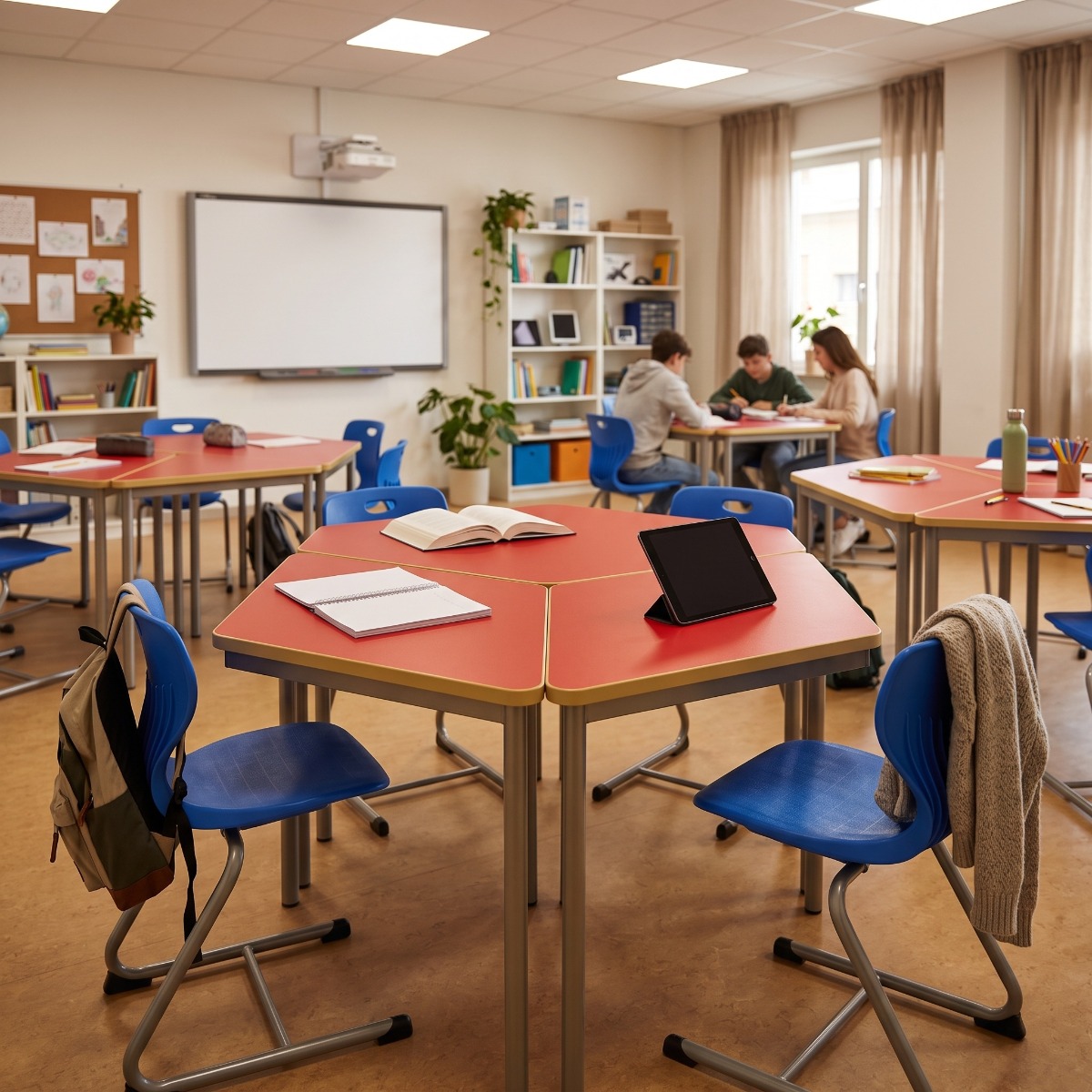 One of the most common mistakes is to automatically associate innovation with unusual shapes. An aesthetically original desk is not necessarily functional for collaborative teaching, just as furniture with wheels does not by itself guarantee a reconfigurable environment. Each feature should be linked to a specific activity. If it is not possible to explain when and why a particular configuration will be used, it is advisable to reevaluate its actual usefulness.
A second mistake is to design only one layout and assume that the others will work automatically. Frontal, collaborative, and laboratory configurations must be verified separately, considering space and routes. Purchasing a large number of different models can also complicate management. A coherent and sufficiently versatile range makes it easier to manage a flexible classroom. It is easy to maintain order and reconfigure the classroom without having to figure out which elements can be combined each time.
How to choose modular desks for innovative classrooms
The selection should start from the number of students, size of the room and planned teaching activities. It is then possible to compare the shape and size of the surfaces, the possibility of aggregation, characteristics of the structure and ease of movement. For purchases intended for multiple classrooms it is also useful to check how much the same workstations can be used in different environments, so as to avoid excessive fragmentation of supplies.
Holity, a point of reference in professional supplies for schools and institutes , allows you to evaluate desks, tables and school furniture also intended for the creation of flexible teaching environments. The choice of modular desks for innovative classrooms becomes truly effective when it starts from the methods of teaching and not from the appearance of the single product. Designing the activities first and then the furnishings allows you to create a space capable of changing configuration in a concrete way, maintaining order, functionality and continuity in daily use.
 English
  Italian
 French
 German
 Spanish