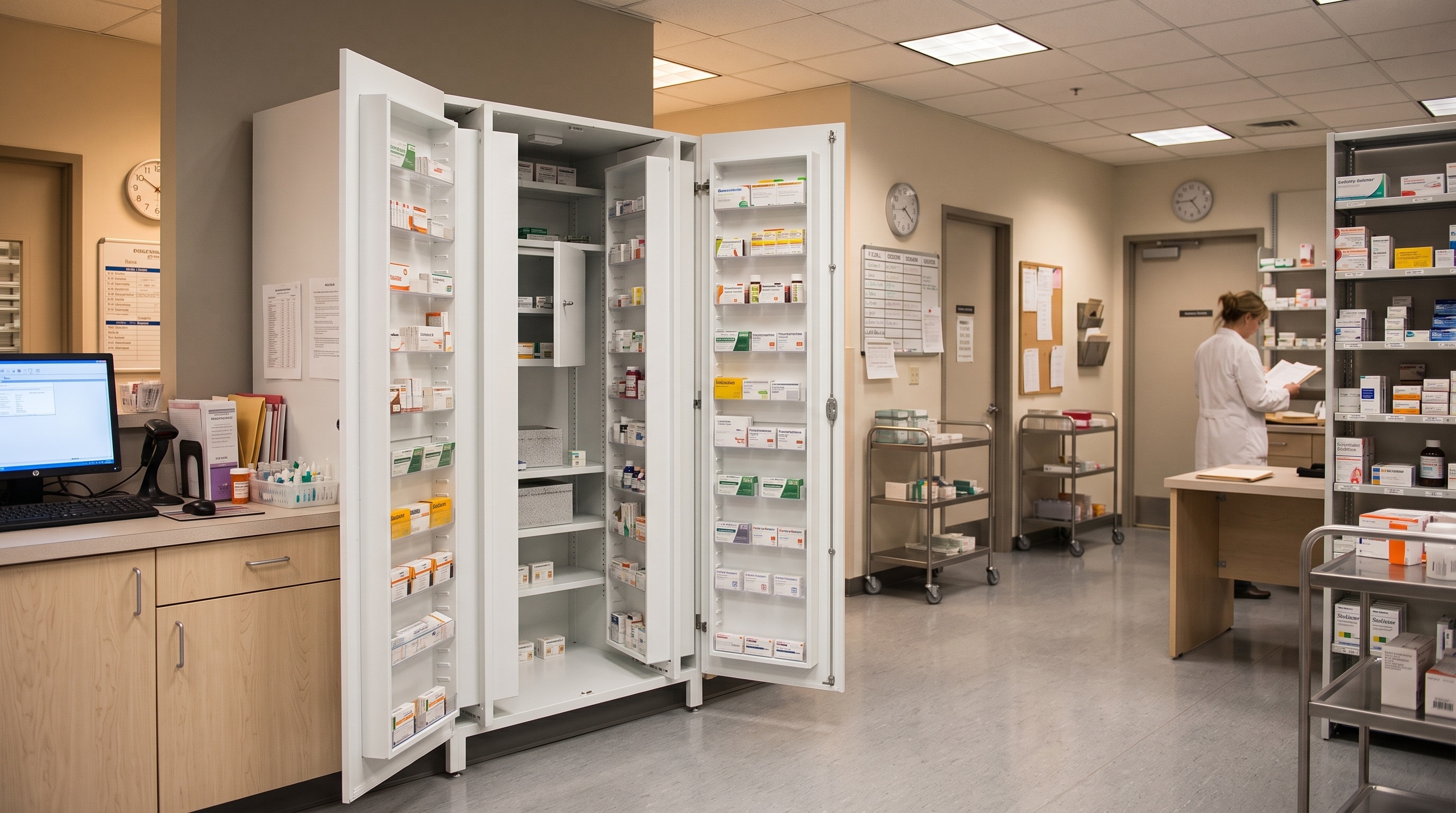
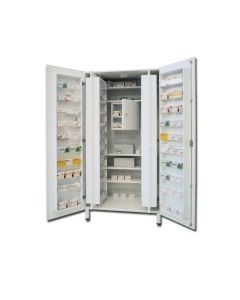
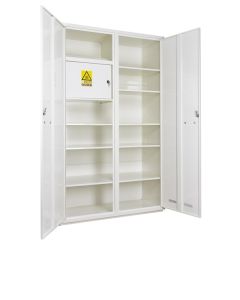
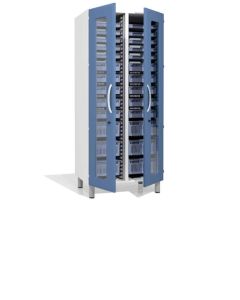
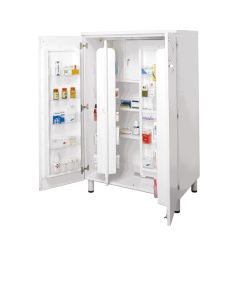
Organizing a medicine cabinet in a hospital or clinic requires a precise method, because medicine management cannot be entrusted to a simple arrangement of the packages on the shelves. The cabinet is part of a larger system that includes access, storage, stock control, expiry date verification and operator responsibilities. A clear structure facilitates daily activities and allows authorized personnel to quickly identify what is needed. The objective is to create a stable, understandable organization consistent with the procedures adopted by the healthcare facility.
Each hospital, clinic or department has different needs, determined by the type of activity carried out, the quantity of medicines managed and the frequency with which they are used. For this reason, there is no universal provision valid for every context. It is necessary to start from the needs department and define a system compatible with internal procedures and applicable provisions. Order, safety and control must proceed together, avoiding improvised solutions that can become difficult to maintain over time.
Why the organization of the medicine cabinet is important
 In a healthcare environment, the medicine cabinet is used continuously by staff who must operate according to defined procedures. An unclear layout can make it more laborious to identify packages, check available quantities and verify expiration dates. However, when each space has a specific function, daily management becomes more legible. The advantage comes not only from visual order, but from the possibility of applying the organizational method established by the structure with greater continuity.
The design should therefore consider the entire management cycle, from the arrival of new stocks to their use. It is important to understand which medicines must be stored in the cabinet, which require different methods and how frequently withdrawals and replenishments occur. The number of authorised operators can also influence the organisation. The professional pharmaceutical cabinet must support the department's process, not force operators to continually adapt their activities to the available configuration.
Define a precise criterion for the arrangement of medicines
The first principle consists in avoiding an arrangement based simply on the available free space. Placing packages wherever they happen makes it progressively more difficult to maintain a stable logic, especially when stocks change frequently. It is It is preferable to adopt a criterion defined by the structure and apply it uniformly, so that authorised operators can immediately understand where the different categories of products must be placed. The chosen logic must remain consistent with internal procedures.
The layout should also avoid overlaps that make the packages or the information required for their identification difficult to see. Shelves, compartments and compartments can be used for different functions, as long as the division remains clear over time. Any internal identification systems must also be updated when the organisation changes. A predictable and recognisable location makes it easier to maintain order and facilitates subsequent stock verification activities.
Separate medicines that require different management methods
Not all medicines can be treated in the same way. Some products may require specific storage conditions, while certain categories may be subject to particular management methods. of storage, control or registration. Before placing any product in the cabinet it is therefore necessary to check the conditions required for its storage. The specific indications of the medicine and the procedures adopted by the facility remain the reference to follow.
The internal separation must be designed on the basis of these needs and not only to obtain a visually orderly cabinet. When a category requires specific management, it is necessary to avoid it being confused with the normal stocks of the department. This principle concerns both the physical layout and the access and control procedures. The classification of medicines must precede their placement, so that each area of the cabinet corresponds to a truly defined function.
Manage access and the responsibilities of operators
The Access to medicines must be included in the organisational procedures of the facility. It is necessary to define who can access the cabinet and how any locking systems are managed. When the model has a lock or other access control solutions, the actual characteristics must be verified in the relevant technical data sheet. The physical device, however, represents only one part of the overall organisation.
Keys, credentials and responsibilities should not be managed informally. The facility must establish procedures consistent with its needs and with applicable provisions, paying particular attention to any categories of medicines subject to specific regimes. Holity, specialist in professional supplies for hospitals, clinics and healthcare facilities, offers solutions for the organisation of medical environments that can be selected in relation to the operational needs of the facility.
Organize stocks to better control expiration dates
 Managing expiration dates is one of the activities that must be considered in the internal layout. Accumulating packages one in front of the other or overfilling the shelves can make control difficult. It is preferable to maintain a configuration that allows the operators in charge to check the stocks according to the established procedures, without having to completely reorganize the cabinet for each check. The quantity stored must therefore also be compatible with the possibility of carrying out periodic checks.
Naturally, physical organization does not replace the control system provided by the structure, but it can make its application easier. Packages must be managed according to internal procedures regarding rotation, use and replenishment. A layout maintained over time also helps to identify any accumulations. Inventory visibility and expiration control are closely related aspects and should be considered together when defining the required cabinet capacity.
Size the cabinet based on the department's actual needs
A cabinet that is too small can lead to excessive concentration of packages, while an oversized solution can take up space without responding to a real need. Before purchasing, it is therefore useful to analyze the quantities and types of products normally stored in the department. The frequency of replenishments is another important parameter, because it influences the quantity of stock that must be managed at one time. Sizing should derive from this data and not from a generic evaluation.
The position planned in the room must also be considered. External dimensions, door opening and accessibility must be compatible with the available space and the activities taking place in the room. A large cabinet but placed in an impractical position can complicate daily operations. Internal capacity and external dimensions must therefore be evaluated simultaneously before identifying the most suitable solution.
Evaluate shelves, compartments and internal configuration
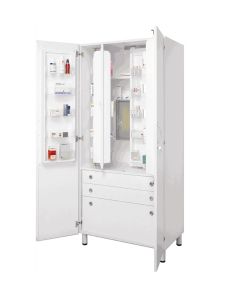
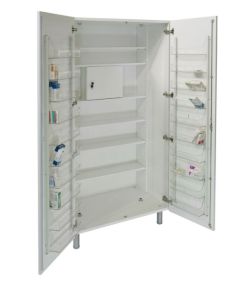
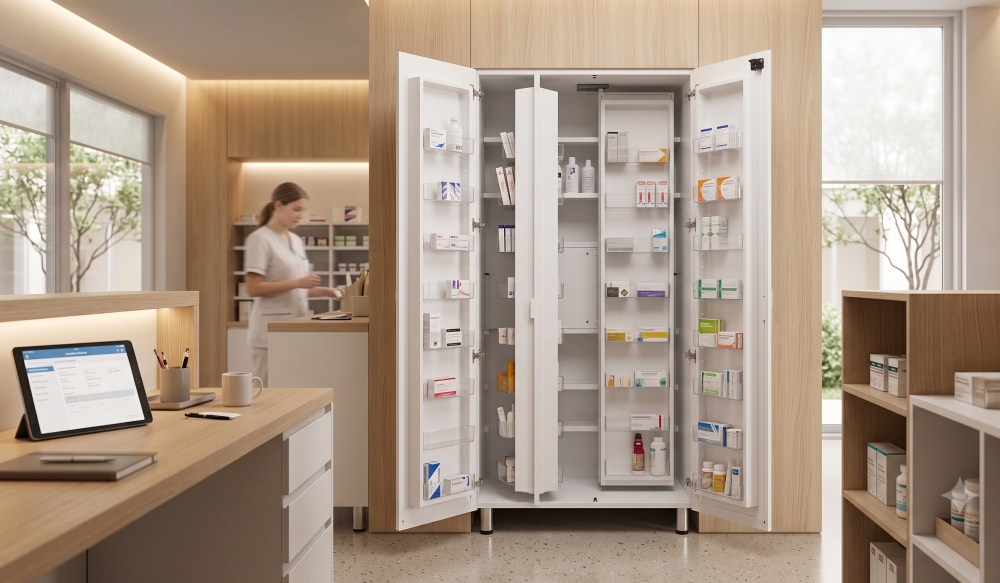
The internal configuration largely determines the possibility of applying the chosen organizational criterion. The number of shelves, their arrangement and the possible presence of compartments must be compared with the categories of medicines that the facility plans to manage. A highly detailed subdivision is not always necessarily more effective. What matters is the correspondence between the organization of the furniture and the operational methods of the department.
Before choosing, it is advisable to check the characteristics declared for each model, avoiding automatically attributing the same equipment to all medicine cabinets. The possibility of correctly organizing the space depends on the specific configuration of the product. Holity offers professional supplies for the healthcare sector and allows hospitals, clinics and other healthcare facilities to compare different solutions based on the characteristics required by their operational context.
Integrate the cabinet into periodic inspection procedures
A well-organized system must be maintained over time. It is therefore necessary to provide periodic checks according to the facility's procedures, verifying that the layout continues to correspond to the established criteria. New supplies, changes in stocks and changes in the department's needs can in fact progressively modify the initial structure. Without checks, even a carefully designed cabinet can quickly lose its organization.
Checks can concern various aspects, from available quantities to expiration dates, up to the correct placement of the packages. Frequency, responsibilities and methods must be defined by the structure according to its own procedures and applicable provisions. The objective is to prevent the order from depending on the initiative of the individual operator. Structured management requires continuity, because the quality of the organization is measured above all in the ability to maintain it during daily activities.
Consider materials and ease of use. Wardrobe Management
 When choosing furniture, it is also important to consider the construction characteristics declared by the manufacturer. Materials, surfaces, and configuration must be evaluated in relation to the environment in which the product will be installed and the procedures adopted by the facility. The instructions relating to the management and maintenance of the wardrobe must be verified in the specific documentation for the model, avoiding indiscriminately applying the same methods to different products.
The accessibility of internal surfaces can also affect daily practicality. A wardrobe organized with an excessive amount of material can make the normal operations required by the structure more difficult, regardless of the characteristics of the furniture. It is therefore important to maintain a balance between available capacity and the quantity actually stored. Ease of use Management arises from the combination of furniture characteristics and stock organization.
Avoid excessive accumulation of medicines
Having a lot of space does not necessarily mean it has to be filled. The quantities stored must be defined in relation to the needs of the department and the procurement procedures adopted. Excessive accumulation can make the layout less legible, complicate controls and increase the number of packages to be checked. The objective should be to maintain a quantity consistent with the expected needs, according to the criteria established by the structure.
Balanced stock management also allows for better use of the cabinet capacity. When each area contains what is actually foreseen by the organizational system, it becomes easier to identify any variations and maintain the defined layout. The capacity of the cabinet must therefore be interpreted as a resource to be organized, not as a space to be saturated. Sizing and supply policy must be consistent with each other.
Mistakes to avoid when organizing the medicine cabinet
One of the most common mistakes is to simply place medicines wherever there is free space. This method makes it difficult to maintain a stable logic and progressively leads to continuous movement of packages. Using different criteria in the same cabinet without a shared procedure can also create confusion. It is preferable to establish a single method and apply it uniformly, modifying it only when the organizational needs of the department actually change.
Another mistake is to consider the lockable cabinet as a sufficient solution for all aspects related to security. Physical control of access must be accompanied by the procedures established by the facility and the applicable provisions. It is also essential not to treat all medicines indiscriminately, because there may be different storage and custody requirements. Furniture supports organization, but does not replace procedures, responsibilities, and controls.
Organizing the medicine cabinet as part of a structured system
Organizing a medicine cabinet in a hospital therefore means starting from the department's needs and transforming them into a physical system that is easy to understand and maintain. Product categories, quantities, frequency of use, access, and controls must be defined before establishing the final configuration. Only subsequently is it possible to identify a cabinet with dimensions and characteristics consistent with the needs. This approach allows you to avoid solutions based exclusively on capacity or immediate availability of space.
Holity, specialist in professional supplies for hospitals, clinics, and healthcare facilities represents a reference for the choice of furniture and equipment intended for healthcare environments. The selection of a medicine cabinet must in any case be accompanied by verification of the specific characteristics of the model, the facility's procedures, and the applicable provisions. When furniture and organization are designed together, the cabinet can become a concrete tool for maintaining order, control and safety in the daily management of medicines.
 English
 Italian
 French
 German
 Spanish