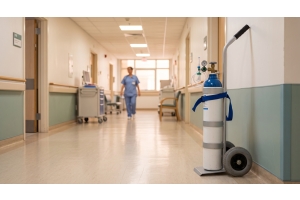
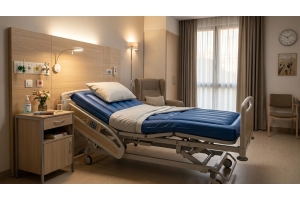
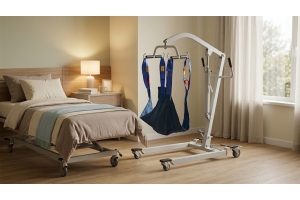
Choosing hospital trolleys requires starting from the activities carried out in the department and the materials that need to be organised or moved. A therapy trolley has different needs compared to a model for emergencies, dressings, instruments, linens or internal logistics. Materials, drawers, wheels, locking systems and accessories therefore acquire meaning only in relation to the intended function. Defining these elements before purchasing allows you to narrow the comparison to configurations that are truly consistent with the organisation of the healthcare facility.
The function of the trolley comes before materials and accessories
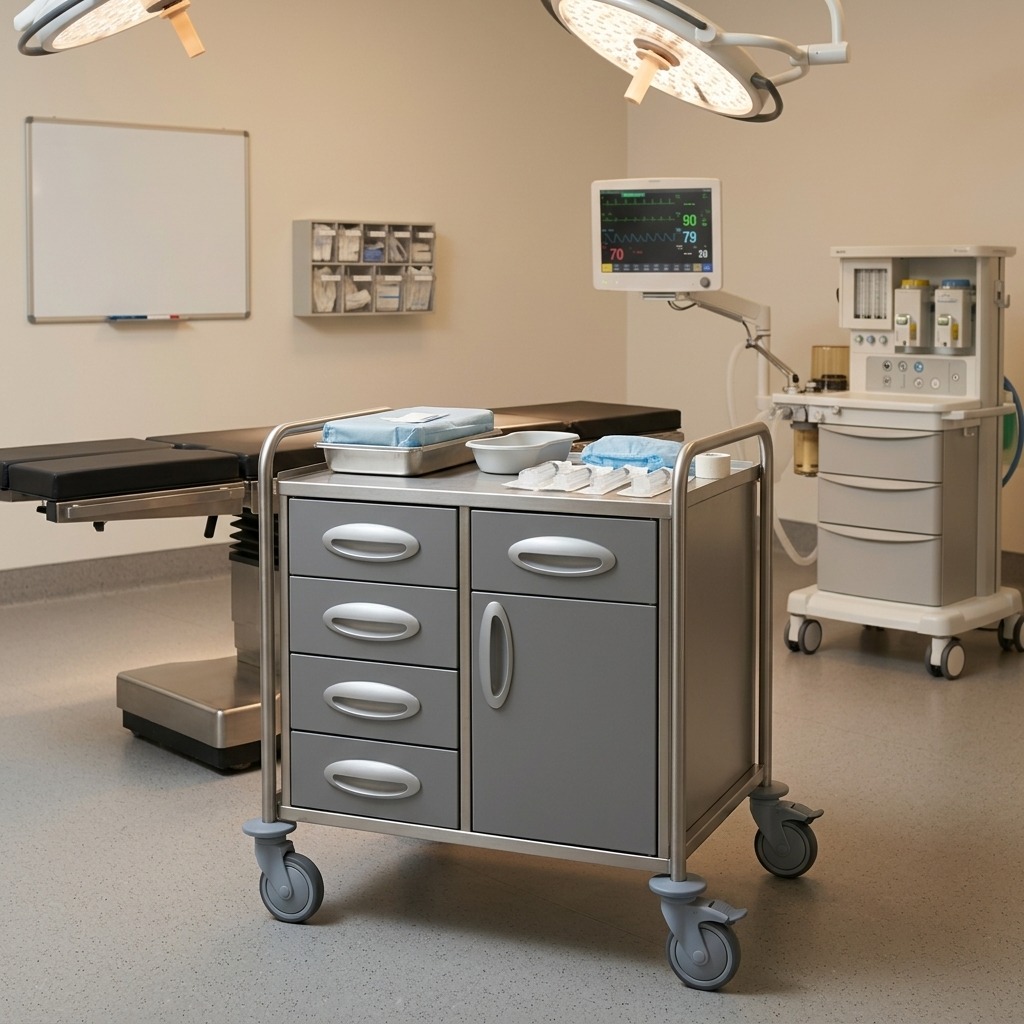 The term hospital trolley includes equipment used for very different tasks. Some models are used to make materials for dressings available, others are organised for drugs, emergencies or specific procedures, while other configurations pertain to the logistics of linens and waste. For this reason, starting from the material of the structure or the number of drawers can lead to comparing non-equivalent products. The first step is to define what the trolley needs to contain, where it will be used and how often it will need to be moved.
. Even within the same department, different configurations may be necessary. A mobile station used during dressings may favour easily accessible support surfaces, while a trolley intended for the distribution of medicines may require more compartments and locking systems. In critical departments, however, the value of an immediately legible internal layout and dedicated accessories increases. The function therefore allows you to establish which features are really necessary and which are merely additional equipment.
Therapy and dressings require different internal organisation
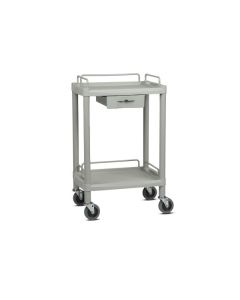
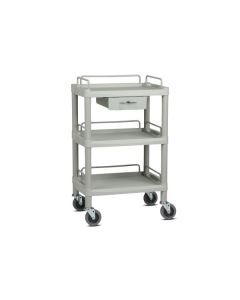
The trolleys used for therapy and dressings must support the organisation of the material during the daily activities of the staff. Open shelves, drawers, dividers and work surfaces can be combined in very different ways. The choice depends on the quantity and type of equipment that the operator needs to carry. A basic two-shelf trolley therefore responds to a different need than a mobile drawer unit with numerous dedicated compartments.
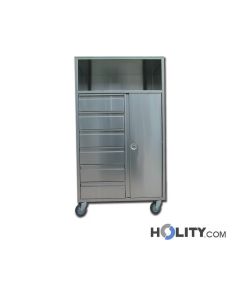
The Holity catalogue clearly shows this difference: among the medication trolleys there are models with two or three shelves, configurations with drawers and solutions made of stainless steel, painted steel or ABS. For the management of medicines, trolleys with numerous compartments and locks are available, designed for greater internal organisation. Holity, a leader in professional supplies for healthcare facilities, thus allows you to compare configurations built around different functions rather than treating all trolleys as interchangeable products.
Emergency trolleys start from the accessibility of the equipment
In the trolley intended for emergencies, the relationship between organisation and speed of access changes above all. Drawers and compartments must allow for an orderly arrangement of the equipment required by the facility, while the entire cart must be easily moveable within the department. The size and number of drawers remain important, but should not be evaluated in isolation. Handles, brakes, supports, and the ability to quickly identify contents also contribute to the functionality of the station.
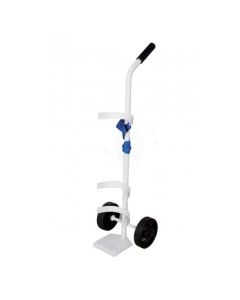
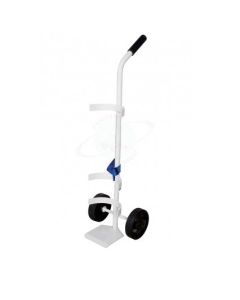
Professional configurations can integrate a defibrillator holder, IV pole, cylinder holder, CPR table, or side containers. A model in the Holity catalog, for example, combines an ABS and stainless steel structure, three drawers, four swivel wheels with brakes, and various accessories for emergency organization. This does not mean that all these elements are necessary in every department. The configuration must correspond to the equipment established by the facility and the procedures with which the cart is actually used.
Sterile materials and instruments require dedicated configurations
When the trolley is used to organize instruments or materials that must remain protected during handling, the internal structure takes on particular importance. Open shelves and closed drawers do not meet the same needs. It is also necessary to consider the way in which the material is loaded, transferred and made available at the point of use. The choice must therefore be linked to the operational flow defined by the healthcare facility.
It is also important to avoid a frequent misunderstanding: a trolley used to transport sterile material does not automatically become a sterile surface. The methods of managing the contents depend on the facility's procedures, the packaging of the material and the characteristics declared for the product. The buyer should focus on protection of the contents, possibility of cleaning, internal organization and intended destination. These parameters allow the configuration to be selected without attributing properties to the trolley that are not evident from the technical documentation.
Linen, waste and logistics follow different flows than clinical ones
A significant part of the trolleys used in hospitals belong to internal logistics and not to the direct management of therapy or procedures. Clean and used linen must be moved according to organised flows, as well as containers, consumables and waste. In these cases, capacity, bag holders, shelves, covers and ease of movement become more important. A chest of drawers designed for medicines would be inconsistent with these activities, even if built with similar materials.
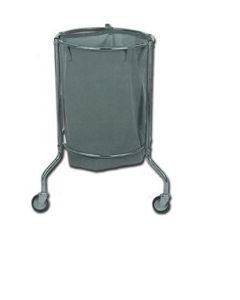
A professional linen trolley can combine shelves for clean linen with bag holders and swivel wheels, creating an organised station for a precise flow. The Holity catalogue also includes stainless steel models intended for the collection of dirty linen and waste, with bag holder and lid. These differences show why healthcare logistics must be segmented by transported material. The configuration must follow the process, not a generic definition of a hospital trolley.
Stainless steel, aluminum, and polymer materials meet different needs
The material must be chosen together with weight, cleaning frequency, and intensity of use. Stainless steel is recurrent in professional trolleys because it offers robust surfaces suitable for numerous healthcare contexts. Aluminum allows for the weight of the structure to be contained and is often combined with other materials. ABS and other polymer components can instead be used for panels, bases, drawers, or specific surfaces, giving rise to mixed configurations.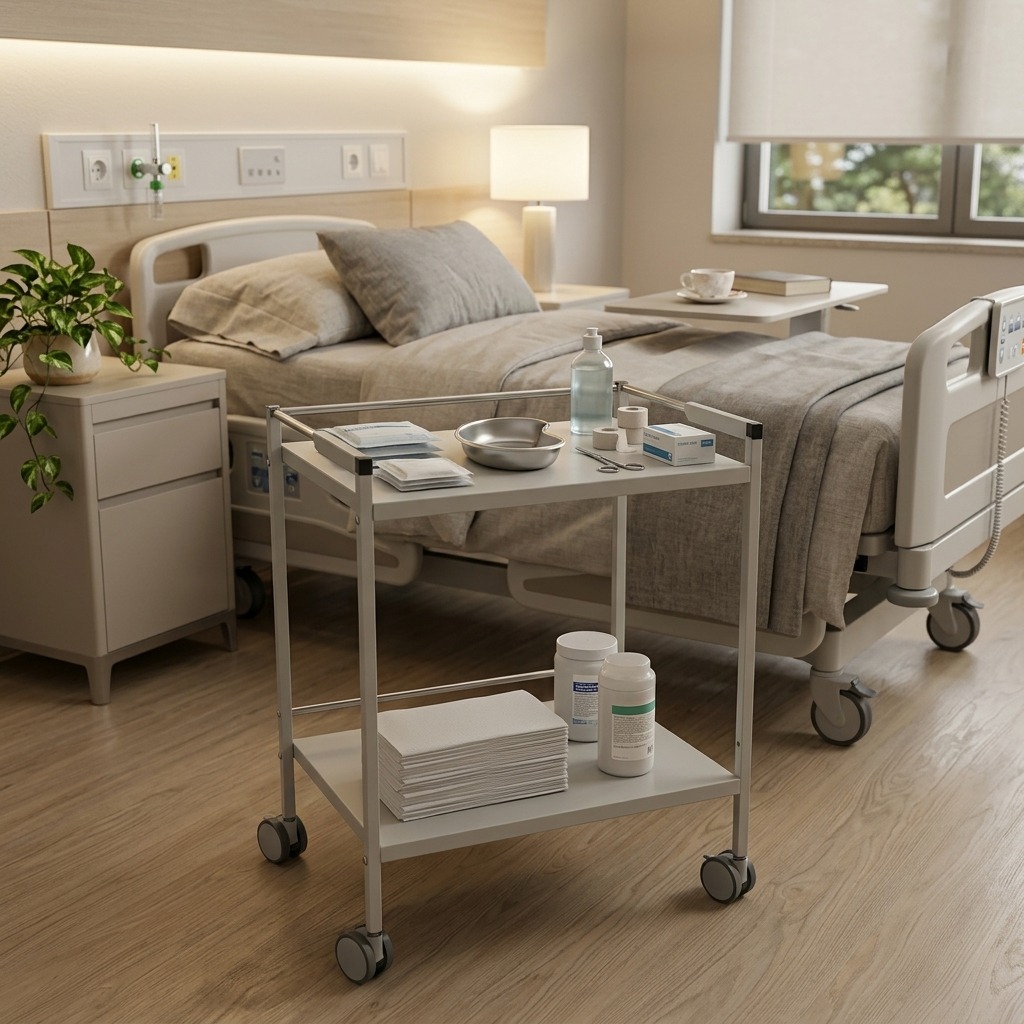
There is therefore no universally best material for all departments. Even two stainless steel trolleys can differ in thickness, construction, shelves, welds, wheels, and additional components. The same applies to models that combine metal and ABS. It is more useful to compare material, overall weight, method of cleaning, and the type of surface. cleaning requirements provided by the manufacturer and the function of the trolley, avoiding transforming a single construction feature into an absolute judgement on quality.
Wheels, brakes and dimensions affect daily handling
A hospital trolley is often moved numerous times during the day, so mobility is not a secondary detail. Wheel diameter, rotation possibility, presence of brakes and push handle affect management in corridors and approach to workstations. The overall size must also be related to doors, elevators and manoeuvring spaces. A very capacious model may become impractical in narrow spaces.
The choice should therefore consider both capacity and manoeuvrability. Four swivel wheels can facilitate changes of direction, while the presence of brakes allows the workstation to be stabilised when necessary. Bumpers and corner protectors can be useful in departments with frequent movements. External dimensions, wheel diameter and load distribution should be among the first data to be compared in the technical data sheets, especially when evaluating a supply consisting of numerous trolleys.
Drawers, locks and accessories define the organisation of the workstation
The number of drawers is only important if it corresponds to the quantity and type of materials to be organised. Shallow compartments can be suitable for small instruments or consumables, while deeper drawers can accommodate different equipment. Internal dividers and label holders facilitate an orderly and repeatable configuration. When the contents require controlled access, locks or other locking systems provided by the model also become relevant.
Accessories should follow the same criteria. An IV pole, a cylinder holder, a side basket or a fold-down shelf can be crucial in a given activity. and useless in another. Adding equipment without connecting it to the operational flow increases space and complexity without necessarily improving the workstation. For this reason Holity, a specialist in professional e-commerce for the healthcare sector, offers different configurations that allow the buyer to start from the department and then compare accessories, drawers and available surfaces.
Intended use and documentation must be verified on the individual product
The fact that a trolley is used in a hospital does not automatically allow it to be assigned the same regulatory framework as any other healthcare equipment. Regulation (EU) 2017/745 links the definition of a medical device to the specific intended use indicated by the manufacturer. The same regulation defines the intended use through the information provided on the label, instructions and materials of the manufacturer. The declared function and documentation of the individual product must therefore be verified before making assessments on its classification.
For the buyer, this distinction has a practical effect. A simple trolley intended for handling linen should not be treated in the same way as a configuration possibly designed and placed on the market for a specific medical function. Before purchasing, it is advisable to read the technical data sheet, available instructions and manufacturer's indications, verifying that they are consistent with the intended use of the facility. This approach avoids both underestimating actually applicable requirements and attributing undocumented certifications or characteristics.
The final comparison must start from the real activities of the department
An effective comparison procedure starts from a few concrete questions. It is necessary to define which material will be transported, how many times the trolley will be moved, which spaces it will have to pass through and how the contents will be organised. Only then does a comparison between materials, number of drawers, wheels, accessories and locking systems become useful. In this way, two products are compared only when they respond to a truly similar need.
Holity, a leader in professional supplies for hospitals, clinics and healthcare facilities, offers a comprehensive catalogue that includes trolleys for dressing, emergency, medicines, linen and other operational needs. To choose the hospital trolleys it is therefore more effective to start from the internal process rather than from the single product. Function, configuration, materials and handling can be evaluated in sequence, progressively narrowing down the alternatives. The result is a supply that is more consistent with the department and easier to compare on a technical and economic level.
 English
  Italian
 French
 German
 Spanish