The choice starts from the characteristics of the cylinder
Before comparing materials and number of wheels it is necessary to precisely identify the container that will be transported. The nominal capacity, external diameter, weight and configuration of the cylinder in fact determine the compatibility with the trolley structure. Two apparently similar cylinders may require different housings, especially when the diameter and overall mass change. The physical compatibility between cylinder and trolley therefore represents the first selection criterion.
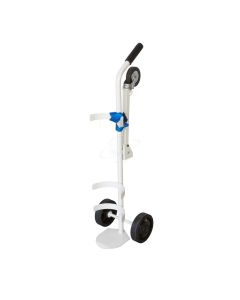
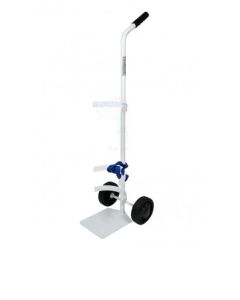
The Holity catalogue shows how much this parameter can vary between different products. For example, trolleys are available for 5/7 litre cylinders, models for 10/14 litres and configurations dedicated to 10/11 litre cylinders, as well as solutions for transporting multiple cylinders at the same time. There are also trolleys defined directly through the compatible diameter of the cylinder, such as some configurations for Ø160 or Ø180 mm. These values belong to the individual models and must always be compared with the actual characteristics of the container used by the structure.
Diameter and capacity must be verified on the specific model
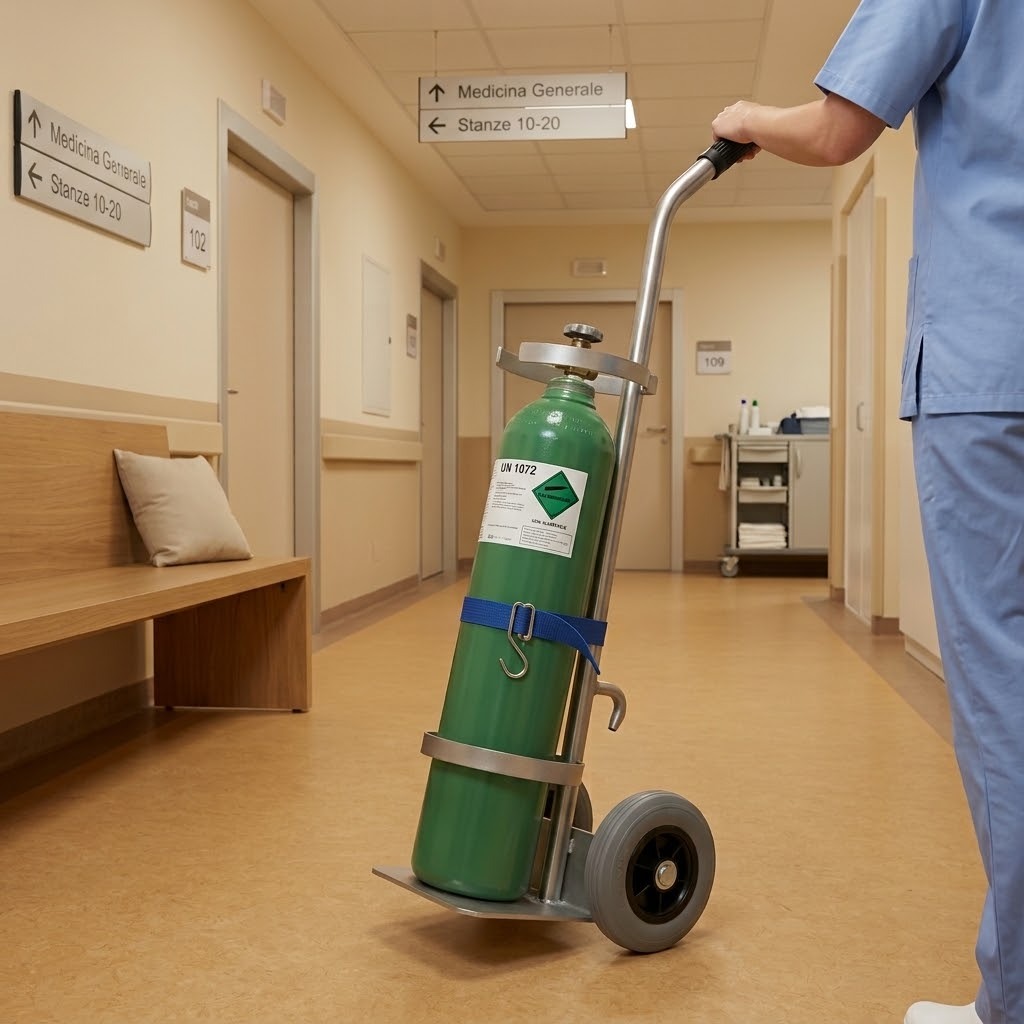 The volume is A useful reference, but it should not be used alone to establish compatibility. The geometry of the cylinder can change and the trolley must be able to accommodate it correctly in its containment elements. It is therefore necessary to simultaneously check the nominal capacity, diameter and dimensions of the housing indicated by the manufacturer. A correctly sized trolley limits unwanted movements of the cylinder during transport.
This check is particularly important when the structure manages cylinders of different sizes. In this case, it may be useful to identify a configuration compatible with multiple cylinders or to adopt separate trolleys, avoiding adaptations not foreseen by the manufacturer. Some Holity models have multiple containment circles along the structure, while others use a specific configuration for a given diameter. The correct data to use for the order therefore remains that reported in the technical data sheet of the individual product.
The restraint system keeps the cylinder secured during transport
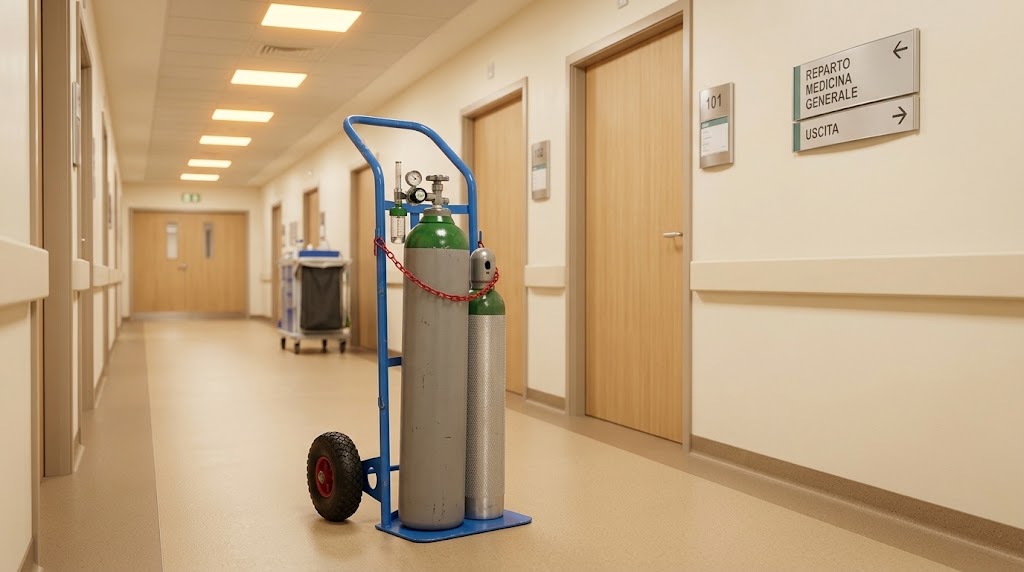
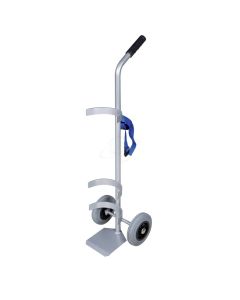
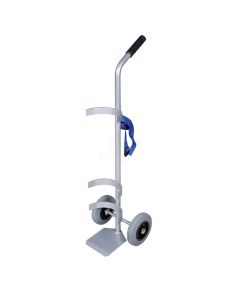
The cylinder should not simply be placed on the trolley, but kept in the configuration intended for the product during handling. Straps, hoops and other containment elements serve to limit the movement of the cylinder with respect to the frame. The presence and position of these components must therefore be checked together with the dimensions of the cylinder. The restraint system is an integral part of the trolley configuration and not a secondary accessory.
The EIGA guidelines for the handling of cylinders recommend keeping them in a stable and secured position and using a dedicated trolley for longer movements. The INAIL documentation dedicated to hospital safety also calls for the use of suitable trolleys equipped with fastening systems during the handling of gas cylinders. The Holity range includes various models with containment or tightening straps, specifically to keep the cylinder connected to the structure during transfer. The operating procedures of the facility and the manufacturers' instructions must however remain the reference for concrete use.
Two, three, four or five wheels meet different needs
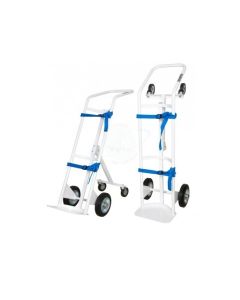
The number of wheels significantly changes the behavior of the trolley. A two-wheel configuration is normally tilted and pulled or pushed by the operator, resulting in compactness when crossing corridors or limited spaces. Transformable versions with an additional wheel can offer a different load distribution during movement. Models with four or five wheels instead adopt a base capable of supporting the load in an autonomous position, with different operating characteristics.
Holity offers, for example, traditional two-wheel trolleys, transformable three-wheel configurations and models with a five-wheel base, some of which are equipped with lockable elements. A trolley for 10/11 litre cylinders uses five 75 mm wheels, two of which are braked, while other models use larger diameter rubber wheels on a two-wheel structure. Number, diameter and locking system must be evaluated with respect to the actual route, not on the basis of an abstract preference for a greater number of wheels.
Load capacity and structure must be evaluated together
The maximum load capacity is an essential piece of information, because it indicates the declared limit for the specific configuration. The weight of the cylinder must fall within the conditions foreseen by the manufacturer and the verification must consider the container actually moved. It is not appropriate to deduce the load capacity from the apparent strength of the frame or the material used alone. Load capacity, geometry of the structure and compatibility with the cylinder are parameters that must be read simultaneously.
The Holity range includes configurations with very different load capacities precisely because the intended uses are different. Some single trolleys declare a load capacity of 60 kg, while a model intended for the transport of multiple cylinders reaches a maximum declared load capacity of 200 kg. Another configuration for 10/11-liter cylinders indicates a maximum load of 25 kg. These numbers are not interchangeable and should be used exclusively to compare products compatible with the handling project.
Stainless steel and painted steel respond to different contexts
The frame material affects its weight, maintenance, surface resistance and management over time. Stainless steel is frequently used in the healthcare sector thanks to its resistance to corrosion and the possibility of obtaining surfaces suitable for contexts in which frequent cleaning is required. Painted steel, on the other hand, allows for the creation of robust structures with specific protective finishes. However, the choice should not be made by looking only at the name of the material.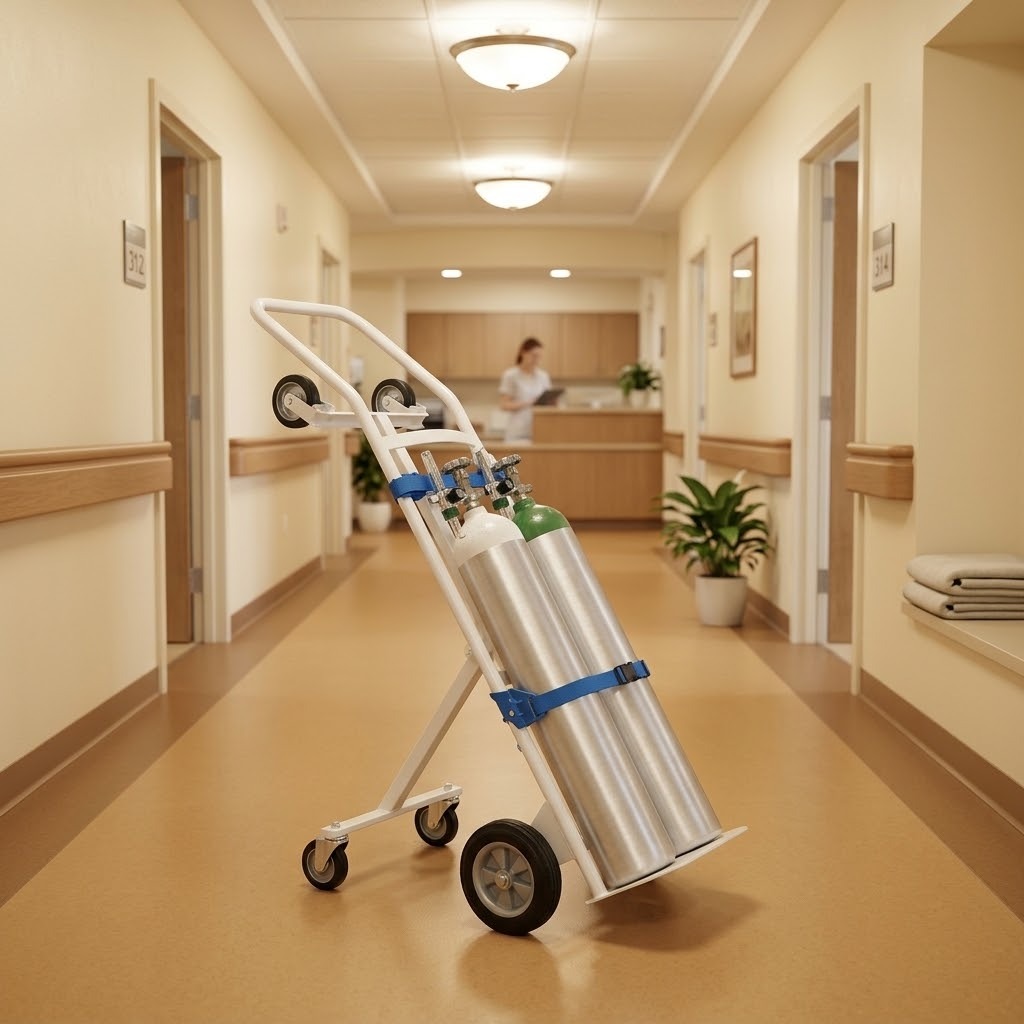
The Holity catalogue includes trolleys in AISI 304 stainless steel, models in painted steel and configurations that combine steel and aluminum. Holity, a specialist in professional supplies for healthcare and assistance facilities, therefore allows you to compare different construction solutions based on the technical data sheets of the individual products. Finish, weight, load capacity and type of wheels must be considered together with the material. In this way, the choice can be related to the actual use and maintenance procedures of the structure.
The movement route affects the choice of trolley
A trolley used only inside a room faces different conditions than one that travels along long corridors every day. Doors, elevators, thresholds, ramps and maneuvering spaces must be checked before purchasing, especially when the cylinder and the frame generate significant bulk. The type of flooring can also affect the smoothness and the effort required of the operator. The assessment should therefore include the entire route and not just the starting and finishing points.
INAIL highlights that in pushing and pulling activities, the applied force, frequency, duration, available space, environmental characteristics and transport system must be considered. A trolley with adequate wheels can contribute to load management, but does not eliminate the need to evaluate the activity as a whole. For cylinders, EIGA also recommends the use of a trolley for longer journeys and maintaining the cylinder in safe conditions. The professional choice should therefore relate to equipment, route and internal procedures of the facility.
Hospitals, nursing homes and home care have different operational needs
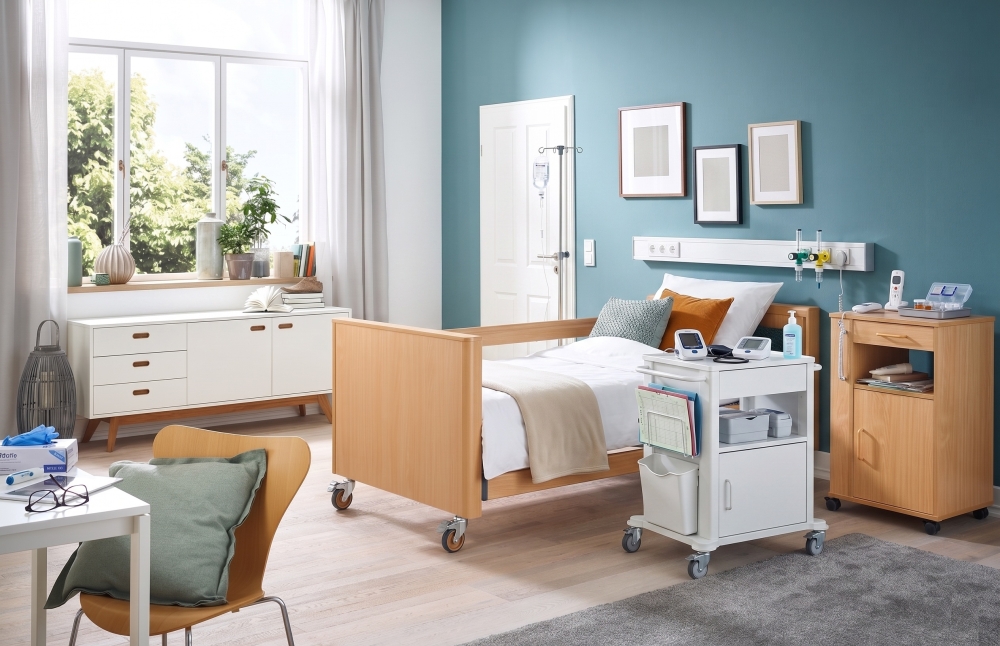
In hospitals the trolley can be used frequently between departments, patient rooms and service areas, making manoeuvrability important. and compatibility with internal routes. A nursing home may have similar needs, but with a different organization of movements and workstations. In home care, however, size, ease of management and compatibility with residential spaces become more important. The specific intended use therefore modifies the comparison priorities.
Furthermore, not all trolleys in the same commercial category must automatically be considered equivalent from a regulatory point of view or the declared destination. It is necessary to read the documentation for the specific model and check the instructions relating to the cylinder and the equipment used. Oxygen is a comburent gas and management procedures require particular attention to the safety indications applicable in the healthcare environment. Holity, a point of reference in professional healthcare equipment and assistance , offers different configurations that allow you to select the trolley starting from the real context rather than just the commercial name.
The final comparison must start from the real use
Before ordering it is useful to collect a few concrete data: capacity and diameter of the cylinder, weight, number of cylinders to be transported, expected route and frequency of movements. Subsequently the frame material, restraint system, number and diameter of wheels, load capacity and overall dimensions can be compared. This method allows you to eliminate incompatible products before comparing secondary characteristics or price. The correct model is the one sized on the cylinder and the work organization.
Holity, specialist in professional supplies for hospitals, clinics and care facilities , offers oxygen cylinder trolleys with different configurations for capacity, frame, wheels and containment systems. The range includes compact solutions for single cylinders and structured trolleys for larger movements, making it necessary to carefully read each technical data sheet. Product selection does not replace a risk assessment, the facility's procedures, or the instructions of the gas and cylinder supplier. A comparison based on compatibility, stability, and usage path allows you to narrow your choice to those models that are truly consistent with the intended service.
 English
  Italian
 French
 German
 Spanish