How to evaluate a professional charging station
 A professional e-bike charging station is an infrastructure designed to provide one or more power points for electric bicycles. Its function must be evaluated together with the characteristics of the environment in which it will be installed, because the needs of a public parking lot are different from those of a hotel or a company headquarters. Before purchasing, it is necessary to determine how many bicycles will be able to use the service simultaneously and how long they will remain at the station. These elements influence the choice between a compact column, a structure with multiple sockets, and an integrated parking and charging system.
Another criterion concerns the relationship between the infrastructure and the organization of the surrounding space. The presence of electrical outlets alone does not guarantee that users can comfortably park their bicycles or reach connection points without obstructing routes. It is therefore necessary to examine space, accessibility, layout of the stalls, and component protection. For those purchasing equipment intended for public use, the selection must also consider maintenance and the possibility of continuous use of the station.
Single columns, multiple stations and electrified racks
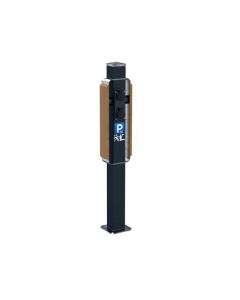
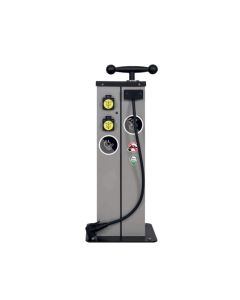
charging stations for electric bikes represent a configuration suitable for concentrating the sockets in a vertical structure, often placed near an already equipped parking area. They can be considered when the available space is limited or when you want to add a charging service to an existing infrastructure. Before choosing a model, it is necessary to check how many sockets are actually available and how they should be used. The presence of multiple connections, in fact, does not automatically correspond to the same number of bicycles that can be safely parked.
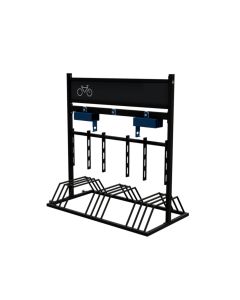
electrified racks for e-bikes instead integrate the parking function with that of power supply, allowing the spaces to be organised in a defined configuration. They are particularly interesting for accommodation facilities, companies and collective areas where the simultaneous arrival of multiple cyclists is expected. The Holity catalog includes racks and stations for four and six bicycles, as well as modular systems with different connection options. The comparison must consider the overall size, the distance between the bicycles, and the number of charging points that can actually be used.
How many charging points are needed and how to size the spaces
The sizing of a station begins by evaluating the number of users who could request the service during the same time slots. A hospitality facility with few guests who use electric bicycles may have different needs than a car park near a train station or a popular cycle route. The duration of the parking period is also important, because a bicycle connected for several hours keeps the charging point occupied. For this reason, the capacity of the e-bike charging stations must be evaluated while simultaneously considering the number of sockets, spaces, and usage methods.
The Holity category includes compact configurations, such as the h672_01 model for two bicycles, and larger solutions, such as the h617_22 model, a six-place rack with the option of integrating selected chargers. The h987_07 modular system is also available, consisting of a column and six modules, with electrical configurations specified in the technical data sheet. These differences allow for the design of stations with different capacities, but require verification of the actual characteristics of each model. In particular, it is necessary to distinguish the number of bike spaces from the quantity of electrical connections and the overall power available.
Sockets, chargers and compatibility with e-bikes
The compatibility of charging systems for electric bicycles is one of the most important technical aspects when choosing a shared infrastructure. Many stations provide electrical outlets to which the user connects the charger provided by the manufacturer of their bicycle. This configuration must be distinguished from systems equipped with integrated chargers or specific connections, which may not be compatible with all batteries. E-bikes do not necessarily use a universal charging connector, so it is necessary to verify the connection methods actually supported.
The Holity catalog includes stations with Schuko sockets and models that provide other connection options. The h987_07 modular system, for example, includes 16 A Schuko sockets and USB ports in the individual modules, with the possibility of adding dedicated connections according to the planned configuration. The h617_22 rack, on the other hand, is described with optionally integrable chargers. Before purchasing a station, it is advisable to evaluate the types of bicycles that will use it and clarify whether the service will require a charger brought by the user or a component already available at the station.
Electrical safety, materials and outdoor installation
Electric bike charging stations Outdoor installations must be selected considering exposure to precipitation, temperature variations and environmental conditions of the location. The IP protection rating declared by the manufacturer provides information on the resistance of the casing to the ingress of solid objects and water, according to the applicable classification. Some models in the Holity catalogue, such as the h672_01 and h672_02 compact stations, have an IP54 protection rating. This information must be read together with the installation conditions and technical instructions, without construing it as a guarantee of suitability for any exposure.
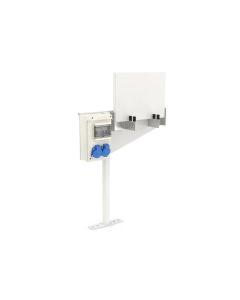
The supporting structure also requires attention, because materials and fixing systems influence the stability and maintenance of the equipment. The catalogue includes configurations in aluminium, stainless steel and impact-resistant plastic materials, with differences that affect the installation methods. A wall-mounted station requires different checks than a column anchored to the ground or a large rack. The electrical connection, system protections, and any preparation work must be assessed by qualified personnel, based on the product's characteristics and applicable regulations.
Charging stations for municipalities, hotels, and businesses
For municipalities and public bodies, e-bike charging stations for street furniture can complement the services offered in squares, rest areas, parking lots, and connection points with cycle routes. In these contexts, it is useful to favor easily identifiable and accessible stations, evaluating the presence of adequate parking and the simplicity of maintenance operations. Access systems can also influence the management of the service, especially when specific conditions for use are foreseen. The choice should therefore not be limited to the number of sockets, but should consider the functioning of the entire area dedicated to bicycles.
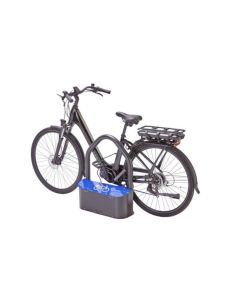
In hotels and accommodation facilities, a charging station can be included among the services intended for guests travelling by e-bike. For companies, the same type of infrastructure can contribute to the organisation of dedicated parking for employees who use bicycles for daily travel. In both cases, it is necessary to check the available space, the number of users and the possible need to store accessories or chargers. Stations with lockable boxes, such as some configurations proposed by Holity, also allow you to evaluate different usage methods than simple free-access sockets. 
The professional solutions available on Holity
Holity, specialist in professional supplies for street furniture and collective structures , offers a range of charging stations that includes columns, electrified racks and multifunctional systems. Available models include the h617_03 station, equipped with two side bike racks, and the h337_31 bike rack, configured for five spaces. There are also wall-mounted stations for charging two or four bicycles and modular structures with multiple connection points. This variety allows you to compare equipment with different features without restricting every need to a single standard configuration.
For environments where you want to integrate multiple services, the catalog also includes charging stations with bicycle inflation and maintenance functions. The h617_19 model, for example, includes retractable tools and dedicated charging and inflation functions, while the h1022_01 station is described as an intelligent system with four charging points and online management. These features should be considered in relation to the needs of the service and the ability of the staff to manage the equipment. Holity, a reference point for the procurement of professional equipment, allows you to compare the specifications of the models and identify the functions actually relevant to the project.
How to evaluate the investment and management over time
The price of a station represents only a part of the investment required to create a professional charging point. The initial cost may include the electrical preparation, installation work, any anchoring work and maintenance activities. A structure with multiple sockets or additional functions may require a different economic evaluation than a basic column, even when both are intended for the same environment. To compare costs it is therefore advisable to consider the number of charging points, components included, power required and installation conditions .
The evaluation must also include the operations necessary to maintain the service efficient over time. Sockets, casings, fixings and opening systems must be checked according to the manufacturer's instructions, distinguishing between ordinary maintenance and electrical checks entrusted to qualified technicians. For municipalities, hotels, and companies, it is useful to establish in advance who will manage the interventions and how any anomalies will be reported. The section dedicated to Holity's Electric bike charging stations allows you to consult the available models and delve into the characteristics of the individual configurations, so as to guide the purchase based on verifiable technical and operational needs.
 English
 Italian
 French
 German
 Spanish