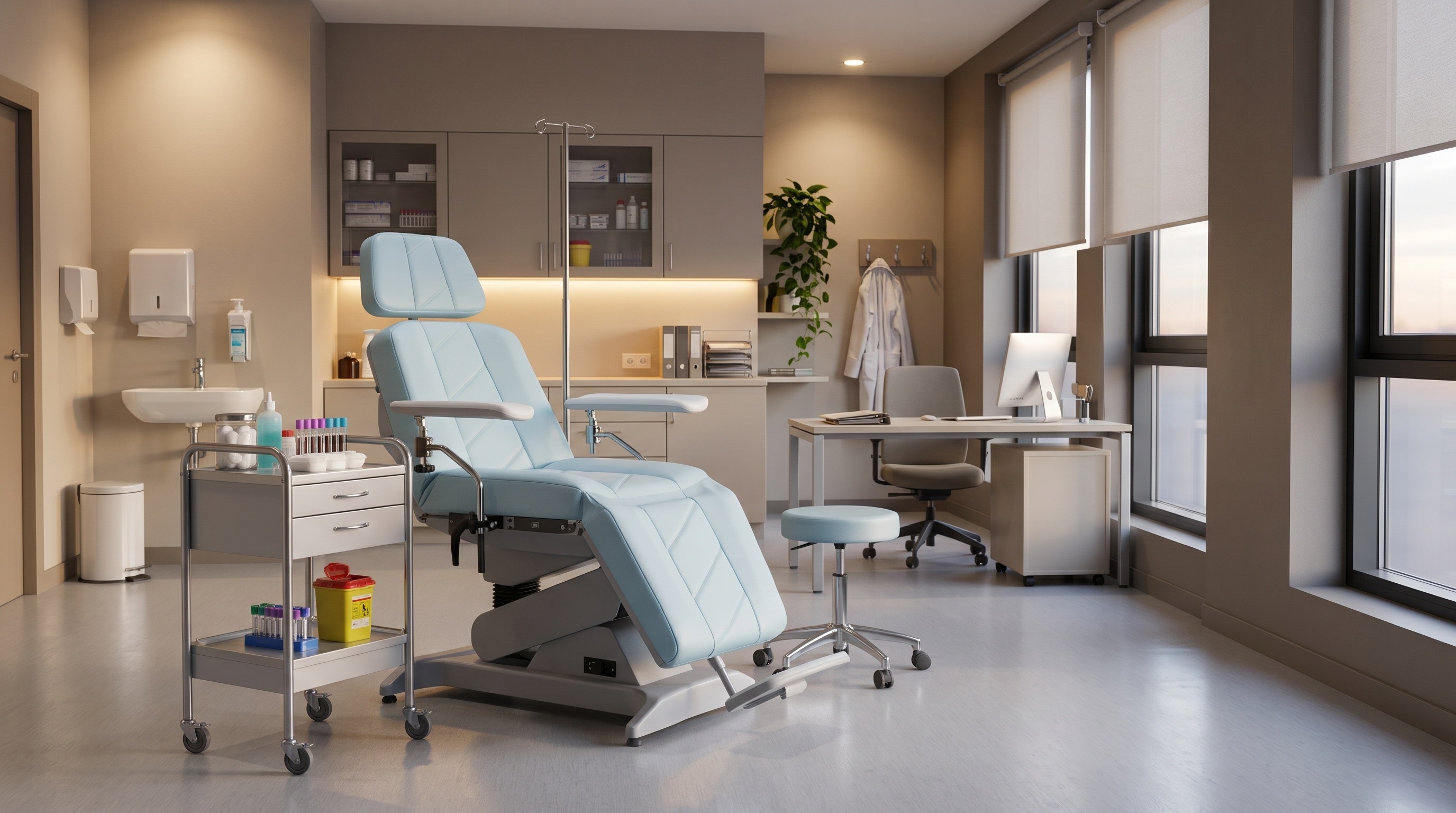
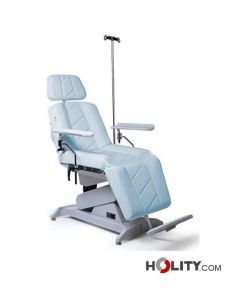
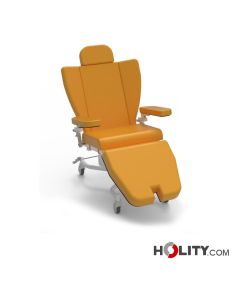
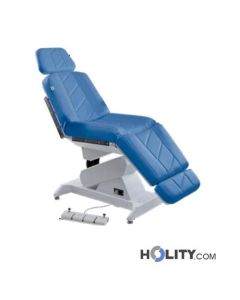
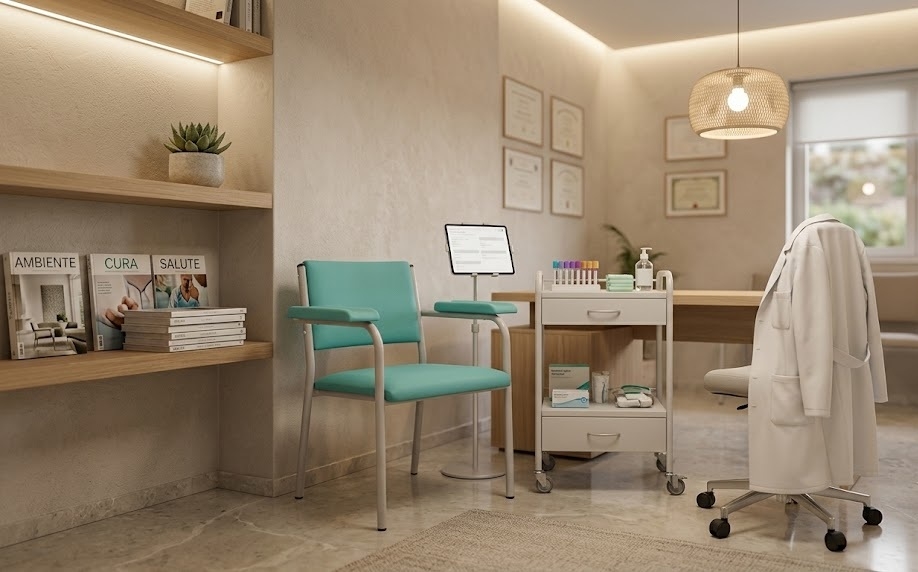
The choice of blood sampling chairs requires attention to the needs of patients and the activities carried out daily by healthcare personnel. In a clinic dedicated to blood sampling, the seat is not just a piece of furniture, but a component of the workstation used during reception, positioning and execution of procedures. Stability, adjustment options, accessibility and ease of cleaning are characteristics that can affect the organization of the service. For this reason, it is important to identify a model consistent with the intended use and the operating conditions of the facility.
Medical practices, outpatient clinics and small diagnostic centers can have different needs in terms of available space, frequency of services and patient characteristics. A fixed chair may be adequate in certain contexts, while an adjustable configuration can offer greater flexibility when it is necessary to change the position of the seat or the supports. The choice of blood sampling chair must reconcile safety, patient comfort and convenience for operators, without neglecting maintenance and compatibility with the facility's procedures. The comparison between models should therefore start from the technical characteristics declared by the manufacturer.
The role of the blood sampling chair in the medical office
 The blood sampling chair is intended to offer an appropriate seating position during the procedures for which the device is designed. Compared to a generic seat, it may have specific features, such as supports for the upper limbs, backrest adjustments or configurations designed to facilitate the operator's work. The available features vary between models and must be verified through the technical documentation. Not all chairs used in healthcare environments are necessarily suitable for the same activities.
Within the medical office, the chair must be placed in a workstation organized according to the procedures performed. Staff must be able to access the patient, use the necessary equipment, and move without interfering with the surrounding furnishings. The functionality of the workstation depends on the combination of the chair, spaces, and work organization, not just on the characteristics of the individual product. A technically adequate solution may be impractical if placed in an environment that does not allow for correct use.
Intended use and characteristics of a professional chair
Before purchasing, it is important to carefully consider the specific features of the chair. It is necessary to verify the intended use declared by the manufacturer and ensure that the model is compatible with the intended activities. A chair intended for blood sampling may have different characteristics compared to a medical examination chair or a device designed for other outpatient procedures. Aesthetic similarity is not sufficient to consider equipment with different functions equivalent. The instructions for use and technical specifications must therefore represent the first reference in the evaluation.
It is also advisable to verify the documentation relating to the product and any regulatory requirements applicable to its specific classification. The presence of adjustments, electrical components or particular accessories may lead to different operating and maintenance instructions. A professional chair must be evaluated for the functions actually intended, avoiding attributing undeclared characteristics to it. This criterion allows purchasing managers to compare solutions consistent with the needs of the customer. of the surgery.
Stability of the structure and safety of the station
The Stability represents one of the fundamental aspects in the evaluation of a blood sampling chair. The device must support the user in the conditions foreseen by the manufacturer and maintain adequate behaviour during the permitted operations. The configuration of the base, the structural materials and any locking systems contribute to the overall characteristics of the product. Apparent robustness does not replace verification of the declared load capacity and conditions of use.
The Safety also depends on the position of the chair within the surgery and on the methods used to assist the patient in sitting down or standing up. Any wheels, if present, must be managed according to the instructions relating to the locking systems. Adjustments must not be operated improperly and staff must know the applicable procedures. A safe station therefore requires a combination of appropriate equipment, controls and correct operating methods.
Seat and backrest: how to evaluate patient comfort
Patient comfort depends on several elements, including the dimensions of the seat, padding characteristics, configuration of the backrest and position of the supports. A chair must allow the positioning intended for the procedure, taking into account the characteristics of the user. Contact surfaces can vary in material, consistency and shape, making it necessary to compare the available specifications. A comfortable seat must also be compatible with the operational and hygienic needs of the office.
The backrest contributes to the support of the trunk and, in adjustable models, can allow for different configurations. The possibility However, the ability to change the position should not be interpreted as a valid clinical indication for every patient. Appropriate positioning must follow the facility's procedures and the assessment of the healthcare staff. It is important that the controls and mechanisms can be used in the intended ways, without introducing sudden movements or difficulties during assistance.
Adjustments and reclining possibilities
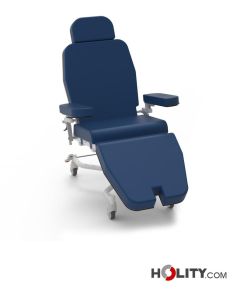
The adjustable blood collection chairs can offer different configuration options, depending on the model. Some allow for the modification of the backrest inclination, others also allow the seat or leg support to be adjusted. The movement systems can be manual, mechanical or motorized, with different characteristics and control methods. The presence of a specific adjustment must be verified in the technical data sheet and not deduced from the commercial category of the product.
The reclining can represent a useful feature when the facility's procedures require the possibility of changing the patient's position. However, not all reclining chairs allow the same positions or are intended for the same situations. The choice must consider the range of adjustments and the conditions of use authorized by the manufacturer. In small clinics, it is also advisable to check that the available space allows the functions to be used without interference from walls, furniture or other equipment.
Armrests and supports for the upper limbs
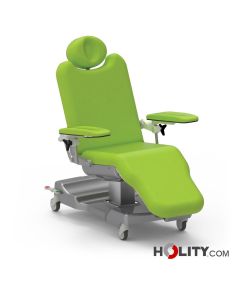
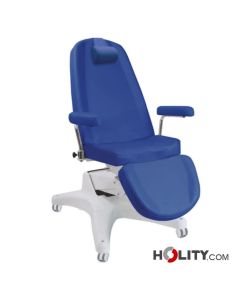
 The armrests are a particularly important element in chairs intended for blood sampling. Depending on the configuration, they can offer a support point for the patient's arm and allow different positioning during the procedure. Some models have supports that are adjustable in height or orientation, while others use fixed elements. The possibility of The decision to adapt the support must be assessed in relation to operational needs and the characteristics of the patients admitted.
The stability of the armrests, the adjustment methods and the compatibility of the materials with the cleaning procedures must also be verified. A support that can be oriented must not be used beyond the limits established by the manufacturer. The position of the arm during blood sampling remains an operational decision of the competent healthcare personnel. When choosing the chair, the objective is to identify a configuration that allows the workstation to be correctly organised and the supports to be used according to the instructions.
Accessibility for the elderly and people with reduced mobility
Elderly patients or people with mobility difficulties who require particular attention when approaching and transferring onto the seat may enter medical offices. The height of the chair, the size of the armrests and free space around the workstation can affect accessibility. It is not enough that the device is comfortable once occupied: the operations required for sitting down and getting up must also be considered. Accessibility must be assessed in relation to the characteristics of the users and the assistance procedures available.
Some configurations may include movable elements or adjustments useful for facilitating certain access methods, but their presence must be verified on a case-by-case basis. A chair must not be automatically considered suitable for wheelchair transfers simply because it has removable armrests. Compatibility depends on the intended use, the characteristics of the device and the assessment of competent personnel. The arrangement of the furniture must also allow the necessary maneuvering spaces, preventing accessibility from being compromised by the organization of the environment.
Load capacity and dimensions of the chair
The Maximum load capacity of the chair for blood sampling is a technical data to be verified before purchase. It must be compatible with the characteristics of the intended users and with the conditions of use declared by the manufacturer. The dimensions of the seat, the height and the overall size also affect the possibility of using the device appropriately. A particularly compact model is not necessarily suitable for every patient, just as a larger chair may require more space.
The Measurements must be evaluated considering both the standard configuration and any positions achieved through adjustments. A reclining chair may occupy a different space when the backrest or leg rest are moved. The comparison between dimensions and load capacity must be based on declared values, avoiding estimates derived from photographs or the appearance of the product. This check is particularly useful in small medical offices, where each piece of equipment must be carefully placed.
Fixed and adjustable chairs compared
The Fixed chairs can be considered when the workstation requires a stable configuration and the planned activities do not require particular changes in position. The simplicity of construction can make it immediate to understand the methods of use, but it should not be automatically considered an advantage in every context. It is necessary to verify that the height, seat and supports are compatible with the patients and the procedures performed. A fixed chair must be chosen for its functional suitability, not only because it has a reduced number of mechanisms.
The Adjustable models offer greater configuration possibilities, but may require different controls and maintenance procedures. The presence of additional controls or mechanisms must be justified by the operational needs of the practice. For a structure that performs different services, flexibility is essential. may constitute a relevant criterion, provided that the device is intended for such uses. The comparison should therefore consider frequency of use, type of procedures, user characteristics and resources available for managing the equipment.
Workspaces and layout of the blood sampling station
The choice of chair must be linked to the layout of the office. It is necessary to consider patient access, the position of the operator and the location of the equipment used during the procedures. Furniture, trolleys and containers must be organised so as not to hinder the expected movements. A functional blood sampling station requires adequate space around the chair, as well as a layout consistent with the procedures and requirements applicable to the facility.
In small spaces, the footprint must be checked with particular attention. An adjustable chair may require additional space to allow for the movement of the backrest or other components. The position of the controls and any electrical connections must also be considered before installation. The design of the workstation should start from the activities actually carried out, avoiding placing the equipment only where it seems to take up less space.
Ergonomics and practicality for healthcare personnel
 The characteristics of the chair also influence the ways in which healthcare personnel carry out their work. The accessibility of the supports, the position of the patient and the possibility of adjusting certain elements can contribute to the organisation of the procedure. It is incorrect to assume that a model equipped with numerous adjustments is automatically more ergonomic. Ergonomics must be evaluated in relation to the activities carried out and the expected methods of use, also considering the characteristics of the environment.
A practical workstation should allow staff to use the controls and reach the necessary elements without avoidable interference. The position of the upper limb supports and any adjustment options can be particularly important during daily work. Holity, a specialist in professional supplies for medical practices and healthcare facilities, represents a point of reference for those who have to compare equipment intended for environments in which patient comfort and operational organization must be evaluated together. The choice must however be based on the technical specifications and the specific needs of the facility.
Upholstery, cleaning and sanitization
The surfaces of the chair must be compatible with the cleaning and disinfection procedures required in the healthcare environment. Materials, stitching, padding and exposed components may have different characteristics and require specific treatment methods. Before purchasing, it is therefore necessary to check the manufacturer's instructions regarding the products that can be used and the permitted operations. A cover defined as washable is not automatically compatible with any disinfectant, nor with any sanitization procedure.
Ease of access to surfaces represents a further element of evaluation. A configuration that allows easy access to the areas to be treated may be more practical for cleaning activities between one use and the next. The presence of moving components and mechanisms that require particular precautions must also be considered. The choice of materials should therefore be made together with the evaluation of the hygiene procedures adopted by the facility, avoiding unforeseen treatments that could damage the product.
Maintenance and periodic checks
Armchairs intended for professional use must be maintained in the conditions foreseen by the manufacturer. Checks may concern stability, integrity of the structure, functioning of the adjustment systems and condition of the components subject to wear. In motorized models, specific checks relating to the electrical elements and controls may be necessary. Maintenance must follow the device's technical instructions, without resorting to improvised interventions or unauthorized modifications.
For a medical practice, it is useful to define clear methods for reporting anomalies and managing equipment requiring inspection. A mechanism that does not function properly or a damaged component should not be ignored to keep the station operational. Continuity of service also depends on the ability to schedule checks and promptly identify any problems. This aspect becomes even more important when the same chair is used by numerous patients during the day.
How to choose the chair for medical practices and small diagnostic centers
To identify the most suitable solution, it is advisable to start from the procedures actually performed and the characteristics of the patients admitted. A medical practice with a single station may have different needs than a multi-clinic with multiple rooms dedicated to blood sampling. It is necessary to verify the intended use, stability, load capacity, dimensions, armrest configuration and adjustment possibilities. The comparison between medical office chairs must focus on the necessary features, distinguishing them from functions that would not bring a concrete advantage to the organization.
The price is one of the elements of the evaluation, but must be considered together with the technical documentation and management needs over time. Cleaning, maintenance, methods of use and compatibility with spaces can affect the practicality of the equipment. Holity, specialist in professional equipment for medical offices, clinics and diagnostic centers, constitutes a reference for structures that must compare solutions intended for healthcare use. A coherent choice requires evaluating the product in the operational context in which it will actually be used.
Mistakes to avoid before purchasing
One of the mistakes to avoid is choosing a chair based solely on its aesthetic appearance or apparently compact dimensions. The configuration must be verified with respect to the intended use, procedures, and patient characteristics. Another mistake is assuming that all reclining models offer the same positioning options. The adjustments must be compared using the specifications declared by the manufacturer, also checking the space required to use them correctly.
The load capacity, the compatibility of the upholstery with hygiene procedures, and maintenance instructions must not be overlooked. A chair that appears adequate at the time of purchase may prove impractical if it requires management methods that are not compatible with the organization of the office. Accessibility must also be considered before final placement. The evaluation should therefore involve those responsible for purchasing and the operators who will use the station on a daily basis, keeping technical aspects separate from clinical decisions.
A functional blood sampling station for patients and operators
The choice of a blood sampling chair must take into account needs that cannot be evaluated separately. Stability and load capacity concern the conditions of use, while the seat, backrest and supports contribute to the configuration of the station. Adjustments and accessibility can play an important role when the office welcomes patients with different needs. The most appropriate solution is the one that is compatible with the procedures of the facility and with the characteristics of the users, in compliance with the manufacturer's instructions.
For medical practices, outpatient clinics and small diagnostic centers, a careful selection also includes the organization of the spaces and the management of the equipment over time. Cleaning, checks and maintenance must be carried out according to defined procedures, without compromising the correct use of the workstation. Holity, specialist in professional supplies for the healthcare sector , represents a reference for the evaluation of equipment intended for outpatient environments. Comparing medical office chairs based on safety, comfort, accessibility and operational practicality allows you to identify equipment consistent with the daily needs of the facility.
 English
 Italian
 French
 German
 Spanish